Basmati vs Jasmine vs Long Grain American Rice: Nutrition, Taste and Price Compared
Basmati rice offers the strongest combination of separate cooked grains, distinctive aroma, and premium positioning, jasmine rice suits fragrant Southeast Asian dishes, and American long-grain rice delivers a familiar, economical staple for everyday meals. The best choice depends on nutritional priorities, cooking requirements, buyer budgets, and target markets.
For consumers and food businesses comparing these varieties, the differences extend beyond grain length. Starch composition, processing, cooking performance, sourcing costs, and storage conditions influence the final decision. Understanding the complete guide to Basmati rice helps buyers connect grain characteristics with quality standards, processing methods, and practical purchasing requirements.
For grocery chains, food distributors, restaurants, and importers, selecting the right rice also means evaluating consistency across commercial shipments. Pakistani Basmati, Thai jasmine, and American long-grain rice serve different market segments. A specification-based comparison helps buyers balance consumer expectations, product positioning, and total procurement costs.
What Are Basmati, Jasmine, and American Long-Grain Rice?
Basmati is an aromatic rice associated with the Indian subcontinent, jasmine is a fragrant rice associated with Southeast Asia, and American long-grain rice is a broad category valued for mild flavor and versatile cooking performance. Each variety serves distinct culinary and commercial needs.
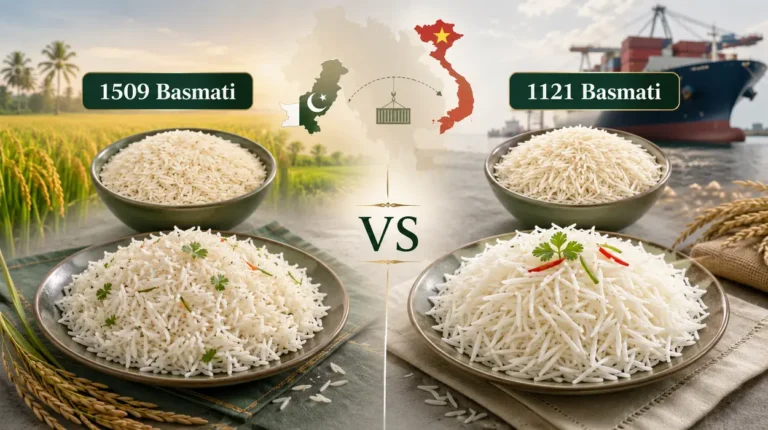
Basmati rice is traditionally grown in the Punjab region of Pakistan and India. Pakistani Basmati is valued for its characteristic aroma, slender grains, and elongation during cooking. Popular commercial varieties include 1121, Super Kernel, and 1509 Basmati rice. Their specifications vary by grain length, processing method, broken percentage, and intended application.
Jasmine rice, particularly Thai Hom Mali, is known for its floral aroma, soft texture, and slightly sticky finish. Its cooked grains retain a tender consistency that complements Thai curries, stir-fries, and other Southeast Asian dishes.
American long-grain rice generally refers to varieties cultivated in the United States, including rice produced in Arkansas, Louisiana, Mississippi, Missouri, and Texas. It typically has a mild flavor and a fluffy texture when prepared correctly. It is widely used in household cooking, institutional kitchens, and packaged rice products.
For commercial sourcing, AHK Rice’s Basmati rice range includes Pakistani varieties suited to different buyer requirements. Selection should follow the intended retail position, grain specifications, cooking performance, and target market rather than the variety name alone.
How Do Basmati, Jasmine, and American Long-Grain Rice Compare?
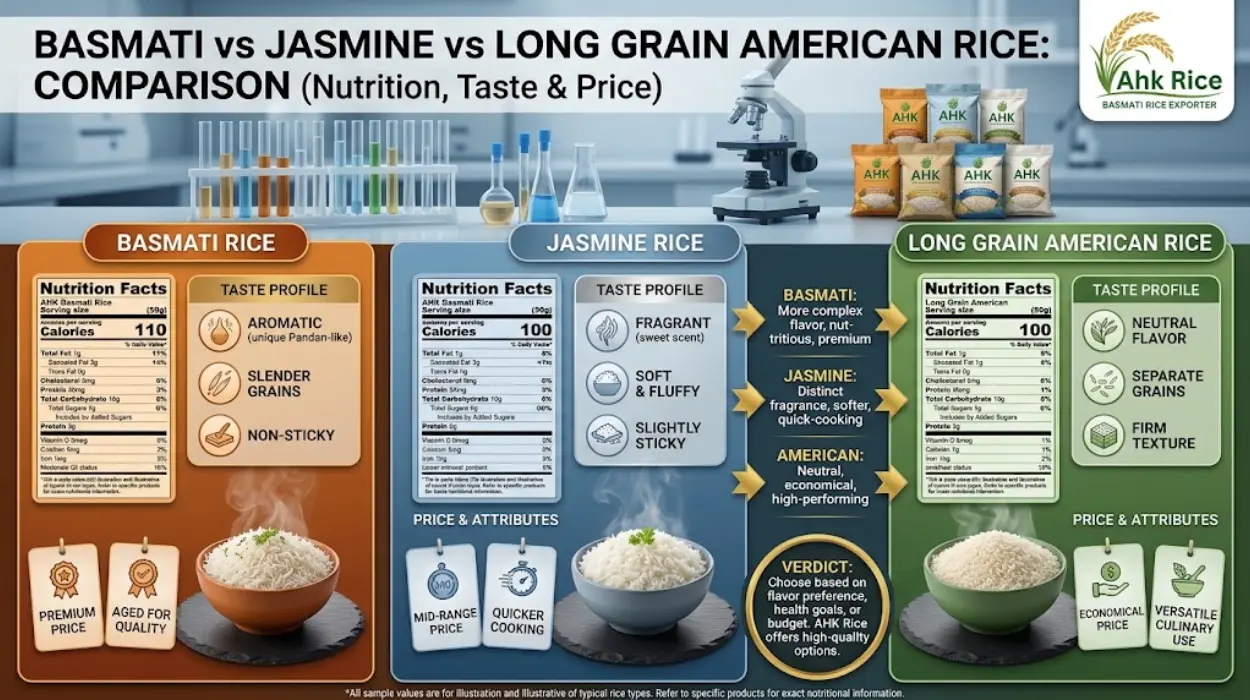
Basmati leads in traditional pilaf applications and premium aromatic positioning, jasmine performs best in Southeast Asian dishes requiring tender grains, and American long-grain rice suits versatile everyday meals. Their nutritional values overlap, while aroma, texture, processing, and procurement costs create meaningful differences.
The following table compares the three categories using practical selection criteria. Nutrition varies by cultivar, milling, enrichment, cooking method, and serving size. Prices represent indicative export-market benchmarks rather than guaranteed retail or landed prices.
| Attribute | Pakistani Basmati | Jasmine Rice | American Long-Grain Rice |
|---|---|---|---|
| Typical grain profile | Long, slender grains; 1121 is especially elongated | Long, slender grains with a softer cooked profile | Long, narrow grains with a familiar appearance |
| Aroma | Distinctive, nutty, characteristic Basmati aroma | Floral, fragrant aroma | Generally mild |
| Cooked texture | Separate, elongated grains when properly prepared | Tender, moist, slightly sticky | Fluffy and relatively separate |
| Calories per 100 g cooked | Approximately 120–130 kcal | Approximately 120–135 kcal | Approximately 125–135 kcal |
| Glycemic response | Often lower for certain Basmati varieties, but cultivar and preparation matter | Varies by cultivar and preparation | Varies by cultivar, processing, and preparation |
| Indicative export price | Premium; roughly US$1,135–1,205/MT FOB Karachi for selected Pakistani grades | Thai jasmine benchmark around US$519–523/MT FOB vessel in September 2026 | US long-grain benchmark around US$673–677/MT FOB vessel in September 2026 |
| Typical culinary use | Biryani, pulao, pilaf, premium rice dishes | Thai curries, stir-fries, Southeast Asian meals | Everyday meals, casseroles, foodservice, and packaged staples |
The nutrition figures are approximate reference ranges for cooked white rice, not laboratory results for every named cultivar. The price figures also use different export origins and commercial benchmarks. FOB Karachi, FOB vessel, and destination-specific landed prices are not interchangeable.
Which Rice Is Best for Nutrition and Low-GI Diets?
No rice variety guarantees a low glycemic response in every serving. Certain Basmati varieties offer a useful option for health-focused consumers, but cultivar, milling, cooking time, portion size, and meal composition influence the response. Buyers should verify product-specific evidence before making low-GI claims.
The glycemic index (GI) measures how quickly a carbohydrate-containing food raises blood glucose relative to a reference food. A low-GI food has a GI of 55 or below, a medium-GI food falls between 56 and 69, and a high-GI food has a GI of 70 or above.
Some Basmati varieties have lower GI values than many other white rice varieties. This does not make every Basmati product low-GI. Jasmine rice and American long-grain rice also show variation according to cultivar and processing.
Brown rice retains its bran layer and generally supplies more fiber than comparable polished white rice. Enriched white rice may provide added nutrients such as iron and B vitamins. These distinctions matter when comparing products intended for nutrition-conscious consumers.
For health-focused grocery chains, a low-GI purchasing decision requires evidence for the exact product. Buyers should request applicable laboratory results, confirm the testing method, and review the proposed label claims against US regulatory requirements. A variety name alone does not establish a verified GI value.
Portion size and meal composition remain important. Combining rice with vegetables, legumes, protein, and healthy fats changes the overall nutritional profile of a meal. Consumers managing diabetes should follow individualized guidance from their healthcare professionals.
What Are the Price Differences Between the Three Rice Types?
Pakistani Basmati generally occupies a premium export segment, jasmine commands a premium within fragrant-rice markets, and American long-grain rice competes in mainstream staple categories. Buyers should compare equivalent grades, packing formats, shipment terms, and delivered costs rather than headline prices alone.
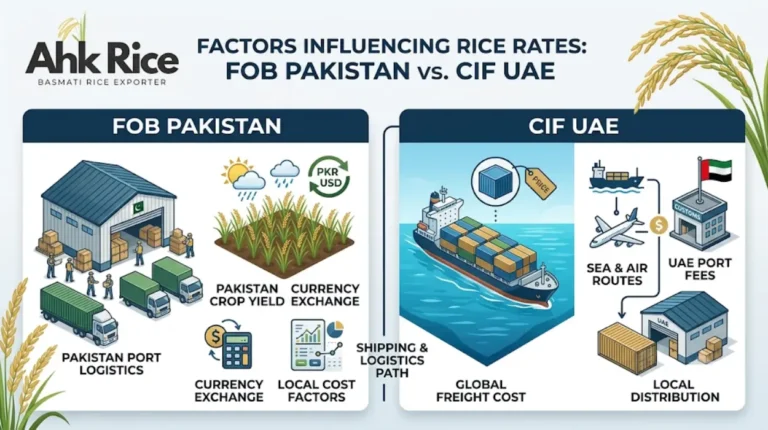
Export prices reflect variety, crop year, broken percentage, moisture, processing, packaging, order volume, and freight. September 2026 market references placed selected Pakistani Basmati grades around US$1,135–1,205 per metric ton FOB Karachi. The Thai jasmine benchmark was approximately US$519–523 per metric ton, while US long-grain rice was approximately US$673–677 per metric ton under the cited market benchmarks. These figures are reference points, not equivalent offers for identical specifications.
A buyer should distinguish three commercial prices:
- FOB price: Covers the goods and the seller’s obligations up to the agreed loading point under the applicable Incoterms.
- CFR or CIF price: Adds ocean freight, with insurance included under CIF. The buyer must check the precise contractual obligations and destination charges.
- Landed cost: Includes the applicable purchase price, freight, insurance where relevant, duties, port charges, customs-related costs, and inland transportation.
Retail packaging also changes unit economics. A private-label 5 kg bag requires different packaging, labeling, and handling arrangements from a 25 kg foodservice bag. Small orders can carry higher per-unit logistics costs than container-volume purchases.
Importers should obtain quotations for the same destination, grade, packing weight, and Incoterm before deciding which rice offers the best commercial value.
Which Rice Works Best in Different Market Regions?
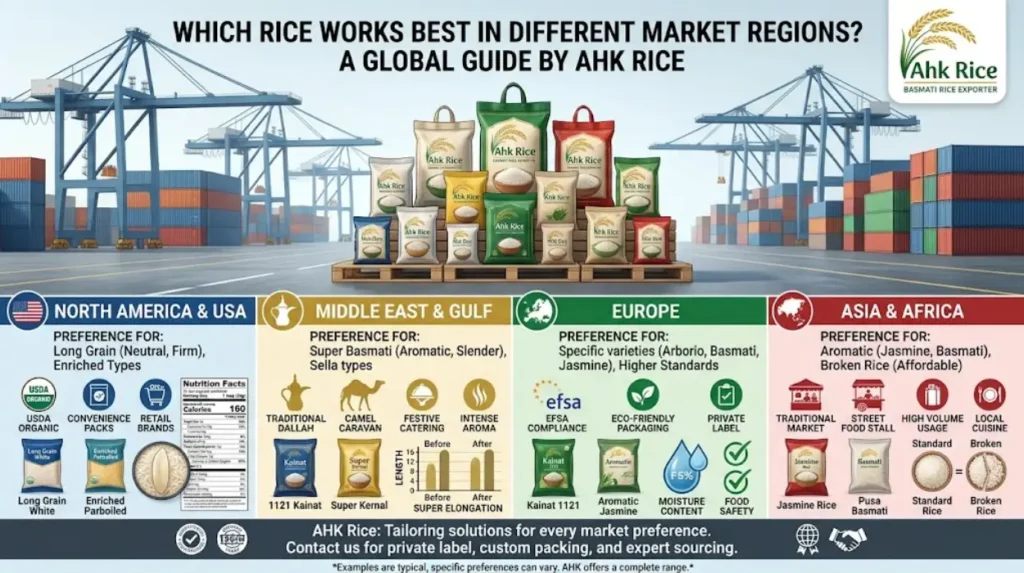
Pakistani Basmati suits premium South Asian retail and foodservice channels in the United States, while jasmine serves Southeast Asian cuisine and fragrant-rice consumers. American long-grain rice fits mainstream household and institutional demand. In Gulf markets, Pakistani Basmati also serves established ethnic retail and catering segments.
United States: Premium Retail and Mainstream Foodservice
US buyers can position Pakistani 1121 and Super Kernel Basmati as premium aromatic products. Health-focused grocery chains can evaluate suitable varieties for their nutrition-oriented ranges, provided any GI-related claims are supported by appropriate product-specific evidence.
Jasmine rice serves shoppers seeking Southeast Asian flavors, while American long-grain rice fits mainstream grocery shelves, cafeterias, and high-volume kitchens. Imported products must meet applicable US food-import requirements, including relevant FDA requirements and the importer’s Foreign Supplier Verification Program obligations.
For commercial planning, selected Pakistani Basmati grades have carried indicative FOB Karachi benchmarks of approximately US$1,135–1,205/MT. Jasmine and American long-grain prices depend on origin, specification, market conditions, and shipment terms. US buyers must calculate freight, customs-related costs, and inland distribution before comparing landed prices.
Gulf Markets: Retail, Wholesale, and Foodservice
In Gulf markets such as the UAE and Saudi Arabia, Pakistani Basmati serves consumers familiar with biryani, pulao, and other rice-centered meals. The 1121 variety suits premium positioning, while Super Kernel offers another aromatic Basmati option. The 1509 variety can serve buyers prioritizing commercial value and specific processing requirements.
Jasmine rice remains relevant to restaurants specializing in Thai and other Southeast Asian cuisines. American long-grain rice can serve general foodservice requirements where mild flavor and cost control take priority.
Prices for Gulf-bound shipments must reflect the selected destination port, freight, insurance where applicable, packaging, and local compliance requirements. A US FOB benchmark does not establish a UAE or Saudi landed price.
How Does Shelf Life Compare?
Shelf life depends on milling, moisture, packaging, warehouse conditions, pest control, and product rotation. White rice generally stores well in cool, dry, protected conditions, while brown rice has a shorter practical storage life because its bran layer contains oils that can deteriorate.
For importers, the supplier’s declared shelf life and supporting product documentation should guide purchasing decisions. Buyers should establish storage specifications and a first-expiry, first-out inventory process rather than assume all three rice types have identical shelf lives.
What Are the Advantages and Disadvantages of Each Rice Type?
Basmati offers distinctive aroma and premium presentation, jasmine provides a soft and fragrant eating experience, and American long-grain rice offers versatility and mainstream market appeal. Each variety has trade-offs involving price, texture, sourcing, and suitability for particular dishes or retail segments.
Basmati Rice: Pros and Cons
Advantages: Basmati has a distinctive aroma, elongated cooked grains, and a premium culinary reputation. Pakistani varieties such as 1121 and Super Kernel suit biryani, pulao, premium retail, and foodservice applications. Certain Basmati varieties also appeal to consumers seeking rice with a potentially lower glycemic response.
Disadvantages: Premium specifications can increase procurement costs. Grain length, broken percentage, moisture, aroma, and cooking performance require quality control. Buyers marketing Basmati as low-GI must obtain evidence for the specific product rather than rely on the variety name.
For example, a US grocery chain developing a premium rice range can evaluate Pakistani Basmati for product differentiation, provided the supplier meets the chain’s specifications and documentation requirements.
Jasmine Rice: Pros and Cons
Advantages: Jasmine rice provides floral aroma and a tender, moist texture. It complements Thai curries, stir-fries, and Southeast Asian meals. Its culinary identity gives retailers a clear way to organize international food products.
Disadvantages: Its softer texture does not suit every pilaf or biryani application. Fragrance, texture, and consistency must meet the expectations of the target cuisine. Importers must also account for origin-specific pricing and freight.
For example, a restaurant group specializing in Thai cuisine can prioritize jasmine because its aroma and texture align with the menu.
American Long-Grain Rice: Pros and Cons
Advantages: American long-grain rice has a mild flavor and works across everyday meals, institutional kitchens, casseroles, and large-volume foodservice. Domestic sourcing can also simplify supply arrangements for US buyers.
Disadvantages: It does not replicate the distinctive aroma of Basmati or jasmine. Buyers seeking a premium aromatic product may find it less suitable for that position.
For example, a cafeteria operator preparing large volumes of everyday meals can choose American long-grain rice when versatility and purchasing efficiency are the main priorities.
What Five Factors Should Buyers Use to Choose the Right Rice?
Buyers should evaluate the intended consumer, cooking performance, nutritional evidence, total landed cost, and supplier consistency. These five factors connect product characteristics with commercial requirements and help retailers, importers, and foodservice operators select rice that meets customer expectations.
| Decision factor | What to evaluate | Best-fit application |
|---|---|---|
| 1. Consumer demand | Cuisine, aroma preferences, brand positioning, and local demand | Basmati for premium aromatic rice; jasmine for Southeast Asian cuisine |
| 2. Cooking performance | Grain separation, tenderness, elongation, and holding performance | Basmati for biryani and pilaf; jasmine for curries; American long-grain for versatile meals |
| 3. Nutritional requirements | Calories, fiber, processing, and verified GI evidence | Health-focused products with substantiated nutrition information |
| 4. Total landed cost | FOB or CIF terms, freight, packaging, duties, handling, and inland delivery | Importers comparing equivalent specifications and destinations |
| 5. Supplier consistency | Grain specifications, COA, samples, food-safety documentation, and shipment records | Retailers and distributors requiring repeatable commercial quality |
A buyer should use this framework before requesting a quotation. The process begins with the target customer and intended use, then moves to product specifications, sample evaluation, and commercial terms.
A health-focused retailer should apply an additional verification step before approving low-GI positioning. The buyer should review the supporting evidence, labeling requirements, and supplier documentation before placing a commercial order.
How Can Buyers Evaluate Pakistani Basmati for Health-Focused Grocery Chains?
Buyers should assess the specific Basmati variety, processing method, laboratory evidence, packaging, food-safety documentation, and repeat-order consistency. Low-GI positioning requires product-specific substantiation, while import compliance and clear labeling remain essential for US grocery distribution.
Pakistani Basmati offers grocery chains an opportunity to develop a premium aromatic rice category. However, buyers must separate established product characteristics from claims that require additional proof. Aroma, grain length, and cooking performance can be assessed through specifications and samples. A low-GI claim requires appropriate evidence for the product being sold.
The purchasing process should cover five steps:
- Define the product: Select the Basmati variety, processing type, grain specifications, broken percentage, and package size.
- Request a representative sample: Evaluate aroma, cooking performance, texture, and grain consistency against the intended retail requirements.
- Verify nutrition claims: Request applicable laboratory evidence and review the proposed US label with qualified regulatory support.
- Review supplier documentation: Confirm the relevant quality records, certificate of analysis, food-safety documentation, and import responsibilities.
- Confirm commercial terms: Compare quotations using the same quantity, packaging, destination, and Incoterm.
For further purchasing guidance, use the planned BOFU article, Stock Low-GI Pakistani Basmati Rice for USA Health-Focused Grocery Chains, to move readers from comparison toward supplier evaluation and ordering requirements.
Basmati, jasmine, and American long-grain rice meet different culinary and commercial needs. Basmati stands out for its distinctive aroma, elongated cooked grains, and premium positioning. Jasmine suits fragrant Southeast Asian dishes, while American long-grain rice supports versatile everyday cooking and mainstream foodservice.
For importers and grocery chains, the best selection combines consumer demand, cooking performance, substantiated nutritional information, supplier consistency, and total landed cost. Buyers considering Pakistani Basmati should evaluate the exact grade, request representative samples, review product documentation, and verify any low-GI claims before approving a product for retail distribution.
Frequently Asked Questions
Is Basmati rice healthier than jasmine rice?
Neither variety is universally healthier. Both provide carbohydrates and energy, while their nutritional profiles depend on the cultivar, milling, enrichment, cooking method, and serving size. Certain Basmati varieties have lower GI values than some other rice varieties, but buyers should verify product-specific evidence before making health claims.
Which rice has the lowest glycemic index?
There is no universal ranking that applies to every product. Some Basmati varieties have lower GI values, but cultivar, processing, and preparation influence the result. Use reliable test results for the exact product when a low-GI claim matters.
Which rice is best for weight management?
Portion size and overall dietary patterns matter more than choosing a variety based on its name alone. Plain cooked Basmati, jasmine, and American long-grain rice have broadly comparable calorie ranges per 100 grams. Whole-grain options provide more fiber than comparable polished white rice.
Why is Pakistani Basmati more expensive than standard long-grain rice?
Pakistani Basmati can command a premium because of its characteristic aroma, grain profile, specialized varieties, processing requirements, and market positioning. The final price also reflects crop conditions, quality specifications, packaging, order size, and freight.
How long can Basmati, jasmine, and American long-grain rice be stored?
Storage life depends on the product, packaging, moisture, and warehouse conditions. Properly stored white rice generally has a long shelf life, while brown rice usually has a shorter practical storage period because of its bran oils. Buyers should follow the manufacturer’s declared shelf life and storage instructions.
Which rice is best for US health-focused grocery chains?
Pakistani Basmati is a strong candidate for premium aromatic rice ranges. For low-GI positioning, however, the retailer must verify the specific product’s evidence and applicable labeling requirements. Jasmine and American long-grain rice remain suitable for other consumer preferences and product categories.