Stock Low-GI Pakistani Basmati Rice for USA Health-Focused Grocery Chains
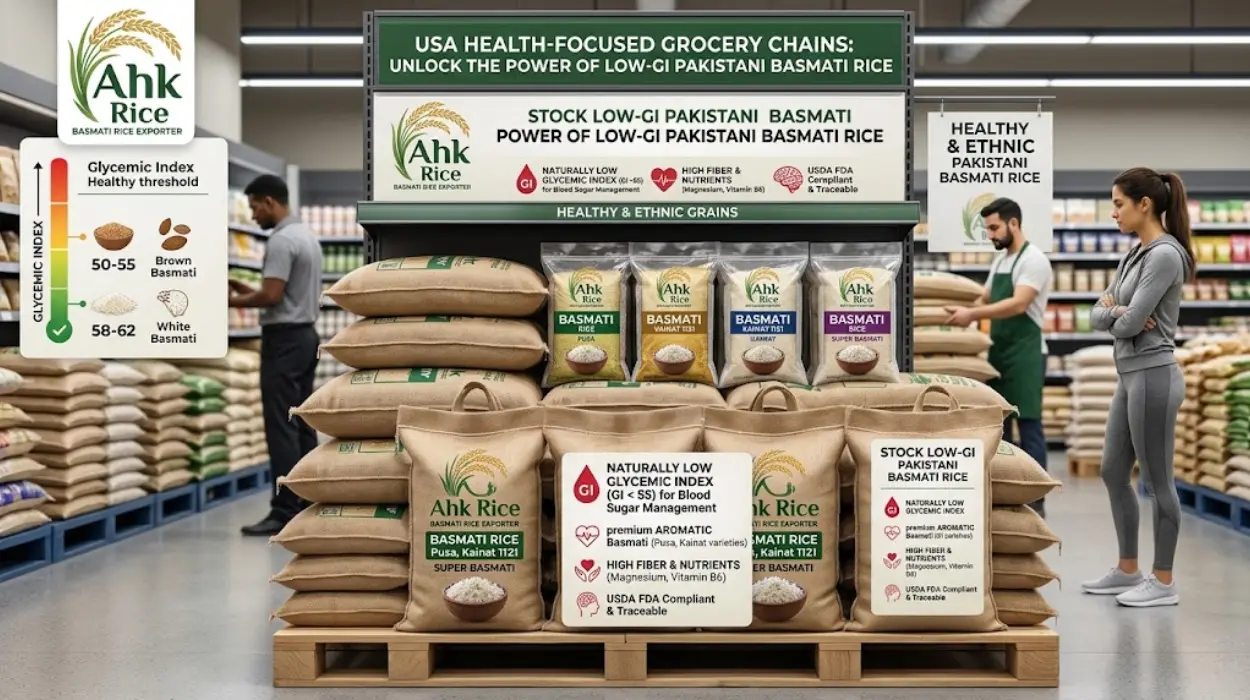
US health-focused grocery chains need rice products that meet consumer nutrition preferences without compromising taste, consistency, or retail margins. Pakistani Basmati rice offers an attractive option for premium grocery shelves, but buyers must evaluate glycemic index evidence, grain specifications, food safety documentation, and landed costs before approving a supplier. Before selecting a product, review Basmati rice health benefits, glycemic index, and nutrition facts for US consumers to understand the nutritional considerations behind purchasing decisions.
AHK Rice is a Pakistani Basmati rice exporter based in Punjab, supplying 1121, Super Kernel, and 1509 Basmati rice to international markets. Its export workflow covers sourcing, processing, grading, packaging, and shipment coordination. For US buyers, the priority is to establish a measurable product specification rather than relying on an unverified low-GI marketing claim.
What Is the Best Solution for Stocking Low-GI Pakistani Basmati Rice?
The best solution is to source Pakistani Basmati rice against documented grain specifications, independent nutritional testing, and US import requirements. Buyers should confirm the actual glycemic index evidence before marketing a product as low-GI and approve a representative sample before commercial production.
Basmati rice is a long-grain aromatic rice associated with South Asian cuisine. Its starch composition, processing method, cooking conditions, and serving size influence its nutritional characteristics and post-meal blood glucose response.
Some Basmati varieties have a lower glycemic response than certain other rice varieties. However, not every Basmati product qualifies as low-GI, and the result depends on the tested variety and preparation method.
For health-focused grocery chains, procurement should begin with three requirements:
- Nutritional verification: Obtain credible glycemic index evidence for the specific product being purchased.
- Physical specifications: Define grain length, broken percentage, moisture, processing method, and acceptable defect levels.
- Import readiness: Confirm applicable US food safety, labeling, documentation, and customs requirements.
AHK Rice can discuss product selection and export specifications for different Basmati varieties. Buyers should establish testing requirements before finalizing a low-GI product claim.
Which Pakistani Basmati Rice Variety Should US Grocery Buyers Select?
The right variety depends on retail positioning, cooked-grain appearance, aroma, price targets, and independently verified nutritional characteristics. Buyers should compare 1121, Super Kernel, and 1509 against their intended consumer segment instead of assuming that one variety automatically delivers a lower glycemic index.
AHK Rice supplies Pakistani Basmati varieties for different commercial requirements. Buyers can review the AHK Rice Basmati sourcing and export service to discuss product specifications, processing, and packaging options.
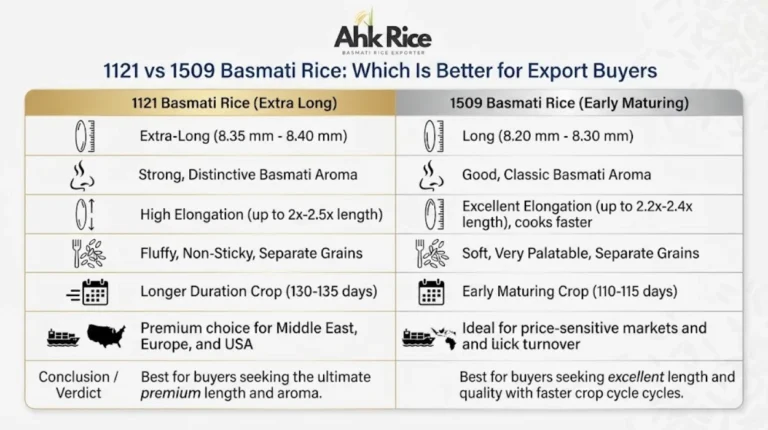
| Variety | Commercial strengths | Suitable retail positioning | Required verification |
|---|---|---|---|
| 1121 Basmati | Long grains and premium presentation | Premium grocery and specialty retail | GI evidence, grain specifications, cooking performance |
| Super Kernel Basmati | Aroma and traditional Basmati appeal | Ethnic grocery and private-label ranges | GI evidence, broken percentage, moisture |
| 1509 Basmati | Yield-oriented sourcing and competitive positioning | Value-conscious premium and bulk retail | GI evidence, processing method, cooking consistency |
For example, a premium grocery chain targeting health-conscious households may prioritize aroma, grain separation, nutritional transparency, and attractive retail packaging. A regional distributor supplying several supermarket formats may place greater emphasis on consistent specifications, predictable supply, and landed cost.
Buyers comparing these varieties with alternative rice products should also review Basmati vs Jasmine vs Long Grain American Rice: Nutrition, Taste and Price Compared. This comparison helps procurement teams assess the differences between rice categories before choosing a product for a specific shelf position.
Important: A variety name does not establish a low-GI classification. A buyer requiring a verified low-GI product should request appropriate testing evidence for the actual variety and processing specification.
Why Choose AHK Rice as a Pakistani Basmati Rice Supplier?
AHK Rice offers a structured export workflow for buyers who need defined product specifications, sample evaluation, customized packaging, and shipment documentation. US importers can assess its suitability through documented requirements, product testing, and commercial approval before committing to a container order.
AHK Rice operates from Punjab, Pakistan, and supplies 1121, Super Kernel, and 1509 Basmati rice to international buyers.
Its export process can cover:
- Product sourcing: Identify the variety and grade that match the buyer’s requirements.
- Processing: Discuss cleaning, grading, and Sortex requirements.
- Quality specifications: Define grain length, moisture, broken percentage, and acceptable tolerances.
- Sample evaluation: Allow the buyer to examine appearance, aroma, cooking performance, and relevant laboratory results.
- Packaging: Establish retail or bulk packing formats, subject to availability and production confirmation.
- Export coordination: Arrange applicable shipping documents and coordinate shipment requirements.
For health-focused retailers, these steps support a more controlled supplier approval process. They also help procurement teams distinguish between a product that simply carries a healthy-food positioning and one supported by appropriate evidence.
AHK Rice should not be treated as proof of a low-GI classification on the basis of its origin or variety range alone. Buyers must confirm the availability and validity of relevant nutritional testing before using low-GI claims on packaging or marketing materials.
What Results Can US Grocery Chains Expect?
A properly specified supply arrangement can improve purchasing consistency, support private-label development, and reduce uncertainty during supplier approval. Results depend on the agreed product specification, laboratory evidence, packaging controls, import compliance, and the supplier’s ability to meet confirmed delivery commitments.
Retail buyers should define success using measurable procurement criteria rather than broad health claims.
Product consistency: Establish acceptable ranges for grain length, moisture, broken percentage, and appearance. Approve a reference sample against which the commercial shipment can be evaluated.
Nutritional credibility: Request evidence supporting the intended nutritional positioning. Glycemic index testing should correspond to the actual product, with preparation methods and testing conditions documented where relevant.
Retail readiness: Confirm that packaging identifies the product accurately and complies with applicable US labeling requirements. Nutrition Facts, ingredient information, net quantity, and country-of-origin information should be reviewed for the intended product and distribution arrangement.
Supply planning: Agree on production lead times, inspection arrangements, shipment schedules, and contingency procedures before placing an order.
For example, a grocery chain launching a private-label Basmati range can first approve a commercial sample, review the laboratory documentation, finalize packaging artwork, and then authorize production. This sequence creates clear checkpoints before the buyer commits to a full shipment.
AHK Rice can discuss these procurement requirements during specification development. Actual results depend on the final contract and verified product performance.
How Much Does Low-GI Pakistani Basmati Rice Cost?
The landed cost depends on the selected variety, crop year, grain specifications, processing, packaging, order quantity, freight, insurance, duties, and compliance expenses. Buyers should request a product-specific quotation and compare the complete delivered cost rather than relying on an indicative FOB price alone.
A commercial quotation should identify the following cost components:
| Cost factor | What buyers should confirm |
|---|---|
| Rice variety | 1121, Super Kernel, or 1509 |
| Quality grade | Grain length, broken percentage, moisture, and tolerances |
| Nutritional testing | Laboratory requirements and responsibility for costs |
| Packaging | Bulk bags or customized retail packs |
| Order volume | Sample, trial order, or container shipment |
| Freight and insurance | Route, shipping terms, and coverage |
| Import expenses | Applicable duties, customs brokerage, and destination charges |
| Compliance | Testing, labeling, inspection, and documentation costs |
FOB pricing generally covers the seller’s responsibilities up to loading the goods aboard the vessel at the agreed port. Under CIF, the seller also arranges and pays for freight and insurance to the named destination port, subject to the applicable Incoterms. Destination import clearance, duties, and other buyer-side charges must still be accounted for.
A US importer should request separate pricing for the rice, packaging, optional laboratory testing, and freight where applicable. This makes it easier to calculate the landed cost per kilogram and the expected retail margin.
AHK Rice should confirm current prices, minimum order quantities, and available testing arrangements directly. No fixed low-GI premium should be assumed without a product-specific quotation.
How Long Does Shipping Pakistani Basmati Rice to the USA Take?
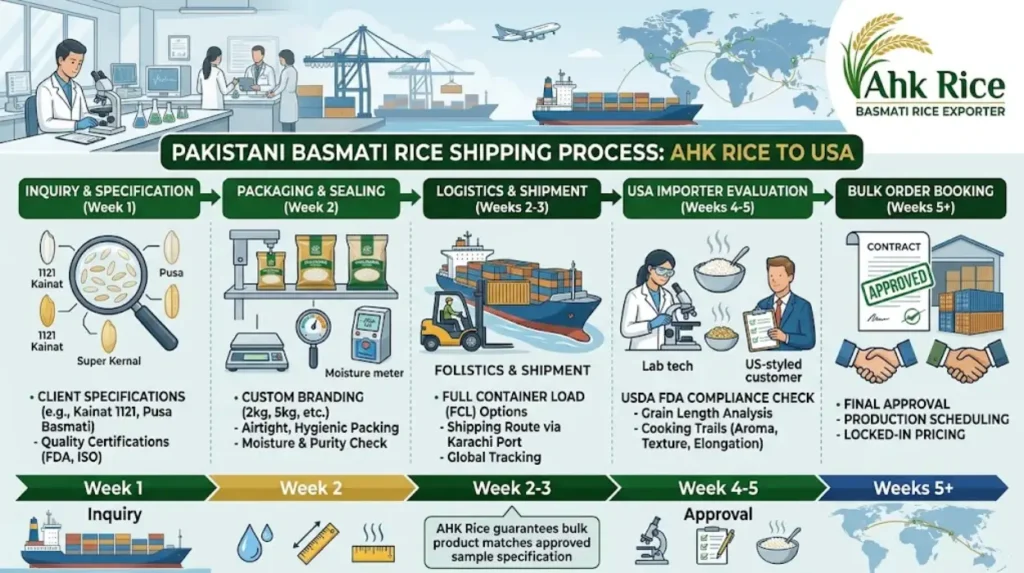
Ocean freight from Pakistan to the United States commonly requires several weeks, with transit depending on the destination port, vessel schedule, transshipment, and carrier conditions. Buyers should budget additional time for production, inspections, export clearance, and US import clearance before setting retail launch dates.
For preliminary planning, buyers can use these indicative ocean-transit ranges:
| US destination | Indicative ocean transit | Planning consideration |
|---|---|---|
| East Coast ports | Approximately 25–40 days | Confirm routing and transshipment |
| Gulf Coast ports | Approximately 25–40 days | Check vessel frequency and port schedules |
| West Coast ports | Approximately 30–45 days | Confirm the selected route and carrier |
These are planning estimates, not guaranteed sailing times. Actual schedules can fall outside these ranges, and total order lead time will be longer when production, testing, documentation, and customs clearance are included.
Before booking, AHK Rice and the buyer should agree on the shipment window, destination port, Incoterm, document requirements, and responsibility for inspections.
US importers should also confirm applicable FDA requirements, including facility registration where required, Prior Notice, and the Foreign Supplier Verification Program responsibilities of the relevant importer. Product admissibility and labeling must be checked against current US requirements.
What Is the Complete Sample Approval Process and Cost?
A sample-first process lets buyers evaluate grain quality, cooking performance, packaging, and available nutritional evidence before approving commercial production. Sample quantities, courier charges, testing expenses, and dispatch timelines must be agreed in advance, with all costs and responsibilities confirmed in writing.
AHK Rice can discuss the following sample approval sequence with prospective US buyers.
Step 1: Submit the specification. Provide the required variety, processing method, grain length, broken percentage, moisture limit, packaging format, and intended order quantity. State explicitly whether independent glycemic index testing is required.
Step 2: Confirm sample availability. Agree on the sample quantity and whether it represents the intended commercial specification. A physical sample alone does not establish nutritional claims.
Step 3: Agree on costs. AHK Rice has previously outlined a sample arrangement of up to 20 kg of Super Kernel Basmati at no charge for the rice itself, with the buyer responsible for courier shipping and applicable phytosanitary charges. This offer must be reconfirmed and should not be assumed to cover every variety, destination, or testing requirement.
Step 4: Arrange shipment. Confirm the courier quotation, destination requirements, applicable documentation, and estimated delivery date. Any laboratory analysis should be quoted separately unless expressly included.
Step 5: Evaluate the sample. Check appearance, aroma, grain uniformity, cooking behavior, and consistency with the specification. Arrange independent laboratory testing where required to support nutritional claims.
Step 6: Approve the commercial order. Sign off on the final specification, packaging, quality tolerances, documents, delivery schedule, and payment terms before production or shipment.
This process helps the buyer identify specification gaps before making a larger commitment. AHK Rice should confirm all sample charges and availability in writing before dispatch.
How Can US Grocery Buyers Get Started with AHK Rice?
Start by defining the retail product, target landed cost, required nutritional evidence, and expected purchase volume. Request a written specification and sample quotation, review the documentation, and approve the product before confirming packaging, production, payment terms, and shipment arrangements.
US buyers should prepare a short procurement brief containing:
- Target variety and processing method.
- Required glycemic index evidence and laboratory standards.
- Grain length, moisture, broken percentage, and quality tolerances.
- Retail packaging format and private-label requirements.
- Trial quantity and expected recurring order volume.
- Destination port, preferred Incoterm, and delivery window.
- Import compliance and documentation requirements.
AHK Rice can use these details to assess the requested specification and prepare a commercial proposal. The buyer should verify nutritional claims, agree on inspection arrangements, and confirm import responsibilities before approving the order.
For a product-specific specification, sample arrangement, and export quotation, contact AHK Rice through its request-a-quote page.
Frequently Asked Questions
Is Pakistani Basmati rice suitable for health-focused grocery stores?
Pakistani Basmati can suit grocery chains seeking aromatic, long-grain rice with transparent nutritional information. Suitability depends on the variety and verified product characteristics.
Buyers should evaluate cooking performance and consistency.
Nutritional information must match the actual product.
Low-GI claims require appropriate supporting evidence.
Is all Pakistani Basmati rice low-GI?
No, Basmati rice does not automatically qualify as low-GI. Glycemic response varies by variety and preparation.
Processing and cooking conditions also matter.
Request evidence for the specific product.
Confirm that testing supports the intended marketing claim.
Can AHK Rice provide private-label packaging for US retailers?
AHK Rice can discuss customized packaging requirements as part of its export service. Buyers should specify pack sizes and artwork needs.
Confirm available materials and minimum order quantities.
Review US labeling requirements before printing.
Approve final artwork before commercial production.
How much does a sample shipment to the USA cost?
Sample costs depend on quantity, courier service, destination, documentation, and testing requirements. AHK Rice has previously offered up to 20 kg of Super Kernel Basmati without charge for the rice itself.
The buyer pays courier shipping and applicable phytosanitary charges under that arrangement.
Independent laboratory testing may incur additional costs.
Confirm current availability and all charges before dispatch.
How long does a commercial shipment to the USA take?
Ocean transit commonly takes several weeks, depending on the destination and shipping route. East Coast and Gulf Coast planning estimates are approximately 25–40 days.
West Coast estimates are approximately 30–45 days.
Production and customs clearance add time.
Confirm the schedule with the exporter and carrier before committing to a retail launch.
What documents should US importers confirm before ordering?
Importers should verify the documents and regulatory steps applicable to their product and shipment. Requirements can include a commercial invoice, packing list, bill of lading, and applicable origin or phytosanitary documents.
FDA Prior Notice and facility registration requirements should be checked.
The responsible US importer must address applicable FSVP obligations.
Confirm current requirements with the relevant authorities and customs broker.