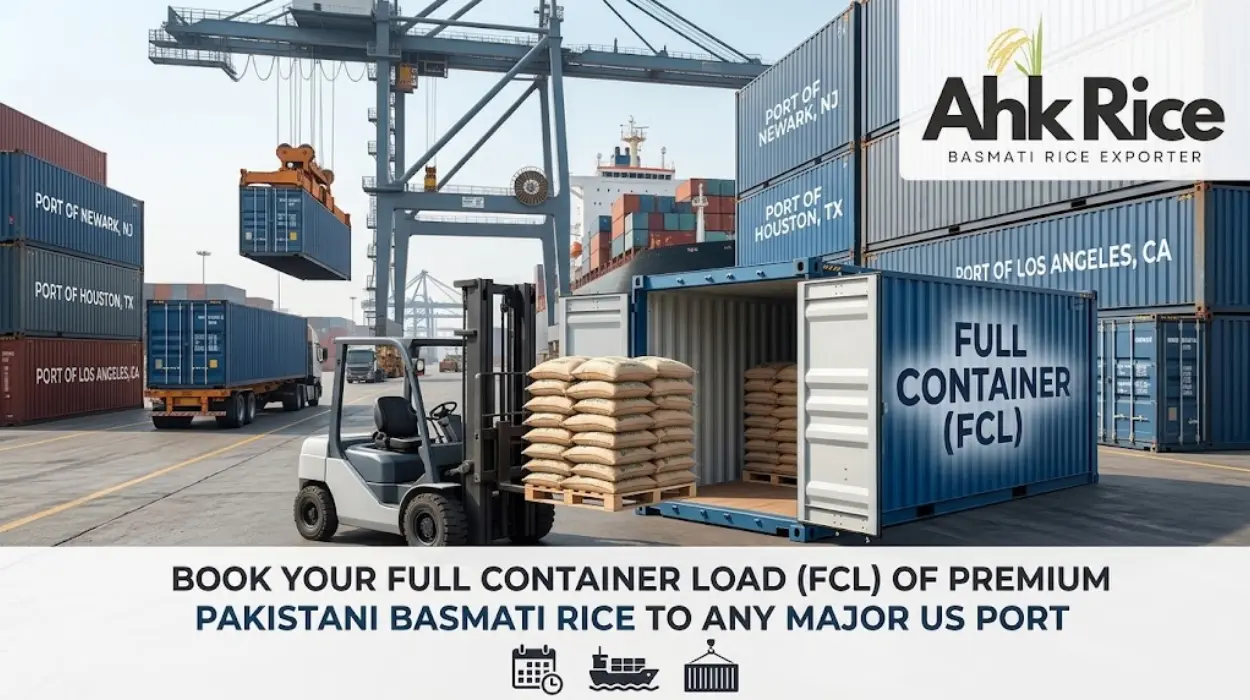
Book a Full Container Load of Pakistani Basmati Rice to Your Nearest US Port
Booking a full container load (FCL) of Pakistani Basmati rice requires three decisions: selecting the right rice specification, confirming the landed shipping cost, and choosing a US port that supports your distribution network. Importers must also coordinate quality approval, export documentation, ocean freight, customs clearance, and delivery arrangements before dispatch.
AHK Rice supplies Pakistani Basmati rice for commercial buyers seeking consistent specifications, export-ready packaging, and coordinated shipment preparation. Buyers can evaluate 1121, Super Kernel, and 1509 Basmati rice according to grain length, aroma, processing method, target market, and budget. The objective is to approve a defined product specification before committing to a full container.
What is the best solution for importing a full container of Pakistani Basmati rice?
The best solution is to confirm the rice grade, packaging, shipment quantity, destination port, and delivery terms before booking freight. This approach gives importers a clear specification, a comparable quotation, and fewer avoidable changes before loading and dispatch.
A full container load is suitable for importers who need a commercial quantity of rice for wholesale distribution, retail packaging, foodservice, or private-label supply. Instead of sharing container space with unrelated cargo, the buyer books a container for the agreed shipment.
The appropriate rice variety depends on the intended market. Pakistani 1121 Basmati suits buyers prioritizing long grains and premium presentation. Super Kernel serves buyers seeking traditional Basmati aroma and an attractive balance between quality and price. The 1509 variety can suit volume-oriented purchasing where yield, price positioning, and supply planning influence the decision.
Before booking, establish the following requirements:
- Rice specification: Variety, processing type, grain length, broken percentage, moisture limit, and crop year.
- Packaging: Retail-ready bags or bulk-oriented packaging in agreed sizes, subject to production availability.
- Quantity: Net rice weight and loading plan confirmed against the container’s permitted payload.
- Destination: Preferred US port and final delivery location.
- Trade terms: FOB or CIF, with responsibilities and included charges clearly defined.
- Compliance: Applicable food-import requirements, documentation, labeling, and any buyer-specific testing.
For a preliminary quantity calculation, consult the educational guide on how many pounds of Basmati rice fit in a 20ft container. Confirm the actual net cargo weight with the exporter and freight provider because packaging, container payload limits, and transport restrictions affect the final loading plan.
Why choose AHK Rice for a US-bound Basmati rice container?
AHK Rice helps commercial buyers source Pakistani Basmati rice through coordinated product selection, specification confirmation, packaging planning, and export preparation. Buyers can define requirements before production and shipment, reducing uncertainty when comparing suppliers and arranging US-bound cargo.
AHK Rice is a Pakistani Basmati rice exporter based in Punjab, supplying 1121, Super Kernel, and 1509 varieties to international markets. Its export process covers product preparation, grading, packaging coordination, and shipment documentation according to the agreed order and applicable requirements.
Importers can review the available varieties and export services through the AHK Rice export and supply service.
The commercial advantage is specification clarity. A buyer who confirms the variety, processing method, moisture limit, broken percentage, bag weight, and inspection requirements before order confirmation has a more useful basis for evaluating quotations and checking the delivered cargo.
AHK Rice can coordinate requirements such as:
- Product specifications agreed before order confirmation.
- Packaging formats and private-label requirements discussed before production.
- Quality documentation and agreed inspection arrangements.
- Export documentation prepared according to the shipment and destination requirements.
- Container loading coordinated with the agreed cargo plan.
- Shipment terms and cost responsibilities clarified before dispatch.
These arrangements help buyers establish a repeatable purchasing process. They do not replace the importer’s responsibility to verify US regulatory requirements, confirm importer eligibility, and arrange customs clearance and any required third-party services.
Which US port should you choose for your Basmati rice shipment?
Choose the US port according to your warehouse location, inland freight costs, available vessel services, and delivery schedule. The cheapest ocean freight option is not necessarily the lowest-cost route once port charges, customs handling, and domestic transportation are included.
The most practical destination depends on where the rice will be sold and distributed. Buyers should compare the total logistics cost from the export port in Pakistan to their final warehouse rather than selecting a port solely by name.
| US destination | Suitable distribution considerations |
|---|---|
| Port of New York and New Jersey | Importers serving the Northeast and nearby metropolitan markets |
| Port of Savannah | Buyers distributing across parts of the Southeast and inland regional markets |
| Port of Houston | Importers serving Texas and other Gulf-region destinations |
| Port of Los Angeles or Long Beach | Buyers supplying California and parts of the western US |
| Port of Norfolk | Importers evaluating East Coast access and inland distribution routes |
These are planning options, not guaranteed routes or transit commitments. Carrier schedules, transshipment arrangements, vessel availability, and port congestion affect actual arrival dates.
How many days does shipping from Pakistan to US ports take?
Ocean transit commonly requires approximately 25–45 days, depending on the destination, carrier routing, transshipment, and sailing schedule. Importers should allow additional time for origin handling, port congestion, customs clearance, and inland delivery rather than treating vessel transit as the complete lead time.
The following ranges are preliminary planning estimates, not confirmed sailing schedules.
| Destination region | Indicative ocean transit | Planning considerations |
|---|---|---|
| US East Coast | 25–40 days | Routing, transshipment, and vessel frequency |
| US Gulf Coast | 30–45 days | Carrier service and connection schedules |
| US West Coast | 25–40 days | Available services and routing through intermediate ports |
Actual transit can fall outside these ranges. A shipment’s total lead time also includes order approval, production or stock preparation, container loading, export clearance, vessel departure, arrival processing, and final delivery.
AHK Rice buyers should request an estimated shipment schedule with the quotation. Before confirming an arrival date for retail launches or warehouse replenishment, obtain the current carrier routing and expected sailing information from the freight provider.
What sample process should US importers complete before booking a container?
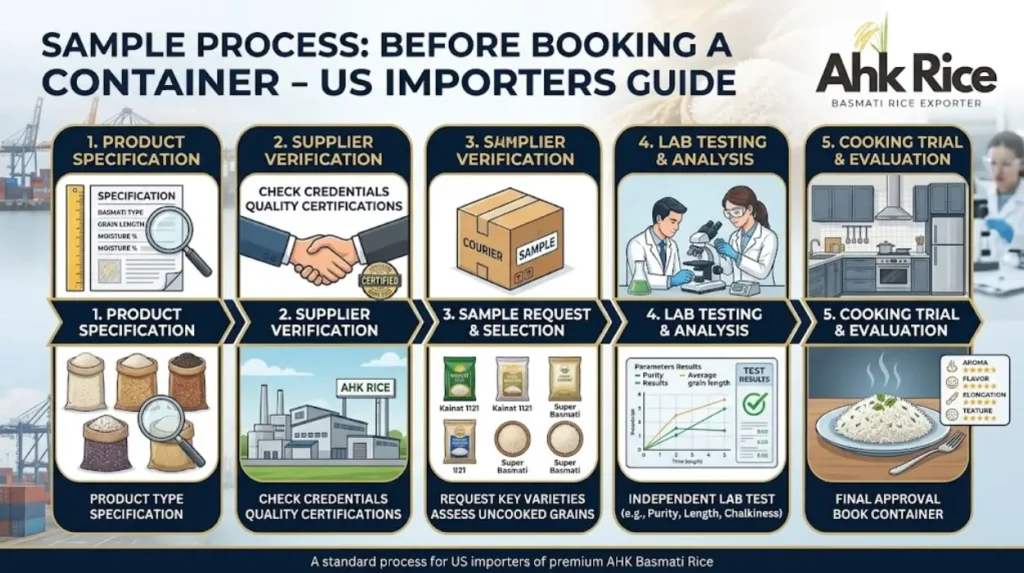
Request a representative sample, approve the cooking quality, confirm the written specification, and obtain a commercial quotation before placing a full-container order. Sample costs depend on sample weight, courier destination, testing requirements, and applicable documentation or handling charges.
A sample helps buyers assess whether the rice matches their requirements for aroma, grain appearance, cooking performance, and consistency. It does not independently guarantee that every grain in a commercial shipment will match the sample, so the final purchase specification must be documented.
AHK Rice can discuss a sample-to-order process based on the buyer’s target variety and destination.
Step 1: Submit your requirements. Identify the variety, processing method, preferred grain length, packaging format, destination, and intended application. Retailers, wholesalers, and foodservice distributors may require different specifications.
Step 2: Confirm sample availability and costs. Ask for the available sample quantity, courier charge, expected dispatch time, and any applicable testing or phytosanitary documentation costs. Confirm the total before authorizing dispatch.
Step 3: Arrange international delivery. The buyer and exporter should confirm the shipping method, delivery address, courier charges, and responsibility for any applicable fees. Delivery time depends on the destination and courier service.
Step 4: Evaluate the sample. Check aroma, appearance, grain uniformity, broken grains, and cooking results. Record the cooking method and water ratio so the results can be compared consistently.
Step 5: Approve the specification. Confirm the agreed variety, processing method, moisture limit, broken percentage, packaging, and any required laboratory tests. Specify the inspection and documentation requirements in writing.
Step 6: Approve the commercial order. Review the quotation, payment schedule, Incoterm, shipment quantity, estimated dispatch date, and freight arrangements before authorizing production or allocation.
What does a Basmati rice sample cost?
Sample pricing is not a fixed amount because the sample size, courier destination, service level, and documentation requirements vary. AHK Rice should confirm the applicable costs before dispatch.
| Cost component | What the buyer should confirm |
|---|---|
| Rice sample | Available quantity and whether the sample itself is chargeable |
| International courier | Actual courier quotation for the destination |
| Documentation | Any applicable phytosanitary or other document charges |
| Laboratory testing | Cost of requested independent tests, if applicable |
| Import charges | Whether destination-side duties, taxes, or handling fees apply |
For example, a US importer evaluating 1121 Basmati for retail distribution should test the sample against the intended cooking profile and packaging requirements. The importer can then approve the specification before comparing the full-container quotation with alternative suppliers.
Do not assume that sample shipping, testing, or certification is included in the rice price. Obtain written confirmation of each charge.
How much does a full container of Pakistani Basmati rice cost?
The final container price depends on rice variety, grade, processing, net cargo weight, packaging, inspection requirements, freight, insurance, and destination charges. Request a shipment-specific quotation instead of relying on a generic price per metric tonne.
The rice price and the total landed cost are different figures. An FOB quotation generally covers the seller’s responsibilities up to loading aboard the vessel at the named port, while a CIF quotation includes the cost of the goods, ocean freight, and insurance to the named destination port under the applicable Incoterms rules.
Neither term automatically includes every destination charge, import duty, customs brokerage fee, or inland delivery expense.
The following factors determine the commercial quotation:
- Variety and grade: 1121, Super Kernel, and 1509 have different market positions and specifications.
- Processing: Raw, Steam, Golden Sella, and other agreed processing options affect production costs.
- Quality parameters: Grain length, broken percentage, moisture, crop year, and purity requirements affect the quoted specification.
- Packaging: Retail bags, wholesale sacks, printed packaging, and private-label requirements affect material and production costs.
- Shipment quantity: Net cargo weight depends on container payload limits and the approved loading plan.
- Inspection and testing: Buyer-specific laboratory analysis or independent inspection can add charges.
- Ocean freight and insurance: Rates depend on routing, carrier availability, shipment timing, and insurance terms.
- US destination costs: Terminal handling, customs brokerage, duties, examination charges, and inland transportation affect landed cost.
For a meaningful comparison, request both the product price and a breakdown of the logistics costs included in the quotation.
What should the quotation include?
A useful commercial quotation identifies the product, net quantity, price basis, packaging, payment terms, shipment window, and required documents. It should also identify which party is responsible for freight, insurance, export clearance, import clearance, and destination delivery.
Before approving the purchase order, check that the quotation and pro forma invoice match the agreed product specification. Confirm whether the price is based on FOB Karachi, CIF a named US port, or another agreed Incoterm.
Buyers should also clarify how quality discrepancies will be handled and which inspection documents will be accepted. These details reduce ambiguity when the cargo reaches the destination.
What container loading and documentation requirements should you confirm?
Confirm the net cargo weight, packaging configuration, container condition, loading plan, and export documents before dispatch. US-bound food shipments must also meet applicable FDA, customs, and other import requirements, which depend on the product, importer, and shipment circumstances.
Container loading is a commercial and operational checkpoint. The exporter and freight provider should confirm the planned cargo weight against the container’s rated payload and all applicable road, port, and transport limits.
Bag size, stacking configuration, pallet use, and moisture protection influence the loading plan. If pallets or other special handling are required, confirm their impact on usable cargo weight before the quotation is finalized.
Importers comparing handling methods can review container loading, palletizing, and fumigation for rice shipments to US ports. The final loading arrangement should reflect the actual shipment, buyer requirements, and applicable destination rules.
The document checklist should be agreed before the shipment leaves Pakistan. Depending on the transaction and applicable regulations, documents may include:
- Commercial invoice and packing list.
- Bill of lading.
- Certificate of Origin, where required.
- Phytosanitary certificate, where applicable.
- Certificate of Analysis or other agreed quality documents.
- Additional certificates or inspection reports required by the buyer or destination.
US food importers must establish who will handle applicable FDA facility registration, prior notice, Foreign Supplier Verification Program responsibilities, and customs entry requirements. These obligations should be verified for the particular transaction rather than assumed to be covered by the exporter’s standard documentation package.
Fumigation should not be treated as universally mandatory for every rice shipment. Confirm whether it is required by the destination authority, buyer specification, or particular shipment conditions before arranging treatment.
What results can importers expect from a properly planned FCL order?
A properly specified full-container order gives importers a defined product, a documented purchasing basis, and a shipment plan aligned with distribution requirements. Actual results depend on the approved specification, production quality, freight arrangements, regulatory clearance, and final delivery conditions.
For a grocery distributor, the priority may be consistent grain appearance, retail packaging, and reliable replenishment. A foodservice importer may place greater emphasis on cooking performance, bulk packaging, and cost per serving.
A wholesale buyer may prioritize competitive pricing, container utilization, and repeat-order availability. These different requirements should be reflected in the original quotation rather than negotiated after production or loading.
AHK Rice supports the purchasing process by coordinating the agreed rice variety, product specifications, packaging requirements, and export preparation. Importers should establish clear acceptance criteria and retain the approved specification for subsequent orders.
The most useful performance measures include:
- Specification compliance: The delivered product matches the written purchase specification.
- Cost control: The buyer understands the quoted product price and additional logistics expenses.
- Shipment visibility: The buyer receives the agreed dispatch and vessel information.
- Documentation readiness: Required export and import documents are prepared within the agreed workflow.
- Repeat-order consistency: Subsequent purchases use a documented specification and defined quality checks.
These measures help procurement teams evaluate suppliers on more than the headline price per tonne.
How can you book your first container with AHK Rice?
Start by identifying your rice variety, required quantity, packaging, destination port, and preferred Incoterm. Request a written quotation, confirm sample availability, approve the product specification, and finalize payment and shipment terms before authorizing the order.
Use the following checklist to prepare your enquiry.
| Booking requirement | Information to provide |
|---|---|
| Rice variety | 1121, Super Kernel, or 1509 |
| Processing | Raw, Steam, Golden Sella, or another agreed option |
| Quality | Grain length, broken percentage, moisture, and other specifications |
| Packaging | Bag weight, material, labeling, and private-label requirements |
| Quantity | Required net weight and preferred container arrangement |
| Destination | US port and final delivery location |
| Trade terms | FOB, CIF, or another agreed Incoterm |
| Compliance | Required certificates, tests, labeling, and import arrangements |
| Timing | Target dispatch window and required delivery date |
| Payment | Agreed payment method and schedule |
Once these details are available, AHK Rice can assess the requirements and prepare a quotation based on the requested product and shipping arrangements. The importer should review the quotation, sample results, and documentation responsibilities before issuing the purchase order.
To discuss your product specifications, packaging, shipping destination, and container quotation, submit your requirements through the AHK Rice request-a-quote page.
Frequently Asked Questions
How much Basmati rice can a 20ft container hold?
The net quantity depends on the container’s payload limit, packaging, and loading configuration. Confirm the permissible cargo weight with the exporter and freight provider before finalizing the order.
How long does shipping from Pakistan to the USA take?
Ocean transit may take approximately 25–45 days, depending on the US destination, carrier routing, and transshipment. Origin handling, customs clearance, and inland delivery require additional time.
Can I request a sample before booking a full container?
Yes, you can discuss sample availability and delivery arrangements with AHK Rice. Confirm the sample quantity, courier cost, applicable documentation charges, and testing expenses before dispatch.
Which Pakistani Basmati variety should US importers choose?
1121 suits buyers prioritizing premium grain length and presentation. Super Kernel offers traditional Basmati aroma, while 1509 can suit buyers focused on yield efficiency and price positioning. The best option depends on the intended market.
Does AHK Rice provide export documentation for US shipments?
AHK Rice can coordinate export documentation according to the agreed shipment requirements. The importer should separately confirm applicable FDA, customs, labeling, and other US import obligations before dispatch.