How Do Importers Evaluate Long-Term Rice Supply Stability?
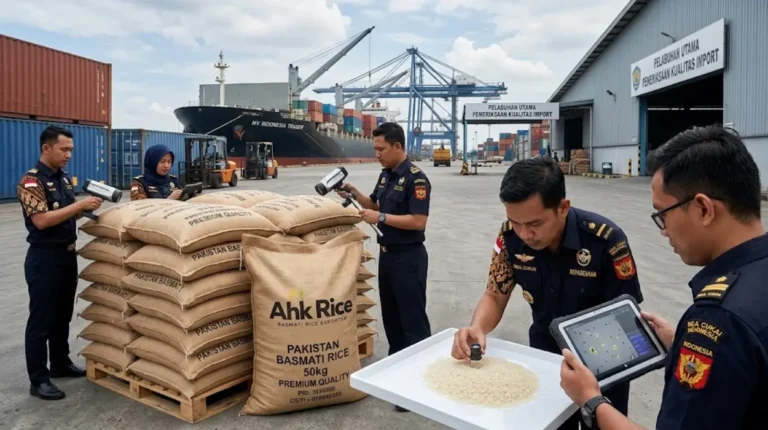
Importers evaluating long-term rice supply stability compare specification consistency, production capacity, inventory access, shipment performance, compliance, shelf life, and landed cost rather than selecting a supplier from price alone. For Tennessee distributors, the strongest sourcing model combines repeatable Basmati grades, documented processing, export capacity, and controlled logistics.
Rice supply reliability matters because a distributor sells a specification, not simply a commodity. A change in grain length, broken percentage, moisture, aroma, packaging, or delivery schedule creates downstream inventory and customer problems. This is why Understanding:
Why supply reliability is critical for Tennessee rice distributors provides the right foundation before comparing supplier models.
Pakistan remains a major global rice-export origin. USDA data for the 2025/26 marketing year places Pakistan’s milled rice production at approximately 9.4 million metric tons, while projected rice exports stand at about 4.8 million metric tons. Pakistan’s 2024/25 exports included approximately 661,907 MT of Basmati in the USDA dataset.
The Rice Exporters Association of Pakistan records a higher Basmati export figure of 808,643 MT for 2024/25, illustrating why importers must identify the dataset, marketing year, grade definition, and shipment period behind every market statistic.
What does long-term rice supply stability actually mean?
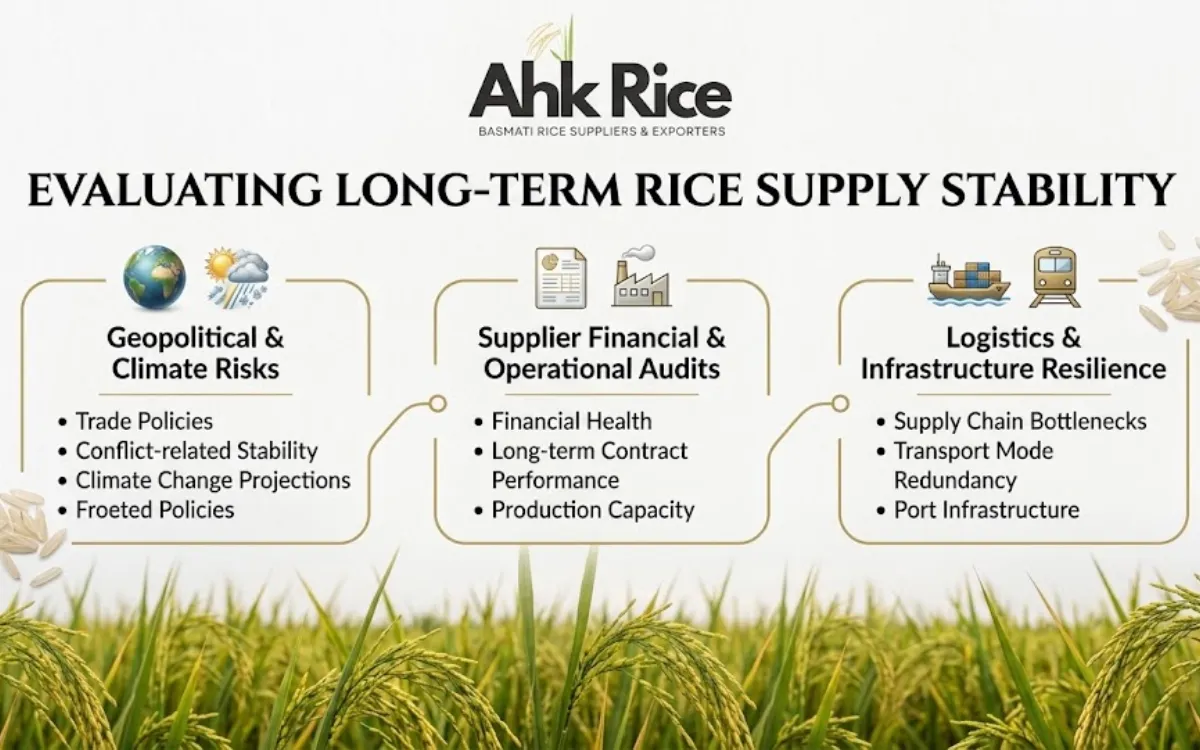
Long-term rice supply stability means an importer receives the agreed variety, grade, quantity, documentation, packaging, and shipment performance repeatedly across purchasing cycles. It combines physical availability with specification control, production capacity, quality assurance, inventory planning, logistics, and regulatory readiness.
Supply stability has several measurable dimensions.
Volume stability measures whether the exporter can fulfil recurring quantities. A distributor ordering 100 MT every quarter needs more than one successful shipment. The exporter needs access to paddy, processing capacity, packaging materials, containers, and export documentation throughout the year.
Specification stability measures whether successive shipments match the approved sample. For Basmati, the specification includes grain length, broken percentage, moisture, purity, milling condition, aroma, processing type, and packaging.
Logistics stability measures the ability to move cargo from the processing facility to Karachi and then to the destination port within the agreed shipment schedule.
Compliance stability measures whether every shipment contains the documents and testing evidence required by the destination market.
AHK Rice operates from Bucheki, Nankana Sahib, Punjab, and manages paddy procurement, cleaning, de-husking, polishing, grading, sorting, packaging, documentation, and container loading within its export workflow. The company supplies 1121, Super Kernel, and 1509 Basmati varieties to international buyers.
This integrated structure matters because every additional handoff introduces another point where specification or documentation can diverge.
What are the available solutions for maintaining stable rice supply?
Importers have four practical sourcing models: direct integrated exporters, trading companies, local inventory suppliers, and multi-supplier procurement. Each model controls a different supply risk, so the best choice depends on volume, lead time, grade complexity, working capital, and the distributor’s tolerance for inventory disruption.
Direct integrated exporter
A direct exporter manages sourcing, processing, grading, packing, documentation, and shipment coordination. This model gives the importer one commercial counterpart and clearer responsibility for specification consistency.
It suits distributors with recurring container requirements and private-label programmes.
Trading company
A trader purchases rice from one or more mills and resells it. The model provides supplier access without requiring the importer to manage multiple mills.
The main evaluation point is traceability. Importers need to know which mill produced each lot and whether the specification remains consistent between shipments.
Local inventory supplier
A U.S. wholesaler or distributor holds imported rice domestically. The buyer receives shorter replenishment times and avoids managing international freight for every order.
The trade-off is higher inventory carrying cost and a price structure that includes domestic warehousing, financing, handling, and distributor margins.
Multi-supplier procurement
The importer qualifies two or more exporters for the same specification. This reduces dependence on one supplier and creates an alternative during capacity or logistics disruptions.
The weakness is specification drift. Two exporters can sell “1121 Basmati” while producing different broken percentages, moisture levels, milling finishes, or packaging specifications.
How do the major Pakistani Basmati varieties compare for supply planning?
1121 provides the strongest premium positioning and long-grain presentation, Super Kernel provides traditional aroma and premium cooking characteristics, while 1509 provides a value-oriented alternative with early availability. Importers select among them according to market segment, price target, and specification requirements.
| Attribute | 1121 Basmati | Super Kernel Basmati | 1509 Basmati |
|---|---|---|---|
| Primary position | Premium extra-long grain | Premium aromatic traditional grade | Value-oriented premium grade |
| Grain profile | Approximately 8.3–8.5 mm | Approximately 7.0–7.5 mm depending specification | Approximately 8.2–8.4 mm |
| Common processing | White, Steam, Sella, Golden Sella, Creamy Sella | White, Steam, Brown, Parboiled | White, Steam, Sella, Golden Sella |
| Typical buyer priority | Grain length and visual presentation | Aroma and cooking familiarity | Price-to-performance balance |
| Broken specification | Premium contracts commonly target 0–2% | Premium contracts commonly target 0–2% | Premium contracts commonly target 0.5–2% |
| Indicative 2026 FOB benchmark | About $1,135–$1,205/MT for published 1121 grades | About $1,165–$1,205/MT in current published benchmarks | About $950–$1,450/MT across grades and destinations |
| Supply-planning role | Premium core SKU | Premium alternative/core SKU | Cost-control or diversification SKU |
Current August 2026 published Pakistan FOB indications place 1121 Sella around $1,135–$1,175/MT, 1121 Steam around $1,160–$1,200/MT, and 1121 White around $1,165–$1,205/MT. Published Super Kernel indications sit around $1,165–$1,205/MT. These are FOB Karachi market references rather than fixed contract quotations.
For 1509, published 2026 export references span a wider range because grade, processing method, destination, crop, and contract specification materially affect the quotation. AHK Rice’s 2026 pricing guide places the range at approximately $950–$1,450/MT.
This makes 1509 useful as a diversification option, but an importer must compare the exact grade rather than comparing the variety name alone.
How do USA and Gulf importers evaluate different Basmati grades?
USA importers generally prioritise 1121 White, Steam, Sella, and Super Kernel for premium retail, ethnic distribution, and foodservice, while Gulf buyers place stronger commercial emphasis on Sella, Golden Sella, Steam, and Super Kernel because grain separation and traditional cooking performance align with regional demand.
| Market region | Preferred grades | Indicative 2026 FOB price/MT | Commercial shelf-life planning | Main evaluation priority |
| USA, including Tennessee | 1121 White, 1121 Steam, 1121 Sella, Super Kernel | $1,135–$1,205 | 12–24 months; contractual specification governs | FDA/FSVP, traceability, consistency, labelling |
| Gulf, including Saudi Arabia/UAE | 1121 Sella, Golden Sella, Steam, Super Kernel | $1,135–$1,205 benchmark | 12–24 months; controlled storage required | Grade conformity, certificates, packaging, food-control compliance |
For the USA, importer evaluation includes FDA requirements, Foreign Supplier Verification Program responsibilities, customs documentation, product labelling, traceability, and supplier verification. Current 2026 market references identify 1121 White, Steam and Sella alongside Super Kernel as common premium options.
The Gulf market has a different commercial emphasis. Sella and Golden Sella receive strong attention because parboiling supports firmer grains and separation after cooking. Saudi Arabia and the UAE are major destinations for Pakistani Basmati, with Jebel Ali serving as an important regional distribution point.
The price ranges are not landed-cost comparisons. USA importers add ocean freight, insurance, port charges, customs-related costs, brokerage, inland transport, and compliance expenses. Gulf importers also add destination freight and local handling.
For this reason, FOB price per MT is a sourcing benchmark, not the final procurement cost.
Shelf life requires the same discipline. Dry rice remains shelf-stable when stored correctly, but commercial shelf life depends on moisture, packaging, storage temperature, humidity, pest control, and product specification. Current export guidance uses approximately 12–24 months as a commercial planning range, while the supplier’s declared shelf-life statement controls the contract.
How do different rice supply approaches compare?
Direct integrated sourcing offers the strongest specification control, local inventory offers the fastest replenishment, multi-supplier sourcing offers the strongest redundancy, and trading-company procurement offers broad supplier access. Importers compare these advantages against price, working capital, lead time, quality control, and administrative complexity.
| Attribute | Direct integrated exporter | Trading company | Local U.S. inventory | Multi-supplier model |
| Specification control | High | Medium | Medium | High if specifications are standardised |
| International logistics responsibility | Shared or exporter-managed | Usually trader-managed | Mostly domestic | Distributed |
| Replenishment speed | Medium | Medium | High | Medium |
| Inventory cost | Lower for importer | Medium | Higher | Medium |
| Supplier redundancy | Low unless backup exists | Medium | Medium | High |
| Traceability | High when mill-controlled | Depends on trader | Depends on source | Requires strong controls |
| Best use case | Recurring bulk programmes | Flexible procurement | Urgent domestic demand | Risk diversification |
The comparison changes according to purchasing volume.
A Tennessee distributor importing several containers annually gains more from specification control and predictable production scheduling than from simply choosing the lowest FOB quotation.
A distributor serving independent restaurants with unpredictable demand gains more from domestic inventory access.
A private-label retailer requires stronger traceability because packaging claims, quality complaints, and repeat shelf presentation depend on batch consistency.
A national distributor requires redundancy because one supplier disruption affects multiple downstream customers.
Which method works best for different importer cases?
The best method depends on the importer’s demand pattern. Direct mill-linked supply fits recurring volume, local stock fits urgent replenishment, multi-supplier procurement fits high-risk programmes, and trader sourcing fits flexible purchasing where supplier consolidation matters more than direct production control.
Recurring Tennessee wholesale demand
A distributor with stable quarterly demand benefits from a direct exporter relationship. The buyer can establish an approved specification, recurring packaging format, shipment calendar, inspection process, and annual volume forecast.
Premium private-label retail
1121 is well suited to premium private-label programmes because its long grain and strong cooking elongation create a visible retail distinction. The importer must lock grain length, broken percentage, moisture, packaging, and quality tolerances into the purchase specification.
Foodservice distribution
Foodservice buyers value cooking consistency and cost control. Super Kernel and 1509 provide alternatives when the purchasing objective focuses on aroma, performance, or price rather than maximum grain length.
Emergency replenishment
Domestic U.S. inventory provides the shortest physical replenishment route. The importer pays for that responsiveness through inventory carrying costs and domestic distribution margins.
Risk-diversified procurement
Two qualified exporters provide redundancy. However, both suppliers must work against the same technical specification. Otherwise, switching suppliers creates a product-quality problem rather than solving a supply problem.
What are the advantages and disadvantages of each supply strategy?
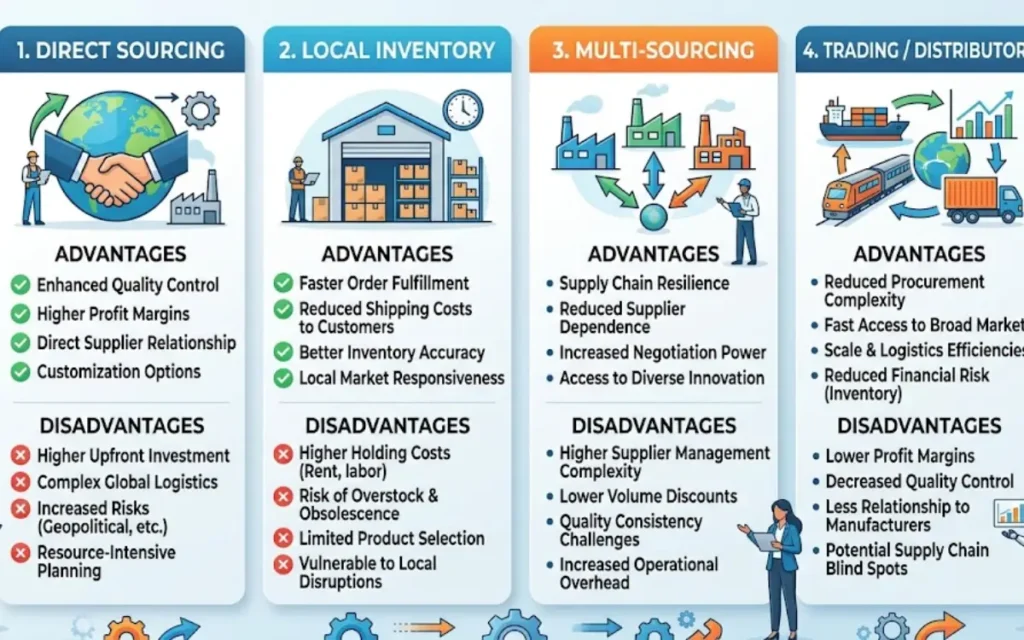
No procurement model removes every supply risk. Direct sourcing improves control but requires planning, local inventory improves speed but costs more, multi-sourcing improves redundancy but increases supplier management, and trading reduces procurement complexity while creating greater dependence on the trader’s upstream controls.
Direct integrated exporter
Advantages: stronger traceability, clearer accountability, better specification control, custom packaging capability, and direct production coordination.
Disadvantages: longer international replenishment cycles and greater dependence on forward demand planning.
For example, a Tennessee distributor forecasting 300 MT annually can schedule shipments around expected consumption instead of waiting until domestic stock becomes critical.
Trading company
Advantages: access to multiple origins or mills, simplified procurement, and flexible buying.
Disadvantages: less direct visibility into production, potential specification variation, and additional commercial layers.
Local inventory
Advantages: rapid replenishment, domestic freight, and reduced exposure to ocean transit schedules.
Disadvantages: higher storage costs, inventory financing, and reduced control over the original processing batch.
Multi-supplier procurement
Advantages: redundancy, competitive benchmarking, and reduced dependence on one exporter.
Disadvantages: additional sampling, audits, contracts, quality approvals, and supplier management.
The strongest multi-supplier programmes use one master specification. Each supplier receives identical requirements for variety, grade, moisture, broken percentage, packaging, inspection, lab testing, and documentation.
What decision factors matter most when evaluating a long-term supplier?
Importers need a weighted evaluation covering product specification, capacity, quality systems, logistics, compliance, commercial terms, and continuity planning. The supplier with the lowest quoted MT price does not automatically provide the lowest long-term procurement cost or the highest supply reliability.
| Decision factor | What the importer checks | Evidence to request |
| Specification consistency | Variety, grain length, broken %, moisture, purity | Approved sample and technical specification |
| Production capacity | Monthly and seasonal output | Capacity statement, production schedule |
| Quality assurance | Testing and inspection controls | COA, lab reports, inspection records |
| Export compliance | Documentation and destination requirements | Phyto, origin, fumigation, shipping documents |
| Logistics reliability | Port access, carrier relationships, shipment planning | Shipping schedule and historical performance |
The first decision factor is technical consistency. “1121 Basmati” is not a complete buying specification. The contract needs measurable tolerances.
The second is capacity. An exporter must demonstrate access to sufficient paddy and processing capacity for the buyer’s forecast. Pakistan’s 2025/26 rice production remains above 9 million MT, but USDA projects lower exports than the previous year, making export availability and supplier-level capacity important evaluation points.
The third is quality assurance. AHK Rice identifies ISO 22000:2018, HACCP, ISO 9001:2015, GMP, and Halal certifications within its quality framework.
The fourth is documentation control. Export documents connect the physical shipment with customs, phytosanitary, origin, packing, quality, and transport requirements. AHK Rice describes an exporter-managed workflow covering these documents before dispatch.
The fifth is logistics continuity. Importers need a clear process covering container availability, Karachi loading, vessel booking, documentation release, tracking, and destination clearance.
How can importers build a practical long-term rice supply programme?
A reliable programme starts with one approved specification, then adds supplier qualification, sample approval, scheduled purchasing, inspection, inventory buffers, documentation controls, and performance reviews. This converts rice procurement from individual spot transactions into a measurable supply-management system.
The first step is to establish the technical specification.
The second is to approve a physical sample before contracting recurring volume.
The third is to qualify the supplier’s processing and documentation system.
The fourth is to establish an annual demand forecast divided into shipment windows.
The fifth is to define acceptable delivery, quality, and documentation tolerances.
The sixth is to monitor each shipment against the approved specification.
The seventh is to maintain an alternative supplier or domestic inventory route when the commercial risk justifies the additional cost.
For Tennessee distributors, this approach aligns procurement with actual customer demand. A distributor selling premium Basmati through restaurants, ethnic supermarkets, wholesalers, and private-label programmes needs predictable product characteristics across each replenishment cycle.
An integrated exporter such as AHK Rice provides one example of this model because its Punjab operation connects paddy sourcing, processing, grading, colour sorting, custom packaging, export documentation, and container loading. Its stated export markets include the USA and more than a dozen other international destinations.
The commercial conclusion is straightforward: long-term rice supply stability is a specification-management problem as much as a sourcing problem. Importers gain stronger continuity when they evaluate variety, grade, capacity, quality, shelf life, compliance, logistics, and price together.
For buyers moving from evaluation to supplier selection, the decision-stage resource:
AHK Rice delivers reliable Basmati rice supply to Tennessee, USA fits naturally after this comparison because it moves from general procurement criteria into a supplier-specific evaluation.
Frequently Asked Questions
What does long-term rice supply stability mean?
Long-term rice supply stability means receiving the agreed rice variety, grade, quantity, quality, packaging, documentation, and shipment schedule consistently across multiple purchasing cycles.
Which Pakistani Basmati rice varieties are suitable for long-term imports?
The main options include 1121 Basmati, Super Kernel Basmati, and 1509 Basmati. Importers select the variety according to grain length, aroma, cooking performance, target market, and price requirements.
Which Basmati grade is preferred in the USA?
US importers commonly evaluate 1121 White, 1121 Steam, 1121 Sella, and Super Kernel Basmati for premium retail, foodservice, and ethnic distribution. Exact grade selection depends on the buyer’s product specification.
How much does Pakistani Basmati rice cost per MT in 2026?
Published 2026 Pakistan FOB benchmarks place many premium 1121 grades around $1,135–$1,205 per MT. The final price depends on variety, processing method, broken percentage, packaging, destination, crop conditions, and contract terms.
How long does Basmati rice remain shelf-stable?
Commercial shelf-life planning commonly uses 12–24 months when rice is stored under controlled conditions. Moisture, packaging, temperature, humidity, pest control, and the supplier’s declared specification determine the applicable shelf-life period.
What should importers check before choosing a Pakistani rice exporter?
Importers should evaluate grade consistency, processing capacity, quality certifications, laboratory testing, export documentation, packaging capability, shipment history, logistics planning, and production availability before establishing a recurring supply contract.
Is direct sourcing better than buying through a rice trader?
Direct sourcing provides stronger visibility into processing, specifications, packaging, and production. Traders provide supplier access and procurement flexibility. The better model depends on the importer’s volume, quality-control requirements, inventory strategy, and risk tolerance.
Why is multi-supplier sourcing used for rice imports?
Multi-supplier sourcing reduces dependence on one exporter and creates supply redundancy. Each supplier must follow the same technical specification to prevent differences in grain length, broken percentage, moisture, processing, and cooking performance.
What certifications are important when importing Pakistani rice?
Importers evaluate certifications and food-safety systems such as ISO 22000, HACCP, ISO 9001, GMP, and Halal, alongside destination-specific regulatory and documentation requirements.
How can Tennessee rice distributors improve supply reliability?
Tennessee distributors can improve reliability by approving a detailed rice specification, forecasting annual demand, scheduling shipments in advance, inspecting batches, maintaining appropriate inventory, verifying documentation, and qualifying an alternative supply route.
What is more important: rice price or supply reliability?
Supply reliability is evaluated alongside price rather than separately. A lower FOB price loses its advantage when inconsistent quality, delayed shipments, additional inspections, rejected cargo, or emergency replacement purchases increase the total procurement cost.