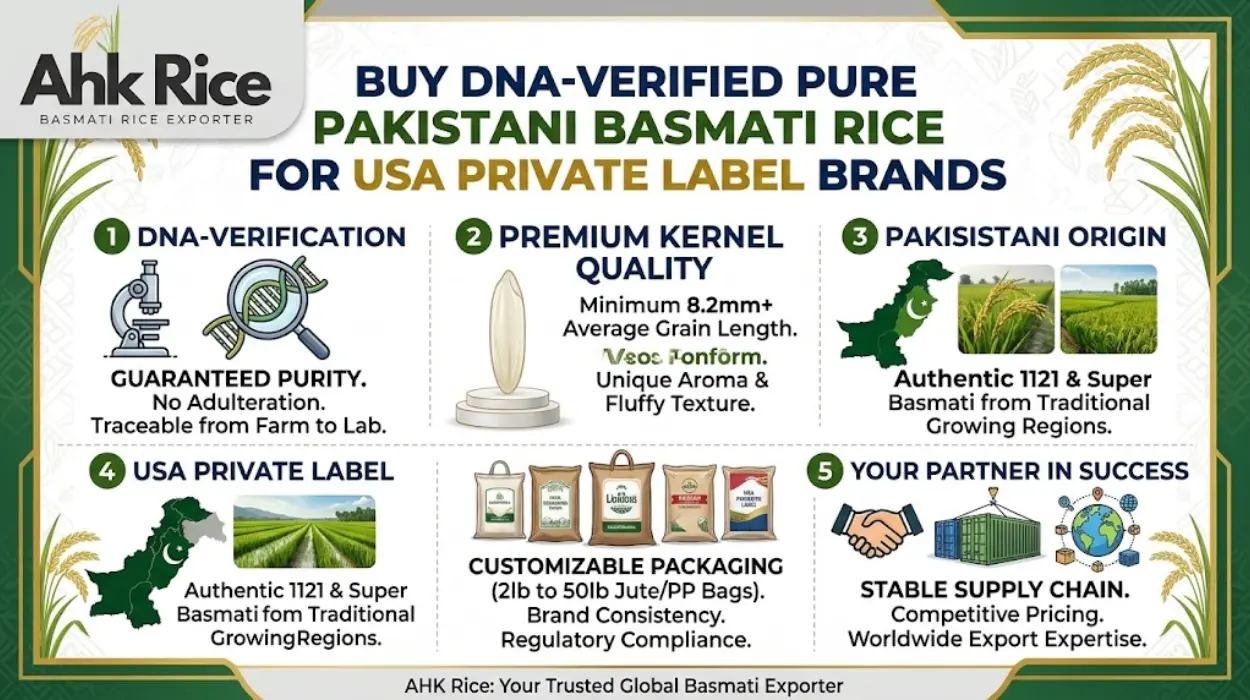
Buy DNA-Verified Pure Pakistani Basmati Rice for USA Private Label Brands
USA private label brands need consistent Basmati identity, documented product specifications, and reliable export execution to protect their reputation. DNA testing can help verify varietal identity, while grain specifications, laboratory documentation, and shipment records support purchasing decisions. Importers should evaluate these controls before approving a Pakistani Basmati rice supplier.
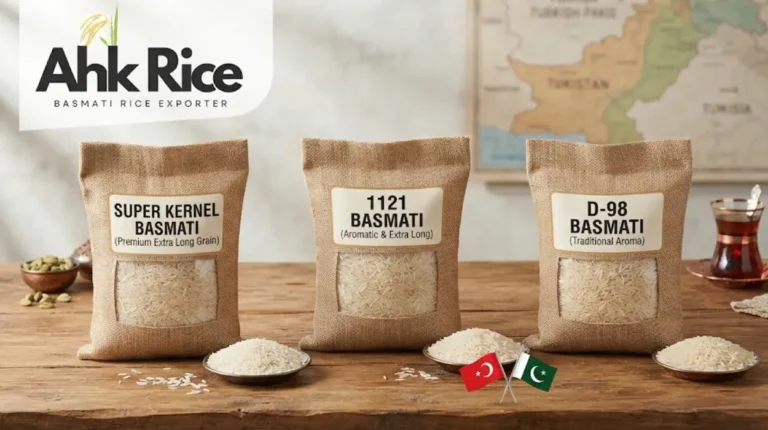
AHK Rice supplies Pakistani Basmati rice for international buyers seeking defined grades, export packaging, and coordinated shipment documentation. Private label importers can assess 1121 Basmati, Super Kernel, and other suitable varieties against their retail positioning, cooking requirements, and target landed cost. Supplier approval should begin with a written specification, sample evaluation, and agreement on the evidence required before shipment.
What Is the Best Solution for Buying DNA-Verified Pakistani Basmati Rice?
The best solution combines varietal DNA testing with physical grain inspection, written specifications, and shipment-level quality documentation. USA importers should confirm the tested sample’s identity, the laboratory’s capabilities, and whether the results represent the commercial lot being purchased.
Basmati adulteration creates commercial risks for American importers. A shipment can have an attractive appearance yet contain non-Basmati rice or an inconsistent varietal mixture. These differences can affect aroma, cooking performance, retail positioning, and customer confidence.
DNA testing helps identify rice varieties through genetic markers. However, the reliability of the result depends on the testing method, reference varieties, sample preparation, and laboratory competence. Buyers should not treat a supplier’s general statement about DNA verification as proof that every shipment has been tested.
Importers should establish four purchasing requirements before placing an order:
- Varietal identity: Specify the required Pakistani Basmati variety, such as 1121 or Super Kernel.
- DNA evidence: Request the laboratory report, tested sample identification, method, and reported findings.
- Physical specifications: Define grain length, broken percentage, moisture, foreign matter, and other contractual limits.
- Shipment traceability: Connect the approved sample and quality records to the production lot and export shipment.
For background on authenticity checks, buyers can review this educational guide on Basmati rice purity and adulteration detection. Importers should confirm the exact article URL before publication if the educational post has a separate permalink.
Why Should USA Importers Choose AHK Rice?
AHK Rice offers Pakistani Basmati sourcing with defined product specifications, processing coordination, custom packaging, and export documentation. Buyers should confirm DNA-testing arrangements, available certificates, and shipment-specific verification requirements before treating any product as DNA-verified.
A private label program requires more than a rice supplier. Importers need a partner that can translate retail requirements into a commercial specification and coordinate the steps between sample approval and container dispatch.
AHK Rice is a Pakistani Basmati rice exporter based in Punjab, supplying varieties including 1121, Super Kernel, and 1509 to international markets. Its export-oriented service can support discussions about grade selection, processing, packaging, and shipment coordination.
Explore AHK Rice’s export and rice supply services to assess the available options for your private label program.
Which Pakistani Basmati Varieties Suit American Retail Brands?
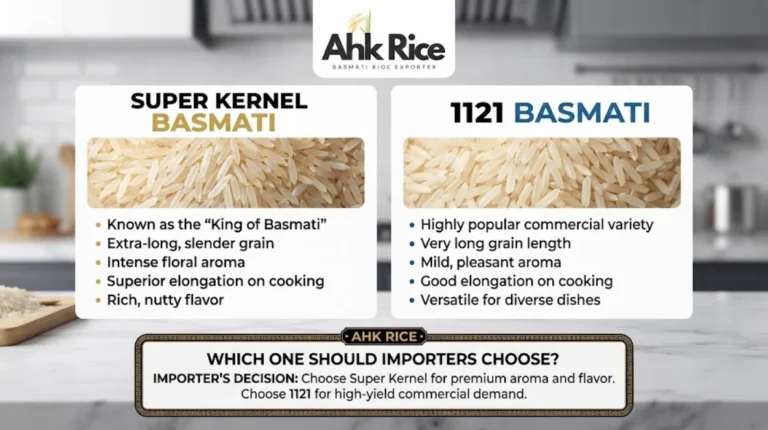
1121 Basmati suits premium positioning where long grains and cooked presentation matter. Super Kernel offers a traditional aromatic profile, while 1509 can suit buyers evaluating grain length, cooking performance, and cost efficiency against their market requirements.
The final selection depends on the intended consumer, shelf price, preparation method, and product specification.
| Variety | Commercial positioning | Buyer evaluation priorities |
|---|---|---|
| 1121 Basmati | Premium retail and specialty grocery | Grain length, aroma, broken percentage, and cooked elongation |
| Super Kernel | Traditional aromatic Basmati | Aroma, grain consistency, cooking performance, and grade |
| 1509 Basmati | Value-conscious retail and foodservice | Price, grain dimensions, cooking performance, and consistency |
These descriptions are purchasing guidelines, not guarantees of a particular shipment’s performance. Importers should approve representative samples and define measurable acceptance criteria before production.
What Evidence Should Buyers Request for DNA Verification?
Buyers should request a laboratory report identifying the tested sample, analytical method, reference varieties, and findings. They should also establish how the sample relates to the commercial lot and whether testing covers varietal identity, mixture detection, or another specific claim.
A useful verification process begins before the purchase order is finalized. The importer and exporter should agree on the evidence needed to substantiate the product description and the procedure for resolving discrepancies.
Request the following information:
- Sample identification: A unique reference connecting the sample to the proposed product and lot.
- Laboratory details: The testing laboratory’s identity, relevant capabilities, and applicable accreditation or quality credentials.
- Analytical method: The DNA method used and the varieties included in its reference database.
- Reported findings: The actual result, limitations, and interpretation provided by the laboratory.
- Lot relationship: Records showing whether the tested material represents the production lot offered for export.
- Retained sample procedure: An agreed method for keeping and identifying a reference sample for dispute resolution.
DNA testing has limitations. Results depend on the method’s ability to distinguish the relevant varieties and detect mixtures. A test report should therefore be interpreted according to its stated scope rather than treated as universal proof of purity.
Buyers comparing verification methods can consult DNA testing for Basmati purity and the questions USA importers should ask Pakistani exporters. Replace this placeholder link with the published MOFU article’s exact URL before publishing.
What Results Can Private Label Buyers Expect?
A controlled sourcing process improves specification clarity, supplier accountability, and consistency between approved samples and delivered rice. Actual results depend on the agreed testing scope, processing controls, product grade, laboratory findings, and compliance with the purchase contract.
Private label brands need repeatable product performance. A shipment that meets the first order’s requirements should provide a documented reference for future purchases.
For example, an American grocery distributor may require 1121 Basmati with a defined grain profile, controlled moisture, low broken percentage, and retail-ready packaging. The buyer can approve a sample, agree on laboratory checks, and specify the required documentation before authorizing production.
The expected commercial benefits include:
- Clearer product identity: Defined varietal requirements reduce ambiguity during procurement.
- More controlled quality: Written specifications give the buyer and exporter measurable acceptance criteria.
- Better traceability: Lot references and sample records help connect verification evidence to the shipment.
- Stronger private label consistency: Agreed processing and packaging requirements establish a repeatable purchasing standard.
- Fewer avoidable disputes: Written inspection procedures clarify what happens if results fall outside the agreed limits.
These are process benefits, not guaranteed outcomes. DNA testing does not replace physical inspection, food-safety testing, packaging checks, or import compliance.
How Much Does DNA-Verified Pakistani Basmati Rice Cost?
The total purchase cost depends on the rice variety, grade, quantity, testing scope, packaging, inspection requirements, freight, insurance, and delivery terms. Buyers should obtain a shipment-specific quotation rather than assume DNA verification carries a universal fixed premium.
A commercial quotation should distinguish the rice price from additional verification and logistics expenses. This helps importers calculate landed cost and compare suppliers on equivalent terms.
| Cost factor | What the importer should confirm |
|---|---|
| Rice variety and grade | 1121, Super Kernel, 1509, or another agreed specification |
| Order volume | Trial quantity, commercial order, or full container shipment |
| DNA testing | Laboratory fee, test scope, number of samples, and who pays |
| Physical inspection | Independent inspection fees and acceptance procedures |
| Packaging | Bulk bags, retail packs, printing, and private label artwork |
| Export documentation | Required certificates, inspections, and document preparation |
| Freight and insurance | Route, carrier, transit arrangements, and insurance coverage |
| Delivery terms | FOB, CFR, or CIF responsibilities and destination costs |
For example, a brand ordering retail-ready 1121 Basmati may incur different costs from a foodservice importer purchasing bulk Super Kernel. Additional laboratory testing, specialized packaging, or independent inspection can also change the total.
The quotation should identify the price basis, currency, quantity, specification, payment terms, and shipment schedule. It should also state whether DNA testing is included, separately charged, or arranged by the buyer.
How Long Does Shipping Take from Pakistan to the USA?
Shipping time depends on the departure port, destination port, carrier schedule, transshipment, customs clearance, and inland delivery. Importers should request a current route-specific transit estimate and distinguish ocean transit from total order-to-delivery lead time.
The export schedule includes several stages: specification approval, sample testing, production, packaging, inspection, export clearance, vessel departure, ocean transportation, and US customs processing.
A buyer should not interpret an estimated ocean transit period as a guaranteed delivery date. Vessel schedules and port conditions can change, and the overall timeline also depends on production readiness and document approval.
Before confirming an order, ask AHK Rice to provide:
- The expected production and packing period after approval.
- The planned port of loading in Pakistan.
- The proposed US destination port and shipping route.
- The current estimated ocean transit time.
- The documentation and inspection milestones.
- The expected arrival window and responsibilities for customs clearance.
The buyer should also confirm that the shipment’s commercial invoice, packing list, origin documentation, and other applicable records match the purchase order. US importers should work with their customs broker to confirm current requirements, including applicable food import obligations.
How Does the Rice Sample Process Work, and What Does It Cost?
The sample process should verify cooking quality, physical specifications, packaging suitability, and any agreed DNA-testing requirements before commercial production. Sample size, courier charges, laboratory fees, and delivery time must be confirmed individually because costs vary by destination and testing scope.
AHK Rice and the buyer should agree on the sample specification before dispatch. This avoids testing a sample that differs from the intended commercial product.
Step 1: Submit the product requirements. The importer identifies the variety, grain specifications, processing type, packaging format, intended use, and estimated order volume.
Step 2: Confirm sample availability. The exporter confirms whether a representative sample is available and whether the requested variety and grade can be supplied.
Step 3: Agree on DNA verification. The parties determine whether existing evidence is available or whether additional testing is needed. They also confirm the laboratory, sample quantity, method, fee, and responsibility for payment.
Step 4: Dispatch the sample. The exporter confirms courier options, shipping charges, expected delivery time, and any applicable documentation or inspection requirements. Importers must verify whether the sample can legally enter the United States under the applicable requirements.
Step 5: Complete the evaluation. The buyer examines grain appearance, aroma, cooking performance, and broken percentage, and reviews the agreed laboratory evidence.
Step 6: Approve the commercial specification. Both parties confirm the accepted grade, packaging, quality limits, inspection procedure, price basis, and delivery schedule in writing.
AHK Rice may offer sample quantities subject to availability and the terms agreed with the buyer. For a sample of up to 20 kg, the buyer should confirm current eligibility and whether courier freight, laboratory testing, phytosanitary charges, or other applicable fees are payable separately. These charges should not be assumed to be included in the rice price.
How Can USA Importers Start a Private Label Order?

Start by submitting a product brief that defines the required Basmati variety, DNA-testing evidence, physical specifications, packaging, order quantity, destination, and delivery terms. Request a written quotation and approve the sample and verification procedure before authorizing commercial production.
A complete purchasing brief enables AHK Rice to assess the request against the buyer’s commercial and technical requirements.
Include the following information:
- Product: 1121, Super Kernel, and 1509 Basmati rice or another specified variety.
- Verification: Required DNA evidence and any independent testing or inspection.
- Quality: Grain length, moisture, broken percentage, foreign matter, and other contractual limits.
- Packaging: Retail pack size, bag material, label artwork, language, and branding requirements.
- Quantity: Trial order, recurring monthly demand, or planned container volume.
- Destination: US port, delivery location, and preferred Incoterm.
- Schedule: Required shipment window and target arrival date.
Before signing the purchase contract, agree on the inspection method, acceptable quality limits, document requirements, payment terms, and process for handling a failed test or specification discrepancy.
The importer should also confirm applicable US food import requirements with qualified regulatory and customs professionals. Supplier documentation supports compliance work but does not automatically establish that every regulatory obligation has been met.
For private label brands, the most reliable purchasing decision comes from combining product evidence with a clear commercial agreement. DNA testing supports varietal verification, while physical specifications, representative samples, traceability, and shipment controls provide additional safeguards.
Contact AHK Rice today and submit your requirements through the quotation request form to receive a tailored export proposal.
Frequently Asked Questions
Does DNA testing guarantee 100% pure Basmati rice?
DNA testing can help verify varietal identity using suitable methods and reference varieties.
Its ability to detect mixtures depends on the test’s sensitivity and scope.
Buyers should request the original laboratory report and its limitations.
Physical inspection and traceability checks provide additional evidence.
No claim of absolute purity should exceed what the test supports.
Which Pakistani Basmati variety is best for US private labels?
1121 Basmati suits brands targeting premium long-grain positioning.
Super Kernel suits buyers seeking traditional aroma and established Basmati characteristics.
1509 may suit programs prioritizing value and cooking performance.
The best option depends on the target consumer and retail price.
Approve a representative sample before selecting the commercial grade.
Can AHK Rice provide DNA-testing documentation?
Importers should discuss their required testing scope with AHK Rice before ordering.
Confirm whether existing reports are available for the requested variety or lot.
Ask whether additional testing can be arranged through a suitable laboratory.
Verify the sample identity and report’s relationship to the commercial shipment.
Do not assume testing is included until the supplier confirms it in writing.
How much does a Basmati rice sample cost to ship to the USA?
The total depends on sample weight, courier service, and destination.
Laboratory testing and applicable documentation charges may be additional.
The buyer should confirm current charges before the sample is dispatched.
Import eligibility and documentation should also be checked in advance.
Request an itemized sample-cost estimate from the exporter.
How long does Pakistani Basmati rice take to reach the USA?
Transit time varies by destination port, carrier, and shipping route.
Production and packaging add time before vessel departure.
Transshipment and customs clearance can extend the overall delivery period.
Ask for a current estimate covering both production and ocean transit.
Confirm the final delivery schedule before placing the purchase order.