Pakistan–Qatar Rice Trade Growth and GCC Import Opportunities
Pakistan–Qatar rice trade continues expanding because Qatar imports premium-quality rice to strengthen food security while Pakistan produces internationally recognized Basmati and non-Basmati varieties through an established export ecosystem. Here is why: rising GCC food demand, diversified sourcing strategies, efficient logistics, and internationally certified processing support long-term trade growth.
Pakistan ranks among the world’s largest rice exporters. The country cultivates aromatic Basmati varieties in Punjab and high-yield non-Basmati varieties across Punjab and Sindh. Qatar imports premium rice because domestic agricultural production remains limited. This complementary relationship creates consistent trade opportunities between both countries.
Rice trade involves far more than cultivation. Farmers harvest paddy. Mills dehusk and polish grain. Exporters inspect quality, certify consignments, package products, clear customs, and dispatch containers through international ports. Every stage influences product quality and import acceptance.
Within this supply chain, companies such as AHK Rice represent the integrated export model by combining cultivation networks, processing, grading, packaging, documentation, and international logistics under one operation. Understanding this export structure explains why Pakistan remains an important supplier for Qatar and the wider GCC region.
What is Pakistan–Qatar rice trade, and why is it growing?
Pakistan–Qatar rice trade represents the commercial exchange of Pakistani rice varieties through certified export systems that satisfy Qatar’s food demand. Growth comes from increasing population, expanding hospitality sectors, government food security strategies, and Pakistan’s reliable rice production capacity.
Pakistan–Qatar rice trade refers to the export of milled rice from Pakistan to buyers in Qatar. Exported products include aromatic Basmati rice and selected non-Basmati varieties that satisfy retail, hospitality, catering, and wholesale markets.
Qatar depends heavily on imported food because agricultural land and freshwater resources remain limited. Rice represents a staple food consumed by households, restaurants, hotels, labour accommodations, and catering companies. This creates consistent annual import demand.
Pakistan supplies rice through structured export channels. Farmers cultivate paddy using irrigated agricultural systems. Modern rice mills process harvested grain into export specifications. Exporters inspect every batch before shipment. Shipping companies load containers for Gulf ports where importers distribute products across domestic markets.
Growing diplomatic and commercial relations between Pakistan and Qatar strengthen agricultural trade. Investments in logistics, port infrastructure, and customs efficiency reduce delivery times while improving supply chain reliability.
Government policies across GCC countries increasingly emphasize diversified food sourcing. Instead of depending on a limited number of suppliers, importers purchase rice from multiple producing countries. Pakistan benefits because it offers premium Basmati varieties alongside competitive non-Basmati alternatives.
Trade growth also reflects changing consumer preferences. Families increasingly purchase premium aromatic rice. Hotels prefer consistent grain length and cooking performance. Catering companies value high-volume packaging and predictable quality specifications.
The next question examines how this complete export system transforms harvested paddy into internationally traded rice.
How does the Pakistan-to-Qatar rice export process work?
The export process follows nine connected stages: cultivation, harvesting, drying, milling, grading, laboratory testing, certification, packaging, and international shipping. Every stage protects grain quality while meeting Qatar’s import regulations and commercial specifications.
Rice exports begin long before containers reach a port. Every processing stage affects appearance, cooking quality, aroma, moisture content, and shelf life.
Cultivation
Farmers cultivate Basmati rice primarily across Punjab using irrigated farmland. Climatic conditions, fertile soil, and controlled irrigation contribute to long, aromatic grains that distinguish Pakistani Basmati internationally.
Harvesting
Farmers harvest mature paddy at optimum moisture levels. Correct harvesting preserves grain integrity while reducing broken kernels during milling.
Drying
Processors dry harvested paddy until moisture reaches export-safe levels. Controlled drying improves storage stability and prevents fungal contamination.
Milling
Rice mills remove the outer husk through dehusking equipment. Milling converts rough paddy into edible rice while protecting grain length.
Polishing
Processing facilities polish rice to improve appearance. Different markets request varying polishing levels depending on consumer preference.
Grading
Quality inspectors sort rice by grain length, broken percentage, colour, purity, and uniformity. Consistent grading ensures buyers receive products matching contract specifications.
Laboratory Testing
Laboratories test moisture, purity, foreign matter, pesticide residues, and microbiological safety. Documented testing supports international compliance.
Certification
Export authorities inspect shipments before issuing required certificates. Documentation verifies origin, phytosanitary compliance, quality standards, and commercial specifications.
Packaging and Shipping
Exporters package rice into PP bags, BOPP bags, paper bags, woven sacks, or private-label retail packaging. Logistics providers load containers, complete customs clearance, and dispatch shipments through Pakistani seaports toward Qatar.
Companies including AHK Rice integrate these processing stages within one export workflow to maintain consistency from procurement through international delivery.
Understanding processing explains why grading becomes one of the most important factors influencing buyer decisions.
What are the major Pakistani rice grades exported to Qatar and GCC markets?
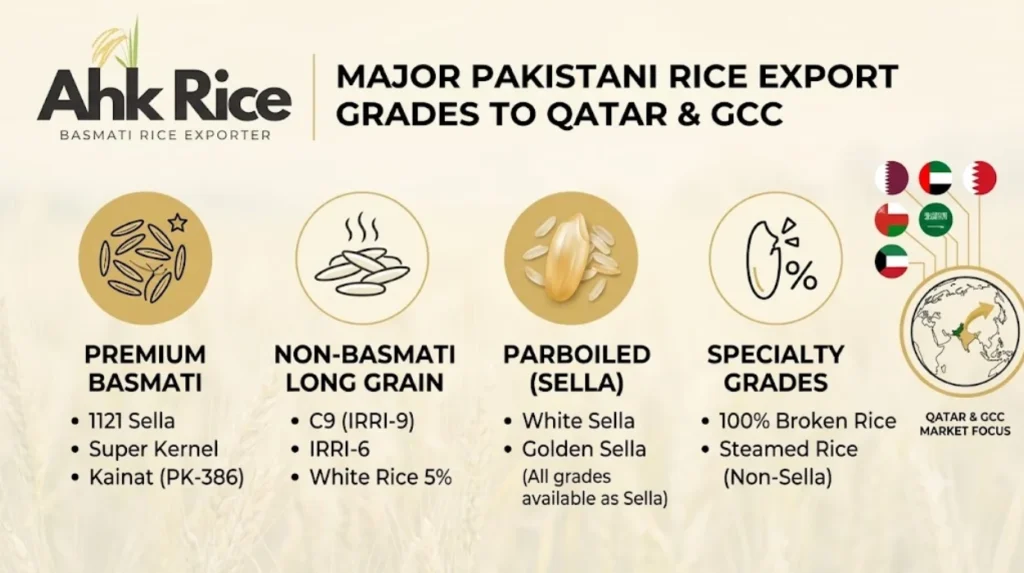
Pakistan exports multiple commercial rice grades including 1121 Basmati, Super Kernel Basmati, 1509 Basmati, PK-386, IRRI-6, and C9 varieties. Each grade serves different cooking applications, wholesale segments, and consumer price categories across GCC countries.
Rice grades differ according to grain length, aroma, ageing, processing method, cooking expansion, and market positioning.
1121 Basmati Rice
1121 Basmati represents Pakistan’s premium export variety. Extra-long grains, distinctive aroma, and exceptional elongation after cooking make it popular across hotels, restaurants, and premium retail stores.
Super Kernel Basmati
Super Kernel Basmati combines traditional aroma with long grain appearance. Consumers throughout the Gulf recognize this variety for everyday premium cooking and festive meals.
1509 Basmati
1509 Basmati matures earlier than traditional Basmati varieties while maintaining excellent cooking quality. Buyers value its affordability and consistent grain characteristics.
PK-386 Rice
PK-386 belongs to Pakistan’s long-grain non-Basmati category. It serves wholesale markets requiring competitive pricing alongside dependable cooking performance.
IRRI-6 Rice
IRRI-6 remains one of Pakistan’s largest exported non-Basmati varieties. Food processors, institutional buyers, and large-scale catering companies frequently purchase this grade.
C9 Rice
C9 offers another long-grain non-Basmati option suitable for commercial food service operations requiring economical procurement.
Each grade also appears in different processing forms, including:
- White Rice
- Steam Rice
- Golden Sella Rice
- Creamy Sella Rice
- Brown Rice
- Parboiled Rice
- Silky Polished Rice
Readers comparing these commercial specifications with wholesale purchasing requirements should continue to the detailed guide on preferred rice specifications for Qatar’s wholesale buyers.
With the available grades established, the next section explains why GCC markets continue increasing imports from Pakistan.
Why do GCC countries import increasing volumes of Pakistani rice?
Pakistan supplies premium Basmati and competitive non-Basmati rice that satisfies GCC demand for quality, consistency, and food security. Rising populations, expanding tourism, and diversified sourcing strategies continue increasing import volumes across Gulf markets.
The Gulf Cooperation Council (GCC) consists of Qatar, Saudi Arabia, the United Arab Emirates, Kuwait, Bahrain, and Oman. These countries import most of their staple foods because arable land and freshwater resources remain limited.
Rice remains a daily staple across households, restaurants, hotels, catering companies, and institutional kitchens. Annual demand grows alongside population growth, tourism expansion, and food service development.
Pakistani rice fits these requirements because exporters supply multiple grain lengths, processing styles, and packaging options suitable for different customer segments.
Which sectors purchase imported rice?
Different industries purchase different rice specifications.
- Hotels purchase premium aged Basmati rice.
- Restaurants purchase aromatic long-grain varieties.
- Catering companies purchase steam and sella rice.
- Supermarkets purchase branded retail packs.
- Wholesalers purchase container-load quantities.
- Food distributors purchase mixed product portfolios.
Each buyer evaluates grain length, aroma, moisture content, broken percentage, and cooking expansion before procurement.
Pakistan supports these requirements through an established export ecosystem that includes cultivation, milling, grading, certification, and logistics.
The growing demand for imported rice also increases the importance of internationally accepted quality certifications.
Which certifications support Pakistani rice exports to Qatar?
International certifications verify food safety, product quality, traceability, and regulatory compliance. These documents increase buyer confidence and simplify customs clearance throughout GCC markets.
Rice exporters prepare documentation before loading export containers. Every document confirms a different aspect of product quality or regulatory compliance.
Common export certifications
- Phytosanitary Certificate
- Certificate of Origin
- Commercial Invoice
- Packing List
- Bill of Lading
- Fumigation Certificate
- Health Certificate
- Quality Inspection Certificate
Many exporters also operate under internationally recognised food safety systems, including:
- ISO 22000
- HACCP
- GMP
- Halal Certification
Laboratories inspect moisture, purity, broken percentage, foreign matter, and residue levels before shipment. These inspections ensure every consignment matches contractual specifications.
Companies such as AHK Rice integrate inspection, testing, certification, and documentation into one export workflow, allowing buyers to receive complete shipping documentation with each order.
With quality assurance established, the next question examines the broader benefits of expanding Pakistan–Qatar rice trade.
What benefits does Pakistan–Qatar rice trade create?
Expanding rice trade strengthens food security, supports agricultural employment, increases export earnings, improves supply chain resilience, and creates commercial opportunities for importers, distributors, and food service businesses.
Pakistan benefits through higher agricultural production and export revenue.
Rice cultivation supports farmers, transport companies, processing mills, packaging manufacturers, laboratories, freight forwarders, and shipping providers.
Qatar benefits through reliable access to premium food products from diversified international suppliers.
Consumers benefit from greater product variety.
Restaurants benefit from consistent cooking quality.
Hotels benefit from premium presentation.
Wholesale distributors benefit from multiple pricing categories suitable for different customer segments.
Long-term commercial partnerships also encourage investment in storage facilities, packaging innovation, and logistics infrastructure.
Trade relationships therefore generate value throughout the agricultural supply chain instead of benefiting only exporters and importers.
Understanding these benefits helps clarify several misconceptions surrounding Pakistani rice.
What common misconceptions exist about Pakistani rice exports?
Pakistani rice follows internationally recognised production, inspection, and export procedures. Common misconceptions usually result from confusing different rice varieties, processing methods, or quality grades.
Misconception 1 — All Pakistani rice is Basmati
Pakistan exports both Basmati and non-Basmati varieties.
Basmati includes 1121, Super Kernel, and 1509.
Non-Basmati includes IRRI-6, PK-386, C9, and other commercial grades.
Each variety serves different market requirements.
Misconception 2 — Every rice grade cooks the same
Cooking performance depends on grain variety, ageing, moisture content, and processing method.
Steam rice differs from Golden Sella.
Brown rice differs from polished white rice.
Each specification suits different cuisines.
Misconception 3 — Export quality depends only on farming
Rice quality depends on the complete supply chain.
Harvesting, drying, milling, grading, laboratory testing, packaging, and shipping all influence the final product.
Understanding these differences helps buyers compare specifications instead of relying only on price.
The final section explores why 2026 presents significant opportunities for Pakistan and GCC rice trade.
Why does present important opportunities for Pakistan and GCC rice trade?
Growing regional food demand, improved logistics, diversified sourcing strategies, and expanding premium rice consumption position 2026 as a strong year for Pakistan–Qatar agricultural trade.
Food security remains a strategic priority throughout the GCC.
Governments continue strengthening supply chains by purchasing agricultural products from multiple producing countries.
Pakistan offers several competitive advantages.
Punjab produces internationally recognised aromatic Basmati rice.
Modern processing facilities improve consistency.
Containerised shipping supports efficient Gulf deliveries.
Exporters increasingly provide customised packaging, private labelling, and buyer-specific specifications.
Premium rice consumption also continues increasing.
Hotels, restaurants, and premium supermarkets increasingly purchase extra-long grain Basmati rice because consumers associate aroma, elongation, and appearance with higher quality meals.
Digital trade platforms also improve communication between exporters and international buyers.
These developments strengthen long-term commercial relationships while increasing transparency across the export process.
Pakistan–Qatar rice trade continues expanding because both countries satisfy complementary economic needs. Pakistan produces internationally recognised rice varieties, while Qatar requires dependable food imports to support households, hospitality businesses, and wholesale distribution networks.
The export process extends far beyond cultivation.
Farmers cultivate and harvest paddy.
Rice mills dehusk, polish, and grade grain.
Laboratories inspect quality.
Authorities certify consignments.
Exporters package products.
Shipping companies dispatch containers to GCC markets.
Every stage contributes to consistent product quality.
Premium varieties such as 1121 Basmati, Super Kernel Basmati, and 1509 Basmati continue strengthening Pakistan’s position within Gulf markets.
Companies including AHK Rice demonstrate how integrated cultivation networks, processing facilities, quality inspection, customised packaging, and export logistics support international rice trade while meeting buyer specifications across more than 15 countries.
As GCC food demand continues expanding throughout 2026, Pakistan remains positioned as an important supplier of premium and commercial rice varieties across the region.
Frequently Asked Questions
What rice varieties does Pakistan export to Qatar?
Pakistan exports 1121 Basmati, Super Kernel Basmati, 1509 Basmati, IRRI-6, PK-386, C9, and several other commercial rice varieties.
Why does Qatar import rice from Pakistan?
Qatar imports Pakistani rice because Pakistan supplies premium quality, reliable export volumes, internationally recognised Basmati varieties, and certified processing.
Which Pakistani rice is most popular in Qatar?
1121 Basmati remains one of the most popular premium varieties because of its extra-long grain, aroma, and cooking elongation.
What certifications are required for rice exports?
Common export documents include the Phytosanitary Certificate, Certificate of Origin, Commercial Invoice, Packing List, Bill of Lading, and Quality Inspection Certificate.
Where is Pakistani Basmati rice grown?
Most export-quality Basmati rice is cultivated in Punjab, where fertile soil and irrigation support premium grain development.
What is the difference between Steam and Golden Sella rice?
Steam rice undergoes steam treatment before milling, while Golden Sella follows a parboiling process that creates stronger grains and a golden colour.
Which industries import Pakistani rice?
Hotels, restaurants, supermarkets, wholesalers, catering companies, food distributors, and institutional kitchens all import Pakistani rice.
Why is food safety certification important?
Food safety certification verifies compliance with international standards and helps importers confirm product quality, traceability, and regulatory compliance.