How Much 1121 Sella Basmati Rice Can Pakistan Supply?
Pakistan supplies hundreds of thousands of metric tonnes of 1121 Sella Basmati Rice annually through a well-established export chain supported by Punjab’s production belt, modern processing facilities, certified exporters, and access to international shipping routes serving Asia, the Middle East, Europe, Africa, and North America.
1121 Sella Basmati Rice is a premium parboiled long-grain aromatic rice variety developed from traditional Basmati genetics. The term “Sella” refers to the parboiling process, where paddy rice is soaked, steamed, and dried before milling. This process strengthens the grain structure, improves cooking performance, and increases grain durability during transportation.
Pakistan remains one of the world’s leading Basmati-producing countries. The primary cultivation zone stretches across Punjab, where fertile alluvial soils, canal irrigation, and suitable climatic conditions produce high-quality aromatic rice with naturally long grains.
Pakistan’s annual rice production exceeds 9 million metric tonnes in recent crop years, while exports consistently remain above 6 million metric tonnes. Basmati contributes a significant portion of export value because of its premium pricing, with 1121 Sella Basmati representing one of the highest-demand export categories.
The country’s export infrastructure includes integrated rice mills, grading plants, colour sorters, laboratories, fumigation facilities, and container loading stations that enable continuous international shipments throughout the year.
Where is 1121 Sella Basmati Rice grown?
Punjab is the centre of Pakistan’s Basmati production. Major cultivation districts include:
- Gujranwala
- Hafizabad
- Sheikhupura
- Narowal
- Sialkot
- Mandi Bahauddin
- Nankana Sahib
- Okara
- Pakpattan
These districts provide ideal conditions for producing extra-long aromatic grains with high milling recovery and excellent cooking expansion.
How does Pakistan produce and supply 1121 Sella Basmati Rice?
Pakistan follows a structured production chain beginning with certified seed selection and ending with international container loading, ensuring consistent grain quality, food safety compliance, and reliable export availability throughout the year after each harvest season.
The supply chain begins before planting. Farmers prepare fields during spring before transplanting seedlings during the monsoon season.
Seed selection
Only certified 1121 Basmati seed is selected to preserve varietal purity.
Land preparation
Fields are levelled to improve irrigation efficiency and maintain uniform plant growth.
Crop cultivation
Farmers monitor irrigation schedules, nutrient application, and weed management throughout the growing season.
Harvesting
Harvest generally takes place between October and November after grains reach optimum maturity.
Paddy procurement
Rice mills purchase harvested paddy directly from farmers or licensed procurement agents.
Parboiling (Sella processing)
Paddy enters specialised processing units where it undergoes:
- Cleaning
- Soaking
- Steaming
- Controlled drying
The parboiling process transfers nutrients into the grain and hardens the kernel before milling.
Milling
The dried paddy passes through multiple milling stages:
- Husk removal
- Whitening
- Polishing
- Length grading
- Thickness grading
Optical colour sorting
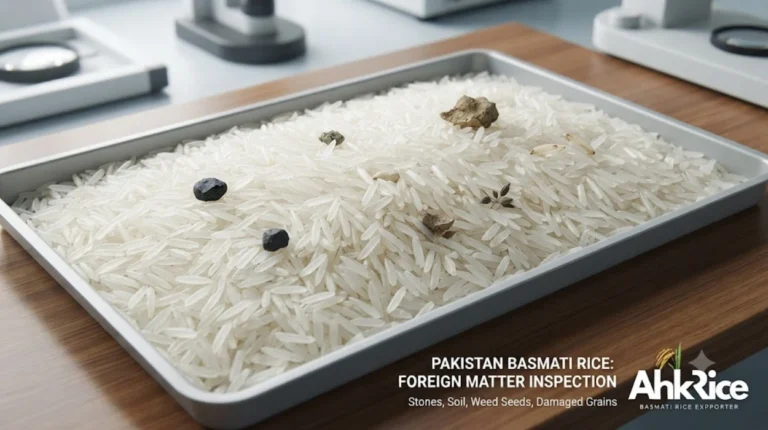
Modern optical sorting machines remove damaged kernels, chalky grains, immature rice, and foreign materials.
Laboratory testing
Every export batch undergoes quality analysis before packing.
Packaging
Rice is packed according to buyer specifications using:
- 1 kg retail bags
- 5 kg bags
- 10 kg bags
- 20 kg bags
- 25 kg bags
- 40 kg bags
- 50 kg export bags
Export logistics
Containers are sealed, inspected, documented, and transported to Pakistani ports for international shipment.
What factors determine Pakistan’s export supply?
Rice production volume, cultivated acreage, weather conditions, irrigation availability, milling capacity, export demand, government trade policies, and international freight schedules collectively determine the annual export availability of 1121 Sella Basmati Rice.
Supply begins with agricultural production.
An increase in cultivated acreage directly increases available paddy for processing. Good rainfall combined with efficient canal irrigation improves yield per hectare.
Modern milling capacity also influences export availability. Pakistan has invested heavily in automated rice processing plants equipped with high-capacity dryers, colour sorters, grading machines, and packaging lines. These facilities allow exporters to process large volumes continuously during the export season.
International demand also shapes supply allocation. Markets with established long-term contracts receive regular shipments throughout the year.
Storage infrastructure also contributes to stable exports. Proper warehouse management maintains grain quality while ensuring continuous availability between harvest seasons.
What quality grades are available for 1121 Sella Basmati Rice?
Pakistan exports several commercial grades of 1121 Sella Basmati Rice based on grain length, broken percentage, colour consistency, milling quality, and customer specifications required by different international food markets.
Quality grading helps buyers choose rice according to intended applications.
Premium Grade
- Extra-long kernels
- Minimal broken grains
- Uniform colour
- High cooking elongation
Sortex Grade
- Machine colour sorted
- Consistent appearance
- Suitable for supermarkets
- Export standard quality
Double Sortex Grade
- Additional optical sorting
- Higher visual purity
- Reduced defective kernels
- Premium retail markets
Steam Sella Grade
Parboiled using controlled steaming while preserving kernel strength.
Golden Sella Grade
Processed through traditional parboiling to produce a natural golden colour.
Creamy Sella Grade
Processed using specialised drying conditions that produce a lighter creamy appearance preferred in several international markets.
Different buyers specify acceptable limits for:
- Broken percentage
- Moisture
- Foreign matter
- Chalkiness
- Damaged grains
- Grain length
Which countries import Pakistani 1121 Sella Basmati Rice?
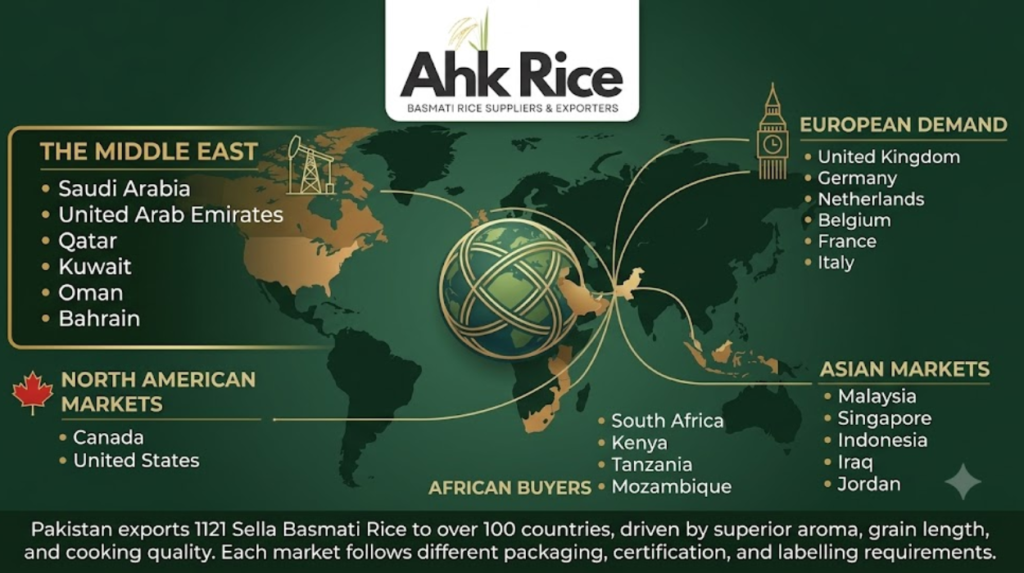
Pakistan exports 1121 Sella Basmati Rice to more than 100 countries, with strong demand from Gulf countries, Europe, North America, Africa, Central Asia, and Southeast Asia because of its aroma, grain length, and cooking quality.
The Middle East remains Pakistan’s largest regional market.
Major importing countries include:
- Saudi Arabia
- United Arab Emirates
- Qatar
- Kuwait
- Oman
- Bahrain
European demand includes:
- United Kingdom
- Germany
- Netherlands
- Belgium
- France
- Italy
North American markets include:
- Canada
- United States
African buyers include:
- South Africa
- Kenya
- Tanzania
- Mozambique
Asian markets include:
- Malaysia
- Singapore
- Indonesia
- Iraq
- Jordan
Each market follows different packaging, certification, and labelling requirements.
What certifications apply to Pakistani 1121 Sella Basmati Rice exports?
International rice exports require recognised food safety, quality management, phytosanitary, and regulatory certifications that verify product safety, traceability, processing standards, and compliance with destination-country import regulations.
Certification requirements differ between countries, but common export documents include internationally recognised standards.
Food safety certifications
Common certifications include:
- ISO 22000
- HACCP
- BRCGS Food Safety
- FSSC 22000
Quality management
Many exporters operate under:
- ISO 9001 Quality Management
Agricultural compliance
Depending on customer requirements, exporters also work with:
- GlobalG.A.P. supply chains
- SMETA ethical audits
- Sedex compliance
Government export documentation
Every shipment generally includes:
- Phytosanitary Certificate
- Certificate of Origin
- Fumigation Certificate (when required)
- Packing List
- Commercial Invoice
- Bill of Lading
- Health Certificate where applicable
These documents facilitate customs clearance and regulatory inspections.
What are the advantages of Pakistan’s large supply capacity?
Large-scale production enables year-round exports, stable procurement, flexible packaging, multiple container quantities, consistent quality grading, and dependable fulfilment of wholesale orders across different international food distribution channels.
A strong national supply chain benefits both importers and distributors.
Large inventories support continuous exports after harvest.
Modern processing facilities maintain consistent grading standards.
Multiple packaging options support wholesalers, retailers, distributors, food manufacturers, restaurants, and private-label brands.
Exporters also accommodate different container configurations, including 20-foot and 40-foot containers, according to shipment requirements.
Consistent production volumes improve planning for international food supply chains.
What are common misconceptions about Pakistan’s 1121 Sella Basmati Rice supply?
Many buyers assume supply depends only on harvest size, but processing capacity, storage infrastructure, export planning, quality grading, logistics coordination, and international compliance determine actual export availability throughout the year.
One misconception is that exports stop after harvest.
In reality, professionally stored paddy and processed rice allow exports to continue throughout the year.
Another misconception is that every shipment has identical specifications.
Export contracts define detailed quality parameters including grain length, moisture content, broken percentage, and packaging.
Some buyers also believe all Sella rice is identical.
Pakistan produces several commercial Sella categories, including Golden Sella, Steam Sella, and Creamy Sella, each serving different culinary preferences and market requirements.
Another misunderstanding is that packaging remains standard.
International buyers request customised retail, wholesale, and private-label packaging according to destination regulations.
Readers interested in understanding how exporters maintain consistency from laboratory testing to shipment scheduling can continue with the article on:
Quality assurance procedures and delivery planning for international buyers:
Frequently Asked Questions
How much 1121 Sella Basmati Rice does Pakistan supply each year?
Pakistan supplies hundreds of thousands of metric tonnes of 1121 Sella Basmati Rice annually, supported by large-scale cultivation in Punjab, advanced processing facilities, and established export networks serving over 100 countries.
Where is 1121 Sella Basmati Rice grown in Pakistan?
1121 Sella Basmati Rice is primarily grown in Punjab, particularly in districts such as Gujranwala, Hafizabad, Sheikhupura, Narowal, Sialkot, Mandi Bahauddin, Okara, and Pakpattan, where climate and soil conditions are ideal for Basmati cultivation.
What is the difference between Golden Sella, Creamy Sella, and Steam Sella Rice?
The difference lies in the parboiling and drying process. Golden Sella has a golden appearance, Creamy Sella has a lighter creamy colour, and Steam Sella is processed with controlled steaming to preserve grain strength and cooking quality.
Which countries import Pakistani 1121 Sella Basmati Rice?
Major importers include Saudi Arabia, the UAE, Qatar, Kuwait, Oman, the United Kingdom, Germany, Canada, the United States, South Africa, Malaysia, Singapore, Iraq, and several other international markets.
What certifications are commonly required for exporting 1121 Sella Basmati Rice?
Export shipments commonly comply with certifications and documentation such as ISO 22000, HACCP, BRCGS Food Safety, FSSC 22000, ISO 9001, Phytosanitary Certificate, Certificate of Origin, and Fumigation Certificate when required.
How is 1121 Sella Basmati Rice processed before export?
The rice is cleaned, soaked, steamed, dried, milled, polished, graded, colour sorted, laboratory tested, packaged according to buyer requirements, and prepared with export documentation before shipment.
What quality grades are available for 1121 Sella Basmati Rice?
Common export grades include Premium Grade, Sortex Grade, Double Sortex Grade, Golden Sella, Creamy Sella, and Steam Sella, with specifications based on grain length, broken percentage, moisture, and colour consistency.
Why is Pakistan one of the leading suppliers of 1121 Sella Basmati Rice?
Pakistan benefits from fertile agricultural land, favourable growing conditions, experienced farmers, advanced rice mills, modern quality control systems, and strong export infrastructure that supports consistent global supply.