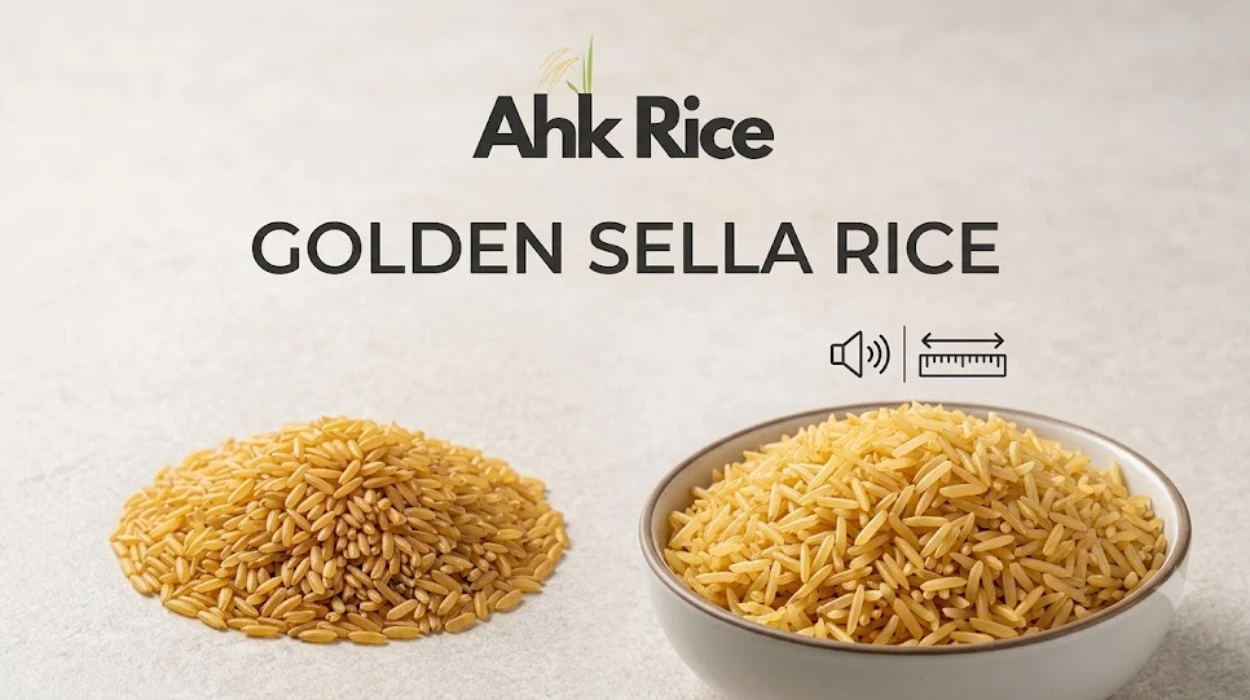
Comparing Cooking Yield and Grain Elongation of Golden Sella Rice
Cooking yield and grain elongation determine whether 1121 Golden Sella Basmati Rice delivers maximum value in commercial kitchens. Buyers serving restaurants, hotels, caterers, and institutional foodservice achieve better profitability when they evaluate both characteristics together rather than relying only on grain length or purchase price.
Foodservice operators purchasing Golden Sella rice usually begin by understanding why this variety has become a preferred choice for commercial cooking. The guide on:
Why professional kitchens prefer premium Golden Sella Basmati rice for consistent service explains the production process, grain characteristics, and export standards before comparing performance in commercial applications.
Among premium Pakistani rice varieties, 1121 Golden Sella Basmati Rice is recognized for combining exceptional grain elongation with high cooking yield. Processors such as AHK Rice, a Pakistani Basmati rice exporter based in Punjab, produce this variety through controlled parboiling, precision milling, grading, and export-quality packaging for international markets.
Cooking yield refers to the increase in cooked rice volume and weight after boiling or steaming. Grain elongation measures how much each grain increases in length during cooking while maintaining its shape. Together, these two performance indicators influence food cost, presentation, customer satisfaction, and kitchen efficiency.
What is the difference between cooking yield and grain elongation?
Cooking yield measures how much cooked rice is produced from one kilogram of raw rice, while grain elongation measures how much each grain increases in length after cooking. Commercial buyers evaluate both factors together because they directly influence portion cost, serving consistency, and visual presentation.
Although these terms are often mentioned together, they measure different performance characteristics.
Cooking yield focuses on volume and weight. Restaurants purchase rice by weight but serve it by volume. Higher cooking yield means more plates can be served from the same raw material.
Grain elongation focuses on appearance. Premium Basmati grains become noticeably longer after cooking without becoming sticky or breaking. Long, separate grains create an attractive presentation that customers associate with premium rice.
Typical performance of export-grade Pakistani 1121 Golden Sella Rice under standardized cooking conditions in 2026 includes:
| Specification | 1121 Golden Sella Rice |
|---|---|
| Average raw grain length | 8.2–8.5 mm |
| Cooked grain length | 17–21 mm |
| Grain elongation ratio | 2.0–2.5× |
| Water absorption | Moderate to high |
| Cooking yield | 2.8–3.2 kg cooked rice from 1 kg raw |
| Broken percentage | 1–5% export grades |
| Grain separation | Excellent |
The cooking process influences both measurements. Water quality, soaking time, cooking method, and resting time all contribute to final performance.
Commercial kitchens therefore standardize recipes to ensure every batch produces consistent results.
How do different cooking approaches compare for Golden Sella Rice?
Different cooking methods produce different levels of grain elongation and cooking yield. Steam cooking provides the most consistent commercial results, absorption cooking balances efficiency with quality, while pressure cooking maximizes speed but slightly reduces grain appearance and elongation.
Professional kitchens generally choose among three preparation methods.
Method 1: Steam Cooking
Steam cooking allows grains to expand gradually.
The controlled heating preserves grain structure and minimizes breakage. Restaurants specializing in biryani and premium rice dishes commonly use this method because every grain remains separate.
Advantages include:
- Maximum elongation
- Uniform cooking
- Low breakage
- Excellent presentation
The disadvantage is longer preparation time.
Method 2: Absorption Method
The absorption method cooks rice using a measured amount of water until fully absorbed.
This approach provides reliable cooking yield while reducing labor.
Many hotels and catering businesses prefer this method because recipes can be standardized across multiple kitchen locations.
Advantages include:
- Consistent yield
- Less supervision
- Good grain separation
- Lower water waste
Improper water ratios reduce elongation.
Method 3: Pressure Cooking
Pressure cooking significantly shortens cooking time.
Institutional kitchens serving thousands of meals daily often use this method because production speed becomes the primary objective.
Advantages include:
- Fast preparation
- High production capacity
- Lower energy consumption
The main drawback is reduced grain elongation compared with steaming.
How do cooking methods compare for commercial performance?
Each cooking method balances appearance, production speed, operating cost, and yield differently. Premium restaurants prioritize grain elongation through steam cooking, while institutional kitchens usually prioritize speed and production efficiency through automated or pressure-based systems.
The comparison below summarizes commercial performance.
| Attribute | Steam Cooking | Absorption Method | Pressure Cooking |
|---|---|---|---|
| Grain elongation | Excellent | Very Good | Good |
| Cooking yield | Excellent | Excellent | Very Good |
| Cooking speed | Moderate | Moderate | Fast |
| Grain separation | Excellent | Very Good | Good |
| Labor requirement | Medium | Low | Low |
| Energy efficiency | Moderate | Good | Excellent |
| Best application | Premium restaurants | Hotels & catering | Institutions |
Each solution fits a different operational requirement rather than replacing another completely.
Which solution works best for different foodservice operations?
The most suitable cooking approach depends on customer expectations, serving volume, kitchen equipment, and menu positioning. Premium dining emphasizes appearance, while high-volume operations prioritize consistency, efficiency, and predictable food cost without compromising acceptable grain quality.
Commercial buyers rarely evaluate rice independently from their operational model.
Premium Restaurants
Presentation carries significant value.
Chefs select export-grade 1121 Golden Sella Rice because elongated grains improve the visual appeal of biryani, pulao, mandi, and kabsa.
Steam cooking produces the best results.
Hotels
Hotels require consistency across breakfast, lunch, banquet, and buffet services.
Absorption cooking provides repeatable quality while maintaining strong cooking yield.
Catering Companies
Caterers prepare hundreds or thousands of servings simultaneously.
Predictable yield helps estimate food costs accurately.
Absorption cooking usually offers the best balance.
Institutional Kitchens
Universities, hospitals, factories, and military kitchens prioritize production speed.
Pressure cooking reduces preparation time while maintaining acceptable quality.
Frozen Meal Manufacturers
Manufacturers require grains that maintain structure after freezing and reheating.
Golden Sella performs well because parboiling strengthens grain integrity before milling.
Which export grades are preferred across different markets?
Different international markets prioritize different quality grades based on consumer expectations, menu style, and pricing strategies. Premium foodservice buyers generally select low-broken export grades, while value-focused distributors often choose commercial grades with similar cooking performance at lower cost.
Market preferences continue evolving in 2026.
United States
Foodservice distributors serving restaurants typically prefer:
- 1121 Golden Sella
- Extra Long Grain
- 1–2% Broken
- Premium export grading
Restaurants value long grain presentation and consistent plate appearance.
Middle East (Saudi Arabia, UAE, Qatar, Kuwait)
Large hospitality groups commonly purchase:
- 1121 Golden Sella
- 5% Broken
- Premium or Standard Export Grade
The emphasis remains on serving traditional rice dishes requiring separate elongated grains.
Market Comparison
| Market | Preferred Grade | Primary Priority |
|---|---|---|
| USA | Premium 1121 Golden Sella (1–2% Broken) | Grain appearance |
| Middle East | Premium 1121 Golden Sella (5% Broken) | Elongation and aroma |
These preferences influence procurement decisions more than simple purchase price.
How do price and shelf life compare across export grades?
Price differences between export grades mainly reflect grain uniformity, broken percentage, sorting accuracy, and packaging specifications rather than cooking yield alone. Proper storage maintains export-quality Golden Sella Rice for up to two years under recommended warehouse conditions.
Indicative 2026 export pricing varies according to crop conditions, freight costs, packaging, and order quantity.
| Grade | Typical Export Price (USD/MT) | Shelf Life |
|---|---|---|
| Premium 1–2% Broken | 1,250–1,420 | Up to 24 months |
| Premium 5% Broken | 1,180–1,320 | Up to 24 months |
| Commercial Grade | 1,050–1,180 | Up to 24 months |
Shelf life assumes:
- Moisture below export specifications
- Dry storage
- Protected packaging
- Controlled warehouse temperature
- Proper pallet stacking
Quality remains stable because parboiling improves grain durability during storage.
What are the advantages and disadvantages of Golden Sella Rice?
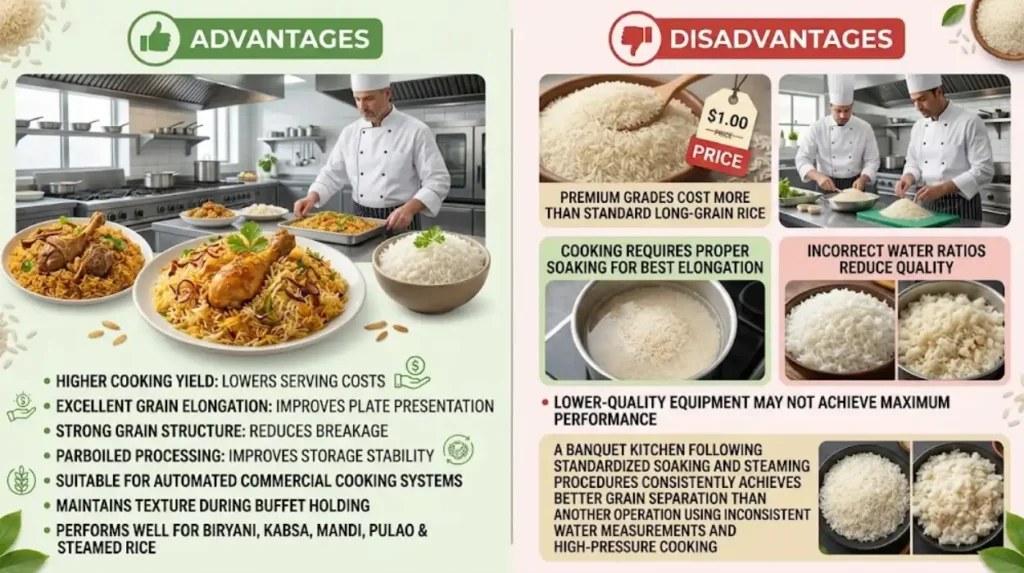
Golden Sella Rice delivers superior cooking performance, excellent grain appearance, and reliable commercial yield, but buyers must also consider longer cooking times, premium pricing, and the importance of standardized preparation methods to achieve consistent results.
Advantages
Higher cooking yield lowers serving costs.
Excellent grain elongation improves plate presentation.
Strong grain structure reduces breakage.
Parboiled processing improves storage stability.
Suitable for automated commercial cooking systems.
Maintains texture during buffet holding.
Performs well for biryani, kabsa, mandi, pulao, and steamed rice.
Disadvantages
Premium grades cost more than standard long-grain rice.
Cooking requires proper soaking for best elongation.
Incorrect water ratios reduce quality.
Lower-quality equipment may not achieve maximum performance.
For example, a banquet kitchen following standardized soaking and steaming procedures consistently achieves better grain separation than another operation using inconsistent water measurements and high-pressure cooking.
Which decision factors should buyers evaluate before selecting Golden Sella Rice?
Commercial buyers should evaluate operational requirements instead of focusing only on purchase price. Cooking yield, grain appearance, consistency, storage conditions, customer expectations, and supplier quality assurance collectively determine long-term purchasing value.
The following framework simplifies procurement decisions.
| Decision Factor | Premium Restaurant | Hotel | Caterer | Institution | Food Manufacturer |
|---|---|---|---|---|---|
| Grain appearance | Highest priority | High | Medium | Medium | Medium |
| Cooking yield | High | High | Highest | Highest | High |
| Speed | Medium | High | High | Highest | High |
| Cost efficiency | Medium | High | Highest | Highest | High |
| Best cooking method | Steam | Absorption | Absorption | Pressure | Automated systems |
Selecting the right combination of rice grade and cooking method produces better operational outcomes than optimizing either factor independently.
How should buyers compare suppliers before making a purchasing decision?
Supplier evaluation should focus on measurable quality standards, production capability, export documentation, and consistency instead of marketing claims. Reliable exporters provide standardized grading, laboratory testing, traceability, and customized packaging suitable for destination markets.
Professional buyers typically compare suppliers using measurable criteria.
Production facilities should maintain controlled processing from paddy cleaning through grading, color sorting, polishing, packaging, and container loading.
Quality reports should include moisture content, broken percentage, grain length, purity, and inspection documentation.
Packaging options should support wholesale distribution, retail sales, and foodservice operations.
Export capability should include documentation, fumigation where required, phytosanitary compliance, and destination-specific labeling.
Companies such as AHK Rice integrate processing, grading, packaging, and export logistics to supply international buyers with standardized 1121 Golden Sella, Super Kernel, and 1509 Basmati varieties. Buyers ready to compare supplier capabilities and procurement specifications can continue with the guide on:
Importing premium 1121 Golden Sella Rice from Pakistan for commercial foodservice operations, which focuses on supplier evaluation, ordering, packaging, and export purchasing decisions.
Frequently Asked Questions
Does higher grain elongation always mean better rice quality?
Not always. Higher grain elongation improves presentation, but overall quality also depends on aroma, grain purity, cooking yield, moisture content, and the percentage of broken grains.
Why is cooking yield important for foodservice buyers?
Cooking yield determines how many servings can be produced from one kilogram of raw rice, directly affecting food cost, portion consistency, and profitability.
Which cooking method produces the best grain elongation?
Steam cooking generally produces the longest and most separate grains because it allows gradual water absorption while minimizing grain breakage.
Can soaking Golden Sella Rice improve cooking performance?
Yes. Soaking the rice for 20–30 minutes before cooking helps achieve more uniform grain elongation, better texture, and consistent cooking results.
Which cooking method is best for restaurants?
Steam cooking is ideal for premium restaurants because it maximizes grain elongation, preserves grain structure, and creates an attractive presentation.
Is pressure cooking suitable for commercial kitchens?
Yes. Pressure cooking is suitable for high-volume institutional kitchens where speed is more important than achieving maximum grain elongation.
Which export grade is most popular in the USA?
Premium 1121 Golden Sella Rice with 1–2% broken grains is commonly preferred by USA foodservice distributors due to its long grain appearance and consistent cooking performance.
Why do Middle Eastern buyers prefer 5% broken grades?
Many Middle Eastern importers choose 5% broken grades because they offer an excellent balance between premium cooking performance and competitive pricing.
How long can Golden Sella Rice be stored?
When stored in a cool, dry warehouse with proper packaging, Golden Sella Rice typically maintains its quality for up to 24 months.
What factors influence the export price of Golden Sella Rice?
Export prices vary based on grain length, broken percentage, crop quality, packaging requirements, destination market, order volume, and freight costs.
What are the main advantages of 1121 Golden Sella Rice?
Its key advantages include excellent grain elongation, high cooking yield, low breakage, strong grain separation, long shelf life, and suitability for commercial kitchens.
Are there any disadvantages to Golden Sella Rice?
It generally has a higher purchase price than standard long-grain rice and requires correct soaking and cooking methods to achieve its best performance.
What should buyers consider when selecting a Golden Sella Rice supplier?
Buyers should evaluate quality certifications, grain specifications, processing standards, export experience, packaging options, production capacity, and documentation compliance.
Why is grain consistency important for commercial buyers?
Consistent grain size and quality ensure predictable cooking results, standardized portions, improved customer satisfaction, and reduced food waste across every batch.