Container Loading, Palletizing and Fumigation for Rice Shipments to Indonesia
For Indonesian rice importers, container loading with controlled palletizing and documented fumigation provides the strongest balance of cargo protection, container utilization, hygiene control, and shipment traceability; loose loading suits maximum weight efficiency, while palletized loading suits retail-ready and higher-handling cargo.
What are the available solutions for loading Pakistani Basmati rice into Indonesia?
Rice containers for Indonesia generally use loose bag loading, palletized loading, or a hybrid configuration, with fumigation selected according to the cargo, packaging, container condition, and applicable import requirements. The best method starts with the product specification and destination handling system.
Container loading is the final physical stage before a rice shipment leaves the export facility. The process connects the approved rice specification with the actual cargo placed inside the container. For Pakistani Basmati exports, this means checking bags, batch identity, packaging condition, container cleanliness, moisture protection, loading sequence, seals, and shipping documents before departure.
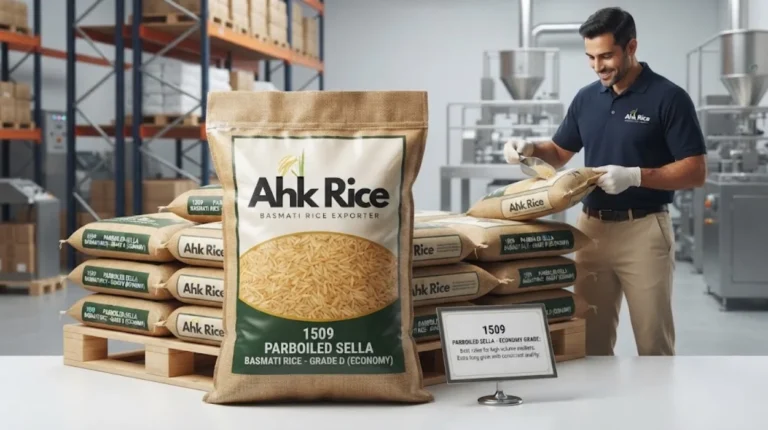
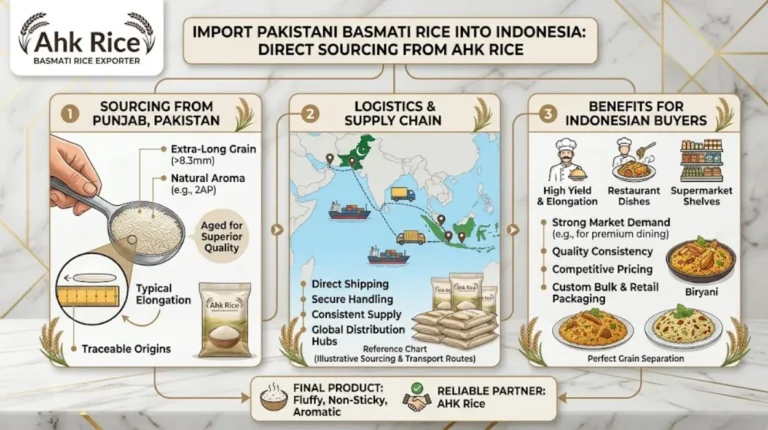
AHK Rice operates an integrated export process covering sourcing, processing, grading, packaging, container preparation and shipment coordination for Indonesian buyers. Its Indonesia export service covers Pakistani Basmati varieties including 1121, Super Kernel, and 1509 Basmati rice.
Indonesian buyers evaluating container capacity can also distinguish between net rice weight and the physical arrangement of bags. A 20-foot container can carry around 25 MT under AHK Rice’s stated Indonesia shipment model, but the final payload depends on packaging, container limits, loading configuration and the shipping line’s restrictions.
Loose loading
Loose loading places individual rice bags directly inside the container. Workers arrange the bags in tight layers to use available cubic space efficiently. This method reduces pallet weight and eliminates pallet purchase, wrapping and handling requirements.
It works particularly well for large 25 kg, 40 kg or 50 kg commercial bags moving through established wholesale distribution networks. The importer receives the container, unloads the bags and transfers them into warehouse storage.
Palletized loading
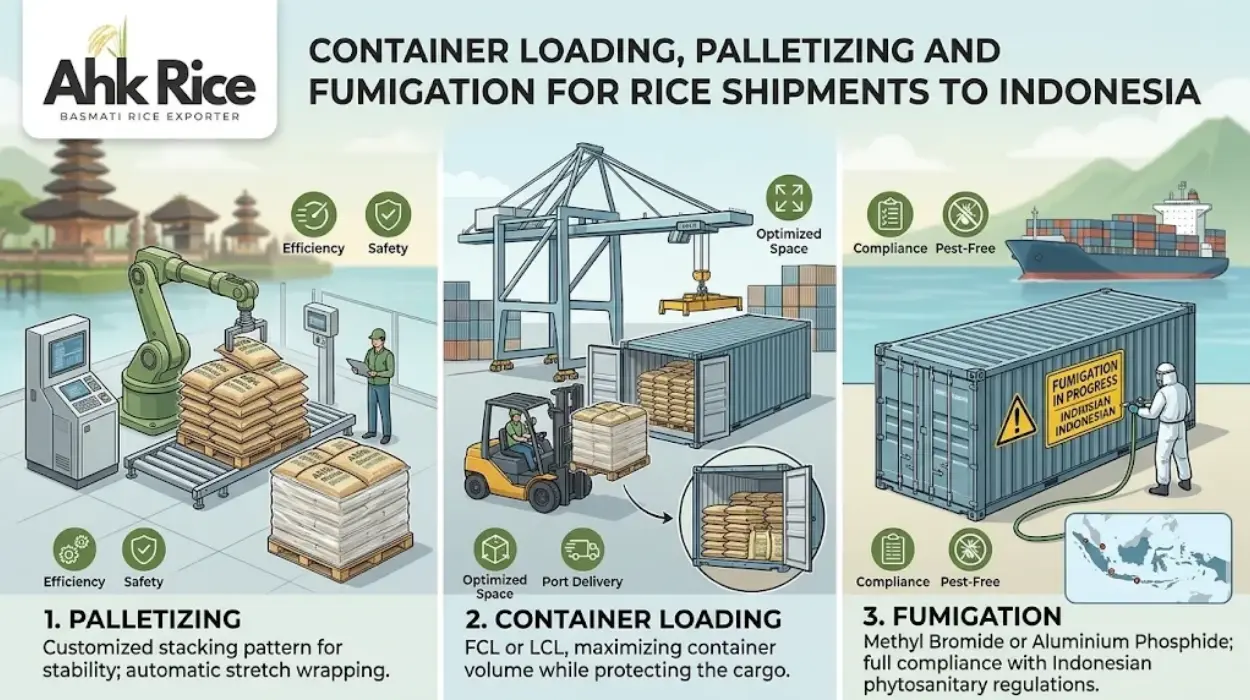
Palletized loading places rice bags or cartons onto pallets before container loading. The completed pallet becomes a single handling unit. Forklifts or pallet trucks can move the cargo more efficiently after arrival.
This method suits supermarket distribution, private-label programs and warehouses that already operate pallet-based handling systems. It also creates a more standardized cargo arrangement, although pallets consume container space and add material and handling costs.
Hybrid loading
Hybrid loading combines palletized and loose cargo. For example, retail-ready cartons can occupy pallets while bulk bags are loaded separately. This method works when one container serves several distribution channels.
The important control is not simply choosing the cheapest loading method. The loading plan must match the bag format, warehouse equipment, destination handling process, container dimensions, maximum payload and commercial delivery requirements.
How do different rice container loading approaches compare?
Loose loading maximizes usable cargo weight and minimizes handling materials, palletized loading improves warehouse handling and cargo organization, while hybrid loading provides flexibility for mixed distribution models. Indonesian importers should compare the three against bag size, destination warehouse, product value and unloading equipment.
| Attribute | Loose Loading | Palletized Loading | Hybrid Loading |
|---|---|---|---|
| Container utilization | Highest | Lower because pallets occupy space | Medium |
| Handling speed | Medium | High with forklifts | High for selected cargo |
| Material cost | Low | Higher | Medium |
| Warehouse efficiency | Medium | High | High |
| Cargo organization | Medium | High | High |
| Retail/private label suitability | Medium | High | High |
| Best application | Bulk wholesale | Retail/distribution | Mixed channels |
The comparison becomes more important when an importer purchases several grades. 1121 Basmati, Super Kernel, and 1509 Basmati can serve different customer segments. Combining them in one container requires clear segregation by product, bag type, batch and documentation.
A mixed-grade shipment should never depend on visual identification alone. Each product unit should carry a clear lot or batch reference. The loading plan should record the position of each grade inside the container. This makes unloading and stock control easier at the Indonesian warehouse.
For a broader explanation of container capacity, payload planning and the factors that affect how much rice fits into an export container, buyers should review the Basmati rice container capacity guide before finalizing a loading plan. This educational step helps separate theoretical container capacity from the practical payload available under the selected packaging and shipment conditions.
Which loading method works best for different Indonesian markets?
Loose loading works best for Indonesian wholesalers and foodservice buyers handling bulk 25–50 kg bags, palletized loading fits retail and private-label distribution, and hybrid loading suits importers combining retail packs with commercial bags in the same container.
Indonesia has several distinct distribution environments. Jakarta and surrounding commercial markets support large-scale retail, wholesale and foodservice activity. Surabaya serves as another important commercial and logistics gateway, while other destinations require additional inland movement after port clearance.
Jakarta and Greater Jakarta
Premium retail and private-label buyers often prioritize organized warehouse handling. 1121 Basmati fits premium retail and foodservice positioning because of its long grain and aromatic profile. Palletized 5 kg, 10 kg or carton-based packaging can simplify movement through modern distribution facilities.
Bulk distributors can still use loose loading where their warehouses have manual unloading capacity. The decision therefore depends more on the warehouse system than on the Basmati variety itself.
Surabaya and wider East Java distribution
Surabaya-based importers frequently manage broader regional distribution. 1509 Basmati can suit buyers seeking a competitive bulk specification, while Super Kernel provides a strong aromatic Basmati option for wholesalers and South Asian food channels.
For larger commercial bags, loose loading remains efficient. For branded retail programs, palletized loading creates better unit control during warehouse transfer.
Foodservice and catering distribution
Foodservice buyers generally prioritize consistent cooking performance, bag durability and predictable replenishment. Golden Sella can suit catering applications requiring firm cooked grains and holding stability.
For this channel, 25 kg or 50 kg bags can be loaded loose when the receiving warehouse uses manual handling. Palletization becomes more valuable when the buyer operates forklifts and moves full units directly into storage.
How do price and shelf life compare between rice grades and loading strategies?
Rice price per metric tonne depends primarily on variety, processing, quality specification, packaging and commercial terms, while shelf life depends on moisture, packaging, storage conditions and processing; loading method changes logistics cost more than the intrinsic shelf life of the rice.
A useful comparison for Indonesian procurement is not simply “cheap versus expensive.” The importer should compare the FOB rice price, packaging cost, container utilization, freight allocation, handling expense and expected inventory period.
| Market application | Typical grade preference | Price position | Shelf-life planning |
|---|---|---|---|
| Premium retail | 1121 | Higher | Long storage requires controlled warehouse conditions |
| Aromatic wholesale | Super Kernel | Mid-to-premium | Controlled dry storage |
| Competitive bulk trade | 1509 | Competitive | Controlled dry storage |
| Catering | Golden Sella | Grade-dependent | Strong storage and cooking stability |
| Mixed distribution | Mixed grades | Blended | Separate batch and stock controls |
AHK Rice currently publishes an indicative reference of around US$1,100/MT FOB Karachi for certain Pakistan Basmati supply discussions, while final pricing changes according to variety, grade, quantity, packaging, season and specification. FOB Karachi is not an Indonesian landed price.
The practical price comparison should therefore use identical specifications. A US$1,100/MT 1121 offer cannot be directly compared with a lower-priced 1509 quotation if grain length, broken percentage, processing method, packaging and inspection requirements differ.
Shelf life also requires a controlled comparison. Rice is a dry food, but storage quality depends on moisture, temperature, humidity, packaging integrity and pest control. A properly packed and stored shipment maintains quality more effectively than cargo exposed to humidity or warehouse contamination.
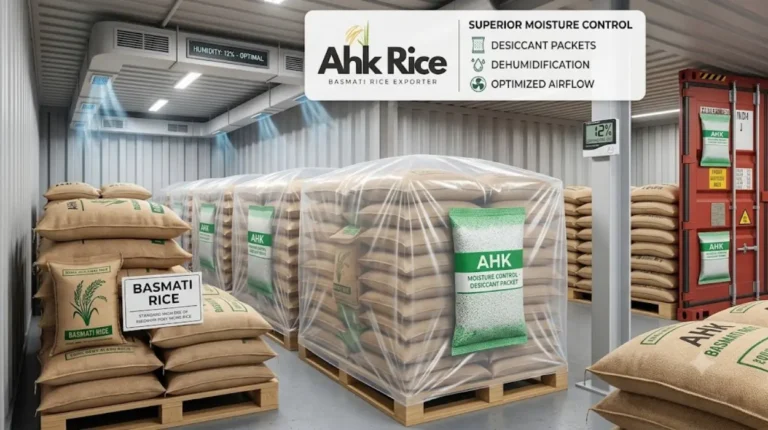
Pallets do not automatically increase rice shelf life. Their primary value is handling efficiency and separation from direct floor contact. Fumigation controls targeted pest risks according to the treatment protocol. It does not replace dry storage, sealed packaging, warehouse hygiene or temperature and humidity control.
What are the advantages and disadvantages of each container strategy?
Loose loading provides better payload efficiency but requires more manual unloading, palletized loading improves handling and organization but consumes container volume, and hybrid loading balances both methods when an importer distributes several packaging formats through different warehouse channels.
Loose loading: advantages and disadvantages
Loose loading provides strong container utilization because there is no pallet structure occupying cargo space. It also reduces pallet procurement and disposal costs.
The main disadvantage is unloading labor. Workers must remove individual bags from the container and transfer them into warehouse storage. A poorly organized load also increases handling time and the risk of bag damage.
For a wholesaler receiving 25–50 kg PP bags at a warehouse with manual labor, loose loading remains commercially practical.
Palletized loading: advantages and disadvantages
Palletization creates consistent handling units. A forklift can move an entire pallet from the container to the warehouse. This reduces manual handling and improves stock organization.
The trade-off is lower effective cargo volume. Pallets, wrapping materials and pallet handling equipment consume space and create additional costs.
For a private-label importer receiving branded 5 kg and 10 kg retail packs, these costs can be justified because warehouse efficiency becomes more important than maximum container payload.
Hybrid loading: advantages and disadvantages
Hybrid loading supports mixed commercial requirements. An importer can place palletized retail stock alongside loose-loaded bulk bags when the container plan supports both formats.
The disadvantage is greater loading complexity. Product segregation, batch identification and unloading instructions must be precise. A mixed container without a clear loading map creates avoidable warehouse problems.
What decision factors should Indonesian importers use before loading?
Indonesian importers should make the loading decision from five connected factors: product grade, packaging format, warehouse handling, fumigation and compliance requirements, and total landed cost rather than container weight alone.
| Decision factor | Question to answer | Preferred approach |
|---|---|---|
| Product grade | Is the cargo one grade or several? | Single-grade or clearly segregated mixed loading |
| Packaging | Are bags bulk or retail-ready? | Loose for bulk, palletized for retail |
| Warehouse | Is forklift handling available? | Palletized where mechanical handling exists |
| Compliance | What treatment and documents apply? | Confirm before loading and fumigation |
| Landed cost | Does higher payload offset handling savings? | Compare total cost per MT |
Product specification comes first. The importer should define variety, processing grade, grain length, broken percentage, moisture, packaging, quantity and destination before the container is loaded. AHK Rice’s published Indonesia supply process emphasizes specification approval, sample evaluation, packaging, documentation and container loading as connected stages rather than separate purchasing decisions.
Container inspection comes next. The container should be clean, dry, odor-free and structurally suitable for food cargo. Holes, water ingress, damaged flooring or contamination create risks before rice is loaded. The container number should also match the shipment records.
Palletizing must match the packaging. Retail cartons and smaller bags benefit from standardized pallet units. Heavy bulk bags can use loose loading where manual unloading is acceptable. Pallet wrapping must secure the load without compromising packaging integrity.
Fumigation must follow the agreed treatment and documentation process. Fumigation is a pest-control treatment applied according to the cargo and destination requirements. The importer should confirm the treatment provider, treatment certificate, applicable dosage or treatment parameters, timing and documentation before shipment. Fumigation does not replace sanitary loading practices.
Final inspection closes the process. The exporter should verify product identity, bag count, packaging condition, container number, seal number and loading records. A pre-shipment inspection can add another layer of verification when required by the commercial contract. AHK Rice states that independent inspections such as SGS can be arranged for buyers who require third-party verification.
What is the most practical solution for a mixed-grade Indonesia shipment?
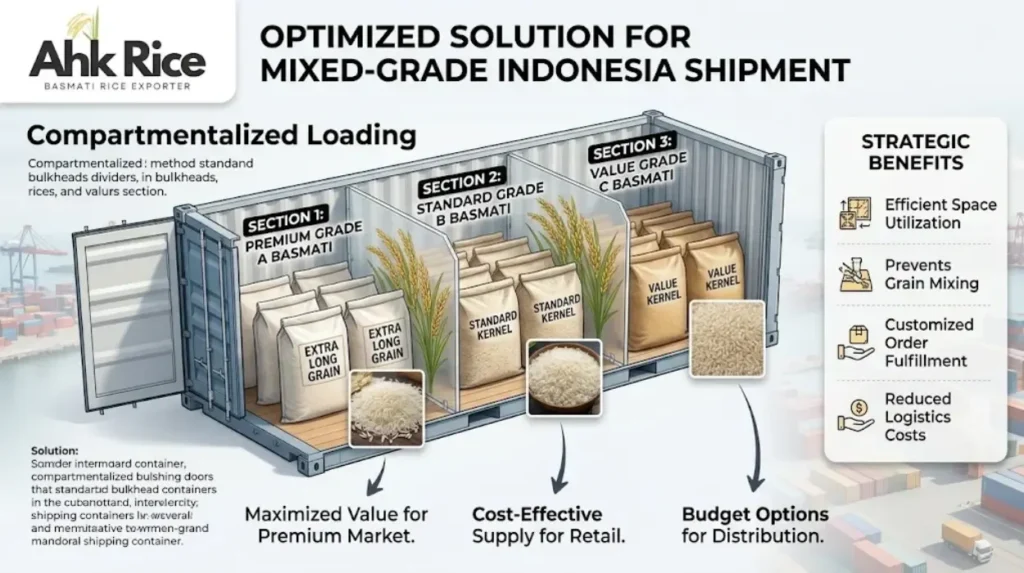
The most practical solution is a specification-controlled loading plan that separates each Basmati grade, uses packaging suited to its sales channel, applies the required fumigation procedure, records the container and seal details, and links every loaded batch to the approved commercial specification.
A mixed-grade container should be treated as several controlled cargo units inside one shipping unit. The importer should approve the product list before production. The exporter then prepares each grade according to its specification and packaging requirement.
For example, a container can contain 1121 for premium retail, Super Kernel for aromatic wholesale distribution and 1509 for price-sensitive bulk sales. Each grade requires clear identification. The loading map should show where each grade is positioned.
The commercial documents should identify the relevant quantities and packaging. The packing list should correspond with the actual container contents. The Bill of Lading should reflect the shipment information used for customs and logistics processing.
Fumigation documentation should also remain connected to the container rather than treated as an unrelated certificate. This creates a traceable record from finished rice to container dispatch.
AHK Rice’s current Indonesia information describes an integrated process covering sample approval, production, packaging, documentation, container loading and shipment. Its stated overall planning window is approximately four to six weeks from order confirmation, including production, documentation and sea transit.
The final commercial decision should therefore compare rice specification + packaging + loading + fumigation + documentation + freight + destination handling, not only the FOB price per metric tonne. This produces a more accurate landed-cost comparison between suppliers.
What should buyers check before approving the loaded container?
Before container release, buyers should confirm the approved rice specification, bag count, packaging condition, loading arrangement, fumigation documentation, container and seal numbers, inspection records, and shipping documents so the physical cargo matches the commercial contract.
The buyer should first confirm that the loaded grades match the approved sample. The next check is packaging. Bags must remain sealed and free from visible damage, contamination and moisture exposure.
The loading record should identify the container number and seal number. The packing list should match the physical cargo. Any mixed-grade arrangement should have a clear segregation record.
The buyer should also retain the relevant fumigation and inspection documents with the shipment file. These records support traceability if the importer needs to investigate a quality or cargo-handling issue after arrival.
This approach turns container loading into a measurable procurement control rather than a final warehouse task. It also supports repeat orders because the importer can compare actual shipment performance against the approved specification.
For Indonesian buyers comparing suppliers, the strongest purchasing model is therefore not simply the lowest-cost container. It is the supplier and loading system that produces consistent product identity, controlled handling, documented fumigation, efficient container utilization and predictable landed cost.
Where to insert the BOFU article link
Insert the BOFU link in the final section after the sentence discussing mixed-grade containers, immediately after explaining that buyers should compare rice specification, packaging, loading, fumigation and landed cost. Use a decision-focused anchor such as “order a mixed-grade Basmati container for Indonesia”. This placement moves readers naturally from evaluating loading methods to taking the next procurement step.
BOFU article: Order a Mixed-Grade Basmati Container for Indonesia from AHK Rice