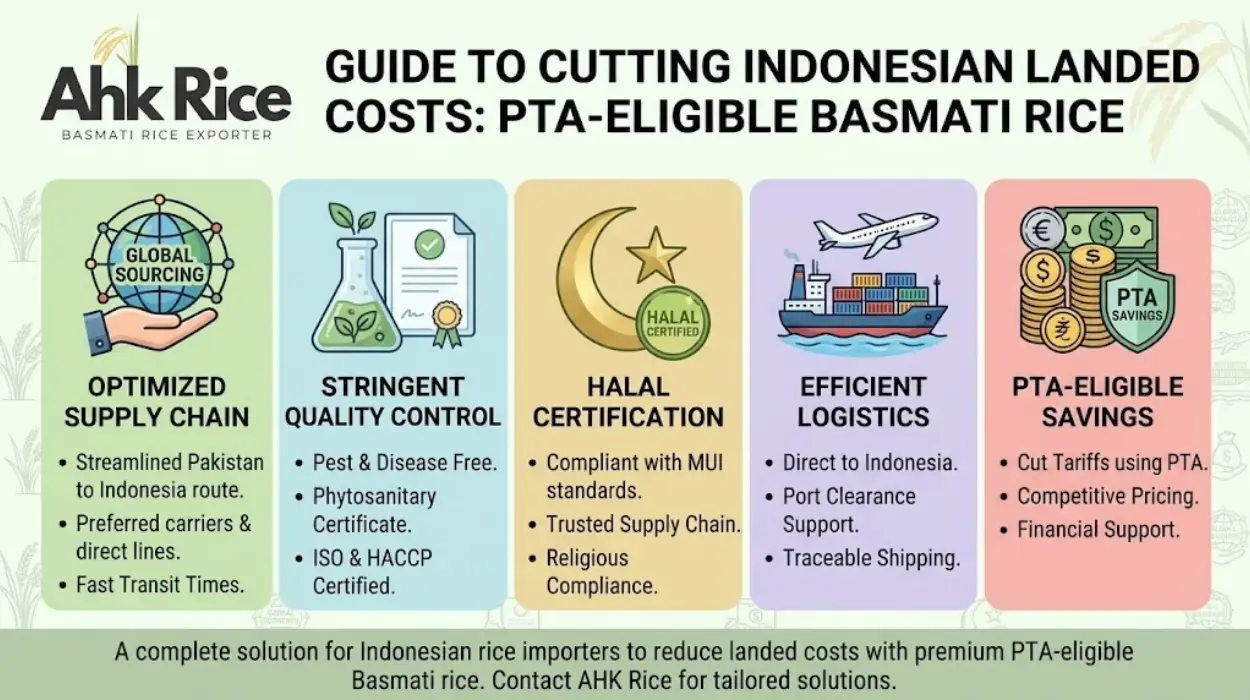
Cut Indonesian Landed Costs with PTA-Eligible Pakistani Basmati Rice from AHK Rice
For Indonesian importers, the lowest Basmati rice landed cost is not simply the lowest FOB quotation. The better decision combines eligible Pakistani origin, correct tariff treatment, compliant documentation, freight planning, and a grade that matches the selling channel. The Indonesia-Pakistan Preferential Trade Agreement (IP-PTA) provides preferential access for specified tariff lines, so importers should verify whether the exact Basmati rice classification and shipment qualify before calculating the final landed cost. Indonesia’s Ministry of Trade confirms that the IP-PTA has operated since 1 September 2013 and covers specified tariff lines rather than every product automatically.
For background on the tariff side, see what import duty applies to Basmati rice in Indonesia before comparing supplier quotations. The key commercial point is simple: a Pakistani rice quotation becomes more competitive when the importer can establish the correct origin, tariff eligibility, product classification, and supporting paperwork.
What is the best solution for reducing Pakistani Basmati rice landed cost in Indonesia?
The best solution is to combine PTA eligibility with disciplined sourcing, verified Pakistani origin, accurate HS classification, efficient packing, and freight planning so duty savings are preserved instead of being lost through documentation errors or excessive logistics costs.
A buyer should compare landed cost per metric tonne, not FOB price alone. The calculation should include the rice purchase price, export handling, ocean freight, insurance where applicable, Indonesian customs charges, import duty, taxes, port expenses, customs clearance, inland delivery, inspection and storage.
PTA eligibility is particularly important because the IP-PTA was designed to provide preferential tariff treatment for selected products. Indonesia’s Ministry of Trade states that the agreement covers 232 Indonesian tariff lines and 311 Pakistani tariff lines under its original tariff schedule. This means an importer cannot assume that every Pakistani Basmati shipment automatically receives a preferential rate.
The commercial solution is therefore a document-led purchase. Before confirming a container, the importer should establish the applicable Indonesian HS classification, confirm whether the tariff line is covered by the preferential arrangement, verify origin requirements, and ensure the required certificate of origin and commercial documents match the shipment.
This approach reduces the risk of paying a standard tariff when preferential treatment is available, while also preventing a shipment from being delayed because the supporting documents do not align.
Why choose AHK Rice for Indonesian Basmati rice imports?
AHK Rice gives Indonesian buyers a Pakistan-based sourcing route for Basmati rice with product selection, processing, custom packing, shipment preparation and export documentation coordinated around the buyer’s required grade and destination.
AHK Rice supplies Pakistani Basmati varieties including 1121, Super Kernel and 1509. The sourcing decision can therefore be based on the end market rather than on one generic rice specification.
For premium retail and foodservice buyers, 1121 and Super Kernel Basmati can provide the long-grain appearance and aromatic profile associated with premium Pakistani Basmati. For buyers focused more heavily on yield, volume and price positioning, 1509 offers a different commercial balance.
AHK Rice can also support custom packaging requirements. This matters when Indonesian distributors need private-label bags, retail formats or foodservice packing instead of generic bulk sacks.
The supplier selection process should begin with the specification rather than the brand name. A buyer should define grain variety, processing type, broken percentage, moisture target, packing size, quantity, destination port and required documentation. AHK Rice can then structure the quotation around the actual order profile.
This is also where AHK Rice’s Basmati rice export service fits the buying process. The objective is not simply to sell a container. It is to align product specification, documentation, packing and shipment preparation before the cargo leaves Pakistan.
What results can Indonesian importers expect?
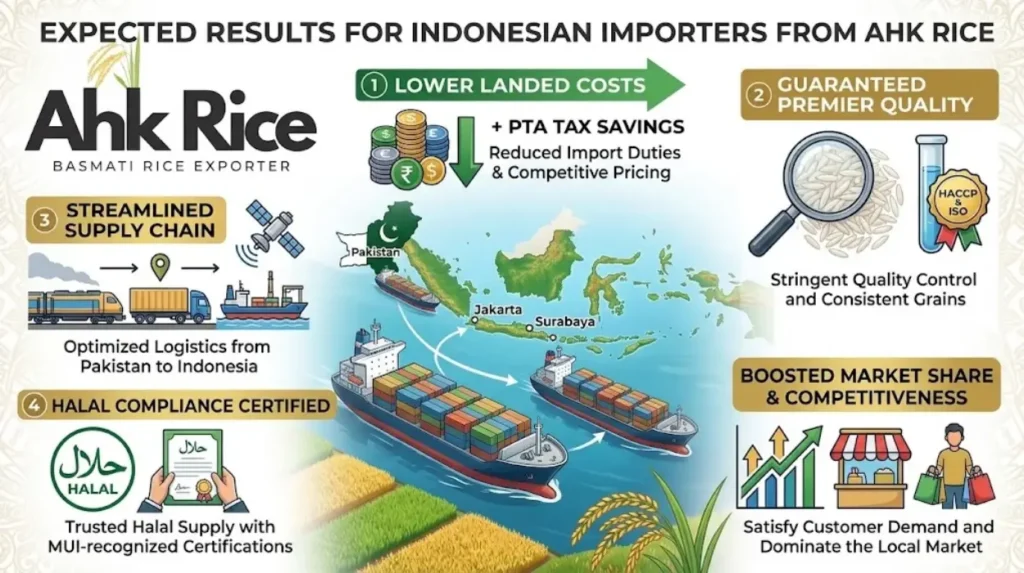
A well-planned Pakistani Basmati shipment can produce a more predictable landed-cost model by combining preferential tariff eligibility, controlled product specifications, optimized container utilization, and clear documentation before cargo reaches an Indonesian port.
Consider an Indonesian distributor importing one container for retail and wholesale sales. A low FOB quotation may initially appear attractive, but the advantage can disappear if the shipment requires costly repacking, generates customs delays, uses inefficient loading, or fails to obtain an expected preferential tariff treatment.
A stronger model starts with the target selling price in Indonesia. The buyer works backward through the acceptable landed cost, freight, duty, taxes, port charges and supplier price.
The same method applies to restaurant and catering supply. A foodservice buyer may prioritize a stable cooking profile, grain length and bulk packing rather than the lowest nominal FOB rate. A retail importer may instead prioritize appearance, packaging and consumer-facing grade consistency.
AHK Rice’s role is strongest when the buyer needs this specification-to-shipment connection. Product selection, sorting, packing and export preparation can be planned around the final market rather than handled as disconnected stages.
The buyer should also retain a clear shipment record. Commercial invoice, packing list, bill of lading, certificate of origin and other required export or import documents should identify the same product, quantity, origin and shipment details.
Indonesia’s IP-PTA framework specifically uses rules of origin to determine whether goods qualify for preferential treatment. Indonesia’s official IP-PTA guidance explains that origin certification is used to prove that exported goods meet the applicable rules of origin.
How does PTA eligibility affect the final price?
PTA eligibility can reduce the duty component of landed cost when the exact product qualifies, but the importer must verify the current Indonesian tariff line, preferential rate, origin requirement and required certificate before treating the duty saving as part of the purchase calculation.
The important distinction is between PTA eligibility and ordinary import duty. The former depends on the specific tariff line and origin rules under the agreement.
The Indonesia-Pakistan PTA was signed in 2012 and implemented from September 2013. Indonesia’s Ministry of Trade describes it as a preferential agreement covering selected tariff lines.
For this reason, a buyer should not use a generic statement such as “Pakistani rice has zero duty under PTA.” The correct approach is to verify the exact HS classification and current tariff treatment for the intended shipment.
For a practical comparison of the mechanism, use the Pakistan-Indonesia preferential trade agreement’s effect on rice import costs before placing the order.
The importer should also consider that Indonesian agricultural import regulations can change. Indonesia issued Permendag No. 11 of 2026, which amended rules covering imports of agricultural and livestock products and entered into force on 8 May 2026.
Therefore, the commercial quotation should identify assumptions clearly. Duty should not be presented as a permanent fixed percentage unless it has been verified for the exact product and shipment date.
Which cost factors should be included in the Indonesian landed price?
A realistic landed-cost calculation should include supplier price, Pakistan-side export costs, ocean freight, insurance where applicable, Indonesian customs duty or preferential duty, taxes, port charges, clearance, inland transport, inspection and storage.
| Cost factor | What the buyer should verify |
|---|---|
| Rice price | Variety, grade, crop, processing and quantity |
| Export preparation | Sorting, packing, documentation and container handling |
| Freight | Karachi-to-Indonesia ocean freight and sailing schedule |
| PTA treatment | Eligibility, HS code, origin and required certificate |
| Indonesian charges | Customs, taxes, port and clearance costs |
| Inland delivery | Port-to-warehouse transport |
| Storage | Demurrage, detention or warehouse charges |
| Packaging | Bulk, retail or private-label format |
Freight can materially change the result. A shipment to Jakarta, Surabaya or another Indonesian destination should be quoted against the actual discharge port and delivery requirement.
Packing also affects cost. A buyer importing large quantities for repacking may prefer bulk bags. A retail distributor may benefit from ready-to-sell packaging despite a higher packaging cost because it reduces local handling.
Container utilization matters as well. The objective is not simply to fill the container. The cargo must be loaded safely while meeting product, packaging and weight requirements.
AHK Rice can structure quotations around these variables rather than providing a disconnected FOB number. That makes supplier comparisons more useful because the buyer can compare the same specification and shipment assumptions.
What Pakistani Basmati grade should Indonesian buyers choose?
Choose 1121 or Super Kernel for premium retail and foodservice positioning, while 1509 is suitable when the commercial objective emphasizes efficient sourcing, volume requirements and competitive pricing rather than maximum premium positioning.
A premium supermarket or specialty distributor may prioritize long grain, aroma and visual appearance. In that case, 1121 or Super Kernel can fit the positioning.
A restaurant group may focus more heavily on cooking performance, consistency, pack size and repeat supply. The preferred grade should therefore be tested in the buyer’s own kitchen before a large purchase.
1509 can be attractive for buyers seeking a different cost-performance balance. Its shorter crop cycle and high-yield characteristics support its commercial use in bulk markets.
Processing also matters. Steam and Sella products serve different commercial requirements. Golden Sella can be relevant for catering, banquets and buyers who prefer parboiled rice characteristics, while Steam Basmati provides a more conventional white-rice presentation.
The correct choice depends on the Indonesian sales channel. AHK Rice can provide the specification needed for commercial sample testing before the buyer commits to a full container.
How does the sample-to-shipment process work?
The sample process should confirm grade, cooking performance, packaging and documentation requirements before bulk production, with courier, sample preparation and any applicable inspection or phytosanitary costs agreed before dispatch.
A practical workflow starts with the buyer’s required specification. The buyer states the variety, processing type, grain requirements, packaging, quantity and destination.
AHK Rice then prepares the commercial sample. For buyers evaluating premium Basmati, the sample should be tested for appearance, aroma, grain separation, elongation and cooking consistency.
The buyer conducts the cooking test in Indonesia. If the result meets the commercial requirement, the buyer confirms the specification and packaging.
Sample courier charges are normally handled separately from the rice order. Any applicable phytosanitary or inspection-related cost should also be confirmed before dispatch because requirements can vary by shipment and destination.
After approval, AHK Rice prepares the bulk order against the approved specification. The production and packing stage should match the accepted sample rather than introducing an unapproved grade substitution.
For a first shipment, this sample-to-order process is especially useful. It reduces the commercial risk of purchasing a full container based only on photographs, specifications or a supplier quotation.
How many days does shipping to Indonesia take?
A typical Pakistan-to-Indonesia ocean shipment requires planning around sailing schedules, transshipment, port congestion, customs clearance and inland delivery, so buyers should use the confirmed carrier schedule rather than treating a generic transit estimate as guaranteed.
For commercial planning, buyers should allow roughly 20–35 days for ocean movement from Pakistan’s loading port to an Indonesian destination depending on the route and transshipment arrangement.
Additional time is required for export documentation, container loading, port handling and Indonesian customs clearance. A practical end-to-end planning window is therefore longer than the vessel’s stated transit time.
For Jakarta-area distribution, the buyer should also include port-to-warehouse delivery after customs release. Surabaya and other destinations can have different schedules depending on the selected service.
AHK Rice should quote the shipment against the buyer’s actual destination and required delivery window. The final schedule depends on the carrier, sailing date, transshipment, port conditions and customs process.
How can an Indonesian importer start with AHK Rice?
Start by sending AHK Rice the required Basmati specification, quantity, Indonesian destination, packaging format and target delivery schedule; the supplier can then prepare a product-specific quotation and sample plan for commercial approval.
The first request should contain enough information to produce a meaningful quotation. Include:
- Basmati variety and processing type
- Required grain and broken percentage
- Moisture specification
- Quantity or container requirement
- Retail or bulk packaging
- Indonesian destination port
- Preferred delivery schedule
- Required export and origin documents
- Sample requirement
The next decision is the commercial sample. Approve the cooking performance before moving into bulk procurement.
After sample approval, compare the quotation on a landed-cost basis. Confirm the tariff classification and PTA eligibility with the Indonesian customs/import team before treating the preferential duty as guaranteed.
The final purchase should document the approved product specification, packaging, quantity, price basis, Incoterm, shipment destination, payment terms and required documentation.
For Indonesian buyers seeking to lower Basmati import costs without compromising product specification, AHK Rice provides a practical Pakistan-origin sourcing route. The strongest decision is not simply to choose the cheapest FOB quotation. It is to choose the supplier and shipment structure that produces the most predictable landed cost after tariff, freight, documentation and local handling are included.
To request a product-specific quotation and begin the order process, request a quote from AHK Rice.
Frequently Asked Questions
Can Pakistani Basmati rice receive preferential treatment in Indonesia?
The IP-PTA provides preferential treatment for specified tariff lines.
Eligibility depends on the exact Indonesian HS classification.
The product must satisfy the applicable rules of origin.
The required origin documentation must also match the shipment.
Importers should verify the current treatment before ordering.
What is the main advantage of buying from AHK Rice?
AHK Rice supplies Pakistani Basmati varieties for different commercial applications.
Buyers can specify grade, processing, packing and quantity.
The sourcing process can include commercial samples before bulk ordering.
Export documentation and shipment preparation can be coordinated around the order.
This helps Indonesian buyers compare suppliers using landed-cost criteria.
How long does Pakistani rice take to reach Indonesia?
Ocean transit commonly requires around 20–35 days depending on the route.
Transshipment can change the vessel schedule.
Port congestion can extend the delivery window.
Customs clearance and inland delivery require additional time.
The final schedule should be confirmed against the booked sailing.
What costs should Indonesian importers calculate?
Importers should start with the rice purchase price and export handling.
They should then add freight, insurance where applicable and customs charges.
PTA eligibility can affect the duty component when requirements are satisfied.
Port, clearance, inland transport and storage also affect landed cost.
The final comparison should be made on a delivered-per-tonne basis.
Can buyers test Basmati rice before placing a container order?
Yes, a commercial sample can be requested before bulk procurement.
The buyer can test aroma, appearance and cooking performance.
Courier and applicable inspection or phytosanitary costs should be confirmed first.
The approved sample should become the reference for bulk production.
This reduces the risk of selecting an unsuitable grade.