EU Rice Import Regulations for Germany Every Exporter Should Follow 2026
EU rice import regulations for Germany in 2026 define the legal, safety, quality, and customs requirements that govern how rice enters Germany through the European Union single market, including pesticide limits, documentation, tariffs, and traceability obligations.
EU rice import regulations operate under a unified legal framework across all member states. Germany applies these rules through its national customs and food safety authorities. Every rice shipment entering Germany must comply with European Union food law, customs law, and agricultural import standards.
Rice is classified as a cereal product under the Harmonized System (HS Code 1006). This classification determines tariffs, inspection procedures, and documentation requirements. Exporters must declare the correct HS code to avoid customs delays or penalties.
The regulatory system focuses on three core areas: food safety, tariff compliance, and traceability. Food safety ensures rice is safe for human consumption. Tariff compliance ensures correct duties are paid. Traceability ensures every batch can be tracked from farm to importer.
How do EU rice import regulations for Germany work?
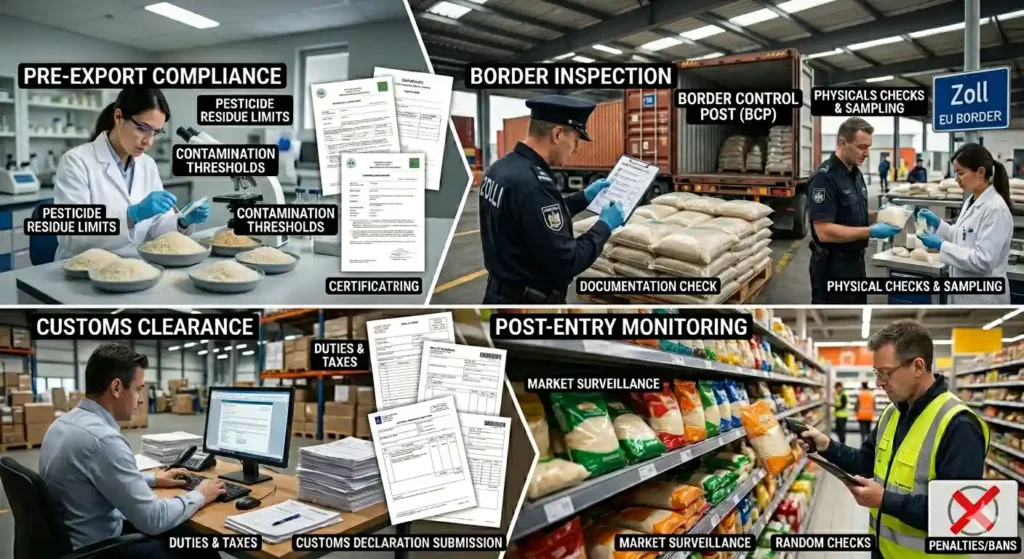
EU rice import regulations work through a structured process that includes pre-export compliance, border inspection, customs clearance, and post-entry monitoring, with strict checks on documentation, pesticide residues, and product labeling before rice enters the German market.
The process starts before shipment. Exporters must ensure rice meets EU food safety standards. This includes pesticide residue limits and contamination thresholds. Laboratories test samples and issue certificates.
At the border, shipments enter through designated Border Control Posts (BCPs). Authorities inspect documentation and may perform physical checks. These checks include sampling for pesticide residues, heavy metals, and microbiological contamination.
Customs clearance follows inspection. Importers submit a customs declaration, including invoice, packing list, bill of lading, and certificate of origin. Duties and taxes are calculated based on the declared value and tariff classification.
After entry, market surveillance continues. Authorities conduct random checks in warehouses and retail channels. Non-compliant products are withdrawn and may lead to penalties or import bans.
What are the key components of EU rice import regulations in Germany?
The key components include customs classification, import duties, pesticide maximum residue limits (MRLs), food safety standards, labeling rules, and traceability systems that ensure full compliance with EU food law and German customs procedures.
Customs classification and HS codes
Rice falls under HS Code 1006. Subcategories include husked rice, semi-milled rice, fully milled rice, and broken rice. Each category has different tariff rates and import conditions.
Accurate classification ensures correct duty calculation. Misclassification leads to fines and shipment delays.
Import duty Germany
Germany applies the EU Common External Tariff. Import duties depend on rice type and origin country. For example:
- Husked rice: lower duty rate
- Semi-milled rice: moderate duty rate
- Fully milled rice: higher duty rate
Preferential trade agreements reduce or eliminate duties for eligible countries. Exporters must provide a valid certificate of origin to claim these benefits.
Pesticide MRL rice Germany
Maximum Residue Limits (MRLs) define the highest allowed pesticide levels in rice. These limits are strict and enforced across the EU.
Examples include:
- Tricyclazole: near-zero tolerance
- Chlorpyrifos: banned in EU
- Carbendazim: tightly restricted
Laboratory testing is mandatory. Results must align with EU MRL databases. Non-compliance leads to rejection at the border.
EU food safety rice standards
Food safety regulations cover contamination risks such as:
- Heavy metals (example: arsenic in rice)
- Mycotoxins (example: aflatoxins)
- Microbiological hazards (example: Salmonella)
Exporters must implement food safety systems such as HACCP (Hazard Analysis Critical Control Points). Certification bodies verify compliance.
Labeling and packaging rules
Rice packaging must include:
- Product name
- Origin country
- Net weight
- Batch number
- Storage instructions
Labels must be in German or include German translation. Incorrect labeling results in market withdrawal.
Traceability requirements
Traceability ensures every batch can be tracked. Exporters must maintain records of:
- Farm origin
- Processing facility
- Packaging date
- Shipment details
This system enables rapid recalls in case of contamination.
Why are EU rice import regulations important for exporters?
EU rice import regulations are important because they ensure food safety, protect consumers, standardize trade practices, and prevent market access restrictions by enforcing strict compliance with pesticide limits, labeling rules, and customs requirements.
Compliance guarantees market access. Germany is one of the largest rice importers in Europe. Non-compliant shipments are rejected, leading to financial loss and reputational damage.
Regulations also create a level playing field. All exporters must meet the same standards. This ensures fair competition and consistent product quality.
Food safety protects consumers. Strict controls prevent contaminated rice from entering the market. This builds trust in imported food products.
Trade efficiency improves with compliance. Proper documentation and certification reduce delays at ports and customs checkpoints.
What are the main use cases of EU rice import regulations in Germany?
The main use cases include commercial rice imports, private label distribution, bulk supply for food service, and retail packaging, where each scenario requires compliance with EU customs, food safety, and labeling regulations.
Commercial importers bring bulk rice into Germany for distribution. These shipments require full compliance with customs duties and safety standards.
Private label brands import rice and package it under their own brand names. These products must meet labeling and traceability requirements.
Food service suppliers import rice for restaurants and catering businesses. Bulk packaging must comply with safety standards and storage regulations.
Retail distributors import packaged rice for supermarkets. These products require strict labeling compliance and quality assurance.
Each use case involves different packaging formats, documentation requirements, and inspection levels, but all follow the same regulatory framework.
What are common problems and misconceptions about Germany rice customs?
Common problems include incorrect HS classification, failure to meet pesticide MRLs, incomplete documentation, and misconceptions that EU rules vary by country, while in reality regulations are standardized across all EU member states including Germany.
One major issue is incorrect HS code usage. Exporters often misclassify rice types, leading to incorrect duty payments and customs delays.
Another problem is pesticide non-compliance. Exporters use pesticides that are banned or restricted in the EU. Laboratory tests detect these residues, resulting in shipment rejection.
Incomplete documentation causes delays. Missing certificates, incorrect invoices, or inconsistent data lead to customs holds.
A common misconception is that Germany has unique import rules. EU regulations apply uniformly. Germany enforces these rules through national authorities, but the legal framework remains the same across all member states.
Another misconception is that testing is optional. Every shipment is subject to risk-based inspection. High-risk origins face increased scrutiny.
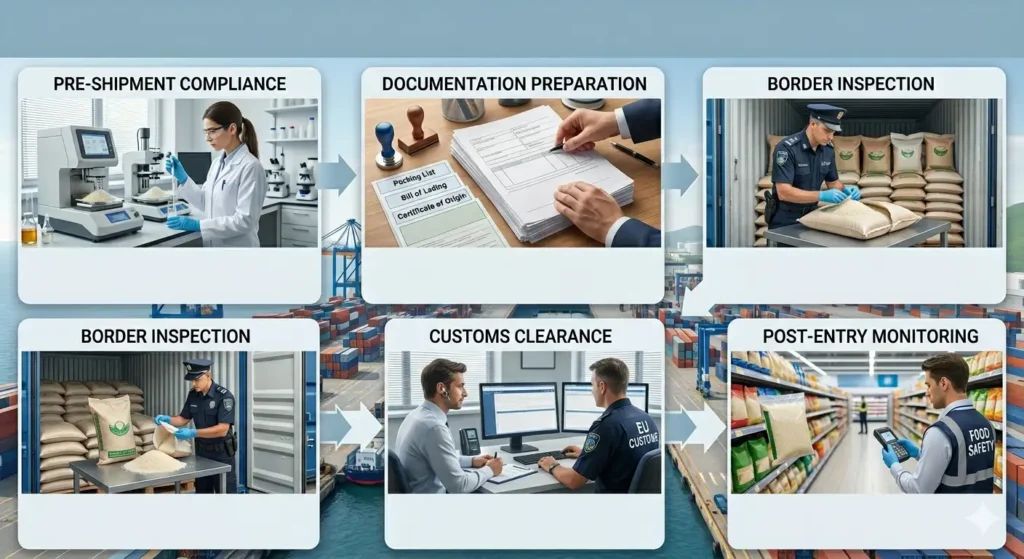
How does the EU rice import process ensure compliance step by step?
The EU rice import process ensures compliance through pre-shipment testing, documentation verification, border inspection, customs clearance, and post-market surveillance, creating a multi-layered control system that guarantees safety and regulatory adherence.
Pre-shipment compliance
Exporters test rice for pesticide residues and contaminants. Laboratories issue certificates confirming compliance with EU standards.
Processing facilities implement HACCP systems. These systems identify and control food safety risks during production.
Documentation preparation
Exporters prepare required documents:
- Commercial invoice
- Packing list
- Bill of lading
- Certificate of origin
- Phytosanitary certificate
Each document must match shipment details exactly.
Border inspection
At the EU entry point, authorities verify documents. Risk-based inspections determine whether physical checks are required.
Sampling may occur. Laboratories test samples for pesticide residues and contaminants.
Customs clearance
Importers submit declarations to customs authorities. Duties and taxes are calculated based on tariff classification and declared value.
Once cleared, rice enters free circulation within the EU.
Post-entry monitoring
Authorities conduct random checks in warehouses and retail outlets. Non-compliant products are removed from the market.
This system ensures continuous compliance beyond the point of entry.
What benefits do exporters gain by following EU rice import regulations?
Exporters gain market access, reduced shipment delays, higher buyer trust, regulatory stability, and long-term trade opportunities by consistently complying with EU rice import regulations and maintaining high food safety standards.
Compliance reduces risk. Shipments clear customs faster when documentation and testing are accurate.
Buyers prefer compliant suppliers. Importers in Germany prioritize exporters with proven compliance records.
Market access expands. Exporters who meet EU standards can supply multiple member states without additional regulatory barriers.
Regulatory stability supports planning. EU regulations are transparent and consistently enforced, allowing exporters to standardize processes.
Long-term trade relationships develop when exporters maintain consistent quality and compliance.