FOB Karachi vs CIF New York, Houston and Los Angeles: Basmati Rice Cost Breakdown
FOB Karachi generally suits US Basmati rice importers who control their freight arrangements, while CIF New York, Houston, or Los Angeles suits buyers who prefer the exporter to arrange ocean freight and insurance to the destination port. The better option depends on the rice grade, shipment volume, freight rates, insurance, destination charges, and the buyer’s control over logistics.
Importing Pakistani Basmati rice requires more than comparing the quoted price per metric ton. Buyers must evaluate product specifications, container loading, ocean freight, marine insurance, customs clearance, port charges, and inland transportation. Understanding the full cost structure helps distributors, wholesalers, private-label brands, and foodservice suppliers compare offers on a consistent basis. For background on rice grades, grain characteristics, processing, and export specifications, read this educational guide to Pakistani Basmati rice varieties and export specifications.
What do FOB Karachi and CIF USA mean for Basmati rice buyers?
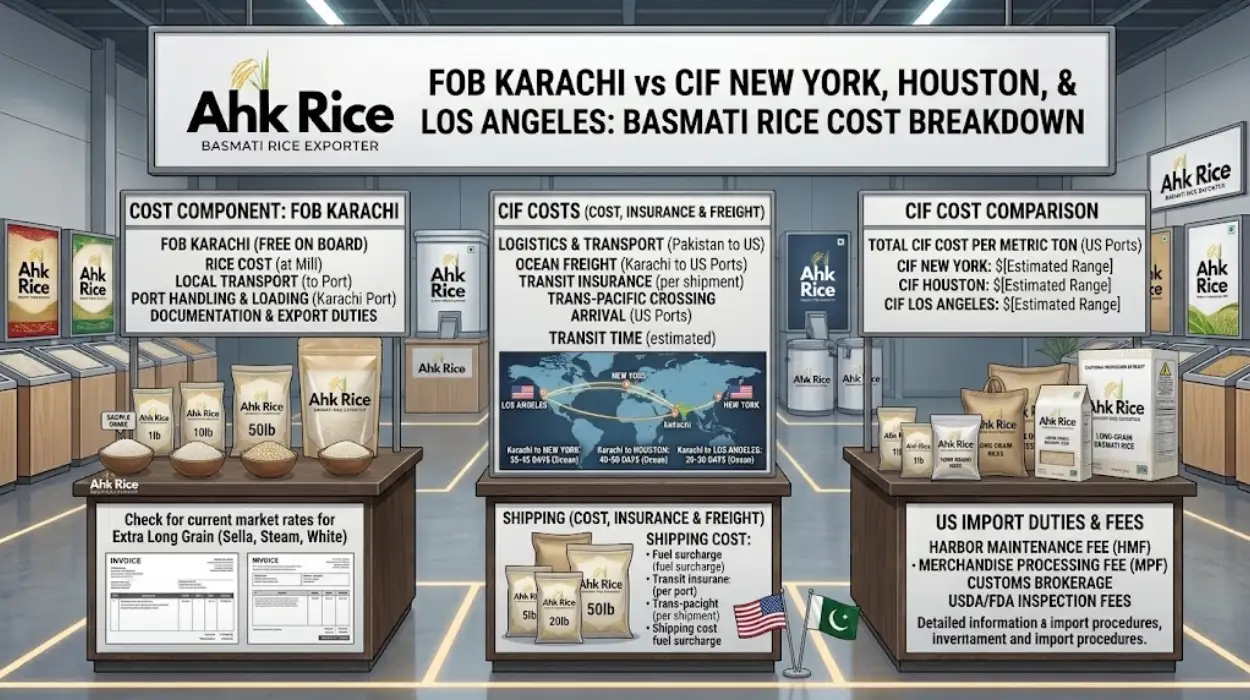
FOB Karachi means the seller delivers the rice on board the nominated vessel at Karachi and completes export clearance under the agreed contract. CIF means the seller also arranges and pays ocean freight and minimum required insurance to the named destination port, while the buyer remains responsible for import clearance and other applicable destination costs.
FOB stands for Free On Board, an Incoterm published by the International Chamber of Commerce. Under FOB Karachi, the buyer generally selects the ocean carrier, negotiates freight, arranges cargo insurance if required, and pays the applicable transport costs after loading. The seller handles export clearance and delivery on board the vessel.
CIF stands for Cost, Insurance and Freight. Under CIF New York, CIF Houston, or CIF Los Angeles, the seller arranges and pays the cost of ocean transportation and the required minimum insurance to the named destination port. However, the risk transfers from seller to buyer when the goods are loaded on board at the port of shipment, not when they arrive in the United States.
Both terms apply to sea and inland waterway transport. The contract must identify the applicable Incoterms edition and name the destination port precisely. Neither term automatically includes US import duties, customs brokerage, terminal handling, unloading, demurrage, or inland delivery.
What cost components determine the final Basmati rice import price?
The final import cost combines the rice purchase price, export handling, ocean freight, insurance, destination charges, customs-related expenses, and inland delivery where applicable. FOB and CIF quotations become comparable only when buyers identify which charges each offer includes and which costs remain payable separately.
A useful comparison separates the supplier’s price from the cost of moving the shipment and receiving it at the intended warehouse. FOB buyers generally arrange freight and insurance independently. CIF buyers receive a quotation that includes ocean freight and the agreed insurance component, but still need to budget for charges outside the seller’s obligations.
Typical cost components include:
- Rice purchase price: The cost of the selected grade, variety, crop year, moisture level, broken percentage, and processing specification.
- Export preparation: Processing, grading, inspection, packaging, export documentation, and delivery to the port as specified in the sales contract.
- Ocean freight: The carrier’s charge for transporting the container from Karachi to the US destination port.
- Marine insurance: Coverage subject to the policy’s terms, exclusions, insured amount, and claim conditions.
- Destination charges: Applicable terminal handling, documentation, port service, and container-related charges.
- Import clearance: Customs brokerage, applicable duties, examination expenses, and other regulatory costs.
- Inland transportation: Trucking or rail delivery from the destination port to the importer’s warehouse.
For an accurate comparison, request a written breakdown of included and excluded charges. Port congestion, carrier surcharges, container availability, shipment timing, and delivery location affect the final cost. A CIF quote is not automatically the cheapest option, and an FOB quote is not automatically the most economical.
How do FOB Karachi and CIF USA compare across seven specifications?
FOB offers greater control over freight selection, carrier negotiations, and insurance arrangements. CIF reduces the buyer’s responsibility for arranging the main ocean transport. The following seven attributes show how the terms differ in cost planning, logistics management, and shipment accountability.
| Comparison attribute | FOB Karachi | CIF New York, Houston, or Los Angeles |
|---|---|---|
| Rice purchase price | Supplier quotes the rice delivered on board, subject to contract terms | Supplier quotes the rice plus contracted ocean freight and insurance |
| Ocean freight | Buyer arranges and pays the carrier | Seller arranges and pays ocean freight to the named destination port |
| Marine insurance | Buyer normally arranges insurance if required | Seller provides the insurance required by CIF, subject to policy terms |
| Risk transfer | Transfers when goods are on board the vessel at Karachi | Also transfers when goods are on board the vessel at Karachi |
| Freight control | Buyer chooses carrier and negotiates freight | Seller selects and contracts the main carriage unless otherwise agreed |
| Destination charges | Buyer generally pays applicable destination charges | Buyer generally pays applicable destination charges not included in the contract |
| Best operational fit | Experienced importers with freight contracts or logistics teams | Buyers seeking a supplier-arranged ocean freight quotation |
The key distinction is responsibility for contracting and paying for the main carriage, not the point at which transit risk transfers. CIF requires the seller to arrange insurance, but the standard CIF obligation provides only minimum cover unless the parties agree otherwise. Buyers importing premium rice should check whether the insurance level matches the cargo value and their risk-management requirements.
FOB is often useful when an importer ships regularly and receives competitive rates from a freight forwarder. CIF is useful when the importer needs a port-specific quotation without independently negotiating the ocean freight. Both approaches require a separate assessment of destination charges and import compliance.
How do freight costs compare for New York, Houston, and Los Angeles?
The lowest-cost US destination depends on the current carrier rate, sailing schedule, container availability, destination charges, and inland delivery distance. New York, Houston, and Los Angeles must be evaluated using shipment-specific freight quotations rather than assumed port rankings or fixed price differences.
Los Angeles serves importers distributing goods across California and other western markets. Houston is relevant to Texas-based wholesalers, distributors, and foodservice suppliers. New York supports buyers serving the Northeast and nearby distribution networks. These locations offer different routing options and inland transport costs, so the nearest port is not always the lowest-cost option.
A buyer comparing CIF offers should request the same rice grade, packaging, quantity, shipment window, and named destination port from each supplier. For FOB, the buyer should obtain comparable freight quotations from carriers or freight forwarders using the same container size and loading assumptions.
Illustrative cost calculation: Assume the FOB value of a shipment is US$1,200 per metric ton and the contracted ocean freight plus insurance allocation is US$100 per metric ton. The resulting CIF value is US$1,300 per metric ton before destination charges, import clearance, duties, and inland delivery.
These figures demonstrate the calculation only. They are not current market quotations for Karachi-to-USA routes. Actual costs depend on the shipment date, carrier, container configuration, contractual terms, and cargo details.
To compare three destinations, calculate the following for each port:
- Rice value per metric ton.
- Ocean freight per metric ton.
- Marine insurance per metric ton.
- Destination and customs-related costs per metric ton.
- Inland transportation per metric ton.
- Total landed cost per metric ton.
The landed-cost calculation should use the same cost categories for every quotation. This prevents an apparently lower CIF price from winning the comparison when its destination charges or inland delivery costs are higher.
Which Basmati rice grades and price factors matter most?
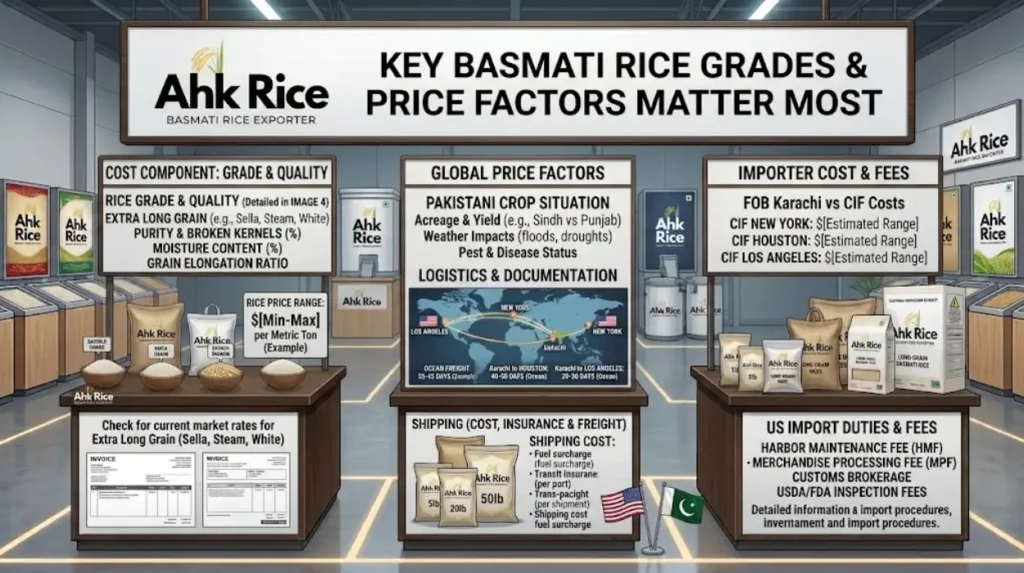
1121, Super Kernel, and 1509 Pakistani Basmati rice serve different commercial requirements. Grade, grain length, aroma, processing, broken percentage, moisture, packaging, and order volume influence the purchase price. Buyers should compare identical specifications before deciding whether FOB or CIF delivers better value.
AHK Rice supplies Pakistani Basmati varieties from Punjab, including 1121, Super Kernel, and 1509, with processing, packaging, and export coordination tailored to buyer requirements. Buyers can review AHK Rice’s Basmati rice sourcing and export services to understand the available product and supply options.
1121 Basmati suits buyers targeting premium retail, specialty grocery, and foodservice markets that value long grains and characteristic Basmati aroma. Steam, Golden Sella, Creamy Sella, and other agreed specifications affect processing requirements and pricing.
Super Kernel Basmati serves distributors and retailers seeking aromatic Pakistani Basmati with a distinctive grain profile. Its commercial value depends on verified grade specifications, purity, processing, packaging, and consistency between shipments.
1509 Basmati provides an option for buyers balancing grain length, volume requirements, and purchase economics. Steam and Golden Sella formats address different presentation, cooking, and foodservice needs.
A quotation should identify the variety, processing type, crop year, raw grain length, moisture limit, broken percentage, foreign matter tolerance, packaging material, bag weight, and inspection requirements. Buyers should also establish the sampling and approval procedure before production.
Do not compare premium 1121 with a different 1509 specification solely on price per metric ton. The products may serve different customers and generate different selling prices. Compare FOB and CIF after confirming that the rice specification, quantity, packing, and quality tolerances are equivalent.
How do US regional markets affect grade preferences, shelf life, and price?
The Northeast and West Coast offer different distribution economics, while Texas can serve regional wholesale and foodservice demand. Grade selection follows customer positioning rather than port location alone. Shelf life depends on processing, moisture, packaging, storage, and product quality, not simply the FOB or CIF term.
Northeast and East Coast: New York distribution
Importers supplying New York and the wider Northeast can evaluate 1121 for premium retail, specialty grocery, and foodservice accounts. Super Kernel also fits channels seeking aromatic Pakistani Basmati. Price competitiveness depends on the agreed grade, pack size, order volume, freight contract, and delivery location.
CIF New York gives buyers a port-specific ocean freight quotation. FOB Karachi gives established importers the flexibility to negotiate carriage through their own logistics partners. The better option depends on whether the buyer’s freight savings exceed the costs of managing transport and insurance.
Texas and Gulf distribution: Houston
Houston can suit wholesalers, ethnic grocery distributors, restaurant suppliers, and institutional foodservice businesses serving Texas and nearby states. Both 1121 and 1509 can meet different customer needs, with 1509 relevant to buyers prioritising bulk supply economics and 1121 serving premium segments.
CIF Houston simplifies the arrangement of ocean freight through the seller, while FOB allows buyers to use existing carrier agreements. The importer should include port-related costs and inland trucking to the actual warehouse when comparing offers.
California and West Coast distribution: Los Angeles
Los Angeles is a practical option for importers supplying California retailers, regional distributors, and foodservice operators. Premium 1121 and Super Kernel can support differentiated retail positioning, while 1509 serves buyers seeking a balance between product specifications and purchase cost.
California-bound shipments also require attention to applicable food-safety, labelling, and chemical-exposure requirements. Buyers should assess California Proposition 65 obligations with qualified compliance advisers where relevant. A CIF Los Angeles price does not establish regulatory compliance.
How should buyers compare price and shelf life?
There is no defensible universal price per metric ton for each US port without a dated quotation and matched product specification. The same applies to shelf life: a variety name or shipping term does not establish a guaranteed storage period.
| Evaluation factor | Northeast: New York | Gulf: Houston | West Coast: Los Angeles |
|---|---|---|---|
| Commercial focus | Retail, specialty grocery, foodservice | Wholesale, foodservice, regional distribution | Retail, ethnic grocery, regional distribution |
| Potential grade preference | 1121, Super Kernel | 1121, 1509, Super Kernel | 1121, Super Kernel, 1509 |
| Price comparison | Obtain dated FOB and CIF New York offers | Obtain dated FOB and CIF Houston offers | Obtain dated FOB and CIF Los Angeles offers |
| Shelf-life assessment | Confirm crop year, moisture, packaging, and storage conditions | Apply the same documented quality criteria | Apply the same documented quality criteria |
| Inland cost | Calculate delivery to the actual Northeast warehouse | Calculate delivery to the actual Texas warehouse | Calculate delivery to the actual California warehouse |
For planning, compare the supplier’s documented best-before period, packaging integrity, storage instructions, and quality guarantees. Dry Basmati rice can retain quality for an extended period when properly processed, packed, and stored, but no single shelf-life figure applies to every product. Request product-specific documentation before agreeing to a commercial order.
Which shipping method works best for different importer profiles?
FOB is generally stronger for established importers with negotiated freight rates and in-house logistics expertise. CIF is useful for buyers seeking a consolidated supplier quotation. The right choice depends on shipment frequency, logistics capability, cash-flow planning, destination costs, and the ability to verify service terms.
| Buyer situation | Preferred starting point | Reason | Main check before ordering |
|---|---|---|---|
| Established importer shipping regularly | FOB Karachi | Uses existing freight contracts and logistics expertise | Confirm carrier rate, insurance, and sailing schedule |
| First-time US importer | CIF destination port | Provides a combined rice, freight, and insurance quotation | Request a complete list of excluded charges |
| High-volume distributor | Compare both | Freight negotiation can materially affect cost at scale | Calculate total landed cost per metric ton |
| Premium retail or private-label buyer | Compare both | Product compliance and consistency matter alongside price | Confirm specifications, testing, packaging, and labels |
| Buyer with a fixed warehouse location | Compare both | Inland transportation may change the preferred port | Obtain delivery costs from each port to the warehouse |
A first-time importer should not treat CIF as a complete door-to-door delivery service. The buyer still needs to plan customs entry, required regulatory steps, destination charges, and inland movement. An experienced importer should not assume FOB saves money without comparing the actual freight and insurance costs against a supplier’s CIF offer.
For both terms, agree on the loading window, shipment quantity, container type, inspection arrangements, document requirements, and process for resolving specification discrepancies. A clear contract makes the price comparison commercially meaningful.
What are the main advantages and disadvantages of FOB and CIF?
FOB provides greater control and potential freight savings, but it requires the buyer to coordinate transport and insurance. CIF reduces freight-arrangement work, but limits the buyer’s direct control over the seller’s carriage contract and does not eliminate destination costs or transit risk.
FOB Karachi: advantages and disadvantages
The principal advantage of FOB is control. An importer with a strong freight-forwarding relationship can negotiate rates, choose carriers, coordinate consolidation where appropriate, and select insurance suited to the cargo. Regular buyers can compare supplier prices independently of freight arrangements.
The disadvantage is the operational workload. The buyer must coordinate the carrier, shipment booking, insurance, and communication between the exporter and logistics partners. Delays or documentation mismatches can create extra costs. FOB is less convenient when a buyer has no established shipping network.
CIF USA: advantages and disadvantages
CIF provides a consolidated quotation for the rice, ocean freight, and required insurance to the named port. It simplifies initial budgeting and helps new buyers compare offers without separately arranging the main carriage.
Its limitation is that the buyer needs visibility into the freight arrangement, insurance policy, and excluded charges. The seller chooses the carriage arrangement unless the contract provides otherwise, and the buyer may have less control over routing. CIF also does not transfer transit risk to the seller until arrival; risk transfers when the goods are loaded on board at Karachi.
In either case, the lowest quoted price may not represent the lowest landed cost. A complete comparison must account for the product specification, freight, insurance, destination charges, clearance, and final delivery.
What should buyers check before requesting a quotation?
Buyers should standardise the rice specification, quantity, packaging, destination port, delivery requirements, and shipment timeline before requesting FOB and CIF prices. A complete request lets suppliers quote comparable terms and helps importers identify hidden costs before approving a purchase order.
Include these details in the request:
- Rice variety: 1121, Super Kernel, or 1509.
- Processing: Raw, Steam, Golden Sella, Creamy Sella, or another agreed specification.
- Quality: Grain length, moisture, broken percentage, purity, and foreign matter limits.
- Quantity: Metric tons, container count, and any minimum order requirement.
- Packaging: Bag weight, material, retail branding, and private-label requirements.
- Destination: New York, Houston, or Los Angeles, plus the final warehouse location if delivery is required.
- Trade term: FOB Karachi or CIF at the precisely named US port.
- Documentation: Commercial invoice, packing list, certificate of origin, phytosanitary documentation where required, and other agreed shipping or compliance records.
- Quality assurance: Sample approval, inspection, certificate of analysis where applicable, and agreed testing requirements.
- Quotation validity: Currency, validity period, expected shipment window, payment terms, and exclusions.
Rice importers should independently verify current US import requirements for their product and shipment. FDA requirements, customs entry, applicable duty classification, labelling rules, and any destination-specific obligations must be assessed before shipment. Supplier documentation supports the process but does not replace the importer’s legal responsibilities.
FOB Karachi is a strong option for importers with established freight contracts, while CIF New York, Houston, or Los Angeles is a practical starting point for buyers who want the supplier to arrange the main ocean transport and required insurance. Neither option automatically delivers the lowest total cost.
Compare equivalent offers using the same Basmati grade, packaging, volume, shipment window, and destination. Include port charges, customs clearance, insurance, and inland transportation in the calculation. Confirm the contract’s risk-transfer point, insurance coverage, and excluded costs before committing to a shipment.
For the next step, buyers can prepare a specification sheet and request matched FOB Karachi and CIF USA quotations from AHK Rice. A like-for-like comparison gives procurement teams a clearer basis for selecting the right grade, route, and shipping arrangement.
FAQs about FOB Karachi and CIF USA Basmati rice shipments
Is FOB Karachi cheaper than CIF New York?
FOB Karachi can be cheaper when the importer secures competitive freight and insurance rates. CIF New York can be more convenient when the seller obtains favourable carriage terms. Compare the complete landed cost rather than the two quoted prices alone.
Does CIF include US customs duties and delivery to the warehouse?
No. CIF covers the contracted cost of ocean freight and required insurance to the named destination port. Import clearance, applicable duties, destination charges, and inland delivery are generally the buyer’s responsibility unless separately agreed.
Who bears the risk when Basmati rice ships under CIF?
Under CIF, risk transfers to the buyer when the goods are loaded on board the vessel at the port of shipment. The seller pays for freight and arranges insurance to the named destination port, but the buyer should review the insurance coverage and claims process.
Which Pakistani Basmati variety should US importers choose?
1121 suits buyers targeting premium grain length and aroma. Super Kernel suits channels seeking aromatic Pakistani Basmati, while 1509 provides another option for buyers balancing specifications and volume economics. The appropriate grade depends on customer demand, price targets, processing, and quality requirements.
How can importers compare FOB and CIF quotations accurately?
Request both quotations for the same rice variety, grade, quantity, packaging, shipment period, and destination port. Add insurance, destination charges, customs-related expenses, and inland delivery to calculate the comparable landed cost per metric ton.
Does CIF Los Angeles guarantee compliance with California Proposition 65?
No. CIF is a shipping term, not a food-safety or labelling certification. Importers and sellers must separately establish the applicable compliance responsibilities, testing requirements, product documentation, and labelling obligations.
What information should a Basmati rice supplier provide before shipment?
The contract should specify the variety, processing type, quality limits, packing, quantity, shipment schedule, agreed Incoterm, payment terms, and required documents. Buyers should also confirm sample approval, inspection procedures, and the process for handling quality discrepancies.