Future of Pakistan Rice Exports in Global Trade
What is the macro landscape of Pakistan rice exports?
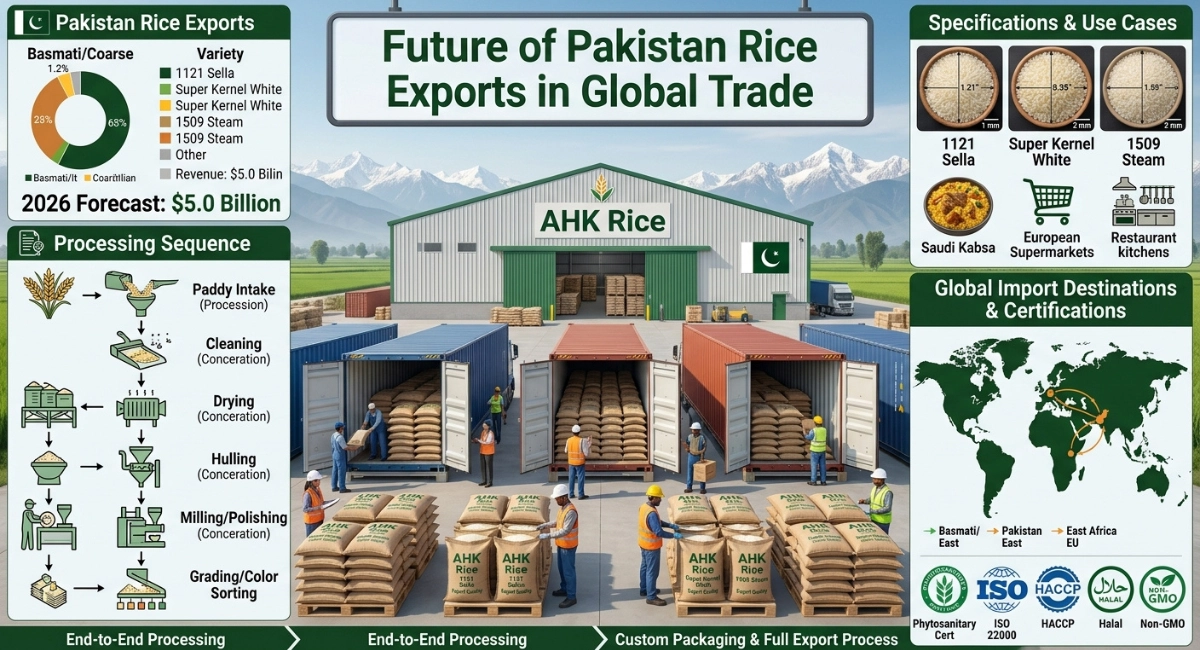
The macro landscape of Pakistan rice exports represents a multi-billion dollar trade sector that supplies premium long-grain aromatic and coarse rice varieties to global markets. In 2026, the country projects total export volumes to reach 5.0 million metric tons.
The international rice trade positions Pakistan as a structural pillar for food security across West Africa, Central Asia, and the Middle East. The export framework comprises two distinct classifications: premium Basmati rice and non-Basmati coarse rice varieties. Total export revenues reached a record 4.19 billion dollars recently, confirming that the country serves a foundational role in global supply chains.
The baseline of this trade rests on three distinct long-grain aromatic cultivars: 1121 Basmati, Super Kernel, and 1509 Basmati. These cultivars carry distinct botanical identifiers, such as an average pre-cooked grain length exceeding 7.0 millimeters, an elongation ratio of 2:1 upon cooking, and a high concentration of 2-acetyl-1-pyrroline, which is the chemical compound responsible for the signature Basmati fragrance.
Where is export-quality Basmati rice grown in Pakistan?
Export-quality Basmati rice grows exclusively within the fertile Indus River basin located inside the Punjab province of Pakistan. The primary cultivation zones include specific geographic regions such as Gujranwala, Sheikhupura, Hafizabad, Muridke, Nankana Sahib, Narowal, and Sialkot.
The geographic profile of northern and central Punjab provides the exact environmental conditions required for Basmati synthesis. The Kalar tract, a dedicated agricultural belt flanked by the Ravi and Chenab rivers, contains dense clay-loam soils that retain moisture without suffocating plant roots. The temperature matrix during the reproductive stage remains between 22 degrees Celsius and 32 degrees Celsius, which allows the grain to accumulate starch slowly.
Melting snow from the Himalayan mountain ranges feeds the Indus River canal system, supplying the mineral-rich water necessary for continuous paddy flooding. This unique ecosystem ensures that varieties like Super Kernel develop their specific amylose structural content, which prevents stickiness after boiling.
How does end-to-end rice processing work step by step?
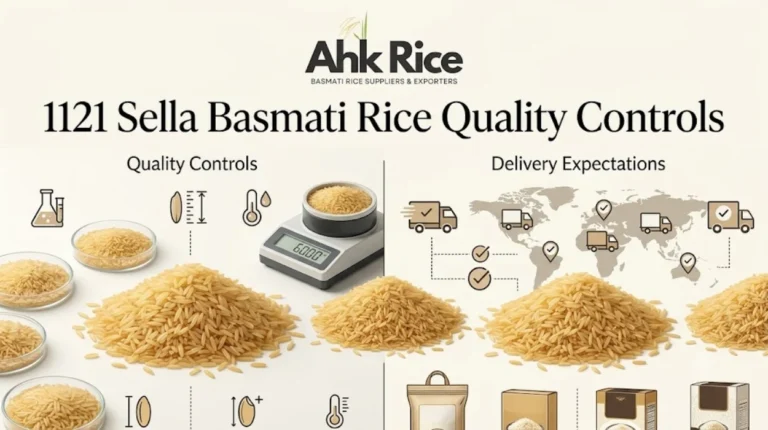
End-to-end rice processing converts raw paddy into shelf-ready milled grains using an uninterrupted mechanical sequence. The process requires precise temperature controls, computerized color sorting, and strict moisture monitoring to eliminate impurities while preserving the structural integrity of the long grains.
The processing lifecycle contains sequential phases that dictate the final grade, texture, and color of the export commodity:
1.Paddy Intake and Mechanical Cleaning:Phase 1.
Raw paddy arrives at the milling complex with an initial moisture level of approximately 18% to 22%. Scalpers, de-stoners, and magnetic separators remove physical contaminants such as straw, mud clots, stones, and ferrous particles.
2.Conditioning and Multi-Stage Drying:Phase 2.
The cleaned paddy passes through vertical recirculating hot-air dryers. The process reduces internal grain moisture down to a stable 12% to 14% threshold over 3 to 4 stages, preventing thermal shock and internal kernel cracking.
3.De-Husking and Paddy Separation:Phase 3.
Rubber roll hullers subject the dried paddy to friction, shearing away the fibrous outer husk to yield brown rice. A sequence of oscillating paddy separators segregates unhulled paddy from the brown rice streams, returning unhulled grains back to the hullers.
4.Milling, Polishing, and Optional Thermal Treatments:Phase 4.
Abrasive and friction whitening cones strip away the nutrient-rich bran layers. The grains then enter mist polishers where purified water vapors create a shiny, silky exterior surface. For specific variants such as Steam or Sella, the paddy undergoes pressurized steaming or parboiling before this stage to gelatinize internal starches.
5.Thickness Grading, Plan-Shifting, and Color Sorting:Phase 5.
The polished rice flows over thickness graders and length graders to separate broken grains from whole kernels. The uniform whole grains pass through computerized monochromatic or trichromatic optical color sorters, where high-speed air valves eject discolored, chalky, or damaged grains.
What are the key components and specifications of export grades?
The key components of export grades comprise the specific processing styles and physical dimensions assigned to the rice varieties. Standard market categories consist of White, Steam, and Sella processing finishes applied directly to the raw grains.
Exporters utilize these explicit processing frameworks to fulfill the culinary preferences of different regions:
1121 Basmati Specifications
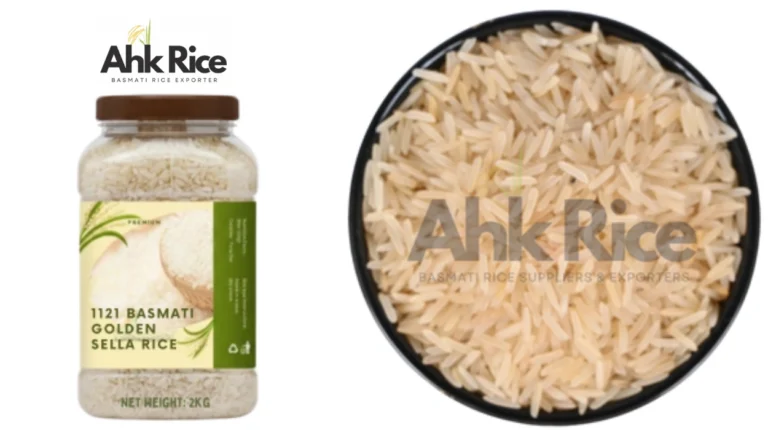
The 1121 variety stands as the global standard for extra-long grain length. It features a pre-cooked grain length between 8.2 millimeters and 8.4 millimeters. The maximum allowable broken grain percentage remains capped at 2% for premium retail packs.
Super Kernel Basmati Specifications
Super Kernel represents the traditional aromatic standard of the Indus basin. It features a pre-cooked grain length between 7.2 millimeters and 7.4 millimeters. It possesses an aging potential of 12 to 24 months, which concentrates its distinct natural fragrance profile.
1509 Basmati Specifications
The 1509 variety is a modern, high-yielding cultivar. It features a pre-cooked grain length between 7.5 millimeters and 7.7 millimeters. It exhibits a shorter crop maturity cycle of 90 days compared to the 130-day cycle of traditional varieties, providing an accessible price-point for high-volume commercial buyers.
What benefits do Pakistani Basmati varieties offer to global buyers?
Pakistani Basmati varieties offer structural resilience during bulk preparation, extreme post-cooking elongation, and low glycemic index profiles. These benefits assure commercial kitchens and retail packagers of superior yield metrics and predictable culinary outcomes.
Global procurement managers choose these varieties due to explicit functional advantages:
- Exceptional Volume Expansion: Grains expand up to 2.5 times their original physical length when boiled, creating an appealing visual presentation in traditional food preparation.
- High Non-Stick Separation: An average amylose content of 22% to 24% ensures that individual cooked grains remain completely detached from one another, preventing clumping in heavy catering vessels.
- Long-Term Shelf Stability: Thorough mechanical processing and moisture regulation at 13% restrict biochemical degradation, allowing the grain to withstand long oceanic transport timelines inside maritime containers.
What are the core use cases for different processing finishes?
The core use cases for different processing finishes cover high-volume commercial catering, premium consumer retail packaging, and traditional hospitality sectors. Each finishing technique prepares the starch structure for specific cooking environments.
The chosen processing method dictates how the final product performs under heat:
Sella and Parboiled Applications
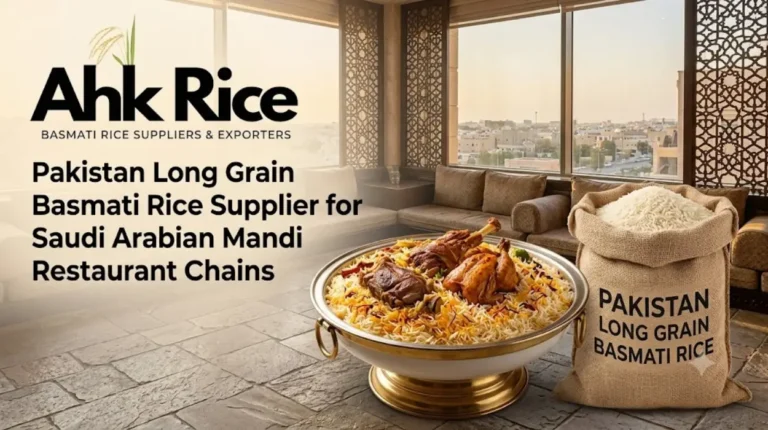
Sella rice undergoes parboiling, which forces water-soluble vitamins deep into the grain endosperm before removing the husk. This process alters the starch matrix, creating rigid grains that withstand long holding times inside commercial warming trays. It serves as the primary ingredient for heavy rice dishes, such as traditional Saudi Arabian Kabsa, Iraqi Quzi, and Emirati Mandi.
Steam Processing Applications
Steam processing subjects the paddy to short bursts of pressurized steam before milling. This preserves the bright white color of the kernel while tempering the outer cells. It allows rapid water absorption during soaking, making it highly suitable for quick-service restaurants that prepare fresh Biryani or Pulao daily.
What are the common misconceptions about Pakistan rice trade?
A common misconception about the Pakistan rice trade is that mechanical steam processing is identical to traditional parboiling. Another frequent error is the belief that shorter Basmati varieties indicate poor milling quality.
Market analysts clarify these trade realities by looking at the physical chemistry of the grains:
Technical Fact: Parboiling requires soaking paddy for multiple hours followed by long steam exposure, turning the starch yellow. Steam processing only treats the paddy for brief minutes, preserving the natural pearlescent white tone of the grain while strengthening the outer walls.
Shorter traditional cultivars, such as Super Kernel, possess higher natural oil content and aromatic concentrations than extra-long hybrid varieties. The shorter length is a distinct genetic trait rather than an indicator of substandard cultivation or broken grains.
Which global markets import Pakistani rice, and what certifications apply?
Global markets importing Pakistani rice extend across 15 plus countries, led by major hubs in the Middle East, East Africa, and the European Union. Import approval relies on strict phytosanitary documentation and international food safety certifications.
The distribution map shows high-volume trade routes terminating at regional destinations:
To cross international borders, export consignments must carry verified compliance documents issued by independent inspection bodies. The mandatory trade certifications include:
- Phytosanitary Certification: Issued directly by the Department of Plant Protection of Pakistan, verifying that the grain shipment is free from storage pests, such as the rice weevil (Sitophilus oryzae).
- ISO 22000 & HACCP: Food safety management frameworks that prove the milling complex eliminates biological, chemical, and physical hazards during mechanical processing.
- Halal Compliance Certification: Verifies that all processing agents, sanitizers, and packaging materials meet global Islamic dietary standards.
- Non-GMO Declarations: Certifies that the rice varieties derive from traditional breeding methods rather than genetic modification, a mandatory prerequisite for European Union entry.