How German Importers Assess Pakistani Sella Basmati Rice Quality Standards
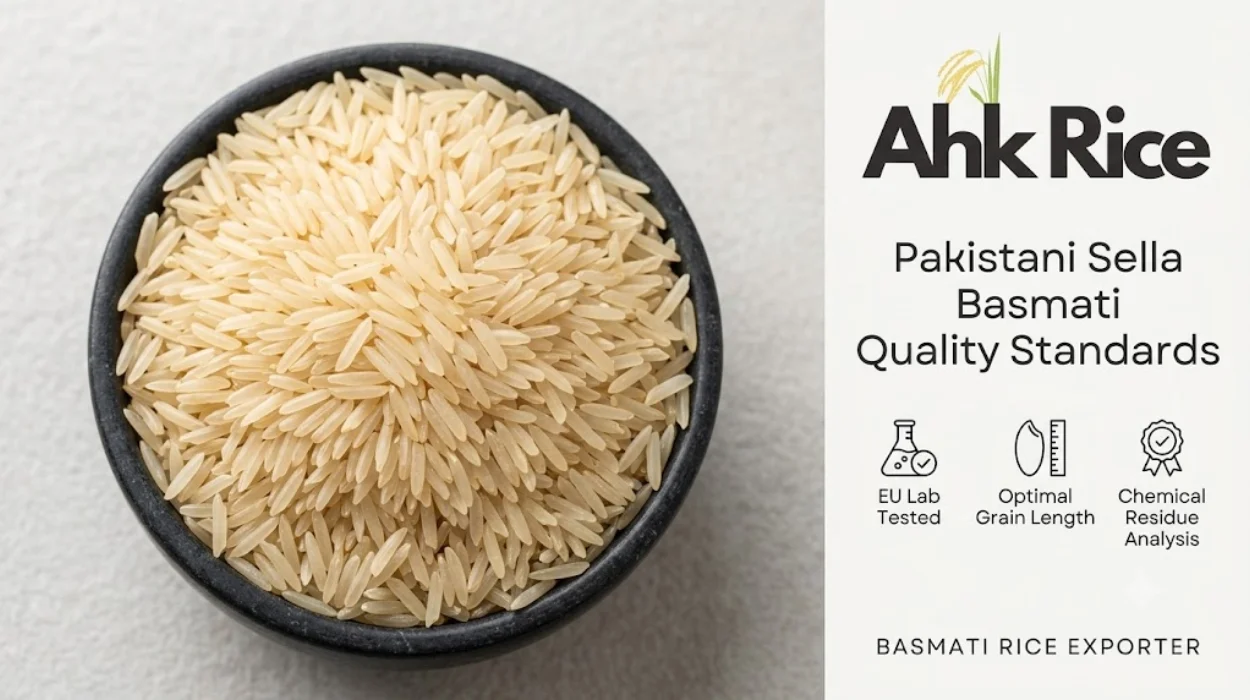
German importers assess Pakistani Sella Basmati rice primarily through grain specifications, certification compliance, processing consistency, food safety testing, and supply reliability. Quality verification determines long-term retail performance, customer satisfaction, and import compliance. Here is why: German buyers operate in one of Europe’s most regulated food markets, where every shipment must meet measurable quality standards before distribution.
Germany remains one of the important European destinations for premium Basmati rice imports. Retailers, ethnic food distributors, wholesalers, and private-label brands evaluate suppliers through detailed quality benchmarks rather than pricing alone. Buyers seeking a deeper understanding of Pakistani Sella rice production often begin by reviewing educational resources about cultivation, processing, and export standards in our guide on how Pakistani Sella Basmati rice is processed from field to export shipment.
AHK Rice supplies Pakistani Basmati rice to international markets through controlled processing, grading, inspection, packaging, and export management. German importers evaluate every stage because consistent quality reduces supply chain risks and strengthens brand reputation.
What quality standards do German importers use to evaluate Pakistani Sella Basmati rice?
German importers prioritize grain length, purity, moisture control, broken percentage, color consistency, food safety compliance, and certification verification because these factors directly affect cooking performance, retail acceptance, and regulatory approval within European food distribution networks.
Pakistani Sella Basmati rice is parboiled rice produced through controlled soaking, steaming, drying, milling, grading, and sorting processes. The parboiling process strengthens the grain structure and improves shelf stability.
German buyers first inspect physical specifications because visual quality influences retail acceptance. Importers verify laboratory reports before approving commercial quantities.
1121 Sella Basmati Quality Specifications
Typical Import Specification Table
| Attribute | German Import Preference |
|---|---|
| Grain Length | 8.20–8.40 mm |
| Broken Grains | Maximum 2–5% |
| Moisture Content | Maximum 13% |
| Purity | 95–98%+ |
| Chalky Grains | Minimal Presence |
| Foreign Matter | Near Zero |
| Color Uniformity | Consistent Golden or Cream Shade |
German retailers often demand stricter specifications than traditional wholesale markets. A premium supermarket chain may require 2% broken grains, while foodservice distributors may accept 5%.
Quality assessment continues beyond physical appearance. Buyers also evaluate food safety documentation and certification systems.
With physical quality standards established, the next question is how different quality assessment approaches compare.
How do different quality assessment approaches compare?
Laboratory testing provides the highest accuracy, physical inspection offers rapid screening, and supplier audits deliver long-term reliability assessment. German importers combine all three methods to reduce procurement risk and maintain product consistency.
German importers rarely rely on a single evaluation method. Multiple verification layers create confidence before shipment approval.
Quality Assessment Comparison
| Assessment Method | Purpose | Accuracy Level | Typical Use |
|---|---|---|---|
| Physical Inspection | Visual grain review | Medium | Initial screening |
| Laboratory Testing | Food safety verification | High | Shipment approval |
| Factory Audit | Process validation | High | Supplier qualification |
| Sample Cooking Test | Performance evaluation | Medium-High | Retail assessment |
| Certification Review | Compliance verification | High | Import clearance |
Physical inspection identifies grain length, color, uniformity, and visible defects. Importers often request representative samples before placing commercial orders.
Laboratory testing verifies pesticide residues, heavy metals, microbiological safety, moisture levels, and contaminant compliance. European food regulations require measurable verification before market distribution.
Factory audits evaluate production capabilities. Buyers inspect milling facilities, sorting equipment, color sorters, packaging systems, traceability procedures, and quality control protocols.
Sample cooking tests remain important because consumer experience determines repeat purchases. German retailers evaluate aroma, elongation ratio, texture, and appearance after cooking.
Certification reviews confirm compliance with internationally recognized quality systems.
Common Certifications Requested by German Buyers
- ISO 22000 Certification
- HACCP Compliance
- BRC Food Safety Standards
- Phytosanitary Certificate
- Certificate of Origin
- EU Food Safety Compliance Reports
Quality verification methods vary according to buyer requirements. The next consideration is which assessment strategy delivers the best results in different import scenarios.
Which quality assessment method works best for different importing situations?
Laboratory testing works best for retail imports, factory audits work best for long-term sourcing partnerships, and combined verification works best for private-label brands seeking maximum consistency and compliance.
Different business models require different quality assurance strategies.
Retail Distribution
Retail chains prioritize food safety compliance and packaging consistency. Laboratory verification becomes the most important evaluation tool.
German supermarkets often maintain strict tolerance levels because consumer complaints directly impact brand performance.
Foodservice Distribution
Restaurants, catering companies, and hospitality suppliers focus on cooking performance, grain elongation, and consistency.
Cooking trials become especially valuable because operational kitchens evaluate rice under real preparation conditions.
Private Label Brands
Private-label importers face higher reputational risk. Combined verification methods provide stronger protection.
Factory audits, laboratory reports, and cooking tests create a complete quality validation framework.
Ethnic Wholesale Markets
Wholesale distributors frequently emphasize grain appearance, price competitiveness, and supply reliability.
Visual inspection and supplier track records often play larger roles than extensive auditing programs.
The most effective quality assessment depends on business objectives. Understanding advantages and limitations helps importers select the right strategy.
What are the pros and cons of different Pakistani Sella Basmati quality verification methods?
Comprehensive testing offers maximum confidence, while simplified inspections reduce costs. German importers balance verification depth against procurement budgets, shipment volume, and retail risk exposure.
Laboratory Testing
Advantages
- Detects contaminants accurately
- Supports regulatory compliance
- Reduces import risks
- Provides documented evidence
Disadvantages
- Increases procurement costs
- Requires additional time
- May delay shipment approvals
Factory Audits
Advantages
- Verifies process consistency
- Assesses operational capability
- Builds long-term confidence
- Identifies production weaknesses
Disadvantages
- Requires travel expenses
- Takes significant planning
- Cannot replace laboratory testing
Physical Inspection
Advantages
- Fast evaluation
- Low cost
- Easy implementation
- Immediate feedback
Disadvantages
- Limited accuracy
- Cannot detect contaminants
- Depends on inspector expertise
Example Comparison
Golden Sella rice often shows stronger grain durability than Steam rice during long-distance logistics. In warehouses operating above 35°C, Golden Sella can maintain quality for approximately 18–24 months, while Steam rice generally performs best within 12–18 months under similar conditions.
For German distributors maintaining large inventory volumes, Golden Sella often reduces storage-related quality deterioration. For fast-moving retail inventories, Steam rice may remain suitable because turnover rates are higher.
Understanding strengths and weaknesses helps buyers compare market options more effectively. The next question focuses on regional preferences and specification differences.
How do German and Middle Eastern importers compare Pakistani Sella Basmati rice specifications?
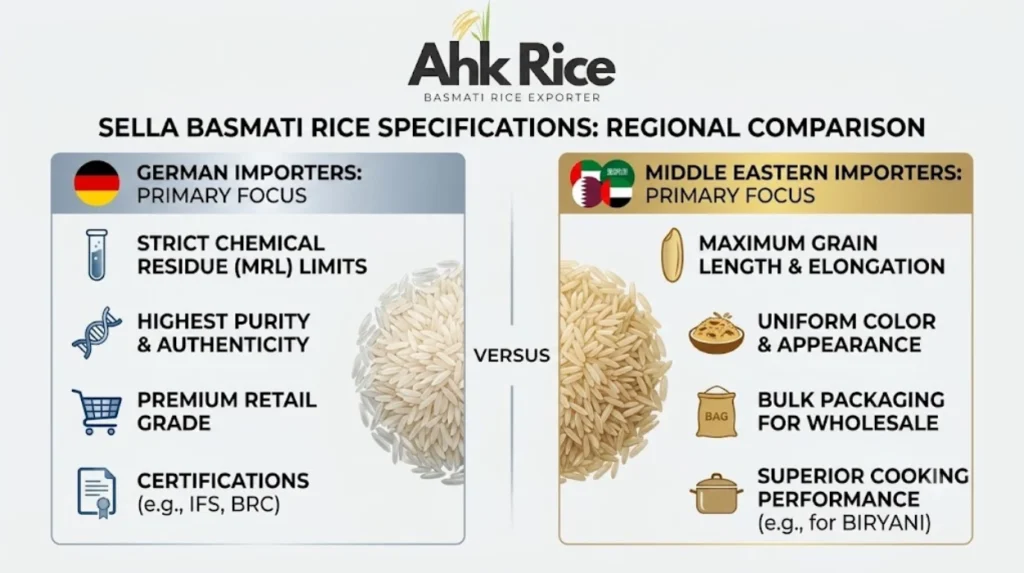
German buyers prioritize food safety documentation and premium uniformity, while Middle Eastern buyers often emphasize grain appearance, elongation performance, and catering suitability for large-scale consumption.
Import requirements differ significantly across regions.
Regional Preference Comparison
| Factor | Germany | Middle East |
|---|---|---|
| Preferred Grade | 1121 Golden Sella Premium | 1121 Golden Sella & Steam |
| Certification Focus | Very High | High |
| Broken Tolerance | 2–5% | 5–10% |
| Packaging Preference | 5kg–20kg Retail | 20kg–40kg Wholesale |
| Food Safety Testing | Extensive | Moderate-High |
| Traceability Demand | Very High | Medium |
| Premium Segment Growth | Strong | Strong |
Price Comparison by Market
| Product Grade | Germany Import Range | Middle East Import Range |
|---|---|---|
| 1121 Golden Sella | Higher Premium Positioning | Competitive Premium |
| 1121 Steam | Mid-Premium | Premium |
| Super Kernel Sella | Niche Demand | Moderate Demand |
Prices fluctuate according to harvest quality, freight rates, currency movements, and export demand (source: REAP export data, December 2025).
Shelf Life Comparison
| Rice Type | Typical Shelf Life |
|---|---|
| Golden Sella | 18–24 Months |
| Steam Rice | 12–18 Months |
| White Basmati | 12 Months |
German buyers often favor Golden Sella because extended shelf life supports retail inventory management.
Regional differences highlight why importers evaluate quality according to end-market requirements. The next step is understanding how buyers make procurement decisions.
What decision factors should German importers use when selecting Pakistani Sella Basmati rice?
Supplier reliability, certification compliance, quality consistency, processing capability, and logistics performance create the strongest framework for evaluating Pakistani Sella Basmati rice suppliers serving the German market.
Importers should evaluate suppliers through measurable criteria.
Import Decision Framework
| Decision Factor | Importance | Evaluation Method |
|---|---|---|
| Quality Consistency | High | Sample comparison |
| Food Safety Compliance | High | Laboratory reports |
| Certifications | High | Documentation review |
| Processing Capability | Medium-High | Factory audit |
| Export Experience | Medium-High | Shipment history |
AHK Rice manages cultivation sourcing, milling, grading, sorting, packaging, inspection, documentation, and export coordination. German importers typically prefer suppliers capable of controlling multiple stages because integrated operations reduce variability.
Supplier selection ultimately depends on consistency. Buyers comparing sourcing partners often move from quality assessment to supplier evaluation. A useful next step is reviewing our guide on choosing a reliable Pakistani seller of basmati rice for Germany, evaluating long-term supplier reliability for the German rice market.
Quality assessment determines product suitability. Supplier assessment determines business sustainability. Together they create a complete import decision process.
Frequently Asked Questions
How do German importers verify Pakistani Sella Basmati rice quality?
German importers verify quality through laboratory testing, physical inspection, certification reviews, factory audits, and cooking performance evaluations. These methods confirm compliance with food safety and quality requirements.
Which Pakistani Sella Basmati grade is most popular in Germany?
1121 Golden Sella Basmati Rice is generally the preferred premium grade because of its extra-long grain length, strong elongation ratio, and extended shelf life.
What moisture level do German buyers prefer?
German importers commonly require moisture levels of 13% or below to support storage stability and regulatory compliance.
Why is certification important for German rice imports?
Certification demonstrates compliance with food safety systems, traceability requirements, and quality management procedures required by European buyers.
What shelf life does Golden Sella Basmati rice offer?
Golden Sella Basmati rice typically provides 18–24 months of shelf life under proper storage conditions.
How important are factory audits?
Factory audits help buyers verify processing controls, equipment standards, quality systems, and operational consistency before establishing long-term partnerships.