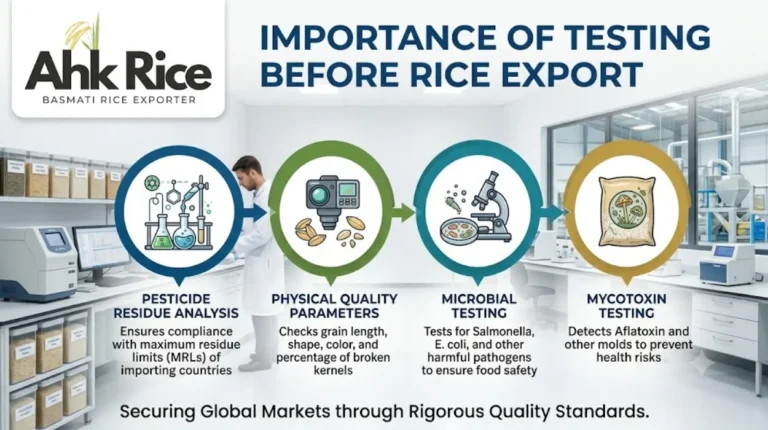
How UK Supermarkets and Asian Grocery Chains Source Rice from Pakistan
UK supermarkets and Asian grocery chains source Pakistani rice through importers, distributors, private-label suppliers, and direct procurement programs. Here is why: buyers specify rice variety, grain length, processing grade, food-safety limits, packaging, documentation, and delivery terms before containers are dispatched from Pakistan.
Pakistan supplies established Basmati varieties to the UK market, including Kernel and Super Basmati types recognised in UK rice classification guidance. UK rules classify rice under heading 1006 according to processing and grain characteristics. Basmati is defined as aromatic, slender, long-grain rice that expands mainly lengthwise during cooking.
UK retail sourcing therefore starts before a container reaches a supermarket warehouse. The commercial chain connects Pakistani cultivation and milling with UK import licensing, customs clearance, food-safety controls, warehousing, retail packaging, and distribution.
What is the UK sourcing process for Pakistani rice?
The UK sourcing process has seven stages: specification, supplier selection, sampling, testing, contracting, shipment, and UK distribution. Each stage connects product quality with import compliance and retail requirements.
Pakistani rice starts with cultivation in Punjab, where farmers grow Basmati varieties suited to aromatic long-grain production. Harvested paddy then moves through drying, milling, grading, sorting, and quality inspection.
UK buyers normally define the specification before purchasing. The specification identifies variety, processing grade, grain length, broken percentage, moisture, packaging, crop year, origin, and required certificates.
The next stage is supplier evaluation. Importers assess milling capacity, inspection procedures, export documentation, packaging capability, production consistency, and shipment history.
Samples establish whether the proposed rice matches the specification. Buyers assess uncooked appearance, aroma, grain uniformity, broken grains, cooking performance, and laboratory results.
Commercial contracts then establish quantity, price, Incoterm, packing, destination, shipment schedule, inspection requirements, and documentation.
Pakistan exporters load approved rice into containers after final inspection. The shipment then moves through the export and UK import process.
UK importers clear the cargo and distribute it through warehouses, wholesalers, supermarket supply chains, Asian grocery networks, restaurants, and foodservice operators.
With the sourcing chain established, the next question is which parties control each stage.
Who are the key participants in UK Pakistani rice sourcing?
Five participant groups shape the supply chain: Pakistani growers, rice mills, exporters, UK importers, and retail or grocery distributors. Each participant controls a different part of sourcing, compliance, or market distribution.
Pakistani growers and rice mills
Pakistani growers cultivate paddy and harvest the crop at maturity. Rice mills then clean, dehusk, polish, grade, sort, and pack the grain according to commercial specifications.
Exporters
Exporters coordinate sourcing, processing, laboratory testing, inspection, packaging, documentation, container loading, and dispatch. AHK Rice operates within this export model and supplies 1121, Super Kernel, and 1509 Basmati rice varieties to international markets.
UK importers
UK importers manage the commercial entry of rice into Britain. Their responsibilities include customs procedures, import documentation, food-safety compliance, warehousing, and onward distribution.
UK rice imports also operate within tariff-rate quota arrangements. The UK Rural Payments Agency published several 2026 rice quota notices, including a September 2026 notice covering applications for the October quota round.
Retailers and Asian grocery chains
Supermarkets purchase through direct procurement, approved suppliers, importers, or private-label arrangements. Asian grocery chains commonly operate through specialist wholesalers and importers that consolidate multiple South Asian food categories.
The sourcing structure determines how rice moves from a Pakistani mill into a UK retail pack.
Which Pakistani rice grades are sourced for UK retail?
UK buyers source several Pakistani Basmati grades, including 1121, Super Kernel, Kernel, and other processed forms such as white, Steam, Sella, and brown rice. The selected grade depends on retail positioning and cooking requirements.
1121 Basmati
1121 Basmati provides long grains and strong visual presentation after cooking. Retailers use white, Steam, Golden Sella, Creamy Sella, and brown formats for different consumer requirements.
Super Kernel Basmati
Super Kernel represents a traditional aromatic Pakistani Basmati category. A commercial specification can target approximately 7.0–7.5 mm raw grain length, controlled moisture, and low broken percentage.
Super Kernel fits retail packs where aroma and traditional Basmati characteristics are central. UK market examples include branded and private-label packs in sizes such as 5 kg and 10 kg. Industry sourcing pages also identify Super Kernel as a UK and European retail product.
1509 Basmati
1509 Basmati provides long grain performance with commercial yield efficiency. Its white, Steam, and Golden Sella formats serve retail, catering, and foodservice applications.
UK buyers select between grades according to grain appearance, cooking behaviour, price positioning, and target consumer.
With the main grades identified, the next stage is understanding how a retail specification becomes export-ready rice.
How is Pakistani rice processed before UK shipment?
Pakistani rice passes through cleaning, dehusking, polishing, grading, sorting, inspection, packing, and container loading before export. Each operation controls a specific physical or commercial characteristic.
- Clean the paddy to remove stones, dust, straw, and other field material.
- De-husk the grain to remove the outer husk and produce brown rice.
- Polish the grain to achieve the required white-rice appearance and surface finish.
- Grade the grain according to size, shape, processing type, and commercial specification.
- Sort by length to separate whole grains, broken grains, and different grain fractions.
- Sort by colour to remove discoloured or visually defective grains.
- Test moisture to verify compliance with the agreed specification.
- Inspect the finished rice for appearance, grain uniformity, foreign material, broken percentage, and other contractual requirements.
- Pack the rice into retail or bulk packaging specified by the buyer.
- Load the containers after final checks and documentation are completed.
UK classification guidance recognises several rice processing states, including husked, milled, glazed, polished, parboiled, and broken rice.
Processing therefore connects the agricultural crop with the exact retail product ordered by the UK buyer.
What certifications and documents do UK rice buyers require?
UK buyers require product specifications, commercial documents, food-safety evidence, laboratory results, and import documentation appropriate to the shipment. The exact document set depends on the product, origin, importer, and applicable controls.
Typical documentation includes:
- Commercial invoice
- Packing list
- Certificate of origin
- Bill of lading
- Laboratory analysis
- Phytosanitary documentation where applicable
- Inspection certificate where required
- Product specification
- Import licence documentation where applicable
- Food-safety compliance records
UK guidance states that cereal imports can face specific import requirements and that Basmati rice is subject to defined UK guidance. UK authorities also maintain rules covering contaminants such as aflatoxins in cereals.
Pakistan-origin rice currently receives specific attention under GB import controls. The FSA’s current listing identifies rice from Pakistan under controls covering pesticide residues, aflatoxins, and ochratoxin A. The page was updated in July 2026.
This makes laboratory testing and traceable documentation important parts of the UK sourcing process.
What benefits does direct Pakistani rice sourcing provide?
Direct Pakistani sourcing gives UK buyers control over variety, specification, processing, packaging, inspection, shipment quantity, and origin documentation. These controls support consistent retail and wholesale procurement.
Specification control
Buyers establish exact grain length, broken percentage, moisture, processing type, and packaging before production.
Processing control
Export mills can process rice according to white, Steam, Sella, brown, or other specified formats.
Packaging control
Retailers can use bulk sacks, consumer packs, printed bags, private-label packaging, or buyer-specific formats.
Origin control
Pakistan-origin documentation connects the finished rice with its producing country and export shipment.
Supply planning
Container-based procurement supports planned replenishment for supermarkets, wholesalers, and grocery chains.
The result is a supply chain where the retail product is defined before export rather than selected after arrival.
Where do UK supermarkets and Asian grocery chains use Pakistani rice?
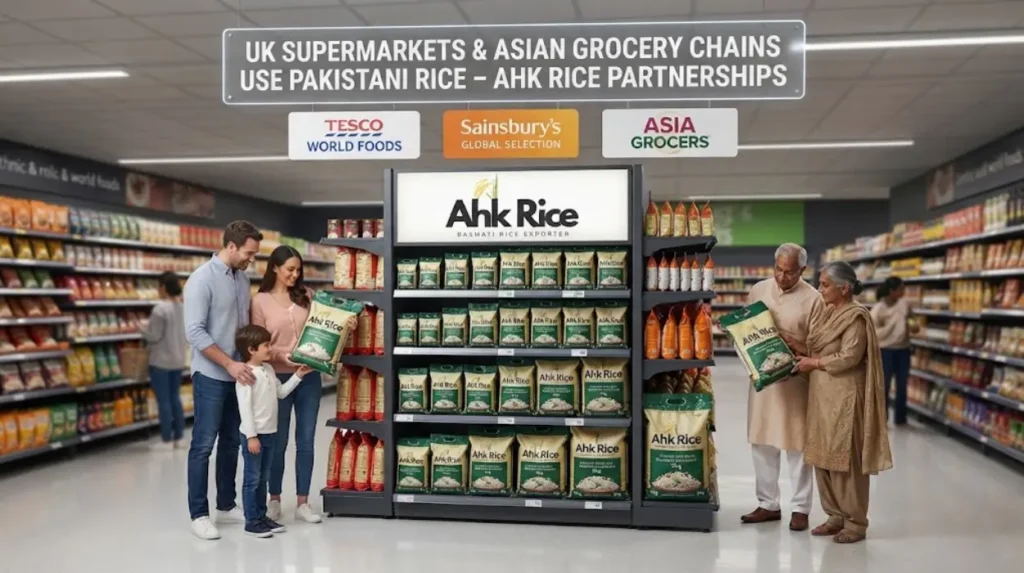
Pakistani rice serves supermarket shelves, Asian grocery stores, wholesalers, restaurants, catering businesses, and private-label food programs across the UK. Each channel applies different specifications and packaging requirements.
Supermarkets commonly require consistent retail presentation, barcode-ready packaging, documented specifications, reliable replenishment, and controlled food-safety compliance.
Asian grocery chains typically carry a wider range of Basmati grades and pack sizes. Products can include 5 kg, 10 kg, 20 kg, and larger trade formats.
Restaurants and catering businesses focus more heavily on cooking performance, grain separation, bulk pack economics, and repeat supply.
Private-label programs require another layer of coordination. The importer or supplier must align rice specification, printed packaging, labelling, product information, shipment quantity, and retail launch schedules.
UK trade examples show Pakistani Basmati moving through both specialist importers and retail distribution channels. Historic UK industry material also documents Pakistani Basmati being imported and milled for branded ethnic retail products.
These use cases explain why one Pakistani rice variety can appear in several UK commercial channels.
What common problems occur when sourcing Pakistani rice for the UK?
The main sourcing problems involve inconsistent specifications, inadequate testing, incorrect documentation, unsuitable packaging, and misunderstanding UK import controls. Each problem can disrupt clearance, retail supply, or product consistency.
Specification mismatch
A buyer orders 1121 but receives grain outside the agreed length or broken percentage. A signed specification and pre-shipment sample reduce this risk.
Food-safety non-compliance
A laboratory result outside an applicable UK limit can create serious import problems. Pakistan-origin rice currently faces controls involving pesticide residues, aflatoxins, and ochratoxin A.
Documentation errors
Incorrect invoices, packing lists, certificates, or import paperwork can delay clearance. Importers should verify documents against the shipment before dispatch.
Packaging errors
Incorrect net weight, labelling, product description, or retail information creates downstream compliance problems. Buyers should approve artwork and packaging specifications before production.
Misunderstanding Basmati
Basmati is not simply a label for long-grain rice. UK guidance defines Basmati through recognised varieties and characteristics, including aromatic, slender grain and lengthwise cooking expansion.
Understanding these problems makes the sourcing process clearer for both supermarkets and specialist grocery chains.
What should UK buyers check before sourcing Pakistani rice?
UK buyers should verify variety, grain specification, processing grade, laboratory compliance, documentation, packaging, inspection, shipment terms, and supplier production capability. These checks connect product quality with successful importation.
A practical sourcing checklist includes:
- Product variety
- Raw grain length
- Broken percentage
- Moisture specification
- Processing grade
- Crop year
- Country of origin
- Laboratory testing
- Packaging format
- Net weight
- Inspection requirements
- Import documentation
- Shipment quantity
- Delivery destination
- Incoterm
For buyers studying how UK demand connects with Pakistani Basmati varieties, the next logical topic is [UK Rice Consumption Trends Driving Demand for Imported Pakistani Basmati in 2026]. The article should connect consumer demand with the grades, channels, and procurement patterns described here.
FAQs About Sourcing Pakistani Rice in the UK
Do UK supermarkets buy rice directly from Pakistan?
Some retail programs use direct procurement, while others purchase through UK importers, distributors, or specialist food suppliers. The commercial structure depends on the retailer’s procurement model and supply requirements.
Which Pakistani rice varieties are sold in the UK?
UK buyers source 1121, Super Kernel, Kernel, 1509, and multiple processed formats. White, Steam, Sella, and brown rice serve different retail and foodservice requirements.
What tests are important for Pakistani rice entering the UK?
Pesticide residues, aflatoxins, and ochratoxin A are important controls for Pakistan-origin rice under current GB import requirements. Buyers should align laboratory testing with the applicable UK controls.
What packaging sizes do UK Asian grocery chains use?
Asian grocery chains commonly use consumer and trade formats ranging from small retail packs to larger wholesale bags. The final size depends on brand positioning, customer demand, and distribution requirements.
Why is supplier specification important?
A written specification defines the exact product that the exporter must process and ship. It controls variety, grain length, broken percentage, moisture, processing grade, packaging, and inspection requirements.