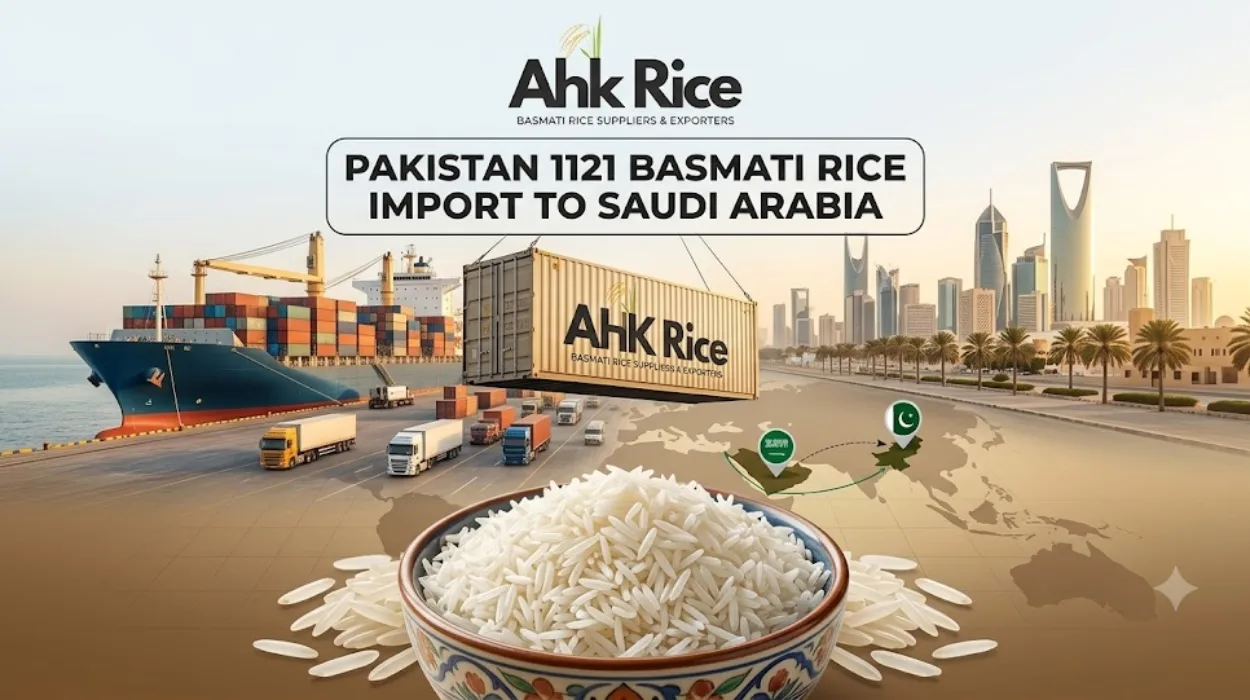
Import High-Purity Pakistan 1121 Basmati Rice into Saudi Arabia
High-purity Pakistan 1121 Basmati Rice is the strongest choice for Saudi importers that need consistent grain appearance, low breakage, controlled moisture, reliable cooking performance, and predictable bulk supply. The right supplier should prove these specifications before shipment, not simply promise premium quality.
For buyers evaluating purity before placing an order, the educational guide on:
Why grain purity matters for extra-long grain Pakistan Basmati Rice in Saudi Arabia explains how varietal consistency affects cooking, appearance, and commercial value. This matters because 1121 Basmati is purchased for its extra-long grain, aroma, elongation, and uniform cooking performance. Saudi buyers can lose margin when a shipment contains excessive mixed grains, broken kernels, discoloration, or inconsistent moisture.
What is the best solution for importing high-purity Pakistan 1121 Basmati Rice?
The best solution is a specification-controlled supply program covering grain purity, length, broken percentage, moisture, sorting, laboratory testing, packaging, documentation, and pre-shipment inspection before every commercial container is released for Saudi Arabia.
A high-purity 1121 program starts with the product specification rather than the price. The importer should define the acceptable grain length, broken percentage, moisture range, purity level, crop requirement, processing grade, packaging, and destination port.
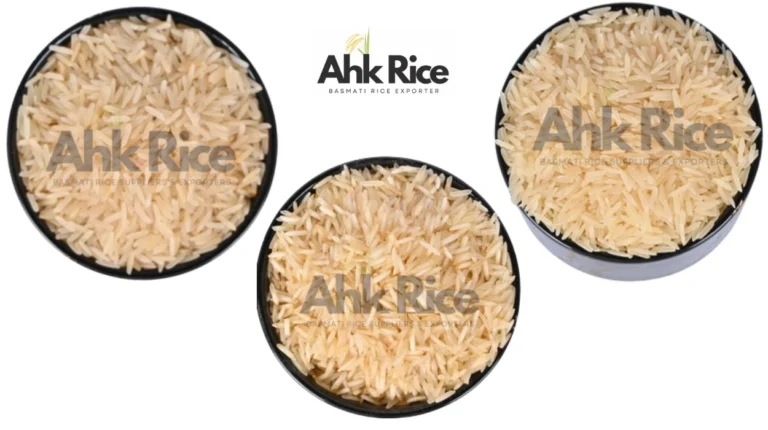
For premium Saudi distribution, 1121 White, 1121 Steam, 1121 Sella, and 1121 Golden Sella can serve different applications. White rice is suitable for retail programs where bright appearance and aroma are important. Steam and Sella grades provide stronger grain structure and can be better suited to foodservice and bulk cooking.
AHK Rice supplies 1121 grades from Pakistan and operates an integrated processing and export model covering paddy procurement, milling, grading, sorting, inspection, packaging, and container loading. Its Saudi export program lists 1121 Basmati among its products and supports delivery to Saudi ports including Jeddah and Dammam.
Purity should also be defined correctly. It is not simply a visual measurement. A commercial purity specification can include varietal conformity, foreign matter, damaged kernels, chalky grains, discoloration, and broken grains. A buyer ordering 1121 Basmati should therefore require a documented specification rather than relying on the term “premium.”
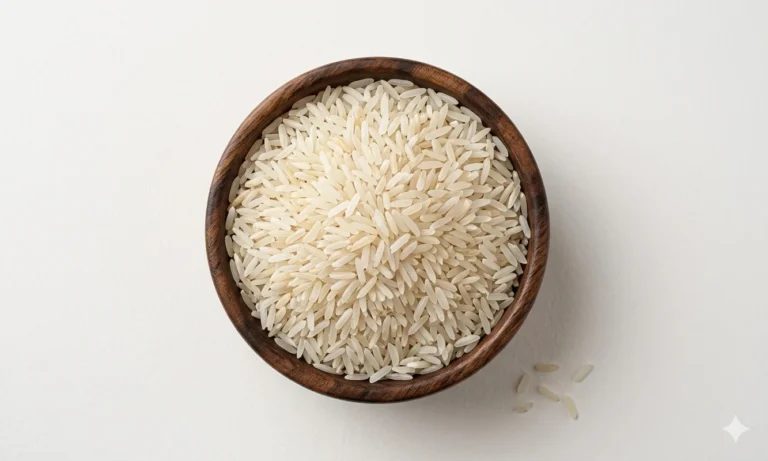
A practical target for a premium contract can be 95–100% purity, depending on the agreed grade and commercial specification. Grain length for Pakistan 1121 is commonly specified around 8.20–8.40 mm before cooking, while moisture commonly sits around 12–14% for export programs. The exact contractual tolerance should always be written into the purchase specification.
The solution is therefore simple in principle: define measurable specifications, verify the sample, reproduce the same specification in production, inspect the finished lot, and only then authorize shipment.
Why choose Saudi Arabia supply from AHK Rice?
Saudi importers need more than a rice mill; they need a supplier that can connect product specifications, processing controls, Saudi documentation, packaging, inspection, and shipping into one repeatable export workflow with clear commercial accountability.
AHK Rice is positioned around this integrated model. The company is based in Bucheki, Nankana Sahib, Punjab, and states that it manages the export chain from paddy procurement through processing and container loading. Its stated markets include Saudi Arabia, while its product range includes 1121, Super Kernel, and 1509 Basmati varieties.
For a Saudi importer, the advantage is specification continuity. The buyer can establish a defined 1121 grade and then use the same requirements for subsequent purchase orders.
The processing sequence is important. Paddy is cleaned first. The grain is then de-husked, milled, polished where required, graded by size, separated for broken kernels, and passed through color sorting. Laboratory checks then verify the agreed parameters before packing and loading. This process reduces the chance that a visually attractive sample is followed by a different commercial shipment.
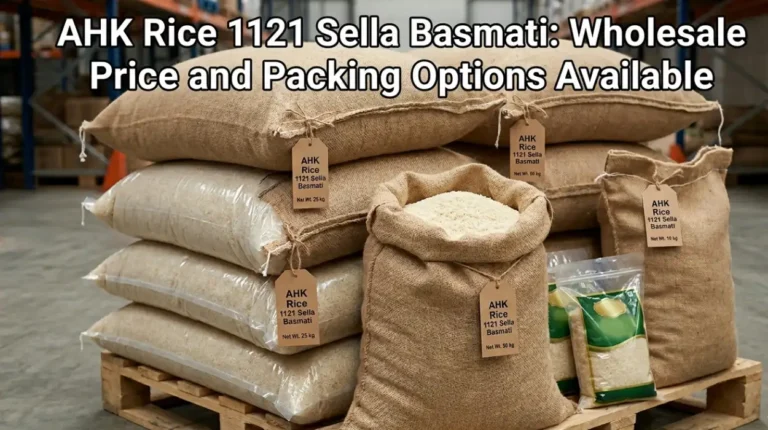
AHK Rice also offers multiple packaging formats. Saudi buyers can specify commercial bags according to their distribution channel, including wholesale formats or smaller retail packaging. Private-label buyers can define their own packaging requirements before production.
Saudi compliance is another critical consideration. The Saudi Food and Drug Authority requires food importers to register their establishment and imported food products, while imported food must comply with applicable Saudi regulations and technical standards. Food labeling requirements reference SFDA.FD/GSO 9 for prepackaged foods, among other regulations.
This makes documentation part of the product specification. A supplier should be able to coordinate the commercial invoice, packing list, certificate of origin, phytosanitary documentation, fumigation documentation, and other certificates required by the buyer or authorities.
AHK Rice also states that third-party inspections can be arranged. For a first commercial order, this provides an additional verification layer when the buyer wants independent confirmation of grain length, purity, moisture, broken percentage, and appearance before loading.
What results can be expected from a high-purity 1121 supply program?
A controlled 1121 procurement program should deliver consistent grain appearance, predictable cooking performance, reduced specification disputes, stronger retail presentation, dependable bulk cooking results, and a repeatable quality benchmark for every subsequent shipment.
Consider a Saudi distributor supplying supermarkets and restaurants. The first shipment contains long, clean grains with low breakage and consistent moisture. If the same specification is reproduced in the next shipment, the distributor can maintain its product positioning without changing cooking instructions or consumer expectations.
For retail, high purity improves visual uniformity inside the package. This is particularly important when the product is positioned as premium Basmati. Mixed grain sizes or excessive broken kernels can weaken the perceived value of the package.
For restaurants and catering operations, grain integrity affects cooking yield. A strong 1121 specification should maintain separation after cooking and provide the elongation expected from extra-long-grain Basmati. Saudi dishes such as biryani, kabsa, and mandi place particular importance on grain appearance and texture.
The commercial benefit is consistency. A buyer does not need the longest possible grain if the rest of the shipment performs poorly. The better decision is a balanced specification that combines grain length, purity, moisture, broken percentage, aroma, and cooking behavior.
Shipping time must also be considered when planning inventory. AHK Rice currently states a 7–14 day sea-transit range from Karachi to Saudi ports on its Saudi export program. This is a transit estimate rather than a complete door-to-door lead time.
A practical planning schedule should therefore separate production from ocean transit:
| Stage | Planning Time |
|---|---|
| Sample dispatch to Saudi Arabia | 3–5 days |
| Production and preparation after approval | 7–10 days |
| Container booking and port preparation | Variable |
| Karachi-to-Saudi ocean transit | About 7–14 days |
| Saudi customs clearance and inland delivery | Variable |
The current Red Sea environment also requires caution when setting delivery promises. Maritime traffic through the Bab el-Mandeb has recently been disrupted by renewed regional security threats, with some vessels rerouting and shipping costs becoming more volatile. Saudi ports such as Jeddah and Yanbu have faced different risk conditions from southern Red Sea ports.
For this reason, importers should treat the 7–14 day figure as a normal transit planning range, not a guaranteed arrival date. The vessel schedule, port congestion, routing, security conditions, customs clearance, and inland transport can change the final delivery date.
For a deeper commercial comparison of purity specifications and their effect on 1121 rice value, buyers can review:
How purity levels affect the market value of Pakistan 1121 Rice in Saudi Arabia.
What affects the price of high-purity Pakistan 1121 Basmati Rice?
The final import price depends on rice grade, purity target, broken percentage, processing method, crop and aging requirements, order volume, packaging, inspection, certificates, Incoterm, freight, insurance, destination port, and current shipping conditions.
There is no responsible single 2026 price for high-purity 1121 Basmati without the buyer’s exact specification. Export quotations change with paddy availability, processing requirements, container rates, currency movements, and vessel schedules.
The first price factor is grade. A 1121 White specification can have a different cost structure from 1121 Steam or Golden Sella because processing requirements and target applications differ.
The second factor is purity. A specification requiring very low foreign matter, tight varietal conformity, low broken percentage, and intensive Sortex sorting can require more processing and yield control.
The third factor is packaging. A bulk 50 kg PP bag has a different cost from printed private-label bags, BOPP packaging, woven bags, or smaller retail formats. Printing, artwork, packaging materials, and production quantities can affect the final price.
The fourth factor is quantity. A full-container order generally produces a different unit economics structure from smaller shipments. Buyers should request quotations in metric tons and specify the exact number of containers.
The fifth factor is Incoterm. FOB Karachi, CFR, and CIF Saudi pricing do not represent the same cost exposure. Under CIF, ocean freight and relevant insurance arrangements are incorporated into the quotation according to the agreed terms.
A commercial sample should therefore be evaluated before comparing supplier prices. A cheaper offer is not necessarily cheaper after accounting for broken rice, inconsistent purity, rejected stock, relabeling, or additional sorting.
What is the full sample process and what does it cost?
A practical sample process is specification confirmation, sample preparation, courier dispatch, Saudi-side testing, buyer approval, commercial quotation, production, inspection, and shipment; sample courier and phytosanitary costs should be confirmed before dispatch.
The process begins when the Saudi buyer sends the exact requirement. This should include 1121 grade, target purity, grain length, broken percentage, moisture, packing, quantity, destination port, and whether third-party inspection is required.
AHK Rice states that samples of up to 20 kg can be provided, while the client covers courier and phytosanitary costs. Its Saudi 1121 product page also indicates a 3–5 day sample dispatch timeline.
The buyer should test the sample for grain length, purity, broken percentage, moisture, aroma, color, cooking elongation, texture, and general appearance. A restaurant or catering buyer should also conduct a cooking trial using the intended preparation method.
The sample cost should not be treated as a fixed published amount because courier charges depend on destination, weight, service level, and the buyer’s courier account. The accurate approach is to obtain the courier and phytosanitary charge before dispatch and record it against the purchase file.
Once the sample passes, the supplier issues the commercial quotation. The buyer confirms quantity, grade, packaging, Incoterm, payment method, inspection requirement, destination port, and delivery schedule.
Production follows approval. The finished rice is then inspected against the agreed specification before container loading. The buyer can request pre-shipment photographs, videos, laboratory results, or an independent inspection where commercially appropriate.
This sample-to-shipment process is important because the approved sample becomes the quality reference. It reduces ambiguity when the buyer places repeat orders.
How should a Saudi importer get started?
Start by sending a complete 1121 specification instead of requesting a generic price; approve the physical sample, confirm testing and documentation, lock the commercial terms, then authorize production and pre-shipment inspection before container loading.
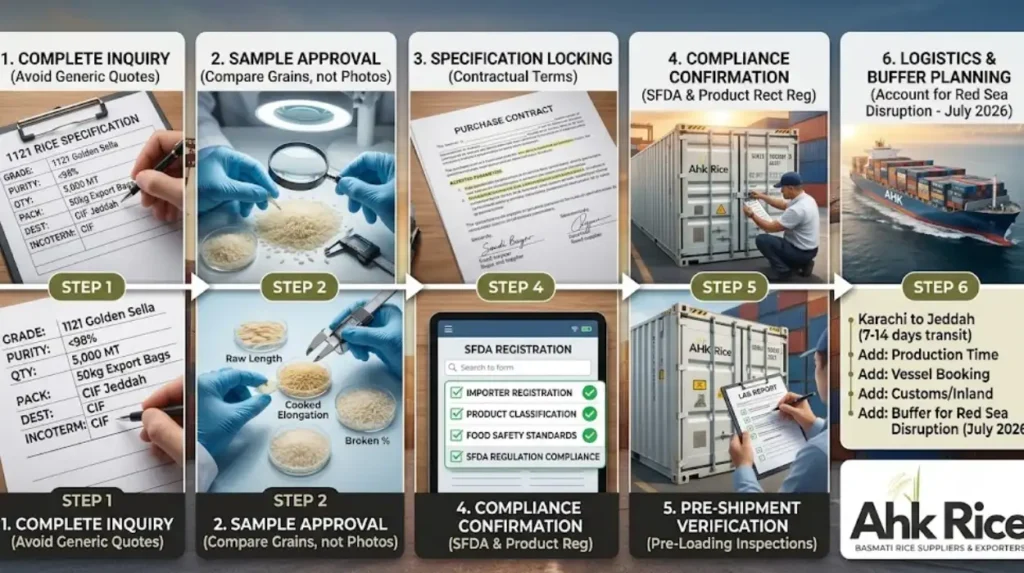
The first inquiry should contain six essential details: 1121 grade, purity requirement, quantity, packaging, destination port, and Incoterm.
For example, a Saudi distributor can request 1121 Golden Sella with a defined purity target, maximum broken percentage, moisture ceiling, 50 kg export bags, CIF Jeddah, and a specific container quantity. This gives the exporter enough information to prepare a meaningful quotation.
The second step is sample approval. Do not approve a supplier based only on photographs. Test the actual grain. Compare raw length, cooked elongation, aroma, color, broken percentage, and cooking behavior.
The third step is specification locking. Put the accepted parameters into the proforma invoice or purchase contract. This creates a measurable standard for production.
The fourth step is compliance confirmation. Saudi importers should verify their SFDA registration and product requirements before shipment. SFDA states that food importers must register imported food products and comply with applicable Saudi regulations and standards.
The fifth step is pre-shipment verification. Request the final laboratory report and inspection evidence before container loading. Where the order value justifies it, an independent inspection can provide an additional safeguard.
The sixth step is logistics planning. Karachi-to-Saudi sea transit may be around 7–14 days under the supplier’s stated normal range, but buyers should add production, vessel booking, port handling, customs, and inland delivery time. Current Red Sea disruption makes schedule buffers particularly important in July 2026.
AHK Rice can therefore be evaluated against the criteria that matter at the decision stage: Pakistani 1121 sourcing, measurable purity specifications, integrated processing, sample approval, export documentation, Saudi delivery capability, customized packaging, and pre-shipment quality verification. AHK Rice’s Saudi export program specifically lists 1121 Basmati and provides a structured sample-to-shipment workflow.
The right buying decision is not simply to choose the supplier offering the lowest price per metric ton. It is to select the supplier that can repeatedly deliver the approved 1121 specification, document its quality, meet Saudi import requirements, and manage shipment execution with transparent commercial terms.
For a Saudi importer ready to confirm the required 1121 purity, quantity, packaging, destination port, and delivery terms, submit the specification and request a quotation.
Frequently Asked Questions
What is high-purity Pakistan 1121 Basmati Rice?
High-purity Pakistan 1121 Basmati Rice is rice produced to a controlled specification for grain length, varietal purity, broken kernels, moisture, appearance, and cooking performance. It is commonly used for premium retail, restaurants, catering, and foodservice applications in Saudi Arabia.
What purity level should Saudi importers request for 1121 Basmati Rice?
Saudi importers should specify the exact purity percentage contractually rather than relying on terms such as premium or high quality. A target of 95–100% purity can be used for premium specifications, subject to the agreed grade and testing method.
What is the typical moisture level for Pakistan 1121 Basmati Rice?
Export specifications commonly target approximately 12–14% moisture, although the exact acceptable range should be agreed between the buyer and supplier. Moisture testing before shipment helps reduce quality and storage risks.
How long does Pakistan 1121 Basmati Rice take to reach Saudi Arabia?
Normal sea transit from Karachi to Saudi ports can be around 7–14 days, according to the supplier’s stated Saudi export range. Total delivery time is longer because production, container booking, port handling, customs clearance, and inland transportation must also be considered.
Which Saudi ports can receive Pakistan 1121 Basmati Rice?
Jeddah and Dammam are important destinations for Saudi rice imports. The appropriate port depends on the buyer’s warehouse location, distribution network, shipping schedule, and freight quotation.
How does AHK Rice verify 1121 Basmati Rice quality?
AHK Rice uses processing, grading, sorting, laboratory testing, and inspection procedures to control product specifications. Buyers can also request sample approval and, where required, third-party pre-shipment inspection before container loading.
Can Saudi importers receive a 1121 Basmati Rice sample before ordering?
Yes. A sample should be evaluated before commercial production. The buyer can assess grain length, purity, broken percentage, moisture, appearance, aroma, cooking elongation, and texture before approving the specification.
How much does a Pakistan 1121 Basmati Rice sample cost?
Sample costs depend on shipment weight, destination, courier service, and phytosanitary requirements. AHK Rice states that the client covers courier and phytosanitary costs, so the exact amount should be confirmed before dispatch.
What packaging options are available for Saudi 1121 Basmati Rice buyers?
Packaging can be selected according to the buyer’s retail or wholesale requirements. Common specifications include bulk export bags, printed bags, BOPP packaging, and private-label formats. Packaging material, size, printing, and order quantity affect the final quotation.
What documents are required to import Pakistan Basmati Rice into Saudi Arabia?
Importers should prepare the applicable commercial and regulatory documentation, which can include a commercial invoice, packing list, certificate of origin, phytosanitary certificate, fumigation documentation, and other certificates required for the specific shipment and Saudi regulations.
What factors determine the price of 1121 Basmati Rice in Saudi Arabia?
Price depends on the 1121 grade, purity target, broken percentage, moisture specification, processing method, crop or aging requirement, order quantity, packaging, inspection, certificates, Incoterm, freight, insurance, and current shipping conditions.
How can Saudi importers avoid receiving lower-purity 1121 Rice?
The buyer should approve a physical sample, define measurable specifications in the purchase contract, require laboratory testing, inspect the finished lot, and verify the shipment before loading. Using the approved sample as the commercial quality reference also reduces disputes.
Is 1121 White better than 1121 Steam or Sella for Saudi Arabia?
There is no single best grade for every buyer. 1121 White can suit premium retail applications where bright appearance and aroma matter, while Steam and Sella grades can provide stronger grain structure for foodservice and bulk cooking. The correct choice depends on the application.
Why does grain purity matter when importing 1121 Basmati Rice?
Grain purity affects appearance, cooking consistency, consumer perception, and commercial value. Excessive mixed grains, broken kernels, foreign matter, or inconsistent grain characteristics can reduce the quality of a premium 1121 Basmati product.
How should a Saudi importer start an order with AHK Rice?
The importer should provide the required 1121 grade, purity target, broken percentage, moisture specification, quantity, packaging, destination port, and preferred Incoterm. The supplier can then provide a sample and commercial quotation for evaluation before production.