LC at Sight vs TT Advance vs CAD: Payment Options for USA Rice Importers
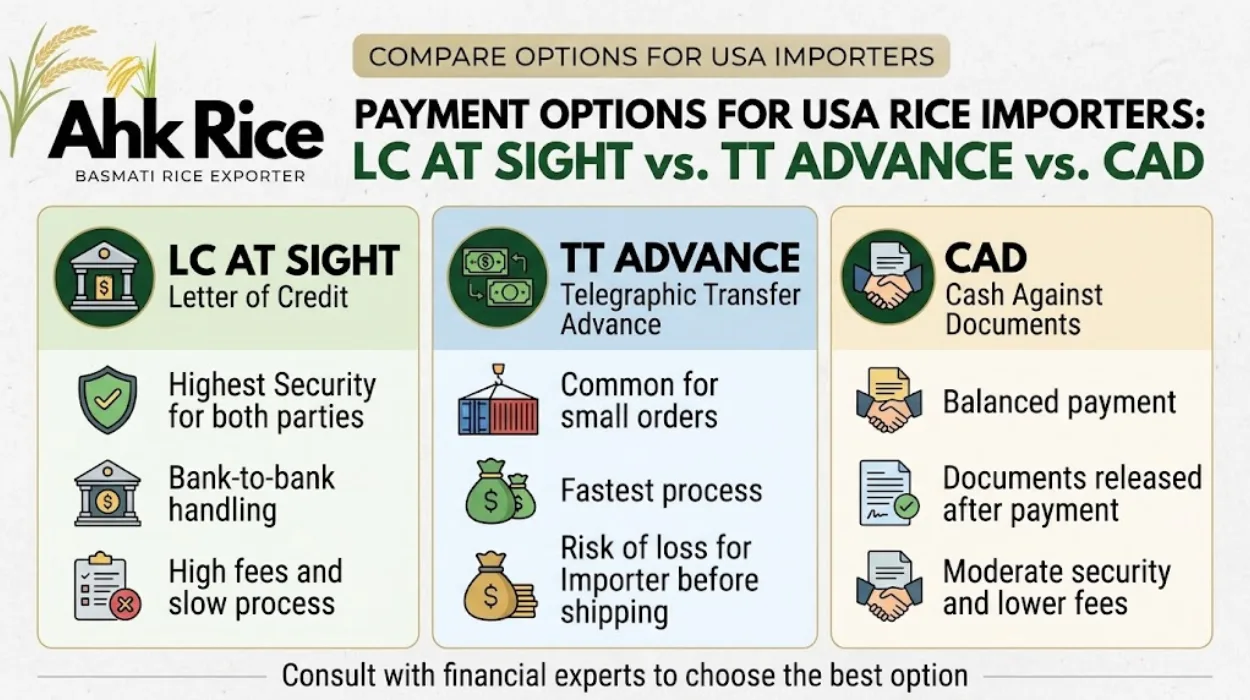
For USA Basmati rice importers, a Letter of Credit (LC) at Sight offers structured bank-mediated payment security, Telegraphic Transfer (TT) Advance gives exporters faster access to funds, and Cash Against Documents (CAD) balances payment and document control without providing the same bank payment guarantee as a documentary credit. The best option depends on supplier trust, shipment value, cash flow, and acceptable risk.
Importing Pakistani Basmati rice involves more than comparing the price per metric tonne (MT). Buyers must evaluate payment timing, documentary requirements, shipment terms, product specifications, and the financial exposure created by each transaction. Understanding how FOB and CIF affect Basmati rice import costs helps importers assess the complete landed-cost picture alongside payment terms. A suitable payment structure protects working capital while establishing clear obligations for both the American buyer and Pakistani exporter.
What payment options can USA rice importers use?
USA rice importers commonly use LC at Sight, TT Advance, and CAD to pay overseas suppliers. Each method allocates financial risk differently between buyer and exporter. Understanding the payment trigger, bank involvement, document control, and working-capital impact helps importers select appropriate terms for their first or repeat Basmati rice shipment.
What is an LC at Sight?
A Letter of Credit at Sight is a documentary credit issued by a bank on behalf of an importer. The issuing bank undertakes to honour a complying presentation under the credit’s terms, subject to its conditions and applicable rules. The exporter receives payment after presenting the required documents and satisfying the documentary requirements.
For a USA importer purchasing Pakistani 1121 Basmati rice, the credit can specify the commercial invoice, packing list, bill of lading, certificate of origin, and other agreed documents. The precise document list depends on the transaction and the import requirements.
The buyer pays bank charges and must arrange the credit before shipment. The exporter gains a bank-mediated payment mechanism, while the importer receives documentary controls. An LC does not guarantee the physical quality of the rice because banks examine documents rather than the goods themselves.
What is TT Advance?
Telegraphic Transfer Advance is an international bank transfer in which the importer pays before the exporter ships the goods. TT describes the transfer method, while advance describes the timing of payment. The parties can agree to full advance payment or a deposit followed by a balance before shipment.
For example, an American distributor may pay a deposit to secure 1509 Basmati rice production and transfer the remaining balance after receiving agreed pre-shipment documents. This arrangement gives the exporter funds for procurement, processing, and packaging.
TT Advance generally involves fewer documentary procedures than an LC. However, the importer carries greater exposure if the supplier delays shipment, delivers nonconforming goods, or fails to perform. Supplier verification, a signed sales contract, a defined inspection process, and clear refund provisions are essential safeguards.
What is CAD?
Cash Against Documents, also called Documents Against Payment (D/P) under documentary collection procedures, requires the buyer to pay through the collecting bank to obtain specified shipping documents. Banks handle the collection but do not normally guarantee payment as they would under a complying letter of credit.
The exporter ships the rice and sends the documents through the banking channel. The collecting bank releases the documents to the importer after payment according to the collection instructions. The importer then uses the relevant documents to arrange cargo release.
CAD provides more document control than an unsecured open-account arrangement, but it does not eliminate commercial risk. The buyer may face storage, demurrage, or resale costs if the goods arrive before payment is arranged. The exporter also retains the risk that the buyer refuses the documents.
How do LC at Sight, TT Advance, and CAD compare?
LC at Sight prioritises documentary compliance and bank-mediated payment, TT Advance prioritises payment speed and exporter liquidity, and CAD prioritises payment-linked document release. Their differences affect fees, cash flow, dispute exposure, and operational complexity, so importers should compare all seven attributes before agreeing to terms.
| Comparison attribute | LC at Sight | TT Advance | CAD / D/P |
|---|---|---|---|
| Payment trigger | Complying document presentation under the credit | Agreed advance payment or pre-shipment balance | Payment against documents through banks |
| Bank payment undertaking | Yes, from the issuing bank under the credit’s terms | No documentary-credit undertaking | No standard bank guarantee of payment |
| Importer cash flow | Funds or credit capacity committed under bank arrangements | Cash committed before shipment | Cash paid when documents are presented |
| Exporter payment security | Stronger when documents comply and the issuing bank is reliable | Strong after funds are received | Depends on buyer payment and document collection |
| Documentation | Detailed, credit-specific documents | Contractual and banking transfer records | Collection instruction and shipping documents |
| Cost and administration | Generally higher | Generally simpler and less administratively intensive | Moderate collection administration |
| Best-fit situation | Larger orders or transactions requiring structured controls | Trusted suppliers and buyers with sufficient liquidity | Established trade relationships with acceptable refusal risk |
Actual costs depend on the banks, credit terms, transaction value, currency, and agreed allocation of fees. An LC can still expose the importer to documentary discrepancies, while TT and CAD leave different forms of supplier or buyer performance risk.
Which payment method works best for different importers?
The best payment method depends on the importer’s experience, order size, supplier relationship, financing capacity, and ability to manage documentary requirements. New buyers benefit from stronger contractual and documentary controls, while established importers can negotiate simpler terms when transaction history, inspection procedures, and supplier performance support a lower-risk arrangement.
When should an importer choose LC at Sight?
LC at Sight suits importers purchasing large consignments, establishing a new supplier relationship, or operating under internal procurement policies that require bank-mediated payment. It creates a defined documentary process and a payment undertaking from the issuing bank, subject to the credit’s conditions.
Consider an American wholesaler ordering 100 MT of 1121 Basmati rice for distribution across several states. The buyer can specify the shipment period, quantity, packaging, documents, and quality-related certificates in the contract and credit. The importer must ensure that every required document is achievable and consistent with the sales agreement.
The main disadvantage is administration. Bank fees, credit limits, amendments, and documentary discrepancies can increase costs or delay payment. An LC is most effective when the buyer and exporter agree on realistic documents before opening the credit.
When is TT Advance the practical choice?
TT Advance works well when the importer has verified the exporter, the order value fits the buyer’s cash-flow capacity, and both parties have a reliable trading history. It also suits smaller trial orders when the buyer accepts the agreed advance exposure and has contractual protection.
For instance, a specialist grocery importer might order 10 MT of Super Kernel Basmati rice for a regional retail launch. A negotiated deposit can help reserve production and packaging capacity, with the balance payable against agreed evidence of readiness.
The buyer should verify the exporting business, beneficiary bank details, product specification, delivery schedule, and refund terms before transferring funds. Paying the entire amount upfront to an unfamiliar supplier increases exposure because a bank transfer alone does not establish that the goods meet the contract.
When does CAD make sense?
CAD suits transactions where the exporter wants to retain control of shipping documents until payment and the importer can arrange funds promptly after shipment. It is more suitable for buyers who understand document collection procedures and have assessed the consequences of refusing a shipment.
For example, a repeat USA importer purchasing 1509 Basmati rice may use CAD when previous shipments have met agreed specifications and the buyer can pay when documents arrive. The importer should confirm the collection instructions, expected document arrival, cargo arrival date, and port charges.
CAD is not a substitute for a letter of credit when the buyer needs an issuing bank’s payment undertaking. It also does not give the importer an automatic right to inspect the rice before paying. Independent pre-shipment inspection and clear quality clauses remain important.
How do payment terms compare across the USA and Gulf markets?
USA and Gulf importers use the same fundamental payment instruments, but their procurement structures and distribution models can influence which terms they accept. Large retail programmes often require documented controls, while established regional wholesalers may prioritise transaction speed, available working capital, and repeat-supplier relationships.
USA market: retail, wholesale, and foodservice
American importers supplying supermarket chains, private-label programmes, and institutional foodservice need consistent specifications, traceability, and reliable delivery documentation. LC at Sight can fit larger first-time purchases where bank-mediated payment is required. TT Advance can suit smaller trial orders with a verified supplier, while CAD can work for repeat transactions when payment and document handling are predictable.
Indicative commercial planning should separate the rice price from freight, insurance, customs brokerage, duties, testing, port charges, and inland delivery. The final price per MT depends on variety, grade, broken percentage, moisture, packaging, volume, shipment timing, and Incoterm. No single payment method establishes the market price of 1121, Super Kernel, or 1509 Basmati rice.
Shelf life also depends on the product and storage conditions rather than the payment instrument. Properly milled white Basmati rice commonly has a commercial shelf life of approximately 18–24 months when sealed and stored in cool, dry conditions, subject to validated packaging and product specifications. Brown rice generally has a shorter shelf life because its bran layer contains more oil.
Gulf market: wholesale, retail, and re-export
Gulf markets, including the UAE and Saudi Arabia, serve retailers, foodservice distributors, wholesalers, and re-export businesses. Premium 1121 and Super Kernel grades suit buyers targeting long-grain presentation and aroma, while 1509 can support price-sensitive bulk distribution and selected foodservice applications.
TT Advance may be practical for established buyers with regular shipments and predictable payment cycles. CAD can suit repeat buyers who can pay promptly against documents. LC at Sight provides a structured option for larger orders where the parties require documentary controls and a bank undertaking.
Price comparisons must use the same commercial basis. An FOB Karachi quote excludes the main ocean freight and destination costs paid by the buyer, while a CIF quote includes cost, insurance, and freight to the named destination port. Buyers should request comparable quotations for the same variety, grade, packaging, volume, shipment period, and Incoterm.
Properly stored white Basmati rice commonly uses an 18–24-month planning range, while brown rice generally requires a shorter shelf-life specification. The importer should confirm the production date, best-before date, storage instructions, and remaining shelf life required at arrival. Local labelling and food-import requirements must also be checked independently of payment terms.
What are the main advantages and disadvantages of each payment method?
LC at Sight strengthens documentary payment controls, TT Advance simplifies payment but shifts more pre-shipment exposure to the buyer, and CAD links document release to payment without guaranteeing buyer performance. The right choice depends on which risk each party can afford to carry and how effectively the sales contract addresses shipment and quality disputes.
| Payment method | Main advantage | Main disadvantage | Practical example |
|---|---|---|---|
| LC at Sight | Bank-mediated payment against compliant documents | Higher fees and strict documentary requirements | A first-time importer orders a large 1121 shipment |
| TT Advance | Fast, straightforward transfer and early supplier funding | Buyer pays before confirming final delivery | A verified supplier produces a small Super Kernel trial order |
| CAD / D/P | Documents are generally released against payment | Buyer can refuse payment and banks do not guarantee it | A repeat importer pays when shipment documents arrive |
| LC with inspection clauses in the sales contract | Separates agreed quality checks from documentary payment controls | Inspection wording and evidence must be carefully defined | A retailer specifies independent pre-shipment inspection |
| Deposit plus balance by TT | Shares initial funding and payment timing | The buyer still carries advance-payment exposure | A wholesaler pays a deposit and settles the balance after agreed shipment evidence |
Inspection requirements must be written into the contract and coordinated with the payment mechanism. Banks examine documents under an LC; they do not independently verify the rice’s aroma, grain length, broken percentage, or cooking performance. Buyers should use agreed specifications and suitable independent inspection where product conformity is critical.
What factors should USA rice importers evaluate before choosing payment terms?
Importers should assess supplier reliability, order value, available credit, document requirements, inspection arrangements, and the cost of delayed cargo release before choosing payment terms. Comparing these factors with the consequences of non-delivery or buyer refusal helps both parties select a method that supports a sustainable trading relationship.
The following decision framework provides a practical starting point:
| Decision factor | If this is the priority | Payment approach to evaluate |
|---|---|---|
| New supplier relationship | Structured bank-mediated payment | LC at Sight |
| Strong supplier history | Simplicity and quick transfers | TT Advance |
| Payment against shipping documents | Controlled document release | CAD / D/P |
| Limited working capital | Preserve cash before shipment | Negotiate a deposit, credit facility, or suitable bank terms |
| Strict documentary procurement policy | Defined documentary conditions | LC at Sight with pre-agreed documents |
These are starting points, not automatic rules. An importer should compare the total transaction cost, including bank fees, financing costs, inspection, insurance, and potential port delays. The sales contract must specify quantity, quality, packaging, shipment dates, inspection arrangements, claims deadlines, governing terms, and the procedure for resolving disputes.
How should buyers structure a first Basmati rice order with AHK Rice?
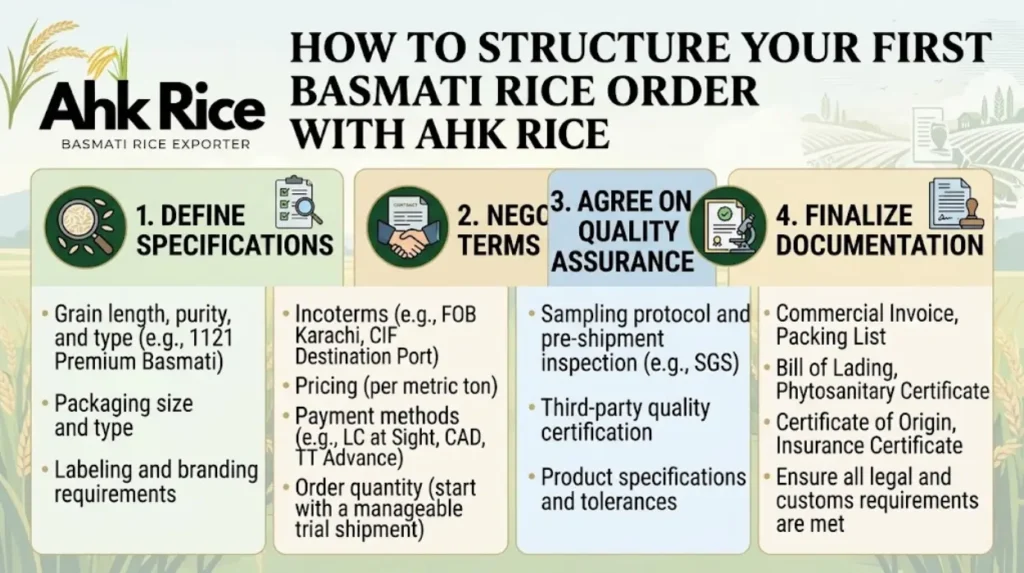
A first order should begin with a confirmed rice specification, a written quotation, an agreed inspection process, and payment terms that both parties can meet. AHK Rice supplies Pakistani 1121, Super Kernel, and 1509 Basmati rice, with processing, custom packaging, and export coordination tailored to the agreed order and destination requirements.
Buyers should confirm the variety, raw grain length, broken percentage, moisture limit, processing type, bag weight, total quantity, and required certificates. The contract should also identify the Incoterm, shipment window, payment trigger, bank charges, document list, and procedure for handling discrepancies. These details help align the commercial offer with the buyer’s retail, wholesale, or foodservice requirements.
AHK Rice can discuss the payment structure alongside the product specification and shipment plan. Importers should provide their destination port, expected order volume, preferred packaging, and documentary requirements when requesting a quotation. The chosen payment method should reflect the buyer’s financial capacity and supplier verification rather than being selected solely because it is common in international trade.
Frequently Asked Questions
What is the difference between LC at Sight, TT Advance, and CAD?
LC at Sight provides a bank’s payment undertaking subject to the credit’s terms and compliant documents. TT Advance requires the buyer to transfer funds before shipment or at another agreed advance-payment milestone. CAD requires payment through the banking collection process to obtain specified shipping documents, but it does not normally provide a bank payment guarantee.
Which payment method is safest for first-time USA rice importers?
LC at Sight provides a structured payment mechanism for first-time transactions because the issuing bank undertakes to pay against a complying documentary presentation. Buyers must still verify the exporter, agree on product specifications, and arrange suitable quality inspections. An LC does not guarantee the physical quality of the rice.
Is TT Advance suitable for importing Pakistani Basmati rice into the USA?
TT Advance suits buyers who have verified their suppliers and can manage the financial exposure of paying before shipment. Importers should confirm the supplier’s identity, beneficiary bank details, rice specifications, delivery schedule, and refund provisions before transferring funds.
How does CAD payment work in Basmati rice exports?
Under CAD, the exporter ships the rice and sends the agreed shipping documents through the banking channel. The collecting bank releases the documents to the importer after payment under the collection instructions. The bank facilitates document collection but does not normally guarantee that the buyer will pay.
Which payment method has the lowest transaction cost?
TT Advance generally involves less documentary administration than LC at Sight. However, the total cost depends on bank transfer charges, currency conversion, financing, and contractual arrangements. CAD involves collection fees, while an LC can include issuance, amendment, and document-handling charges.