What Payment Terms Are Used When Importing Basmati Rice from Pakistan?
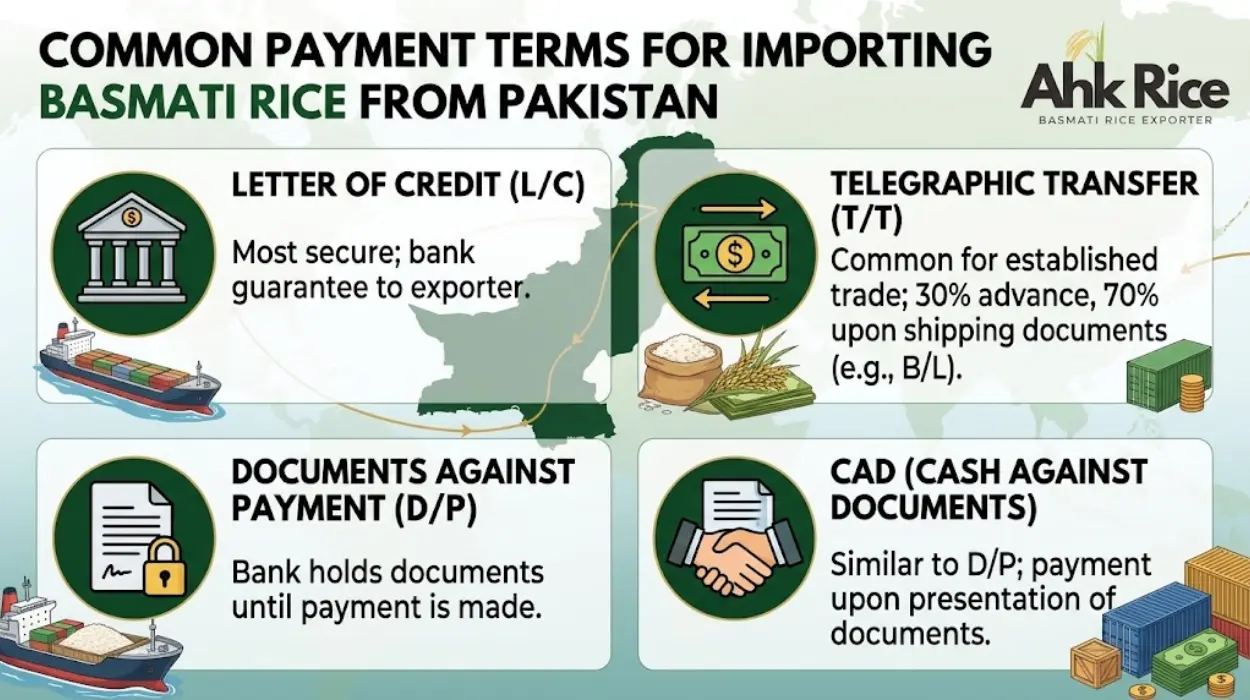
Payment terms define when a buyer pays a Pakistani rice exporter, how funds move between countries, and which documents control the transaction. Importers commonly use Letters of Credit (LC), Telegraphic Transfers (TT), and Cash Against Documents (CAD). Each method allocates payment risk differently between the buyer and seller.
When importing Pakistani Basmati rice, payment arrangements depend on order value, supplier verification, banking requirements, shipment documents, and the agreed Incoterm. Buyers sourcing 1121, Super Kernel, and 1509 Basmati rice also need clear specifications, including grain length, broken percentage, moisture content, processing type, and packaging. Understanding payment terms helps importers assess costs, manage working capital, and establish transparent international trade agreements.
What Are Payment Terms When Importing Basmati Rice from Pakistan?
Payment terms are contractual conditions that specify when an importer pays for rice, which payment method applies, and what conditions trigger payment. They define the responsibilities of both parties and establish the financial process for completing an international shipment.
In Pakistani rice exports, payment terms form part of the commercial agreement between the exporter and overseas buyer. The agreement identifies the product, quantity, price, currency, payment deadline, banking charges, and documents required to release funds.
For example, a US importer purchasing 25 metric tonnes of 1121 Basmati can agree to pay the full amount in advance through TT. Another importer purchasing the same quantity can arrange an LC through a bank, subject to the bank’s approval and the agreed documentary conditions.
Payment terms are separate from shipping terms. FOB Karachi defines the seller’s delivery responsibilities under the agreed Incoterms rules, while payment terms establish how and when the buyer settles the invoice. A contract must define both clearly.
How Does the Payment Process Work for Pakistani Basmati Rice Exports?
The payment process begins with a quotation and agreed specifications, followed by a sales contract, banking arrangements, rice processing, shipment, document presentation, and settlement. The exact sequence depends on whether the buyer uses advance payment, a Letter of Credit, or CAD.
Step 1: Agree on the Product and Price
The buyer and exporter confirm the rice variety, grade, quantity, packing, price, destination, and delivery conditions. Product specifications identify measurable requirements, such as grain length, moisture content, broken percentage, and processing method.
For example, an importer ordering 1121 Golden Sella Basmati specifies the required grade, bag size, quality limits, and shipment quantity before approving the order.
Step 2: Sign the Sales Contract
The sales contract records the agreed commercial terms. It identifies the buyer and seller, payment method, payment deadline, shipment schedule, inspection requirements, and documents required for settlement.
The contract also addresses discrepancies, claims, and procedures for resolving disputes.
Step 3: Arrange the Payment
The buyer instructs its bank to transfer funds, issue an LC, or process another agreed payment arrangement. The exporter confirms the relevant banking conditions before committing to production or shipment.
Step 4: Process and Ship the Rice
The exporter arranges milling, grading, sorting, packing, and quality checks according to the contract. After shipment, the exporter obtains the required transport and export documents.
Step 5: Complete Settlement
Payment follows the agreed method. An advance TT settles funds before shipment, an LC pays against a complying documentary presentation under its terms, and CAD releases documents through a documentary collection arrangement after the buyer pays.
What Are the Main Payment Methods Used in Pakistani Rice Exports?
The 3 important payment methods are Telegraphic Transfer (TT), Letter of Credit (LC), and Cash Against Documents (CAD). They differ in payment timing, bank involvement, document handling, transaction costs, and the level of protection available to importers and exporters.
Telegraphic Transfer (TT)
A Telegraphic Transfer is an electronic bank transfer used to send money internationally. Exporters and importers use TT for advance payments, deposits, and balances due under agreed contracts.
For example, a buyer pays a 30% deposit before production and transfers the remaining 70% before shipment. Another contract requires full payment before processing begins.
TT offers a straightforward payment process, but an advance transfer does not independently guarantee product quality or delivery. Buyers should verify the supplier, confirm specifications in writing, and establish refund or dispute provisions before transferring funds.
Letter of Credit (LC)
A Letter of Credit is a bank undertaking to pay the exporter when the beneficiary presents documents that comply with the credit’s terms and conditions. Banks examine documents rather than physically inspecting the rice.
An LC at sight generally provides payment after a complying presentation has been examined and accepted under the credit’s terms. The exact timing depends on the credit wording and banking procedures.
For example, a US importer purchasing a container of Pakistani Basmati asks its bank to issue an LC in favour of the exporter. The credit specifies the invoice, packing list, transport document, and other required certificates.
An LC adds documentary controls and bank involvement. It also creates issuance, amendment, and processing costs. Incorrect documents or inconsistent terms delay payment.
Cash Against Documents (CAD)
Cash Against Documents is a documentary collection arrangement in which the exporter sends shipping documents through banks with instructions to release them to the buyer against payment.
For example, a Pakistani exporter ships Super Kernel Basmati and forwards the documents through its bank. The collecting bank releases the documents to the US importer after receiving payment.
Banks handle the documents and collection instructions but do not provide the same independent payment undertaking as an LC. CAD therefore exposes the exporter to the risk that the buyer refuses to pay or collect the documents.
What Factors Determine the Right Payment Terms?
The appropriate payment method depends on supplier credibility, order value, buyer liquidity, banking costs, destination requirements, and the negotiating strength of both parties. Importers should compare these factors before signing a contract or authorising an international transfer.
Supplier and Buyer History
Established trading relationships support negotiated payment arrangements because both parties understand each other’s performance and procedures. First-time buyers require stronger verification, clear documentation, and carefully defined contractual protections.
Order Value and Cash Flow
A large rice shipment ties up more working capital than a small trial order. Advance payment reduces the exporter’s collection risk but increases the buyer’s exposure before delivery.
An LC adds bank costs but provides a documentary payment mechanism. CAD avoids the need for an LC but does not guarantee payment.
Banking and Currency Costs
International transfers, LC issuance, document handling, amendments, and foreign exchange conversion create transaction costs. The contract should identify which party pays each banking charge and which currency applies.
Product Specifications and Inspection
Payment arrangements should align with agreed quality checks. Contracts can identify inspection procedures, sampling methods, certificates, and acceptance criteria.
For instance, a buyer ordering 1509 Basmati can specify maximum moisture, broken percentage, packing weight, and inspection requirements. These details reduce disputes over whether the delivered product meets the contract.
What Are the Benefits of Clear Payment Terms?
Clear payment terms improve financial planning, establish documentary responsibilities, reduce avoidable disputes, and help both parties manage shipment obligations. Their value comes from written conditions that define payment timing, required documents, banking costs, and remedies for non-compliance.
For importers, a documented payment schedule supports cash-flow planning and helps align payments with inventory purchasing and distribution. LC conditions provide a structured documentary process, while TT can simplify settlement when the supplier relationship and contract provide adequate safeguards.
For exporters, clear terms establish when production funding becomes available and when outstanding invoices are due. They also reduce uncertainty about document presentation and collection procedures.
Both parties benefit from consistent records. The quotation, sales contract, commercial invoice, packing list, transport document, and payment instructions should identify the same product, quantity, price, and shipment details.
Clear payment conditions do not eliminate commercial risk. They establish procedures for managing it.
What Problems Occur When Importers Choose Payment Terms?
Common problems include paying unverified suppliers, using inconsistent contract details, misunderstanding bank guarantees, submitting incorrect shipping documents, and overlooking currency or collection risks. Written agreements, independent verification, and careful document checks reduce these problems.
Paying Before Verifying the Exporter
Advance TT exposes the buyer to delivery risk. Importers should verify the company’s identity, export history, banking details, and contractual authority before transferring funds. Changes to bank details require independent confirmation through a trusted communication channel.
Assuming an LC Guarantees Rice Quality
An LC is a documentary banking instrument, not a physical quality guarantee. Banks examine the documents specified in the credit rather than independently testing grain length, aroma, moisture, or purity.
Importers should arrange appropriate inspection and laboratory testing separately when required by the contract.
Treating CAD as a Bank Payment Guarantee
CAD does not require the collecting bank to pay the exporter if the buyer refuses the documents. The exporter retains collection risk, while the buyer must understand the document-release process and destination-country clearance requirements.
Preparing Inconsistent Documents
Differences in company names, invoice amounts, quantities, shipment dates, or product descriptions create documentary delays. LC transactions require particular attention because discrepancies can prevent payment under the credit until resolved.
Confusing Payment Terms with Import Compliance
Payment completion does not establish that rice meets every destination-country requirement. US importers must separately assess applicable Food and Drug Administration (FDA) requirements, customs procedures, food safety obligations, and labelling rules.
How Do Payment Terms Apply to Different Basmati Rice Varieties?
Payment terms generally apply across Basmati varieties, but product specifications, order quantities, packaging, inspection requirements, and shipment values influence negotiations. Importers should connect the payment schedule to the precise grade and quantity identified in the contract.
1121 Basmati Rice
1121 Basmati is known for its long grains and cooked elongation. Importers purchasing Steam, Golden Sella, Creamy Sella, or Brown variants should define the processing type and required specifications before agreeing on payment.
Super Kernel Basmati Rice
Super Kernel Basmati is valued for its characteristic aroma and suitability for retail and foodservice markets. Contracts should identify grain specifications, broken percentage, moisture limits, and packaging requirements.
1509 Basmati Rice
1509 Basmati is associated with relatively short crop maturity and commercial suitability across different market segments. Buyers should specify whether they require white, Steam, or parboiled rice and establish the relevant quality requirements.
These varieties do not automatically require different payment methods. The commercial value, buyer-seller relationship, and agreed contract conditions determine the payment arrangement.
Which Documents Support Payment for Pakistani Basmati Rice?
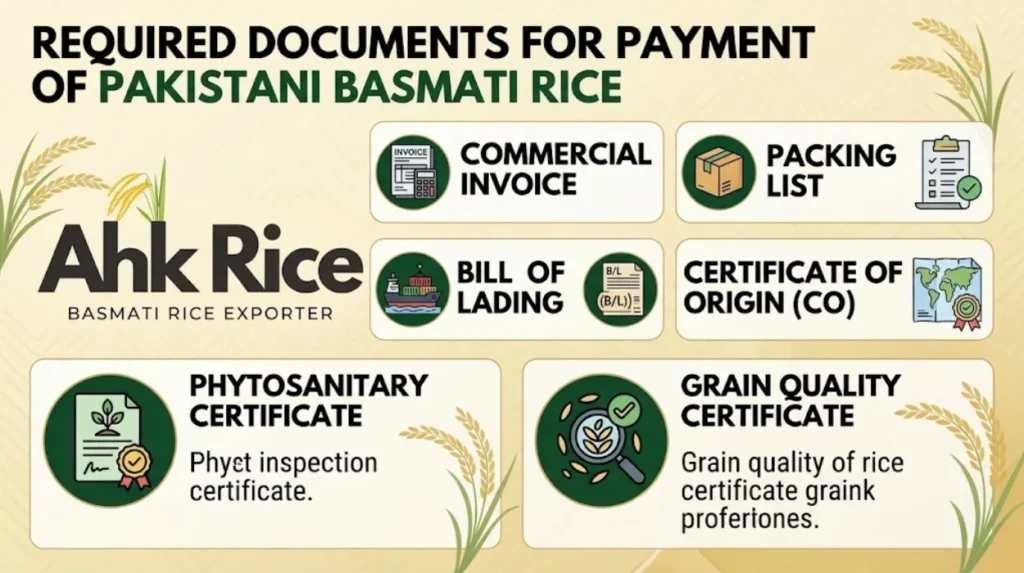
Export payment documentation establishes the commercial value, shipment details, product description, and compliance evidence required by the contract. Common documents include the commercial invoice, packing list, transport document, certificate of origin, and any specifically required inspection or phytosanitary certificates.
The commercial invoice records the seller, buyer, product, quantity, unit price, total value, and payment conditions. The packing list identifies package counts, weights, and packing details.
A bill of lading or other applicable transport document provides shipment evidence according to the transport arrangement. A certificate of origin identifies the declared country of origin when required.
Depending on the product and destination, authorities or buyers also require phytosanitary documentation, inspection certificates, laboratory reports, or food safety records. The exact requirements depend on the destination, product, and transaction.
For LC shipments, the exporter must prepare the documents specified in the credit. For TT and CAD transactions, the contract and collection instructions determine which documents are required and how they are delivered.
How Can US Importers Compare LC, TT Advance, and CAD?
US importers should compare payment timing, documentary control, bank fees, supplier risk, and working-capital requirements before selecting a method. Each option serves different commercial circumstances, so the sales contract must define the selected arrangement and its conditions.
A first-time buyer prioritising documentary controls can evaluate an LC at sight. An importer working with a verified supplier can consider TT under a clearly documented payment schedule. CAD provides a documentary collection route when both parties accept the risk of payment refusal.
The best choice depends on the transaction rather than the rice variety alone. Importers should also account for freight, insurance where applicable, customs charges, inspection expenses, and other landed costs separately from the rice payment.
For a detailed comparison of documentary credits and transfer-based arrangements, consult the guide to [LC at sight, TT advance, and CAD payment options for US rice importers] (insert the MOFU article link here). This comparison helps buyers evaluate payment methods against their purchasing and cash-flow requirements.
What Should Importers Confirm Before Agreeing to Payment Terms?
Importers should confirm supplier identity, product specifications, total price, payment deadlines, bank charges, shipment responsibilities, document requirements, and dispute procedures. Recording these details in the signed contract creates a clear reference for both parties throughout the export transaction.
Before payment, buyers should verify that the beneficiary’s bank details match the contracted exporter and confirm the agreed currency. They should review the payment trigger, shipment schedule, inspection requirements, and process for resolving discrepancies.
For larger transactions, importers should obtain advice from their bank and trade professionals about documentary requirements and applicable rules. US buyers should also confirm import compliance obligations before shipment.
Payment terms are a core part of international rice trading. A well-defined agreement connects financial obligations with product specifications, shipping documents, and delivery responsibilities. This structure helps importers purchase Pakistani Basmati rice with a clearer understanding of their financial exposure and contractual obligations.
Frequently Asked Questions
What payment methods are used when importing Basmati rice from Pakistan?
The main payment methods are Telegraphic Transfer (TT), Letter of Credit (LC), and Cash Against Documents (CAD). Each method has different payment conditions, banking costs, and risk allocations for importers and exporters.
What is the safest payment method for importing Pakistani rice?
A Letter of Credit can provide stronger documentary payment controls when issued by an acceptable bank with clearly defined conditions. However, it does not guarantee the physical quality of the rice or eliminate every commercial risk.
What does TT advance payment mean in rice exports?
TT advance payment means the importer transfers money electronically before the exporter ships the rice. The contract can require full advance payment or an initial deposit followed by a balance payment at an agreed stage.
What is the difference between LC at sight and TT advance?
An LC at sight involves a bank undertaking to pay against a complying documentary presentation under the credit’s terms. TT advance requires the buyer to transfer funds before the agreed shipment or production milestone without the same documentary payment undertaking.
How does Cash Against Documents work in Pakistani rice exports?
Under CAD, the exporter sends shipping documents through banks with instructions to release them to the buyer against payment. The collecting bank handles the documents and collection but does not guarantee payment if the buyer refuses the transaction.