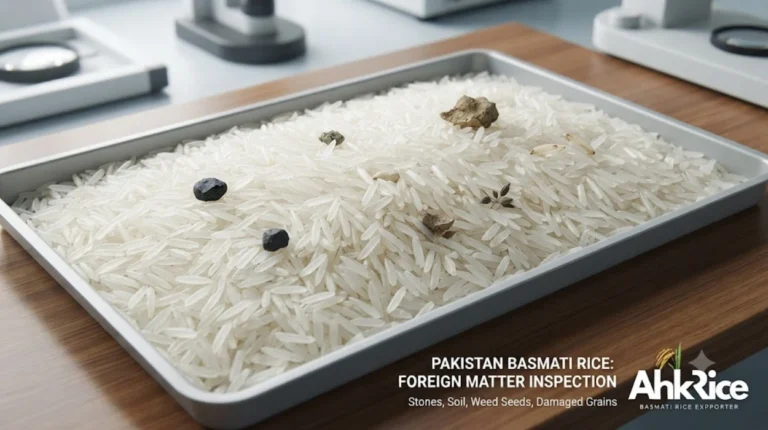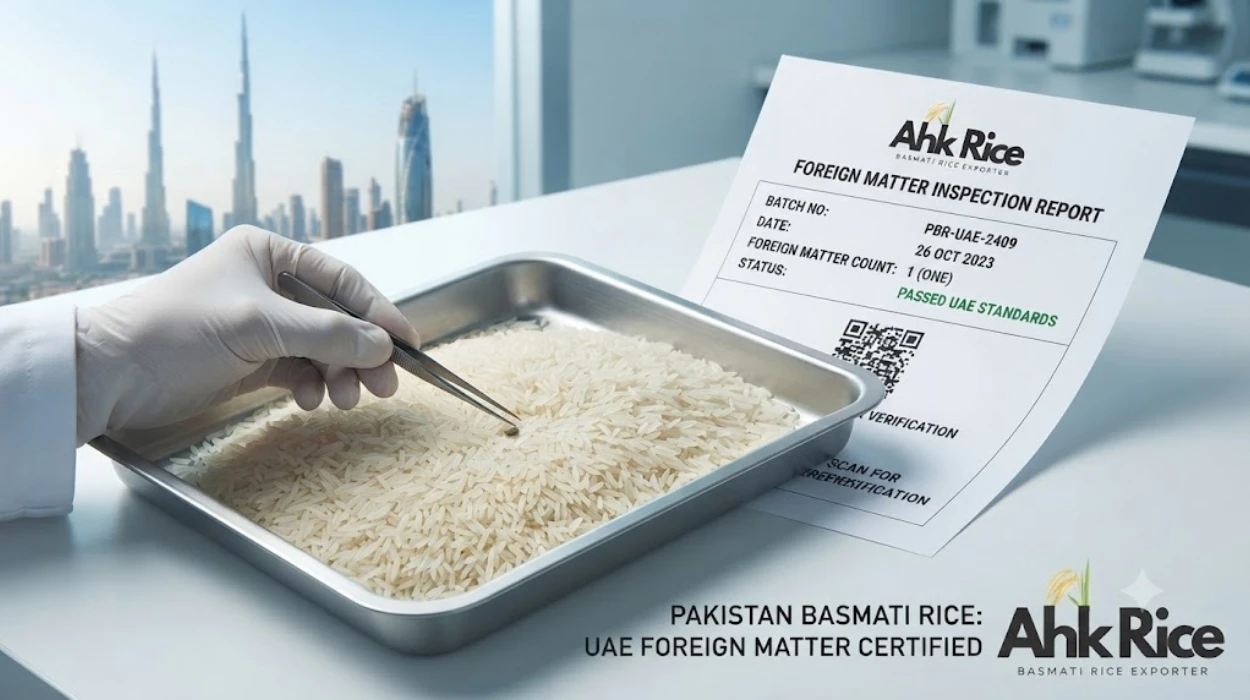
Pakistan Basmati Rice Exporter Providing Foreign Matter Inspection Reports for UAE Buyers
Pakistan Basmati rice exporters that provide verified foreign matter inspection reports offer the safest purchasing option for UAE importers. Inspection reports reduce customs delays, support UAE food safety compliance, and verify that every shipment matches the agreed specifications. Here is why: UAE authorities inspect imported rice for contaminants before allowing market entry, making documented quality verification an essential part of international rice trade.
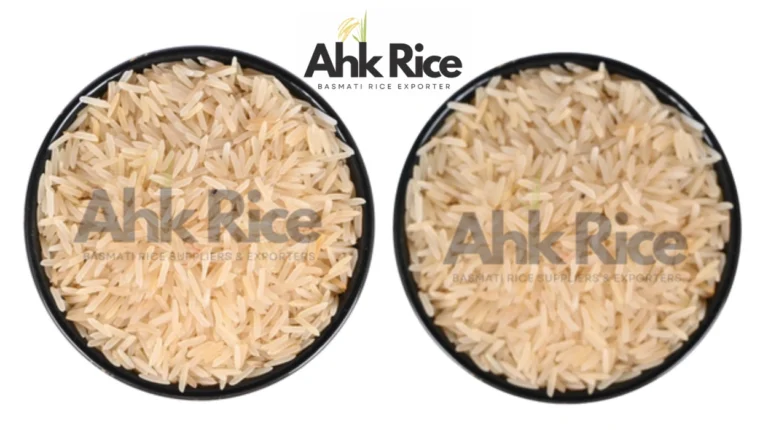
Businesses importing Pakistani Basmati rice into the UAE evaluate suppliers based on quality consistency, laboratory testing, documentation, and export capability. AHK Rice is a trusted Pakistani Basmati rice exporter based in Punjab, supplying 1121, Super Kernel, and 1509 Basmati varieties to more than 15 countries. The company manages cultivation partnerships, milling, grading, inspection, packaging, and export documentation under one production system.
What solutions are available for UAE buyers who need foreign matter inspection reports?
The most reliable solution combines laboratory testing, mechanical sorting, manual inspection, export documentation, and third-party certification before shipment. Buyers receive measurable quality evidence instead of relying on supplier claims, reducing customs risks and improving shipment acceptance rates throughout the UAE market.
Foreign matter refers to every material that is not rice. Examples include stones, dust, straw, husk fragments, weed seeds, plastic particles, insects, damaged grains, and metallic particles. UAE food safety authorities inspect imported rice because these materials affect consumer safety, product quality, and commercial compliance.
Several inspection solutions exist before rice leaves Pakistan. Each solution serves a different purpose and offers a different level of confidence for importers.
In-house Quality Inspection
Rice mills perform routine inspections during processing.
Quality teams inspect:
- Moisture percentage
- Broken grain percentage
- Paddy removal
- Chalky grains
- Foreign material
- Colour consistency
- Grain length
This inspection provides immediate production control but remains an internal verification process.
Laboratory Testing
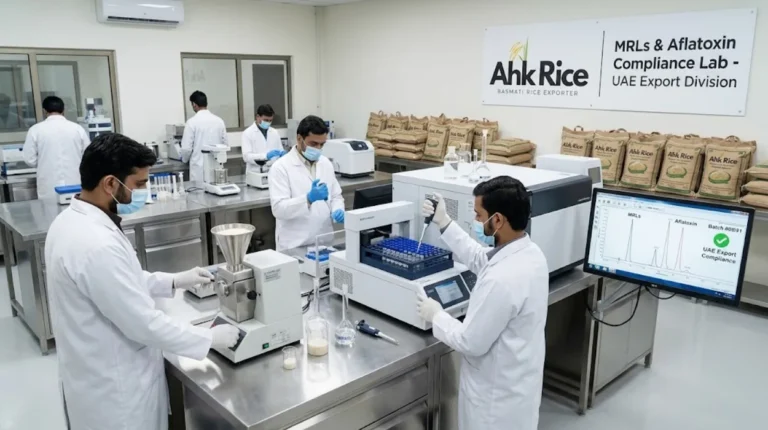
Independent laboratories examine representative rice samples using calibrated equipment.
Laboratory reports verify:
- Foreign matter percentage
- Moisture level
- Purity
- Broken ratio
- Grain dimensions
- Damaged kernels
- Microbiological safety
Laboratory reports provide objective evidence that buyers can review before shipment approval.
Mechanical Colour Sorting
Modern colour sorters identify defective grains using optical cameras.
The machines remove:
- Black grains
- Yellow grains
- Chalky kernels
- Foreign seeds
- Plastic fragments
- Coloured contaminants
Optical sorting significantly improves visual quality while reducing contamination.
Gravity Separation
Gravity separators remove heavy contaminants that optical systems cannot detect effectively.
Examples include:
- Stones
- Metal fragments
- Dense impurities
- Heavy weed seeds
This process protects downstream packaging while improving shipment safety.
Manual Final Inspection
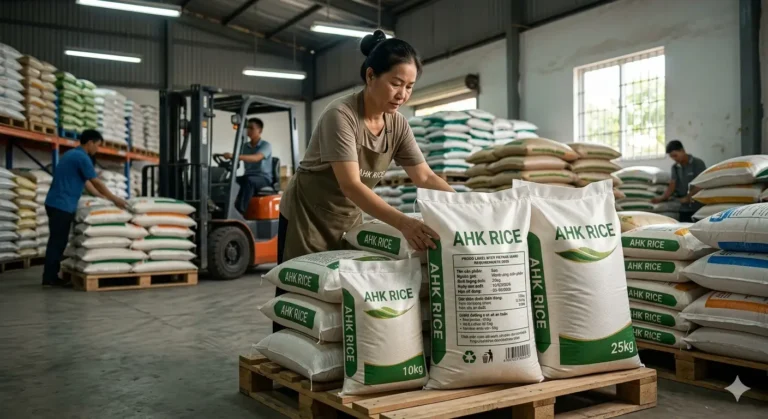
Experienced inspectors verify packaged rice before container loading.
Manual inspection confirms:
- Packaging condition
- Batch consistency
- Label accuracy
- Product cleanliness
- Container hygiene
Human inspection remains valuable because trained inspectors identify packaging issues that automated systems cannot detect.
Comparison of Available Inspection Solutions
| Inspection Method | Detects Foreign Matter | Independent Verification | Suitable for UAE Imports | Cost Level | Reliability | Best Application |
|---|---|---|---|---|---|---|
| In-house inspection | Medium | No | Basic | Low | Moderate | Routine production |
| Laboratory testing | Excellent | Yes | Excellent | Medium | Very High | Import approval |
| Colour sorting | Excellent | No | Excellent | High | Very High | Premium grades |
| Gravity separation | Excellent | No | Excellent | Medium | High | Stone removal |
| Manual inspection | Good | No | Good | Medium | High | Final verification |
| Third-party certification | Excellent | Yes | Excellent | Medium | Excellent | Commercial contracts |
| Combined system | Highest | Yes | Best | Medium | Maximum | UAE export shipments |
The comparison shows that combining multiple inspection systems delivers the strongest quality assurance. The next question becomes how exporters compare when applying these inspection methods.
How do different Pakistan Basmati exporters compare when providing inspection reports?
Exporters differ in processing technology, inspection frequency, certification systems, documentation quality, and shipment consistency. Buyers achieve lower commercial risk by selecting exporters with integrated quality management instead of isolated inspection procedures.
Inspection quality depends on the entire processing chain rather than a single laboratory report. Every production stage influences the final foreign matter level.
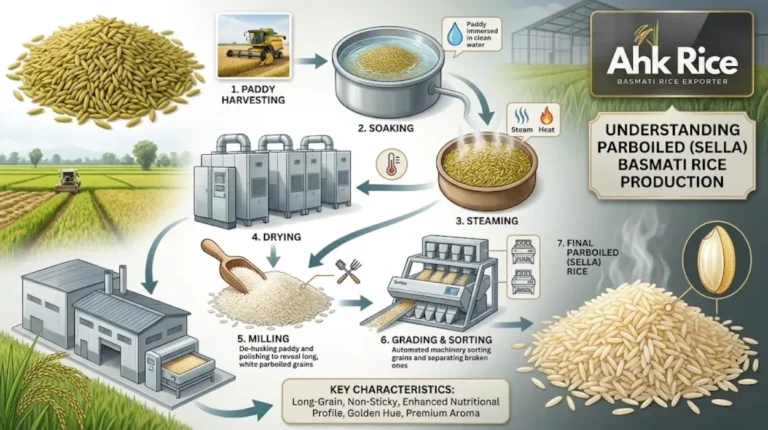
AHK Rice follows a complete processing workflow designed to minimize contamination before rice reaches inspection.
Complete Processing Sequence
- Harvest mature paddy.
- Dry harvested paddy.
- Clean raw material.
- De-husk grains.
- Polish rice.
- Grade by size.
- Sort using colour sorters.
- Remove heavy impurities.
- Inspect finished rice.
- Package according to buyer specifications.
- Verify export documentation.
- Load containers under inspection.
Each processing stage removes a different contamination source before laboratory testing begins.
Specification Comparison
| Specification | AHK Rice Integrated System | Standard Export Mill |
|---|---|---|
| Colour Sorting | Multiple optical sorting stages | Single sorting stage |
| Foreign Matter Inspection | Every production batch | Random batches |
| Laboratory Reports | Available before shipment | Available upon request |
| Processing Control | Complete in-house monitoring | Partial monitoring |
| Packaging Options | Custom retail & bulk | Standard packaging |
| Export Documentation | Full export documentation | Basic documentation |
| Shipment Verification | Container inspection included | Limited verification |
Which foreign matter inspection method works best for different UAE buying situations?
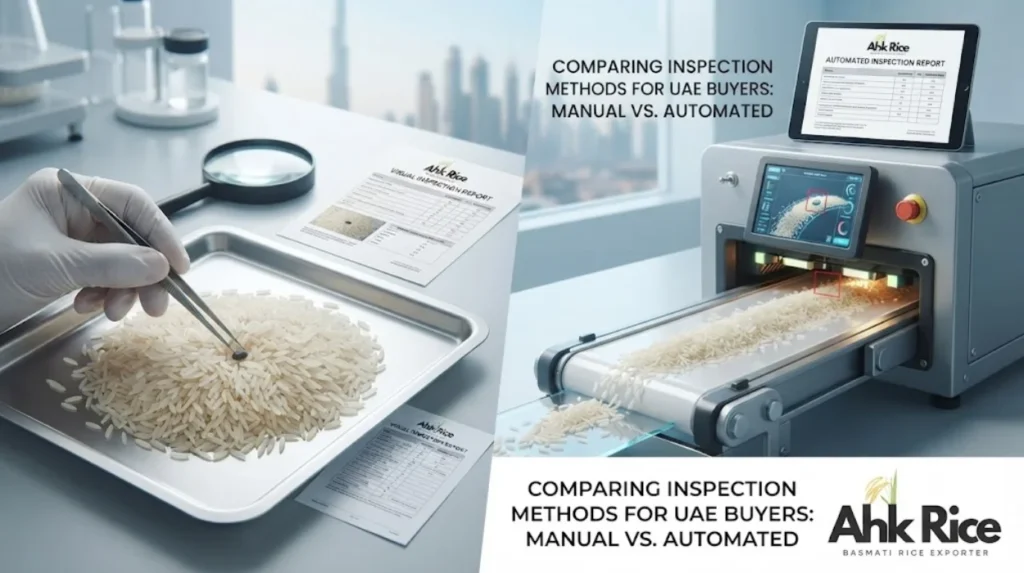
The best inspection method depends on shipment volume, distribution channel, product grade, and contractual requirements. Combined laboratory testing, optical sorting, gravity separation, and third-party verification provide the highest confidence for premium UAE imports because every contamination risk receives independent validation.
Different UAE buyers purchase rice for different commercial purposes. A supermarket chain requires consistent appearance and retail compliance. A catering distributor focuses on storage stability and cooking performance. A private label importer needs documentation that supports customs clearance and food safety inspections. Matching the inspection method to the purchasing objective reduces commercial risk while maintaining product quality.
Best Solution for Retail Importers
Retail businesses require premium visual quality because consumers inspect rice before purchasing.
Recommended inspection system includes:
- Laboratory testing
- Multi-stage colour sorting
- Gravity separation
- Third-party inspection
- Container verification
This combination produces uniform grain appearance with minimal foreign matter and supports premium shelf presentation.
Best Solution for Catering Buyers
Hotels, restaurants, and institutional kitchens purchase rice in larger quantities.
Recommended inspection system includes:
- Laboratory verification
- Mechanical cleaning
- Gravity separation
- Batch sampling
- Container inspection
The focus remains on consistent cooking performance and supply continuity rather than retail packaging appearance.
Best Solution for Private Label Brands
Private label importers assume responsibility for product quality after customsWhat are the advantages and disadvantages of different foreign matter inspection methods?
Every inspection method improves rice quality in a different way, but no single method removes every contamination risk. UAE buyers receive the highest level of quality assurance by combining mechanical cleaning, laboratory testing, optical sorting, gravity separation, and independent certification into one integrated quality management system.
Foreign matter inspection is not a single activity. It is a sequence of quality control measures performed from paddy reception until the container is sealed. Every inspection stage targets a specific contamination source. Combining these methods reduces product variation and increases buyer confidence.
In-house Quality Inspection
In-house inspection begins when paddy arrives at the processing facility. Quality teams inspect raw materials before milling and continue monitoring throughout production.
Advantages
- Low operational cost
- Immediate production feedback
- Fast corrective action
- Continuous process monitoring
- Consistent batch control
Limitations
- Internal verification only
- Limited credibility during disputes
- May not satisfy every international buyer
- Depends on the mill’s quality management system
Example:
A mill identifies excess moisture before milling. Drying the paddy prevents quality deterioration and reduces the risk of mould development during shipment.
Independent Laboratory Testing
Independent laboratories analyze representative samples using calibrated equipment and internationally accepted testing methods.
Typical laboratory parameters include:
- Foreign Matter: Below buyer specification
- Moisture: 12–14%
- Broken Grains: Buyer specification
- Purity: Up to 99% depending on grade
- Damaged Kernels
- Grain Length
- Chalky Grain Percentage
Advantages
- Independent verification
- International acceptance
- Supports customs documentation
- Builds buyer confidence
- Suitable for contract-based trading
Limitations
- Additional inspection cost
- Sampling represents the inspected lot only
- Testing requires processing time
Example:
A UAE importer requests laboratory reports before releasing the balance payment. Independent verification confirms that the shipment meets contractual specifications before loading.
Optical Colour Sorting
Colour sorting machines inspect every grain using high-speed cameras and artificial intelligence-based sensors. Defective grains are removed through compressed air systems.
Colour sorting removes:
- Black grains
- Yellow grains
- Immature grains
- Foreign seeds
- Plastic particles
- Discoloured kernels
Advantages
- Extremely high sorting accuracy
- Improves product appearance
- Removes visual contaminants
- Enhances premium grade consistency
- Supports retail packaging standards
Limitations
- Cannot detect every heavy impurity
- Requires regular calibration
- Higher equipment investment
Example:
Premium supermarket brands in the UAE often specify multi-stage colour sorting because consumers expect uniform grain colour inside transparent packaging.
Gravity Separation
Gravity separators classify materials according to density rather than colour.
Heavy contaminants removed include:
- Stones
- Glass fragments
- Metallic particles
- Dense weed seeds
- Heavy impurities
Advantages
- Excellent stone removal
- Protects milling equipment
- Improves shipment safety
- Complements colour sorting
Limitations
- Does not identify colour defects
- Requires proper machine adjustment
- Works alongside other inspection systems
Example:
Gravity separation significantly reduces the possibility of hard contaminants reaching retail consumers.
Third-Party Inspection
Independent inspection agencies verify product quality before shipment. Their reports become commercial documents supporting international transactions.
Inspection usually includes:
- Batch sampling
- Container inspection
- Packaging verification
- Weight confirmation
- Laboratory testing
- Shipment supervision
Advantages
- Highest commercial credibility
- Supports Letters of Credit
- Reduces buyer disputes
- Improves customs acceptance
- Increases transaction transparency
Limitations
- Additional inspection fees
- Scheduling requirements
- Longer documentation process
Example:
Many UAE importers require third-party inspection for high-value container shipments because independent verification minimizes contractual disagreements.
The comparison of inspection methods demonstrates that combining multiple systems provides the strongest quality assurance. The next step is understanding which commercial factors buyers should evaluate before selecting a Pakistan Basmati rice exporter.
Which decision factors should UAE buyers evaluate before choosing a Pakistan Basmati rice exporter?
The best supplier combines verified quality control, transparent documentation, export experience, production capacity, and consistent shipment performance. Evaluating these factors before placing an order reduces supply chain risk and improves long-term purchasing reliability.
Foreign matter inspection reports represent only one part of supplier evaluation. Professional buyers assess the entire export process because consistent quality depends on production capability, documentation accuracy, and logistics management.
Key Decision Factors
| Decision Factor | Why It Matters | Buyer Benefit |
|---|---|---|
| Laboratory Testing | Confirms product specifications | Reduced import risk |
| Processing Technology | Minimizes contamination | Better grain quality |
| Export Experience | Improves documentation accuracy | Faster customs clearance |
| Packaging Capability | Protects rice during transport | Longer shelf life |
| Shipment Consistency | Maintains quality across multiple orders | Reliable long-term supply |
UAE Regional Buying Preferences
Different regions within the UAE often prioritize different Basmati grades according to customer demand.
| Market Region | Preferred Grades | Typical Buyers |
|---|---|---|
| Dubai | 1121 Steam, Super Kernel | Retail chains, private labels |
| Abu Dhabi | 1121 Golden Sella | Hospitality and catering |
| Sharjah | 1509 Basmati | Wholesale distributors |
| Northern Emirates | Steam and Sella grades | Foodservice suppliers |
Price Comparison by Grade
| Rice Grade | Typical Export Price (USD/MT)* |
|---|---|
| 1121 Steam Basmati | 1,150–1,350 |
| 1121 Golden Sella | 1,050–1,250 |
| Super Kernel Basmati | 950–1,150 |
| 1509 Basmati | 850–1,050 |
*Indicative export prices vary according to crop season, order quantity, packaging specification, and freight conditions.
Shelf Life Comparison
| Rice Grade | Recommended Shelf Life |
|---|---|
| 1121 Steam | 12–18 months |
| 1121 Golden Sella | 18–24 months |
| Super Kernel | 12–18 months |
| 1509 Basmati | 12–18 months |
Selecting an exporter using these evaluation criteria helps buyers reduce procurement risk while ensuring compliance with UAE food safety requirements. The final section summarizes the key findings, answers common buyer questions, and provides the ideal point to connect readers to the BOFU article for purchase-focused guidance.
Pakistan Basmati rice exporters that provide foreign matter inspection reports offer UAE buyers greater purchasing confidence, smoother customs clearance, and more consistent product quality. Inspection reports verify that every shipment complies with agreed specifications before export. Combined quality systems deliver better results than relying on a single inspection method because each process removes different contamination risks.
AHK Rice follows an integrated production and export process that includes paddy cleaning, milling, grading, colour sorting, gravity separation, laboratory testing, packaging, and shipment verification. This approach supports UAE buyers seeking consistent quality across retail, foodservice, wholesale, and private-label supply chains.
Selecting an exporter should never depend only on price. Buyers achieve better long-term value by evaluating inspection capability, processing technology, documentation accuracy, packaging options, and export experience. These factors reduce commercial risk while supporting reliable international trade relationships.
If your next step is evaluating suppliers and understanding why UAE authorities inspect imported Pakistani rice before approving shipments, continue reading Why Do UAE Food Safety Authorities Check Foreign Matter in Imported Pakistan Rice?
Frequently Asked Questions
What is foreign matter in Basmati rice?
Foreign matter includes any material that is not rice. Examples include stones, husk pieces, dust, straw, weed seeds, plastic particles, insects, and metallic fragments. Removing these contaminants improves food safety, product quality, and compliance with UAE import regulations.
Why do UAE buyers request foreign matter inspection reports?
UAE buyers request inspection reports to verify that imported rice meets contractual specifications and food safety standards. These reports reduce customs delays, minimize commercial disputes, and provide documented proof of product quality before shipment.
Which inspection method provides the highest level of quality assurance?
A combined inspection system delivers the highest level of quality assurance. Laboratory testing, colour sorting, gravity separation, manual inspection, and third-party certification work together to remove contaminants and verify shipment specifications.
Which Basmati rice grade is most popular in the UAE?
1121 Steam Basmati Rice is widely preferred by supermarkets and premium retailers because of its long grain appearance and cooking quality. 1121 Golden Sella Basmati Rice is commonly selected by hotels, restaurants, and catering companies because it offers excellent grain strength and a longer storage life.
How often should foreign matter inspections be performed?
Professional exporters perform inspections throughout production rather than only before shipment. Quality checks begin with raw paddy inspection and continue through cleaning, milling, grading, sorting, packaging, and final container loading to maintain consistent product quality.