Expected Delivery Time for Basmati Rice Imports from Pakistan
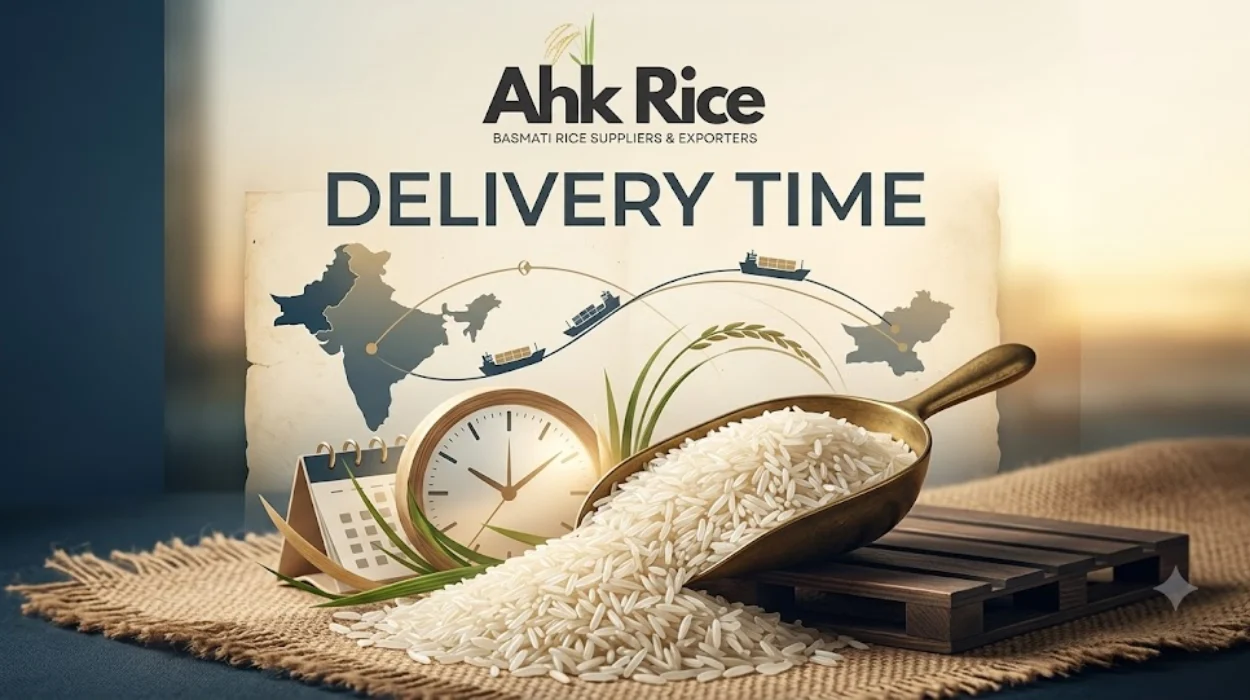
Importing Basmati rice from Pakistan follows a defined export timeline that starts with order confirmation and ends with cargo arrival at the destination port. In 2026, the expected delivery time depends on production scheduling, processing, packaging, customs clearance, vessel availability, transit distance, and destination country. Every stage has a measurable duration, making delivery planning predictable for importers who understand the export process.
What Is the Expected Delivery Time for Basmati Rice Imports from Pakistan?
The expected delivery time for Basmati rice imports from Pakistan ranges from approximately 15 to 45 days after production begins, depending on processing requirements, export documentation, shipping schedules, destination port, and customs procedures. Each stage follows a structured sequence with defined operational timelines.
Expected delivery time refers to the total period required for rice to move from a Pakistani processing facility to the importer’s destination port. The timeline starts after an export order enters production and ends when the shipment reaches the port of arrival.
The delivery schedule consists of several operational stages instead of one continuous shipping period. These stages include production planning, paddy cleaning, milling, grading, polishing, color sorting, packaging, laboratory testing, container loading, customs clearance, port handling, ocean freight, and destination customs processing.
For example, an importer purchasing 1121 Steam Basmati Rice, Super Kernel Rice, or 1509 Basmati Rice receives different timelines depending on processing requirements and vessel schedules, although the export workflow remains largely the same.
Typical export timelines in 2026 include:
- Production scheduling: 1–2 days
- Rice processing: 3–5 days
- Packaging and quality inspection: 2–5 days
- Container stuffing and documentation: 2–3 days
- Port handling and vessel departure: 2–7 days
- Ocean freight: 7–30 days depending on destination
Understanding each stage allows buyers to estimate realistic arrival dates instead of relying only on vessel transit times.
How Does the Delivery Process Work from Pakistan to the Importing Country?
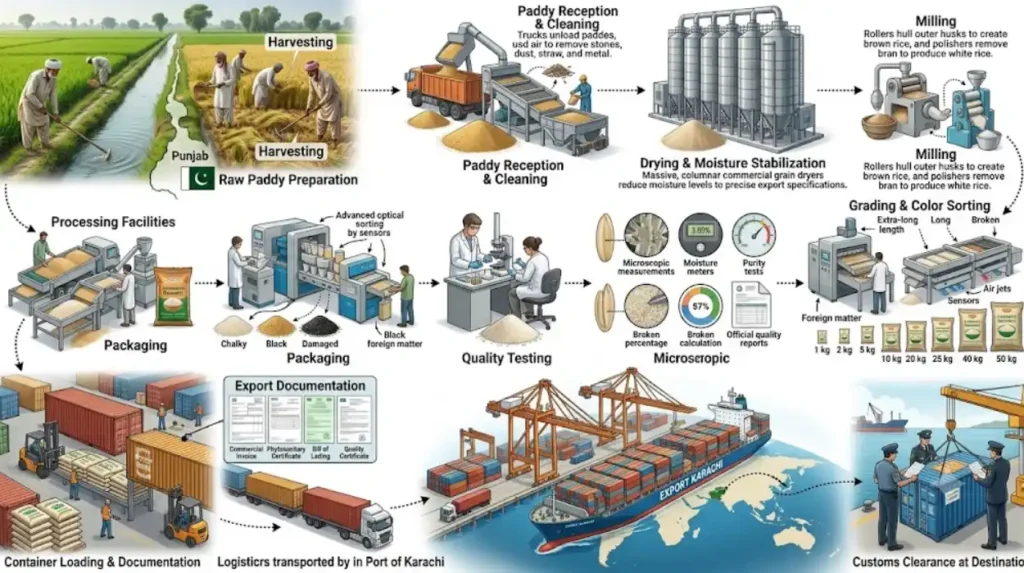
The delivery process follows a continuous export chain that begins with raw paddy preparation and ends with customs clearance at the destination. Every operational step has quality controls, documentation requirements, and logistical checkpoints that determine the overall shipment timeline.
Pakistan produces Basmati rice primarily in Punjab, where fertile soil, canal irrigation, and favorable climatic conditions support aromatic long-grain rice cultivation.
After harvesting, paddy enters modern rice processing facilities.
The production workflow includes:
Paddy Reception and Cleaning
Farmers deliver harvested paddy to rice mills.
Machines remove:
- Stones
- Dust
- Straw
- Metal particles
- Broken organic material
Cleaning protects milling equipment and improves final product quality.
Drying and Moisture Stabilization
Fresh paddy contains varying moisture levels.
Drying systems reduce moisture to export specifications.
Uniform moisture improves milling efficiency and storage stability.
Milling
The outer husk is removed.
The rice kernel becomes brown rice.
Further milling removes bran layers to produce white rice.
Steam and parboiled varieties follow additional hydrothermal treatment before milling.
Grading
Length graders separate kernels according to size.
Examples include:
- Extra-long kernels
- Long kernels
- Broken rice
- Small fragments
Grading improves consistency inside every export bag.
Color Sorting
Optical sorting machines detect:
- Chalky grains
- Black kernels
- Damaged rice
- Foreign material
Rejected kernels are automatically removed.
Quality Testing
Laboratories inspect:
- Grain length
- Moisture
- Purity
- Broken percentage
- Foreign matter
- Milling quality
Quality reports confirm compliance with customer specifications.
Packaging
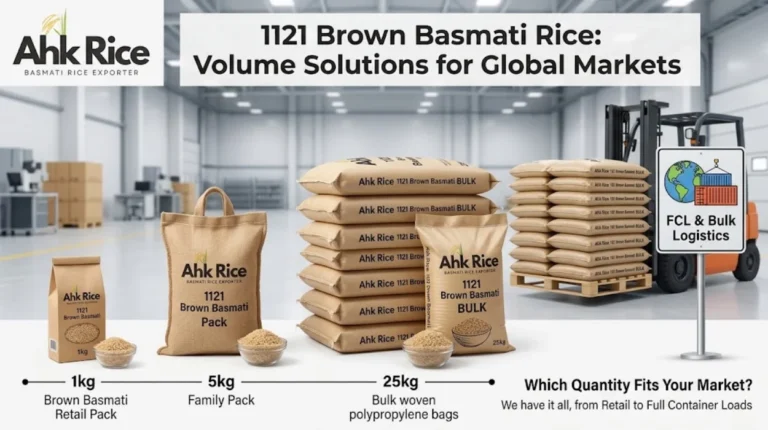
Rice enters export bags in different sizes.
Examples include:
- 1 kg
- 2 kg
- 5 kg
- 10 kg
- 20 kg
- 25 kg
- 40 kg
- 50 kg
Packaging protects rice during transportation and storage.
Container Loading
Export containers undergo inspection before loading.
Rice bags are stacked systematically to maximize container space while maintaining cargo stability.
Export Documentation
Required documents generally include:
- Commercial invoice
- Packing list
- Certificate of origin
- Phytosanitary certificate
- Bill of lading
- Quality certificate
Once documentation is complete, containers enter the shipping terminal for vessel loading.
Readers interested in the production timeline after order confirmation can continue with the detailed explanation in the companion article about:
Why rice processing and packaging typically take seven to ten days, which explains the manufacturing stages in greater operational detail.
What Are the Key Components That Determine Delivery Time?
Processing duration, packaging requirements, export inspections, shipping schedules, transit distance, and customs procedures are the six primary components that determine total delivery time. Every shipment passes through these operational stages before reaching the importing country.
Several measurable factors influence export schedules.
Rice Variety
Different varieties require different processing procedures.
Examples include:
- 1121 White Basmati
- 1121 Steam Basmati
- 1509 White Basmati
- 1509 Steam Basmati
- Super Kernel White Rice
- Super Kernel Steam Rice
Steam and parboiled products require additional processing compared with white rice.
Packaging Requirements
Retail packaging requires more preparation than bulk packaging.
Examples include:
- Printed consumer bags
- Plain polypropylene bags
- Vacuum packs
- Woven sacks
- Non-woven bags
Packaging customization increases production time.
Laboratory Testing
Quality inspection verifies compliance with customer specifications.
Testing includes physical and laboratory analysis before shipment approval.
Shipping Schedule
Ocean carriers operate fixed weekly schedules.
Containers remain at port until vessel loading begins.
Destination Country
Transit times vary by region.
Examples include:
- Middle East
- Europe
- North America
- Africa
- Southeast Asia
- Australia
Longer sailing distances increase total delivery duration.
Customs Clearance
Both exporting and importing countries perform customs procedures before cargo enters commercial circulation.
What Benefits Come from Understanding the Expected Delivery Timeline?
Understanding the complete delivery timeline improves inventory planning, purchasing decisions, warehouse management, production scheduling, seasonal buying strategies, and supply chain coordination because every operational stage becomes predictable instead of uncertain.
Importers use delivery estimates to manage stock levels.
Food distributors schedule replenishment before inventories decline.
Retail companies align promotional campaigns with expected arrivals.
Food manufacturers coordinate ingredient purchasing with production plans.
Restaurants estimate procurement cycles before seasonal demand increases.
International wholesalers organize warehouse capacity based on expected shipment arrivals.
Predictable delivery schedules reduce emergency purchasing.
They also improve transportation planning inside importing countries.
Better scheduling lowers storage congestion at destination warehouses.
Understanding delivery timelines also supports financial planning because inventory turnover becomes easier to estimate.
Where Is Pakistani Basmati Rice Commonly Imported?
Pakistani Basmati rice reaches commercial buyers across Asia, the Middle East, Europe, Africa, North America, and Oceania through established maritime trade routes supported by international food safety regulations and standardized export documentation.
Pakistan remains one of the world’s leading exporters of aromatic Basmati rice.
Major importing regions include:
Middle East
Examples include:
- Saudi Arabia
- United Arab Emirates
- Qatar
- Kuwait
- Oman
- Bahrain
These markets import premium long-grain aromatic rice for households and food service industries.
Europe
Examples include:
- United Kingdom
- Germany
- Netherlands
- Italy
- France
European buyers require compliance with food safety regulations and traceability standards.
North America
Examples include:
- United States
- Canada
Retail chains and ethnic food distributors import packaged and bulk Basmati rice.
Africa
Examples include:
- Kenya
- South Africa
- Tanzania
- Ghana
Demand includes both retail and wholesale markets.
Asia-Pacific
Examples include:
- Australia
- Malaysia
- Singapore
- New Zealand
These markets purchase premium aromatic rice for supermarkets and hospitality businesses.
Which Certifications Support International Basmati Rice Exports?
International Basmati rice exports follow recognized food safety, quality management, phytosanitary, and traceability standards that help importing countries verify product quality, hygiene, and regulatory compliance before commercial distribution begins.
Export shipments typically involve internationally recognized certifications depending on buyer requirements.
Common certifications include:
ISO 22000
Food safety management system certification covering production and processing.
HACCP
Hazard Analysis and Critical Control Points identify and control food safety risks throughout processing.
Phytosanitary Certificate
Confirms that agricultural products meet plant health requirements established by importing countries.
Certificate of Origin
Identifies the country where the rice was produced and processed.
Fumigation Certificate
Confirms treatment when required by destination regulations.
Quality Inspection Reports
Independent or internal laboratory reports verify export specifications before shipment.
Certification requirements differ among countries, but food safety documentation remains an essential component of international rice trade in 2026.
What Are the Most Common Misconceptions About Delivery Time?
Many buyers assume vessel transit represents the entire delivery period, but processing, quality inspections, documentation, packaging, and port operations consume significant portions of the export timeline before ships leave Pakistan.
One common misconception states that rice ships immediately after an order is placed.
Production begins only after scheduling and raw material allocation.
Another misconception assumes all rice varieties require identical processing time.
Steam rice requires additional hydrothermal treatment compared with white rice.
Some buyers believe customs clearance occurs only after vessel arrival.
Export customs procedures begin before containers leave Pakistan.
Another misunderstanding is that every country receives shipments within identical transit periods.
Shipping distance directly affects sailing duration.
Understanding the complete export sequence creates more accurate delivery expectations and improves international supply chain planning.
Frequently Asked Questions
How long does it take to import Basmati rice from Pakistan?
The total delivery time generally ranges from 15 to 45 days in 2026, depending on processing, packaging, vessel schedules, destination country, and customs clearance.
What factors affect the delivery time of Basmati rice imports?
Production scheduling, rice variety, packaging requirements, quality inspections, shipping routes, port congestion, and customs procedures all influence the final delivery timeline.
Why does rice processing take several days before shipment?
Rice undergoes cleaning, drying, milling, grading, color sorting, laboratory testing, and packaging before export, and each stage requires dedicated processing time to meet quality standards.
Which Pakistani Basmati rice varieties are commonly exported?
The main export varieties include 1121 White Basmati, 1121 Steam Basmati, 1509 White Basmati, 1509 Steam Basmati, Super Kernel White Rice, and Super Kernel Steam Rice.
Which countries import Pakistani Basmati rice?
Major importing markets include Saudi Arabia, the UAE, Qatar, Kuwait, Oman, the United Kingdom, Germany, Canada, the United States, Australia, Malaysia, and South Africa.
What documents are required for exporting Basmati rice from Pakistan?
Typical export documents include the commercial invoice, packing list, certificate of origin, phytosanitary certificate, bill of lading, and quality inspection certificate.
What certifications are commonly used for Basmati rice exports?
Common certifications include ISO 22000, HACCP, phytosanitary certification, certificate of origin, fumigation certificates (when required), and quality inspection reports.
Does the destination country affect delivery time?
Yes. Ocean transit varies by destination, so nearby regions such as the Middle East generally receive shipments faster than Europe, North America, or Australia.
What packaging sizes are available for export?
Export packaging commonly includes 1 kg, 2 kg, 5 kg, 10 kg, 20 kg, 25 kg, 40 kg, and 50 kg bags, depending on buyer requirements.
Why is understanding the delivery timeline important for importers?
Knowing the complete delivery timeline helps importers plan inventory, schedule warehouse space, coordinate distribution, and avoid stock shortages through accurate procurement planning.