How Does Production Capacity Impact Long-Term Rice Supply Contracts?
Production capacity directly affects whether a rice exporter can maintain agreed volumes, specifications, shipment schedules, and pricing over repeated contract cycles. For New York importers, the strongest long-term supply strategy combines verified milling capacity, diversified production scheduling, documented quality controls, and realistic monthly allocation commitments.
For buyers evaluating supplier capability before signing a recurring agreement,
Why Should New York Buyers Evaluate Rice Production Capacity? is the appropriate educational starting point. Production capacity is not simply the maximum amount of rice a factory can process. It is the practical ability to produce the contracted grade at the required specification and release it on schedule.
For Pakistani Basmati rice, this distinction matters because production moves through several stages. Paddy procurement, cleaning, husking, whitening, grading, sorting, processing, packing, inspection, and container loading all affect the final delivery schedule. A supplier may have substantial nominal capacity but still struggle with a large order if the required grade, packaging format, or shipment window competes with other production commitments.
What does production capacity mean in a long-term rice supply contract?
Production capacity is the verified quantity of specified rice a supplier can consistently process, pack, inspect, and dispatch within an agreed period without reducing quality or missing contractual delivery dates.
A long-term rice supply contract normally specifies quantity, variety, grade, packaging, quality limits, delivery schedule, payment terms, inspection requirements, and destination. Production capacity connects these commercial terms to actual factory performance.
Capacity should therefore be measured in available exportable metric tons, not only installed machinery capacity. A factory may have equipment capable of processing hundreds of tons daily, while its practical contract capacity is lower because paddy availability, drying, grading, packaging, labor, maintenance, inspection, and container availability limit output.
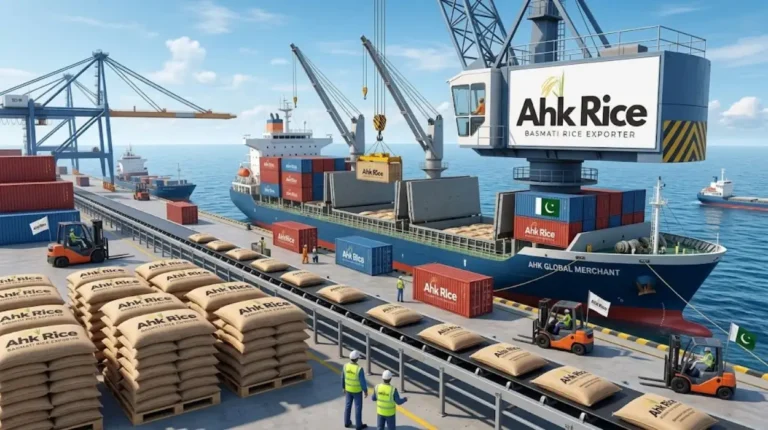
AHK Rice operates an integrated processing and export facility in Bucheki, Nankana Sahib, Punjab, managing activities from paddy procurement through container loading. Its export portfolio includes 1121, Super Kernel, and 1509 Basmati rice.
For a New York buyer, capacity verification should examine five numbers: monthly processing capacity, monthly committed volume, available production capacity, average production lead time, and maximum realistic allocation during peak demand.
A buyer ordering 100 MT every month requires a different capacity profile from a distributor ordering 500 MT every quarter. The supplier must demonstrate that the contracted quantity remains available after accounting for existing commitments.
What are the available solutions for securing long-term rice supply?
Buyers can secure recurring supply through dedicated production allocations, rolling purchase orders, seasonal contracts, multi-grade sourcing, or larger annual agreements, with each structure balancing volume security, pricing flexibility, inventory exposure, and supplier commitment.
Dedicated production allocation
A dedicated allocation reserves a defined quantity for one buyer during each production period. For example, a New York distributor can request 150 MT of 1121 Basmati each month.
This structure provides stronger planning visibility because the supplier knows the required quantity in advance. It works best when the buyer has predictable demand and needs consistent grain specifications.
Rolling purchase orders
A rolling purchase order uses a forecast and confirmed release schedule. A buyer may forecast 600 MT for six months but release 100 MT monthly.
This approach gives the exporter production visibility while allowing the buyer to adjust releases according to inventory movement.
Seasonal supply contracts
Seasonal contracts align purchasing with crop availability and market cycles. They can be useful when a buyer wants to secure a defined quantity after harvest and schedule shipments over several months.
The major advantage is supply planning. The buyer can establish the required grade before competing demand increases.
Annual volume agreements
An annual agreement establishes a total volume, such as 1,200 MT, while shipments are divided into monthly or quarterly lots.
This model suits established distributors with predictable sales. It also gives the exporter a clearer production forecast.
Multi-grade sourcing
A buyer can contract several grades instead of relying on one product. For example, 1121 can serve premium retail while Super Kernel serves ethnic grocery distribution.
This reduces dependence on one specification and allows the buyer to adjust the product mix without changing the entire supplier relationship.
How do different rice supply approaches compare?
Dedicated allocations provide the strongest recurring-volume control, rolling orders provide the greatest flexibility, seasonal contracts improve harvest planning, and annual agreements provide the clearest capacity commitment when demand is predictable and specifications remain stable.
| Attribute | Dedicated Allocation | Rolling Orders | Seasonal Contract | Annual Volume Agreement |
|---|---|---|---|---|
| Volume security | Very high | High | Very high | Highest |
| Buyer flexibility | Medium | High | Medium | Medium |
| Price visibility | High | Medium | High | Highest |
| Capacity planning | Excellent | Excellent | Excellent | Excellent |
| Inventory exposure | Medium | Low | Medium-high | Medium |
| Best contract size | 100–500 MT/month | 50–300 MT/release | 300–1,000+ MT | 1,000+ MT/year |
| Best use case | Stable distribution | Variable demand | Seasonal procurement | Established programs |
These quantities are planning examples rather than universal industry thresholds. Contract structure should match actual demand, warehouse capacity, and supplier production availability.
For New York buyers, capacity should also be evaluated against the shipment route. Karachi is Pakistan’s primary export port for these commercial movements, while New York-area buyers commonly plan around East Coast port receiving schedules. A supplier’s production lead time must therefore leave sufficient time for inspection, documentation, vessel booking, ocean transit, customs processing, and domestic delivery.
Current 2026 market information illustrates why grade selection also affects procurement economics. Indicative FOB Karachi pricing published in 2026 places Super Kernel around $965–$1,005 per MT, while 1121 occupies a higher premium range, with published market references varying according to grade and specification.
Another July 2026 market reference lists 1121 White at approximately $1,165–$1,205 per MT FOB Karachi, 1121 Steam at $1,160–$1,200, and 1121 Sella at $1,135–$1,175. These are indicative FOB values, not fixed contract prices.
Which rice grades work best for different New York supply cases?
1121 suits premium retail and foodservice programs requiring extra-long grain presentation, Super Kernel suits established ethnic distribution seeking strong aroma and lower sourcing cost, while 1509 provides another extra-long Basmati option for buyers balancing price and cooking performance.
1121 Basmati is generally the strongest choice when visual grain length is central to the product proposition. AHK Rice lists 1121 specifications around 8.3 mm or greater for certain USA export grades, with white, Sella, and parboiled forms available.
Super Kernel is better suited to buyers whose customers recognize traditional Basmati aroma and want a premium product without moving fully into the highest-priced 1121 segment. Published 2026 comparisons place Super Kernel below premium 1121 pricing.
1509 can work for distributors seeking extra-long aromatic rice with a different cost and processing profile. AHK Rice lists 1509 Basmati for USA wholesale applications in Sella and other processing forms.
The right grade depends on the buyer’s sales channel. A private-label supermarket program needs strong visual consistency. A South Asian grocery distributor may prioritize aroma and traditional cooking behavior. A foodservice distributor needs repeatable cooking results and predictable availability.
Which grades suit two major US market regions?
| Market region | Preferred grade direction | Indicative FOB price comparison | Shelf-life planning | Supply priority |
| Northeast / New York | 1121 White, 1121 Steam, Super Kernel | 1121 generally higher; Super Kernel generally lower | Plan around 12–24 months according to product, packaging, and storage conditions | High consistency and scheduled replenishment |
| West Coast / California | 1121, Super Kernel, 1509 | 1121 generally higher; Super Kernel generally lower | Plan around 12–24 months according to product, packaging, and storage conditions | Larger assortment and flexible container planning |
The shelf-life figures above are procurement planning ranges rather than a universal guarantee. Actual shelf life depends on moisture, processing, packaging, warehouse temperature, humidity, pest control, and storage conditions. Contract specifications should state the required best-before period and minimum remaining shelf life at arrival.
The regional distinction is commercial rather than a rigid rule. New York and other Northeast markets can support premium 1121 programs, while West Coast distributors can also carry 1121, Super Kernel, and 1509. The key variable is consumer demand within the buyer’s own distribution network.
What are the advantages and disadvantages of high-capacity rice supply contracts?
High-capacity contracts improve volume security, production planning, and specification continuity, but they can increase inventory commitments and reduce flexibility when demand changes, making contract size, release schedules, storage capacity, and quality controls essential.
The main advantage is continuity. A buyer does not need to renegotiate availability for every shipment when a defined production allocation already exists.
The second advantage is specification consistency. Repeated production can follow the same grain length, broken percentage, moisture target, polishing level, packaging, and inspection requirements.
The third advantage is better production planning. A supplier receiving a six-month forecast can schedule paddy procurement, milling, sorting, packaging materials, labor, and container loading more efficiently.
The main disadvantage is volume commitment. A buyer that contracts 1,200 MT but sells only 700 MT creates unnecessary inventory exposure.
A second disadvantage is market-price exposure. Rice prices change according to crop conditions, procurement costs, demand, freight, packaging, and currency movements. A fixed price for an extended period transfers market risk differently between buyer and seller.
A third disadvantage is grade rigidity. A contract for only one grade may become restrictive if customer preferences shift from 1121 to Super Kernel or another specification.
The solution is a contract with defined release windows, tolerance ranges, quality specifications, price-review mechanisms, and documented capacity commitments.
How should New York buyers evaluate supplier capacity before signing?
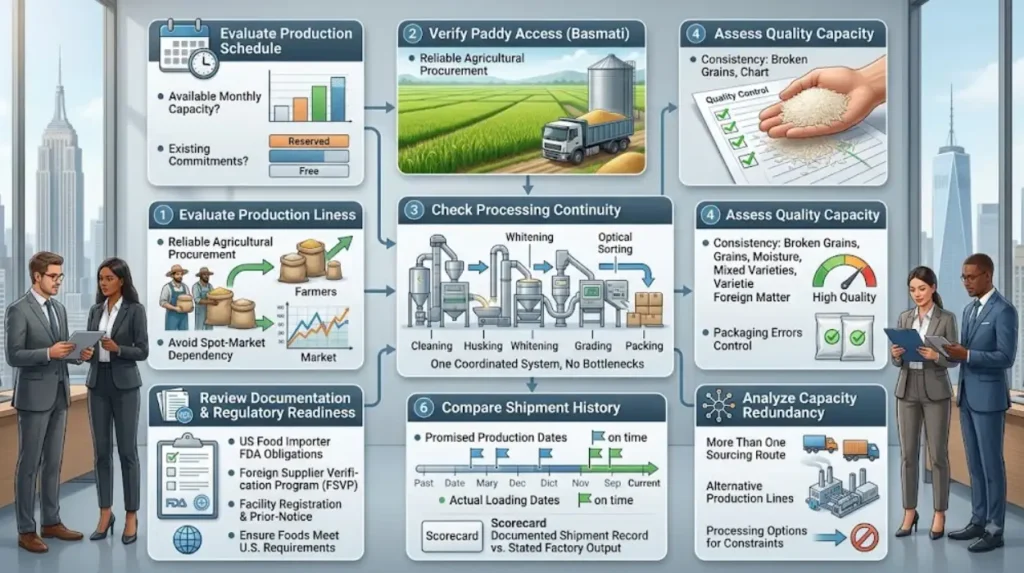
New York buyers should evaluate available monthly capacity, existing commitments, production lead time, quality consistency, raw-material access, packaging capability, inspection controls, and shipment history before treating an exporter’s stated production capacity as contract-ready supply.
Capacity verification should begin with the supplier’s production schedule. Ask how much rice the facility can process monthly and how much of that capacity is already committed.
The second factor is paddy access. Basmati supply begins with agricultural procurement. A processor with reliable access to suitable paddy has stronger control over future production than one dependent on spot-market purchases.
The third factor is processing continuity. Cleaning, husking, whitening, grading, optical sorting, and packing must operate as one coordinated system. A bottleneck in any stage can reduce actual exportable output.
The fourth factor is quality capacity. More production does not create useful supply if increased volume causes broken grains, inconsistent moisture, mixed varieties, foreign matter, or packaging errors.
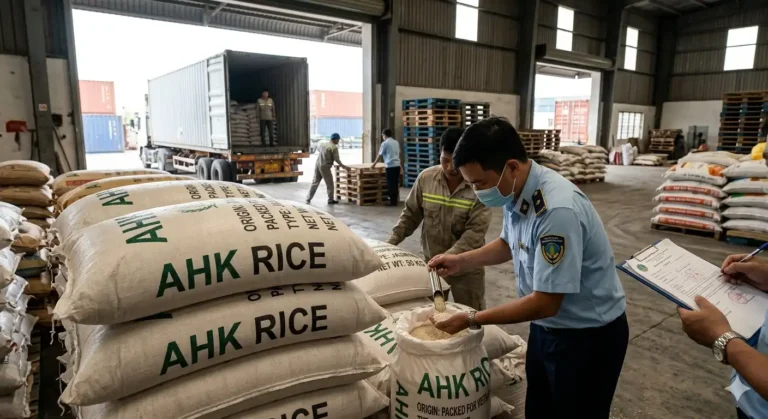
The fifth factor is documentation and regulatory readiness. U.S. food importers have responsibilities under FDA requirements, including applicable Foreign Supplier Verification Program obligations. Imported food facilities must meet relevant registration and prior-notice requirements, and importers must ensure imported foods meet U.S. requirements.
The sixth factor is shipment history. Buyers should compare promised production dates with actual loading dates across previous shipments. A documented shipment record is more useful than a stated maximum factory output.
The seventh factor is capacity redundancy. A supplier with more than one sourcing route, production line, or processing option can respond more effectively when one production stream becomes constrained.
What decision framework should buyers use for long-term supply contracts?
The best supplier is not the exporter claiming the largest factory output; it is the supplier whose verified available capacity, quality system, production schedule, pricing structure, and shipment record match the buyer’s recurring volume and market requirements.
| Decision factor | What to verify | Strong position |
| Monthly capacity | Processing and packing capability | Capacity exceeds committed volume |
| Available allocation | Existing customer commitments | Dedicated recurring allocation |
| Specification control | Grain, moisture, broken, purity | Documented repeat specifications |
| Production lead time | Order confirmation to loading | Predictable production window |
| Shipment performance | Previous loading and dispatch records | Consistent on-time execution |
A buyer should also calculate the capacity coverage ratio:
Capacity coverage ratio = available monthly capacity ÷ contracted monthly volume.
For example, if a supplier has 1,000 MT of genuinely available monthly capacity and the buyer requires 200 MT, the coverage ratio is 5.0. If available capacity is only 250 MT, the ratio falls to 1.25. The second arrangement leaves much less room for production disruption, additional orders, maintenance, or seasonal demand.
This calculation is more useful than a headline claim such as “1,000 MT daily capacity” because it focuses on capacity actually available to the buyer.
AHK Rice states that its USA supply operation supports bulk Basmati programs and provides processing, grading, inspection, documentation, packaging, and export coordination. Its USA-facing information also lists New York among destination ports and describes container supply for wholesale buyers.
For a long-term New York contract, the buyer should therefore compare capacity with the exact specification rather than evaluating factory size alone. A supplier may process several rice varieties, but the relevant question is how much of the buyer’s chosen grade can be produced consistently within the agreed shipment window.
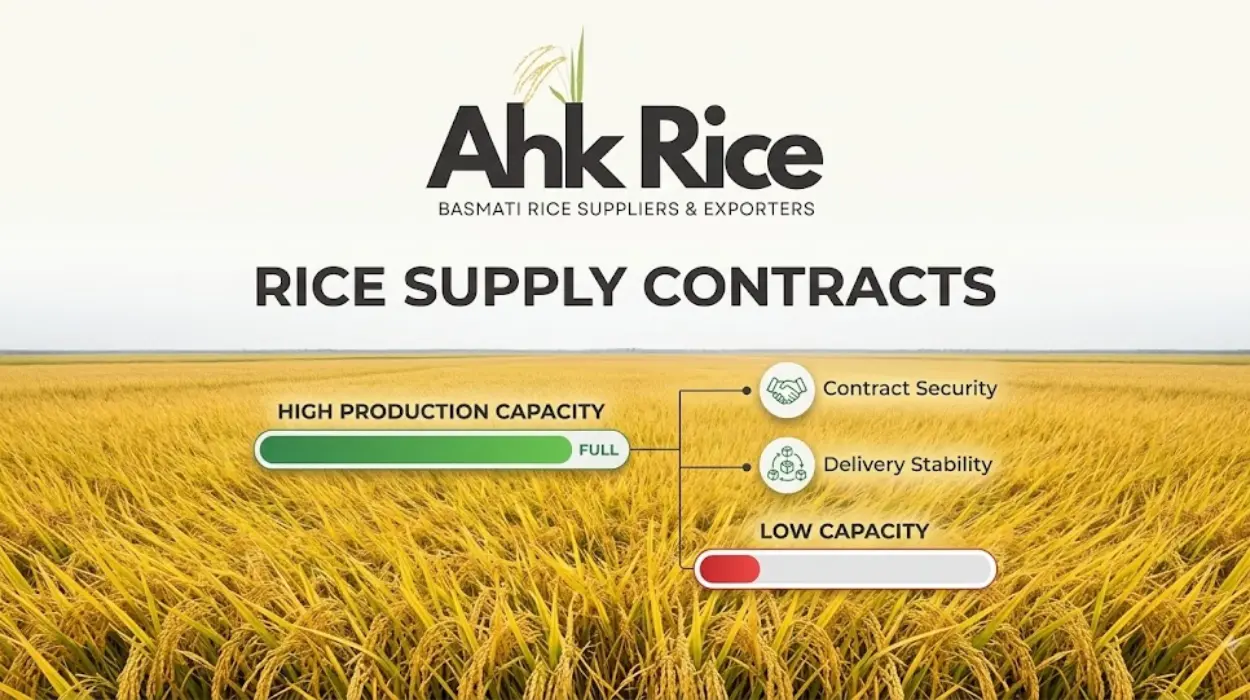
Production capacity ultimately becomes a commercial risk-control measure. A supplier with sufficient capacity can protect recurring availability, while a supplier operating near its practical limit may struggle when demand rises.
The strongest contract structure combines a defined annual volume, monthly release schedule, measurable product specifications, minimum remaining shelf-life requirements, inspection rights, documentation requirements, and a capacity review before each major production cycle.
For decision-stage readers, the natural next internal link is:
AHK Rice Supports High-Volume Basmati Rice Imports into New York, USA because it moves from evaluating production capacity to reviewing a supplier-specific high-volume supply solution.
Frequently Asked Questions
How does production capacity affect long-term rice supply contracts?
Production capacity determines whether a rice exporter can consistently produce and dispatch the contracted quantity without causing delays, quality variation, or supply interruptions.
Why should New York rice buyers evaluate production capacity?
New York buyers need reliable recurring supply. Evaluating production capacity helps confirm that a supplier can maintain agreed volumes, specifications, packaging, and shipment schedules.
What is the difference between installed and available rice production capacity?
Installed capacity refers to the maximum output equipment can theoretically process. Available capacity is the realistic volume remaining after existing customer commitments, maintenance, labor, raw-material availability, and production schedules.
Which Pakistani Basmati rice grades are suitable for long-term contracts?
Common options include 1121 Basmati, Super Kernel, and 1509 Basmati. The appropriate grade depends on the buyer’s retail, foodservice, wholesale, or private-label requirements.
How much rice should a buyer commit to in a long-term contract?
The contracted quantity should match verified demand, warehouse capacity, cash flow, and the supplier’s available production allocation. Buyers should avoid committing to volumes substantially above their predictable sales requirements.
Does higher production capacity guarantee better rice quality?
No. Capacity and quality are separate measurements. A supplier must demonstrate that increased production maintains specifications for grain length, broken percentage, moisture, purity, sorting, packaging, and other agreed quality parameters.
How can buyers verify a rice supplier’s production capacity?
Buyers can request production records, monthly capacity figures, current commitments, processing schedules, shipment history, quality documentation, factory information, and evidence of raw-material availability.
What is a capacity coverage ratio?
A capacity coverage ratio compares available production capacity with the buyer’s contracted volume. For example, 1,000 MT of available monthly capacity divided by a 200 MT monthly contract gives a 5.0 capacity coverage ratio.
What are the benefits of a dedicated rice production allocation?
A dedicated allocation gives the buyer greater volume security and helps the exporter schedule procurement, processing, packaging, inspection, and container loading around the buyer’s recurring requirements.
What are the disadvantages of high-volume rice contracts?
Large contracts can increase inventory exposure, reduce purchasing flexibility, and create greater price risk if market conditions change. Buyers should use realistic forecasts and scheduled shipment releases.
How does rice production capacity affect pricing?
Larger, predictable orders can improve production planning and may support more structured commercial pricing. However, final pricing also depends on rice grade, crop conditions, paddy costs, processing, packaging, freight, currency movements, and market demand.
How does production capacity affect rice delivery times?
Higher available capacity can shorten production queues and provide greater scheduling flexibility. When capacity is heavily committed, production and container-loading schedules can become more constrained.
How long can Basmati rice be stored?
Basmati rice can generally be planned around a 12–24 month shelf-life range, depending on processing, moisture, packaging, storage conditions, and the supplier’s stated product specification. The contract should define the required remaining shelf life at arrival.
Which rice grades are commonly considered for New York importers?
New York buyers may evaluate 1121 White, 1121 Steam, Super Kernel, and 1509 Basmati, depending on customer demand, price positioning, cooking requirements, and distribution channel.
What should a buyer include in a long-term rice supply contract?
The contract should define variety, grade, specifications, quantity, shipment schedule, packaging, inspection requirements, documentation, payment terms, quality tolerances, shelf-life requirements, and procedures for handling production or delivery deviations.