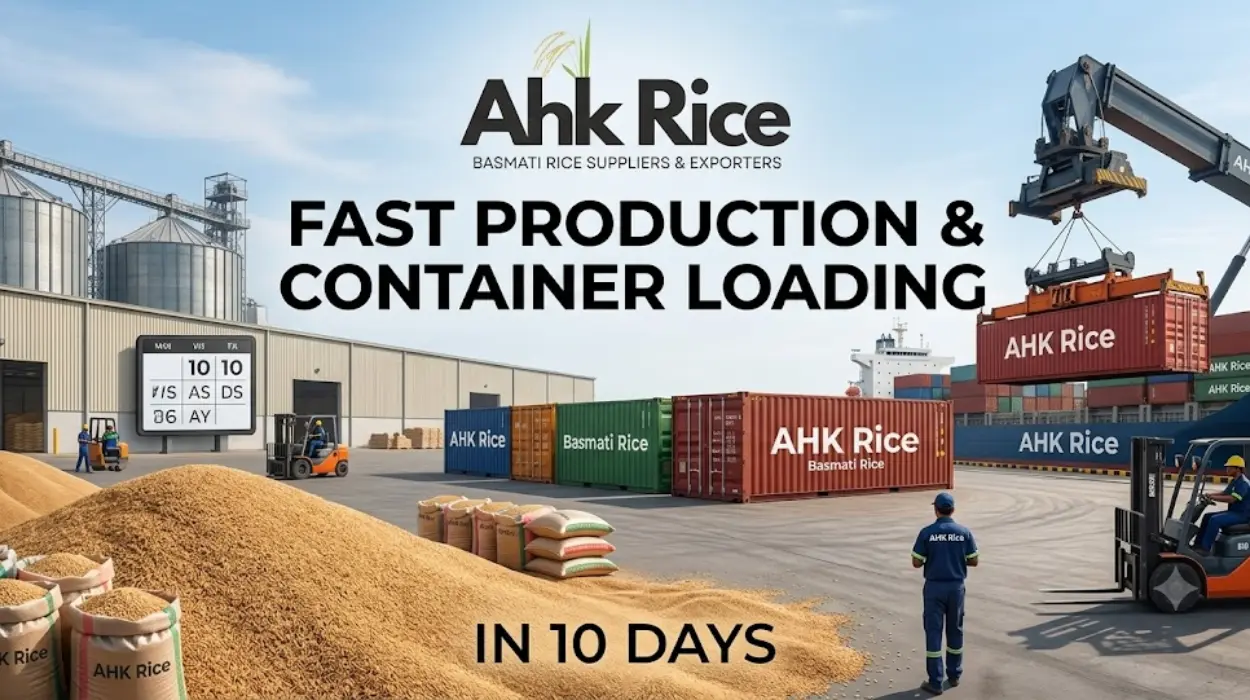
AHK Rice Completes Production and Container Loading Within Ten Days
Businesses importing Basmati rice need predictable lead times because delayed production can disrupt inventory, increase warehousing costs, and affect retail supply. If you want a supplier that can process, pack, inspect, and load export containers within ten days after confirming production, AHK Rice offers a structured manufacturing and export workflow designed for international buyers. If you are unfamiliar with the complete export sequence, first read our guide on:
What happens after an advance payment for a Basmati rice order before comparing production timelines. Buyers can also compare the complete:
Rice processing and export preparation timeline to understand how different suppliers manage production efficiency.
Is completing production and container loading within ten days the best solution for importers?
Yes. Completing production and container loading within ten days reduces inventory uncertainty, improves shipment planning, lowers supply chain risk, and helps importers maintain retail stock availability. A structured manufacturing schedule also minimizes unnecessary storage expenses while providing buyers with predictable export documentation and shipment readiness.
For food importers, wholesalers, distributors, supermarket chains, and government procurement agencies, delivery reliability is often more important than obtaining the lowest price. Missing a shipment window may result in delayed product launches, stock shortages, contractual penalties, or increased freight costs.
AHK Rice has developed a production workflow that enables completed manufacturing and container loading within ten working days for standard commercial orders, provided raw material availability, packaging approval, payment confirmation, and shipping schedules are finalized before production begins.
The ten-day production cycle generally includes:
- Production planning
- Paddy selection
- Cleaning
- De-stoning
- Whitening
- Grading
- Length sorting
- Color sorting
- Metal detection
- Quality inspection
- Packaging
- Palletizing (when required)
- Container loading
- Export documentation preparation
Rather than waiting several weeks for processing, buyers receive a structured production schedule with regular updates.
This production capability makes AHK Rice suitable for repeat import programs where consistent lead times directly affect sales performance.
Why choose UAE supply services from AHK Rice?
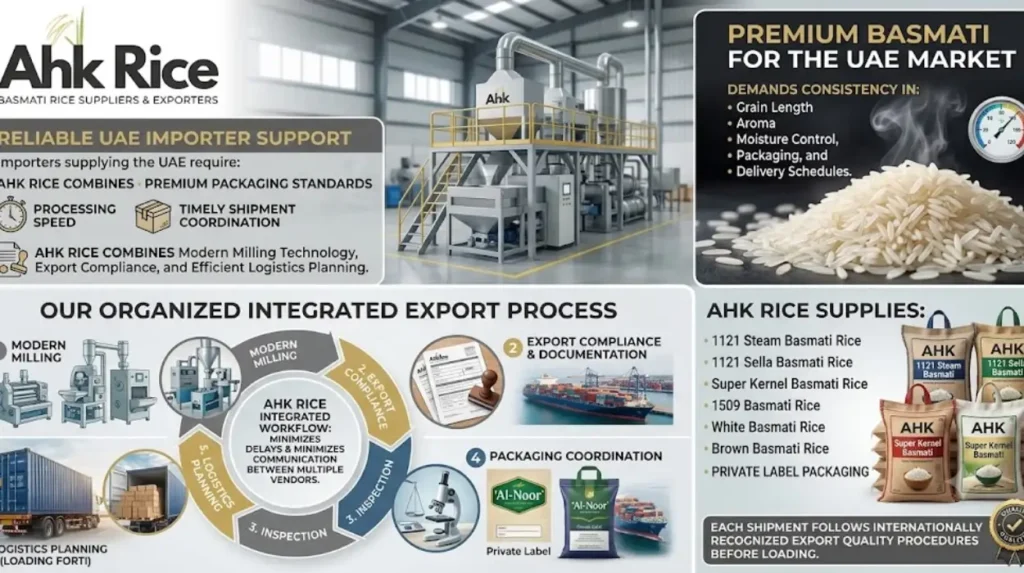
Importers supplying the UAE require reliable processing speed, premium packaging standards, accurate documentation, and timely shipment coordination. AHK Rice combines modern milling technology, export compliance, and efficient logistics planning to deliver containers ready for shipment within an organized production schedule that supports long-term commercial partnerships.
The UAE remains one of the largest destinations for premium Pakistani Basmati rice. Buyers demand consistency in grain length, aroma, moisture control, packaging quality, and delivery schedules.
When purchasing through the UAE service , buyers receive support throughout the export process rather than only purchasing rice as a commodity.
AHK Rice supplies:
- 1121 Steam Basmati Rice
- 1121 Sella Basmati Rice
- Super Kernel Basmati Rice
- 1509 Basmati Rice
- White Basmati Rice
- Brown Basmati Rice
- Private Label Packaging
Each shipment follows internationally recognized export quality procedures before loading.
Unlike suppliers that outsource several production stages, AHK Rice coordinates manufacturing, inspection, packaging, documentation, and logistics through one organized export process.
This integrated workflow helps minimize communication delays between multiple vendors.
How does AHK Rice complete production and loading within ten days?
A structured manufacturing schedule supported by raw material planning, automated processing equipment, trained quality inspectors, and coordinated logistics enables AHK Rice to complete production and container loading efficiently without compromising export quality standards required by international buyers.
The production schedule typically follows this sequence.
Day 1
Production confirmation
Packaging approval
Raw material allocation
Quality specifications review
Day 2–4
Cleaning
De-stoning
Whitening
Grading
Length separation
Color sorting
Day 5–6
Laboratory testing
Moisture verification
Broken percentage inspection
Foreign matter inspection
Final quality approval
Day 7–8
Packaging
Weight verification
Bag stitching
Pallet preparation if required
Barcode labeling
Day 9
Container inspection
Food-grade cleanliness verification
Loading supervision
Photographic documentation
Day 10
Export documentation
Bill of Lading coordination
Certificate preparation
Shipping line confirmation
Container dispatch
Throughout production, AHK Rice maintains communication with buyers by providing production updates, inspection reports, photographs, and shipment readiness information.
What export documents are prepared before shipment?
Professional documentation ensures smooth customs clearance, faster import processing, reduced inspection delays, and greater confidence for international buyers. Accurate paperwork is equally important as manufacturing quality because customs authorities require complete documentation before releasing imported food products into commercial markets.
Depending on destination country requirements, AHK Rice prepares:
- Commercial Invoice
- Packing List
- Certificate of Origin
- Phytosanitary Certificate
- Fumigation Certificate (when required)
- Health Certificate
- Bill of Lading
- Insurance documents (if applicable)
- Quality Inspection Reports
Additional documentation can be arranged according to importing country regulations.
This preparation allows importers to begin customs procedures immediately after shipment.
How does the sample approval process work before production begins?
A structured sampling process helps buyers verify grain quality, aroma, cooking performance, moisture level, and packaging specifications before full-scale manufacturing starts. Sample approval significantly reduces commercial risk because production follows mutually approved quality standards instead of assumptions.
Before commercial production begins, AHK Rice recommends approving representative product samples.
The process usually includes:
Step 1
Buyer submits quality specifications.
Step 2
Available rice grades are selected.
Step 3
Sample preparation.
Step 4
Laboratory verification.
Step 5
Courier shipment.
Step 6
Buyer evaluation.
Step 7
Final confirmation.
Typical sample quantities include:
- 500 grams
- 1 kilogram
- 2 kilograms
Courier charges depend on destination country, courier company, and delivery speed.
In 2026, international courier costs generally range between USD 45 and USD 120 for small food samples, depending on destination and service level. Buyers usually pay courier charges, although sample value is commonly adjusted against confirmed commercial orders according to supplier agreement.
Once approved, AHK Rice begins commercial production according to the accepted specifications.
What results can buyers expect after choosing AHK Rice?
Buyers typically achieve faster replenishment, more predictable inventory planning, consistent product quality, reduced operational uncertainty, and improved customer satisfaction because production schedules, export documentation, and logistics coordination follow an organized workflow designed specifically for international Basmati rice trade.
Reliable production offers measurable commercial advantages.
Expected outcomes include:
- Faster shipment readiness
- Lower inventory shortages
- Better seasonal planning
- Reduced emergency purchasing
- Consistent grain quality
- Repeatable product specifications
- Professional export documentation
- Improved retailer confidence
For importers serving supermarket chains, foodservice companies, restaurants, wholesalers, and distributors, predictable production schedules simplify procurement planning.
This is particularly valuable during Ramadan, festive seasons, and promotional campaigns when demand increases significantly.
Many repeat buyers select AHK Rice because shipment reliability becomes a competitive advantage in their domestic market.
What factors affect production cost and final export pricing?
Rice export pricing depends on product specifications, packaging requirements, certification needs, freight rates, destination market, and order quantity. Understanding these variables enables buyers to compare quotations accurately while selecting suppliers capable of delivering consistent commercial value rather than only lower prices.
Several factors influence the final quotation.
Rice variety
Premium varieties command higher prices than standard grades.
Milling quality
Extra polishing, sorting, and grading require additional processing.
Broken percentage
Lower broken percentages generally increase product value.
Packaging
Private-label printed bags cost more than standard export packaging.
Container quantity
Larger orders usually improve production efficiency.
Certifications
Additional inspection or certification services may increase costs.
Ocean freight
Shipping rates fluctuate according to destination and shipping market conditions.
Destination country
Different markets require different documentation and compliance standards.
Although market prices change throughout the year, buyers should compare quotations based on identical specifications rather than only total price.
Consistent quality and dependable production frequently provide greater long-term value than selecting the lowest-priced supplier.
How many shipping days should buyers expect after container loading?
Transit time varies by destination, shipping route, port congestion, and carrier schedules. Buyers should plan procurement using estimated sea freight durations rather than production time alone because ocean transportation represents a significant portion of total delivery lead time.
Typical sea freight transit times in 2026 are approximately:
| Market | Estimated Shipping Time |
|---|---|
| UAE | 8–12 days |
| Saudi Arabia | 10–16 days |
| Oman | 7–12 days |
| Qatar | 10–15 days |
| Kuwait | 10–16 days |
| Bahrain | 10–15 days |
| East Africa | 18–28 days |
| South Africa | 25–35 days |
| United Kingdom | 28–38 days |
| European Union | 25–35 days |
| United States East Coast | 35–45 days |
| United States West Coast | 28–40 days |
| Canada | 35–45 days |
| Australia | 25–35 days |
Transit estimates may vary depending on shipping line schedules, customs processing, weather conditions, and port congestion.
AHK Rice coordinates booking with established shipping lines to help buyers secure suitable sailing schedules.
How do you get started with AHK Rice?
Starting an export order is straightforward when specifications, packaging, documentation, and production schedules are confirmed early. A structured onboarding process minimizes misunderstandings and allows manufacturing to begin quickly while ensuring every shipment matches the buyer’s approved commercial requirements.
The ordering process follows several straightforward steps.
First, submit your product specifications, destination market, packaging preferences, and estimated order quantity.
Next, review the quotation together with technical specifications and commercial terms.
Then, approve representative samples before commercial production begins.
After confirmation, AHK Rice schedules production, completes quality inspections, prepares export documentation, and loads the container within the agreed production timeline.
Throughout the process, buyers receive production updates until shipment is dispatched.
For importers seeking dependable Pakistani Basmati rice with organized production scheduling, transparent communication, and efficient export management, AHK Rice provides a practical solution designed around international trade requirements.
Frequently Asked Questions
How does AHK Rice complete production and container loading within ten days?
AHK Rice follows a structured workflow that includes production planning, milling, quality inspection, packaging, documentation, and container loading. Once order details and payment are confirmed, standard export orders can be completed within ten working days.
Can I approve a sample before placing a bulk rice order?
Yes. AHK Rice provides representative rice samples for quality evaluation. Buyers can inspect grain length, aroma, moisture content, cooking performance, and packaging before approving full-scale production.
Which export documents are included with the shipment?
Depending on the destination country’s requirements, AHK Rice provides documents such as the Commercial Invoice, Packing List, Certificate of Origin, Phytosanitary Certificate, Bill of Lading, and other required export certifications.
How long does shipping take after container loading?
Shipping times depend on the destination. Typical transit times are 8–12 days for the UAE, 10–16 days for Saudi Arabia, 25–35 days for Europe, and 35–45 days for North America.
What factors affect the final export price of Basmati rice?
Pricing depends on the rice variety, order quantity, packaging type, milling specifications, certification requirements, destination country, and current ocean freight rates.
Does AHK Rice offer private label and customized packaging?
Yes. AHK Rice supplies customized retail and wholesale packaging, including private label printing, different bag sizes, and packaging materials tailored to importer and distributor requirements.
What is the minimum order quantity for export?
The minimum order quantity depends on the rice variety and packaging requirements. Most commercial exports are shipped as Full Container Load (FCL) orders, while specific requirements can be discussed during the quotation process.
Why should importers choose AHK Rice for Basmati rice exports?
AHK Rice combines modern processing facilities, strict quality control, timely production, export documentation support, and reliable logistics coordination to help importers receive consistent, export-ready Basmati rice with predictable delivery schedules.