Saudi Rice Import Market Trends and Demand for Pakistani Basmati in 2026
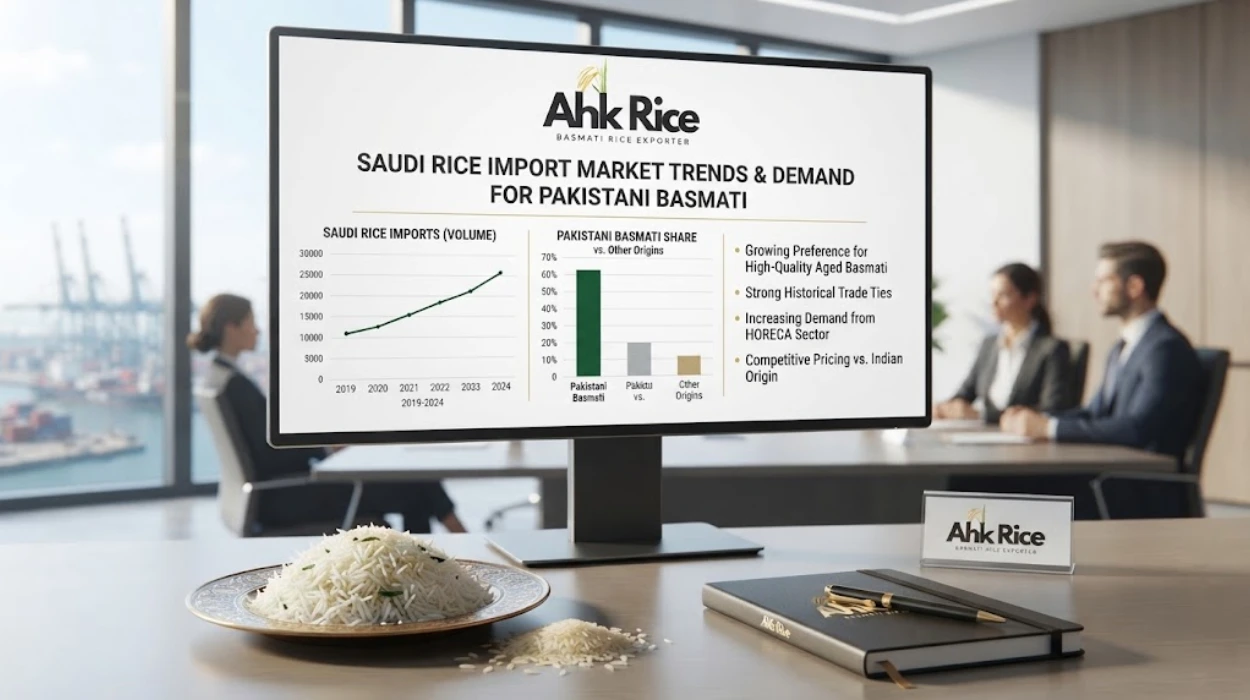
Saudi Arabia remains a major rice-importing market, with Pakistan supplying about 169,000 metric tons of rice worth approximately US$163 million in 2025. Here is why: Saudi Arabia relies heavily on imported rice, while Pakistani Basmati fits demand for long grains, aroma, cooking performance, and established wholesale supply.
What Is the Saudi Rice Import Market in 2026?
The Saudi rice import market is an import-dependent food supply system serving households, wholesalers, retailers, restaurants, caterers, and hospitality businesses across the Kingdom. Rice enters through international suppliers and moves through importers, distributors, supermarkets, and foodservice channels.
Saudi Arabia imported 1.845 billion kilograms of rice worth US$2.013 billion in 2024. India supplied 1.391 billion kilograms, while Pakistan supplied 217.028 million kilograms. Pakistan therefore represented about 11.8% of Saudi Arabia’s total rice import volume in 2024.
Semi-milled and wholly milled rice represented most of this trade. Saudi Arabia imported 1.815 billion kilograms of this category in 2024. Pakistan supplied 213.834 million kilograms valued at US$221.735 million.
Pakistan’s position strengthened in 2025. Saudi Arabia received about 169,000 metric tons of Pakistani rice valued at approximately US$163 million. Saudi officials also expressed interest in expanding rice imports from Pakistan in subsequent years.
The market therefore connects several entities. These include Pakistani rice millers, Saudi importers, wholesale distributors, retail chains, restaurants, catering companies, and household consumers.
With the market structure established, the next question is how Pakistani rice moves through this supply chain.
How Does Rice Importing Work in Saudi Arabia?
Saudi rice importing starts with product specification, supplier selection, documentation, shipment, customs clearance, food inspection, and distribution through Saudi commercial channels. Each stage connects product quality with regulatory and logistics requirements.
How Is Pakistani Rice Prepared for Export?
Pakistani rice begins with paddy cultivated and harvested in producing regions, especially Punjab for Basmati varieties. Export mills then convert harvested paddy into commercially specified rice.
The main processing sequence includes:
- Clean the paddy to remove stones, dust, straw, and other foreign material.
- De-husk the grain to remove the outer husk.
- Polish the grain to achieve the required appearance.
- Grade the rice according to grain size and processing specification.
- Sort the rice using mechanical and colour-sorting systems.
- Parboil the grain for Sella or parboiled specifications.
- Dry the rice to establish controlled moisture.
- Inspect the finished rice against the agreed specification.
- Pack the rice in retail or commercial formats.
- Load the shipment for dispatch to Saudi Arabia.
Export specifications normally define grain length, broken percentage, moisture, foreign matter, milling quality, packaging, and crop information.
What Happens After Shipment Reaches Saudi Arabia?
Saudi food imports operate under the regulatory framework of the Saudi Food and Drug Authority. Saudi importers must register their establishment, pre-register imported food products, and ensure compliance with applicable regulations and technical specifications.
Commercial shipments therefore require coordination between the exporter and Saudi importer before dispatch. Documents, product information, invoices, packaging details, and food compliance records form part of the import process.
Ports then connect the shipment with domestic distribution. Jeddah and Dammam are important commercial destinations for rice entering Saudi Arabia, while inland distributors move products toward Riyadh and other population centres.
The import process links agricultural production with regulatory compliance and final distribution.
What Are the Main Components of Saudi Rice Demand?
Saudi rice demand consists of household retail, wholesale distribution, foodservice, catering, hospitality, product specifications, packaging formats, and regulatory compliance requirements. These components determine which rice varieties enter different commercial channels.
Which Consumer Channels Buy Rice?
Household retail represents a major rice consumption channel. Consumers purchase branded rice through supermarkets, grocery stores, hypermarkets, and traditional food retailers.
Wholesale distribution serves smaller retailers and food businesses. Wholesale buyers typically evaluate price, grain quality, packing format, supply continuity, and shipment consistency.
Foodservice includes restaurants, hotels, catering companies, and institutional kitchens. These buyers evaluate cooking performance because rice must remain visually consistent across large batches.
Which Rice Characteristics Matter?
Long grain length remains an important Basmati characteristic. Aroma, elongation, whiteness, cooking texture, broken percentage, and moisture also influence product selection.
Saudi demand includes both white and parboiled rice. Pakistani shipments into Saudi Arabia demonstrate commercial demand for 1121 Basmati Sella, 1121 Basmati White, 1121 Basmati Steam, and other long-grain Sella specifications.
Volza recorded 330 shipments of 1121 Basmati from Pakistan to Saudi Arabia between May 2024 and April 2025, involving 69 exporters and 110 verified buyers. Its dataset showed 54% shipment growth compared with the previous period.
These shipment patterns connect variety selection directly with Saudi purchasing activity.
Which Pakistani Basmati Varieties Serve the Saudi Market?
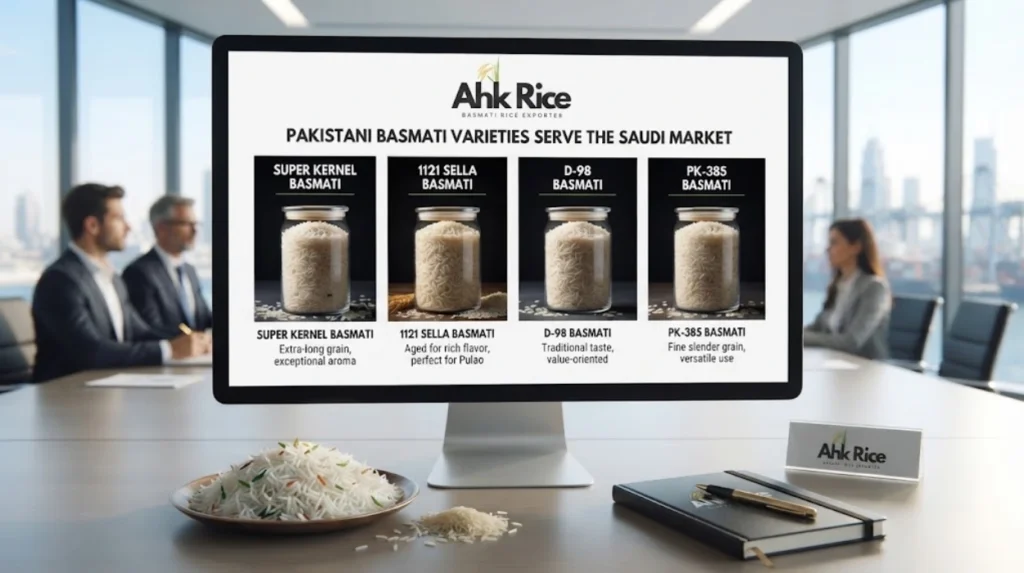
1121 Basmati, Super Kernel Basmati, and 1509 Basmati represent three important Pakistani Basmati categories, with differences in grain profile, processing options, pricing position, and commercial application.
What Is 1121 Basmati?
1121 Basmati is a long-grain Pakistani Basmati variety associated with extended cooked grain length, aroma, and premium presentation. Its processing forms include White, Steam, Golden Sella, Creamy Sella, Brown, and broken grades.
Saudi import records show repeated shipments of 1121 Sella, 1121 White, and 1121 Steam from Pakistan. One recorded shipment contained 75,000 kilograms of 1121 Basmati Steam. Another shipment contained 50,000 kilograms of long-grain Sella Basmati with less than 2% broken grains.
What Is Super Kernel Basmati?
Super Kernel Basmati is a traditional Pakistani Basmati category valued for aroma, long grain appearance, and broad retail and foodservice use. Saudi buyers can specify white or parboiled processing according to the intended channel.
What Is 1509 Basmati?
1509 Basmati is a long-grain Pakistani variety known for shorter cultivation duration and strong commercial yield. Its processing options include White, Steam, and Golden Sella.
These varieties give Saudi buyers multiple specification routes rather than a single Basmati product.
For buyers evaluating the differences between these varieties, the next-stage comparison is covered in the guide to key Pakistani rice varieties preferred by Saudi wholesale buyers in 2026.
What Are the Main Saudi Rice Import Trends in 2026?
The 2026 market shows sustained import dependence, strong Pakistani rice trade, active Basmati shipment flows, and continued attention to specification, price, compliance, and supply reliability.
Is Pakistani Rice Demand Increasing?
Pakistan’s Saudi rice trade expanded significantly before 2026. Pakistan’s FY2024 export data recorded Saudi Arabia as a major Basmati destination, with 101,909 metric tons of Basmati exported to Saudi Arabia worth US$112 million. Quantity increased 80.4%, while value increased 81.4% compared with FY2023.
Pakistan’s broader Saudi rice supply reached approximately 169,000 metric tons in 2025. The Saudi government stated interest in increasing imports from Pakistan in future years.
Is Basmati Still Important?
Basmati remains important because Saudi consumption includes dishes such as Kabsa, Mandi, and Biryani. Long grains and cooked elongation support the visual and textural requirements of these dishes.
Pakistan’s State Bank also identified Saudi Arabia among the main destinations for Pakistani Basmati exports during H1-FY2025.
The 2026 trend therefore combines volume demand with product differentiation.
What Benefits Does Pakistani Basmati Provide for Saudi Buyers?
Pakistani Basmati provides long-grain presentation, natural aroma, multiple processing grades, established export supply, and specification flexibility for retail, wholesale, restaurant, and catering channels.
Long-grain Basmati supports dishes requiring separated cooked grains. Steam and Sella processing provide different cooking characteristics for commercial kitchens.
Multiple grades also allow buyers to align rice with different price and usage segments. Premium retail can prioritize appearance and aroma. Catering can prioritize cooking resilience and batch consistency. Wholesale channels can prioritize cost, packaging, and supply continuity.
Pakistan also has an established Saudi trade relationship. The bilateral rice flow reached approximately US$163 million in 2025, demonstrating an established commercial route rather than a new market relationship.
These benefits explain why variety and processing specification remain central to Saudi procurement.
What Are the Common Problems and Misconceptions in the Saudi Rice Market?
Common problems include treating all Basmati grades as identical, comparing prices without specifications, overlooking import compliance, and confusing total rice imports with Basmati-specific demand.
Is All Pakistani Basmati the Same?
No. 1121, Super Kernel, and 1509 have different grain characteristics and commercial positioning. White, Steam, Golden Sella, Creamy Sella, and Brown processing also create different finished products.
Does the Lowest Price Represent the Best Import Value?
No. Rice price must be compared against grain length, broken percentage, moisture, milling quality, packing, quantity, freight, and delivery terms.
A 40-kilogram commercial bag and a 5-kilogram retail pack do not represent the same landed cost structure. A White specification and a Golden Sella specification also require different processing.
Does Saudi Rice Import Data Equal Basmati Demand?
No. Total rice imports include Basmati, non-Basmati, parboiled rice, and other rice categories. In 2024, Saudi Arabia imported 1.845 million metric tons of rice, while Pakistan supplied 217,028 metric tons across the complete HS 1006 rice category.
Basmati shipment databases provide a narrower view. Volza recorded 625 Basmati shipments into Saudi Arabia from May 2024 to April 2025 and identified Pakistan among the leading supplier countries.
What Certifications and Compliance Requirements Apply?
Saudi food imports require compliance with SFDA requirements. Importers must register their establishments and imported food products. The products must meet Saudi regulations, technical regulations, and approved specifications.
Certification requirements depend on the product, shipment, importer, and applicable Saudi regulations. Exporters therefore need to verify current requirements before dispatch rather than relying on a generic certification list.
Saudi rice demand is therefore shaped by volume, variety, processing, price, food safety, packaging, and logistics. The next consideration is how Saudi wholesale buyers select between Pakistani varieties based on these specifications.
Frequently Asked Questions
What is the Saudi rice import market?
The Saudi rice import market is an import-dependent food supply chain serving retail, wholesale, restaurants, catering companies, hotels, and households. Saudi Arabia imported 1.845 million metric tons of rice in 2024.
How much rice did Pakistan export to Saudi Arabia in 2025?
Pakistan supplied approximately 169,000 metric tons of rice worth US$163 million to Saudi Arabia in 2025, according to Saudi government statements.
Which Pakistani Basmati varieties are important in Saudi Arabia?
Important Pakistani Basmati categories include 1121 Basmati, Super Kernel Basmati, and 1509 Basmati. Processing forms include White, Steam, Golden Sella, Creamy Sella, and Brown.
Why is 1121 Basmati popular in Saudi Arabia?
1121 Basmati provides long grain presentation, aroma, and strong cooking performance. Saudi import records show commercial shipments of 1121 White, 1121 Steam, and 1121 Sella from Pakistan.
What does SFDA require for imported rice?
Saudi food importers must register their establishment and imported food products with SFDA. Imported food must comply with applicable Saudi regulations, technical requirements, and approved specifications.