Basmati Rice Selection for Bali and Jakarta Hotels: Sella vs Steam for Buffet Holding
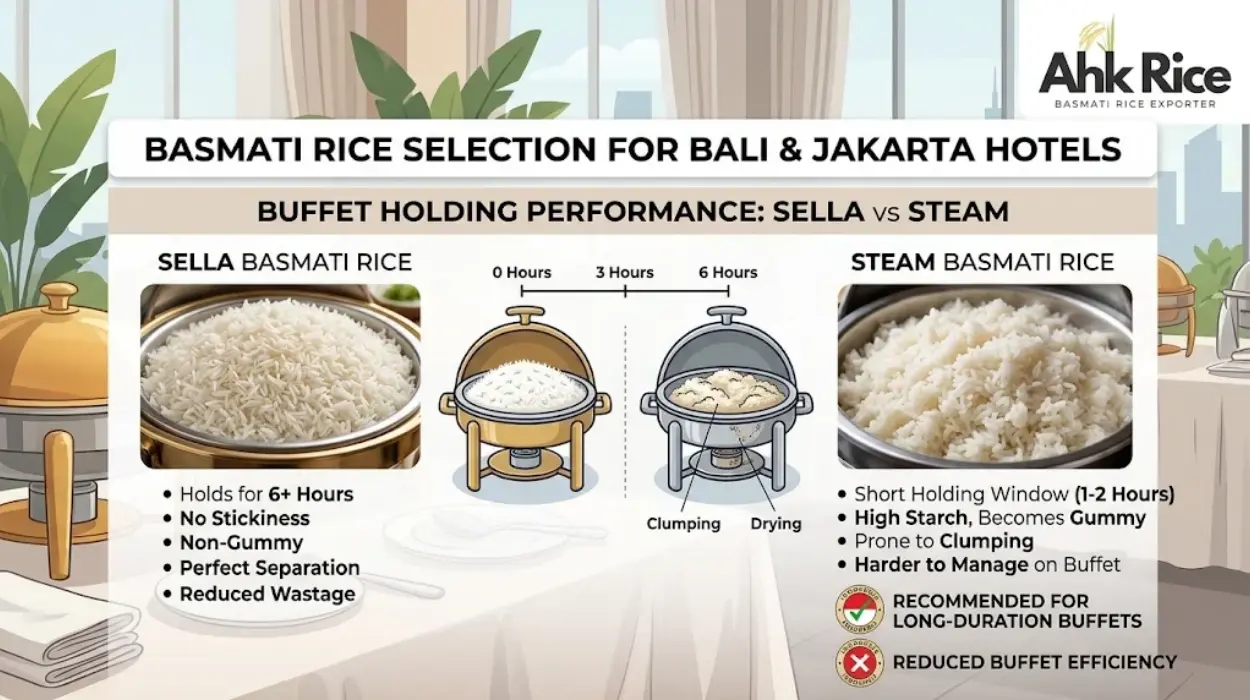
For Indonesian hotels, Sella Basmati generally suits long buffet holding better than Steam Basmati because its firmer cooked structure, lower clumping tendency, and stronger grain separation withstand extended service, while Steam Basmati delivers a softer, fresher texture for shorter buffet cycles and high-turnover dining.
Hotels in Bali and Jakarta face different buffet conditions. Bali properties often serve international tourists through breakfast, lunch, wedding, and resort buffets. Jakarta hotels operate high-volume business breakfasts, conferences, banquets, and restaurant services. Choosing between Sella and Steam therefore requires more than comparing grain length or price. The decision depends on holding time, reheating, menu positioning, kitchen throughput, and guest expectations. A useful foundation is this guide to Pakistani Basmati rice varieties and their characteristics, which explains how variety and processing affect commercial rice performance.
For procurement teams, the central distinction is processing. Sella Basmati is parboiled before milling, while Steam Basmati is steam-processed without the same parboiling profile. Processing changes water absorption, firmness, cooking behavior, and resistance to prolonged holding. The best choice depends on whether a hotel prioritizes buffet stability or immediate cooked texture.
What are the available solutions for Bali and Jakarta hotel buffets?
Hotels can choose Steam Basmati for fresh, fast-turnover buffets, Sella Basmati for extended holding, or a split procurement strategy that assigns each type to different menus, service periods, and banquet requirements.
The two principal solutions are Sella Basmati and Steam Basmati. Both can be produced from Pakistani Basmati varieties such as 1121, 1509, and Super Kernel. The variety determines the genetic grain characteristics, while processing determines much of the cooking behavior.
Sella Basmati is parboiled paddy rice that undergoes controlled steaming and drying before milling. This process produces firmer cooked grains with strong structural integrity. It is particularly useful where rice remains in a buffet pan for extended periods.
Steam Basmati receives steam treatment and milling without the same parboiling process used for Sella. It produces a more immediately familiar white-rice texture. Hotels often select it where the cooking cycle is short and replenishment is frequent.
A third solution is menu-based procurement. A Jakarta hotel can use Sella for banquet rice, biryani, nasi-style preparations, and high-volume buffet service while using Steam for breakfast or à la carte dishes. A Bali resort can use Steam during breakfast and Sella during wedding receptions or long-duration international buffets.
The strongest procurement strategy does not treat one processing method as universally superior. It matches the rice to the operating environment.
How do Sella and Steam Basmati compare for hotel buffet holding?
Sella provides stronger buffet-holding performance, while Steam provides a softer and fresher eating profile; the correct choice depends on holding duration, replenishment frequency, menu style, and the hotel’s target dining experience.
| Attribute | Sella Basmati | Steam Basmati |
|---|---|---|
| Processing | Parboiled and milled | Steam processed and milled |
| Cooked grain structure | Firm and resilient | Softer and more delicate |
| Grain separation | Strong | Good with correct cooking |
| Long buffet holding | Better suited | Better for shorter holding |
| Reheating tolerance | High | Moderate to high |
| Texture after service | Firm, separate grains | Softer, fresher texture |
| Best hotel application | Banquets, long buffets, catering | Breakfast, restaurants, rapid-turnover buffets |
This distinction becomes important when a hotel operates chafing dishes or heated buffet pans for several hours. Rice continues to lose moisture during holding. Softer rice therefore requires tighter cooking and replenishment control.
Sella’s firmer structure gives procurement teams greater operating tolerance. It does not eliminate quality loss, but it maintains grain separation more effectively during extended service.
Steam has a different advantage. When served soon after cooking, its texture can feel softer and more natural to guests who expect freshly prepared white Basmati. This makes it attractive for breakfast buffets where kitchen teams replenish smaller quantities several times during service.
How do Bali and Jakarta hotels differ in their rice requirements?
Bali hotels generally benefit from flexible rice procurement for resort, wedding, and tourist buffets, while Jakarta hotels require stronger consistency for corporate events, conferences, banquets, and high-volume foodservice operations.
Bali hotel requirements
Bali’s hotel sector includes resorts, villas, wedding venues, international restaurants, and destination properties. Breakfast can extend for several hours, while wedding and event buffets create longer service windows.
For these operations, Sella 1121 or Sella Super Kernel works well when cooked rice must remain separate during extended buffet holding. Long-grain appearance also supports premium international buffet presentation.
Steam 1121 or Steam Super Kernel suits breakfast service where cooks replenish rice frequently. The softer texture fits menus where rice is served alongside eggs, vegetables, grilled items, curries, and other breakfast dishes.
A hotel purchasing team should also consider whether rice is served as plain Basmati, pulao, biryani, or as part of a mixed international buffet. Sella generally has the stronger role where visual grain separation remains important throughout service.
Jakarta hotel requirements
Jakarta’s hotel market has a strong corporate and event component. Business hotels serve conferences, meetings, weddings, banquets, and large group meals. These operations create predictable periods of high-volume demand.
Sella Basmati is particularly appropriate for Jakarta banquet operations because kitchen teams can cook larger batches and maintain a firmer cooked structure during service. It also suits catering contracts where food reaches guests after preparation, transport, or staged buffet setup.
Steam remains valuable for breakfast and restaurant operations. A hotel with rapid table turnover can cook smaller batches and replenish them as demand increases.
Jakarta procurement therefore favors a more segmented model. Sella handles extended holding and event service. Steam handles rapid-turnover dining.
What are the price and shelf-life differences between Sella and Steam?
Sella normally carries a processing premium over comparable Steam rice, while both products can maintain commercial quality for long storage when moisture, packaging, warehouse conditions, and stock rotation are properly controlled.
Price per metric ton should be evaluated by grade, grain length, broken percentage, moisture, packing format, quantity, destination, and Incoterm, rather than by Sella or Steam processing alone.
For an Indonesian hotel buyer, a practical comparison is:
| Market use | Preferred grade | Indicative price position | Shelf-life consideration |
|---|---|---|---|
| Bali resort buffet | Sella 1121 / Super Kernel | Premium | Strong storage stability with controlled conditions |
| Bali breakfast | Steam 1121 / Super Kernel | Competitive | Best under controlled stock rotation |
| Jakarta banquet | Sella 1121 / 1509 | Premium | Suitable for planned bulk procurement |
| Jakarta breakfast | Steam 1121 / 1509 | Competitive | Suitable for frequent replenishment |
| Large catering | Sella 1509 / 1121 | Competitive to premium | Strong fit for planned inventory |
Actual FOB or CIF pricing must be quoted against the required specification. A buyer comparing two offers should request the same grain variety, processing type, moisture limit, broken percentage, packaging, quantity, and delivery basis.
Shelf life is also a supply-chain issue rather than a simple Sella-versus-Steam characteristic. Rice should remain dry, protected from pests, and stored away from excessive heat and humidity. Indonesian importers should apply stock rotation according to warehouse conditions and supplier documentation.
Which rice works best for different hotel cases?
Sella is the stronger choice for long buffet holding, banquets, weddings, and catering, while Steam performs best for fresh breakfast service, rapid replenishment, and menus where softer cooked texture has greater value.
A Bali wedding venue serving rice for several hours has a different requirement from a five-star breakfast restaurant replenishing rice every 20 minutes.
Case 1: Long wedding buffet
Choose Sella. Large batches remain in service longer, and grain separation becomes a major presentation factor. 1121 Sella provides long-grain appearance, while Super Kernel Sella provides a strong premium visual profile.
Case 2: International breakfast buffet
Choose Steam when the kitchen replenishes rice frequently. Freshly cooked rice can reach guests with a softer texture, reducing the need to hold large quantities for long periods.
Case 3: Jakarta conference catering
Choose Sella. Conference meals follow fixed schedules, and the rice may remain prepared while multiple dishes are completed and the buffet opens. Sella provides greater structural stability during this operational window.
Case 4: Restaurant with rapid turnover
Choose Steam. Smaller cooking batches and frequent replenishment reduce the need for extended holding. The cooking profile therefore becomes more important than long-duration resilience.
Case 5: Mixed hotel operation
Use both. Assign Sella to banquets, weddings, catering, and long buffets. Assign Steam to breakfast, à la carte service, and rapid-turnover restaurant operations.
What are the main pros and cons of Sella and Steam?
Sella’s main advantage is holding stability, while its firmer texture is less suitable for guests who prefer softer freshly cooked rice; Steam offers a fresher texture but requires tighter cooking, replenishment, and buffet management.
Sella advantages
Sella maintains a firm cooked grain structure. This supports buffet presentation, banquet service, and catering. It also provides consistent grain separation when kitchen teams prepare larger quantities.
Its disadvantage is texture preference. Some guests prefer softer rice, particularly when rice is served immediately after cooking.
Steam advantages
Steam provides a softer and fresher eating profile. It works well for breakfast and restaurant service where rice moves quickly from kitchen to guest.
Its limitation appears during prolonged holding. Excessive holding, overcooking, or poor moisture management can reduce texture quality.
Example
Suppose a Bali resort serves 80 kg of cooked rice across a four-hour wedding buffet. Sella provides a stronger operational fit because the kitchen requires longer holding stability.
A Jakarta hotel serving 15 kg of rice in rotating breakfast batches has a different requirement. Steam can provide the preferred texture because the kitchen replaces rice frequently.
What decision factors should hotel buyers use?
Hotel buyers should evaluate holding time, cooking batch size, guest texture preference, menu application, and landed cost before selecting Sella or Steam, because processing performance only becomes valuable when it matches the hotel’s actual foodservice operation.
| Decision factor | Choose Sella when… | Choose Steam when… |
|---|---|---|
| Holding time | Rice remains on buffet for extended periods | Rice is replenished frequently |
| Batch size | Kitchen prepares large batches | Kitchen prepares smaller batches |
| Menu | Banquet, wedding, catering, biryani | Breakfast, restaurant, fresh buffet |
| Guest texture | Guests value firm, separate grains | Guests prefer softer fresh rice |
| Procurement | Stability and operational tolerance matter | Fresh-service texture has priority |
The buyer should then define the required grade. 1121 provides premium long-grain characteristics and strong international market recognition. 1509 provides an efficient commercial option with long grain and strong suitability for bulk foodservice. Super Kernel offers an aromatic premium profile from Punjab.
Processing and variety should therefore be specified separately. “Basmati rice” is not enough for a commercial hotel contract.
How should hotels structure the final rice specification?
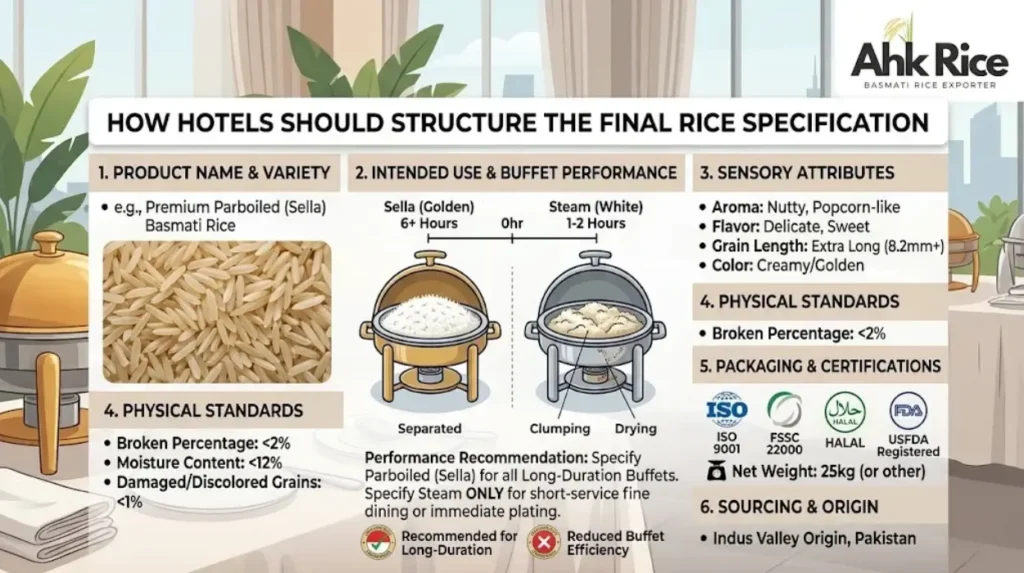
A complete hotel specification should state variety, processing method, grain length, moisture, broken percentage, packaging, quantity, inspection requirements, and delivery terms so every shipment is evaluated against the same commercial standard.
A procurement specification can state:
Product: Pakistani Basmati rice
Variety: 1121, 1509, or Super Kernel
Processing: Sella or Steam
Moisture: Defined maximum according to agreed specification
Broken: Defined maximum according to grade
Packing: 5 kg, 10 kg, 25 kg, 50 kg, or custom hotel requirement
Inspection: Pre-shipment sample and agreed quality inspection
Documentation: Commercial invoice, packing list, certificate of origin, phytosanitary documentation, and required Indonesian import documents
Delivery: FOB Karachi or CIF Jakarta/Surabaya according to contract
The buyer should test the rice under actual kitchen conditions before committing to recurring supply. A cooking test should measure water absorption, cooked yield, grain separation, holding performance, reheating behavior, and guest-facing texture.
This approach converts a generic rice purchase into a foodservice specification.
What is the best overall strategy for Bali and Jakarta hotels?
The strongest strategy is not choosing one processing method for every menu; it is assigning Sella to long-holding and event applications while using Steam for rapid-turnover service, then standardizing each grade through controlled specifications and cooking tests.
AHK Rice supplies Pakistani Basmati varieties from Punjab, including 1121, Super Kernel, and 1509, with end-to-end processing, custom packaging, and export documentation. For Indonesian hotel procurement, the important comparison is not simply supplier versus supplier. It is whether the shipment matches the hotel’s operational specification.
A hotel buyer should first identify service windows. Next, select the processing method. Then select the variety and grade. Finally, compare FOB or CIF offers using identical specifications.
For a resort with frequent weddings and long buffets, Sella deserves priority. For a business hotel with fast breakfast turnover, Steam can provide better texture economics. For a large property with both operating patterns, a dual-product procurement strategy provides the most precise solution.
Frequently Asked Questions
Is Sella Basmati better than Steam for hotel buffets?
Sella is generally better for long buffet holding because its cooked grains remain firmer and more separate. Steam is better when rice is cooked in smaller batches and served quickly.
Which Basmati variety is best for Indonesian hotels?
1121 is suitable for premium long-grain presentation, 1509 suits efficient bulk foodservice, and Super Kernel fits premium aromatic applications. The final selection depends on menu, budget, and guest expectations.
Is Sella Basmati more expensive than Steam?
Sella can carry a processing premium, but the final price depends on variety, grade, broken percentage, moisture, packaging, quantity, destination, and Incoterm.
How long can Basmati rice be stored?
Commercial Basmati can be stored for an extended period under controlled warehouse conditions. Moisture, temperature, pest control, packaging integrity, and stock rotation determine practical storage performance.
Should Bali hotels use a different rice strategy from Jakarta hotels?
Yes. Bali resorts frequently require flexible supply for tourism, weddings, and long buffet service, while Jakarta hotels have strong demand from corporate events, conferences, and banquets. Both markets benefit from matching processing to service duration.