What Is Super Kernel Basmati Rice? Why Pakistan Calls It the King of Rice
Super Kernel Basmati rice is a long-grain aromatic rice cultivated in Punjab, Pakistan, with an average grain length of 7.2–7.6 mm and strong natural fragrance. Here is why: its elongation ratio reaches 2.0 after cooking, its aroma compounds remain stable after milling, and its export demand spans over 40 countries (source: REAP export data, December 2025).
What is Super Kernel Basmati rice and why is it called the king of rice in Pakistan?
Super Kernel Basmati rice is a traditional long-grain variety grown in Punjab with strong aroma, slender grains, and high elongation after cooking. Pakistan calls it the king of rice because of its consistent quality, export dominance, and cultural importance in premium rice segments.
Super Kernel Basmati rice belongs to the basmati family, which means “fragrant rice.” The term defines rice varieties with natural aroma, long grain structure, and post-cooking elongation. Super Kernel stands as a mid-length basmati type between shorter local varieties and extra-long 1121.
Punjab produces this rice using controlled irrigation from the Indus basin. The region’s soil contains balanced minerals that support aroma development. Farmers cultivate and harvest during the Kharif season, which starts in June and ends in November.
Pakistan calls it the king of rice because it maintains a balance between price and performance. Premium buyers choose it for aroma stability. Bulk buyers choose it for cost efficiency. This dual positioning strengthens its global identity.
With the definition of Super Kernel established, the next question is how this rice moves from field to export-ready grain.
How does Super Kernel Basmati rice work from cultivation to final product?
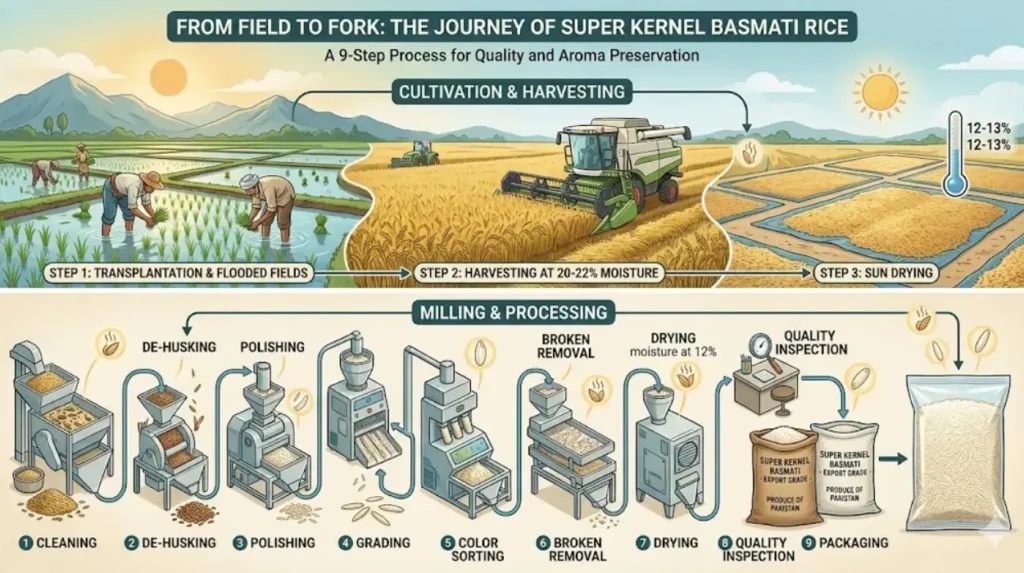
Super Kernel Basmati rice works through a 9-step process from cultivation to milling, where each stage preserves aroma, controls moisture, and ensures grain uniformity for export standards.
Rice production follows a defined agricultural and industrial sequence. Each stage contributes measurable quality outcomes.
Cultivation and harvesting process
Farmers cultivate Super Kernel using transplanted paddy methods. Seedlings grow in nurseries for 25 days. Farmers then transplant them into flooded fields. Irrigation continues at controlled intervals to maintain soil moisture.
Harvesting starts when moisture content reaches 20–22%. Farmers cut the paddy using mechanical harvesters. They then dry the paddy under sunlight until moisture drops to 12–13%. This controlled drying prevents cracking during milling.
Milling and processing steps
Processing transforms paddy into edible rice through precise mechanical actions:
- Clean the paddy to remove stones and dust
- De-husk the grain to separate husk from kernel
- Polish the rice to improve appearance
- Grade by length using mechanical graders
- Sort by color using optical sorters
- Remove broken grains
- Dry to stabilize moisture at 12%
- Inspect quality parameters
- Pack in export-grade materials
Each step protects grain structure and aroma compounds. Improper milling reduces elongation ratio and fragrance retention.
With the process explained, the next step is understanding the internal components that define this rice’s quality.
What are the key components that define Super Kernel Basmati quality?
Super Kernel Basmati quality depends on grain length, aroma compound concentration, moisture level, chalkiness percentage, and broken grain ratio. These measurable factors determine export grade classification and market acceptance.
Rice quality uses objective specifications. Buyers evaluate these components before procurement.
Physical components
Grain structure defines visual and cooking performance.
- Grain length: 7.2–7.6 mm
- Grain width: 1.6–1.8 mm
- Length-to-width ratio: 4.5–5.0
- Broken grains: ≤5% in premium grade
Longer grains produce better plate presentation. Lower broken percentage increases market value.
Chemical components
Aroma and cooking behavior depend on internal chemistry.
- 2-acetyl-1-pyrroline (2AP): aroma compound
- Amylose content: 22–25%
- Moisture level: 12–13%
Higher amylose ensures fluffy texture after cooking. Stable moisture prevents fungal growth during storage.
Processing grades
Super Kernel Basmati exists in multiple processing forms:
- White rice: fully milled and polished
- Steam rice: partially heat-treated
- Parboiled rice: soaked and steamed before milling
Each grade serves different markets. For example, Gulf buyers prefer steam rice for softness, while African markets choose parboiled for durability.
With components defined, the next question focuses on the benefits that make this rice dominant in global trade.
What are the main benefits of Super Kernel Basmati rice?
Super Kernel Basmati rice offers high aroma retention, consistent elongation, long shelf life, and balanced pricing, which makes it suitable for both premium retail and bulk food service markets.
Benefits translate into measurable value for buyers and consumers.
Cooking performance
Super Kernel expands uniformly during cooking. The elongation ratio reaches 1.8–2.0 times original length. This property improves dish presentation in recipes like biryani and pulao.
Rice remains non-sticky after cooking. Each grain stays separate, which is essential for large-scale catering operations.
Storage and shelf life
Super Kernel maintains quality for 12–18 months under dry conditions. Moisture stability prevents insect infestation when stored below 25°C.
In high-temperature regions like the Middle East, steam variants retain quality for 12 months without refrigeration. This durability supports bulk importers.
Market adaptability
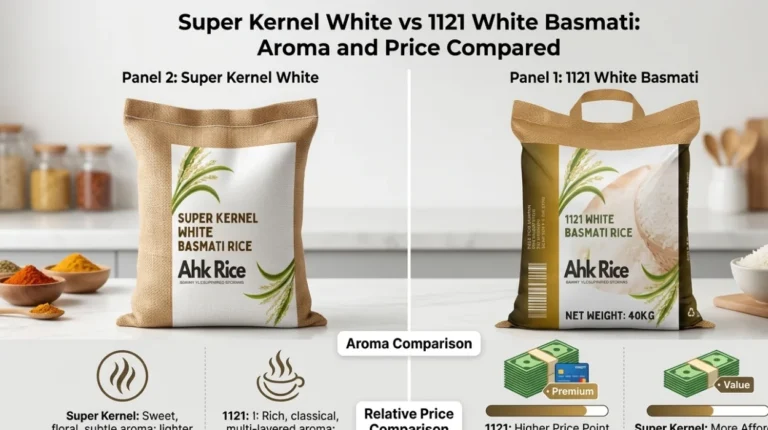
Super Kernel fits multiple price segments. It costs less than 1121 but delivers comparable aroma. This balance increases its demand across Asia, Africa, and the Middle East.
For buyers comparing options, a detailed breakdown of aroma, price, and market differences appears in this guide on super kernel vs 1121 basmati comparison for global buyers.
With benefits clear, the next step is identifying where this rice is used across industries and regions.
Where is Super Kernel Basmati rice used globally?
Super Kernel Basmati rice is used in retail packaging, food service operations, and industrial catering across regions like the Middle East, Africa, Europe, and Asia due to its balanced quality and cost.
Usage depends on cooking style and buyer requirements.
Retail applications
Retail brands package Super Kernel in 1 kg, 5 kg, and 10 kg formats. Consumers use it for daily meals and traditional dishes.
Examples include:
- Biryani in Pakistan and India
- Kabsa in Saudi Arabia
- Pilaf in Central Asia
Each dish requires long grains and aroma stability.
Food service and catering
Restaurants and catering companies prefer bulk packaging. Typical sizes include 25 kg and 50 kg bags.
Large kitchens select steam or parboiled grades because these withstand long cooking cycles. Parboiled rice maintains structure even after reheating.
Industrial use
Food processing companies use broken Super Kernel grains in products like rice flour and ready-to-eat meals. Lower-grade rice reduces cost without affecting processing output.
Global demand reflects these use cases. Pakistan exported over 4.5 million tons of rice in FY2024–25 (source: Pakistan Bureau of Statistics).
With applications covered, the next section addresses common misconceptions that affect buying decisions.

What are common problems and misconceptions about Super Kernel Basmati rice?
Common misconceptions include confusing Super Kernel with 1121, assuming all basmati has equal aroma, and ignoring processing grade differences, which leads to incorrect purchasing decisions and inconsistent cooking results.
Misunderstandings create real financial losses in bulk trade.
Misconception 1: All basmati rice is the same
Basmati varieties differ in length, aroma, and price. Super Kernel measures 7.2–7.6 mm, while 1121 exceeds 8.0 mm. This difference affects cooking expansion and presentation.
Buyers selecting based only on “basmati” label often receive mismatched specifications.
Misconception 2: Longer grain means better quality
Grain length does not define total quality. Aroma concentration and moisture stability matter equally. Super Kernel delivers stronger aroma than some longer varieties because of higher 2AP retention.
Misconception 3: White rice and parboiled rice perform the same
Processing changes cooking behavior. White rice cooks faster but breaks easily. Parboiled rice takes longer but maintains structure under pressure cooking.
Selecting the wrong type reduces dish quality in commercial kitchens.
Misconception 4: Storage conditions do not matter
Improper storage increases moisture above 14%, which leads to fungal growth. Controlled storage conditions protect rice quality during long shipping cycles.
Correcting these misconceptions improves procurement accuracy and cooking outcomes.
With misconceptions clarified, the blog now completes the full understanding of Super Kernel Basmati rice from origin to usage.
Frequently Asked Questions
What makes Super Kernel Basmati rice different from other basmati varieties?
Super Kernel Basmati rice differs in grain length, aroma strength, and price positioning. It measures 7.2–7.6 mm, offers strong fragrance, and costs less than 1121. This balance makes it suitable for both retail and bulk markets.
Which countries import Super Kernel Basmati rice the most?
Super Kernel Basmati rice is widely imported by countries in the Middle East, Africa, and parts of Europe. Major buyers include Saudi Arabia, UAE, Iraq, and Kenya due to consistent demand for aromatic and affordable long-grain rice.
How should Super Kernel Basmati rice be stored for maximum shelf life?
Store Super Kernel Basmati rice at below 25°C with moisture levels under 13%. Use airtight packaging to prevent humidity exposure. Proper storage maintains quality for 12–18 months without affecting aroma or grain texture.
Is Super Kernel Basmati rice suitable for biryani and pulao?
Super Kernel Basmati rice performs well in biryani and pulao because of its elongation ratio of 1.8–2.0 after cooking. The grains remain separate and aromatic, which improves presentation and taste in traditional dishes.
What are the main processing types available for Super Kernel Basmati rice?
Super Kernel Basmati rice is available in white, steam, and parboiled forms. White rice cooks faster, steam rice offers balanced softness, and parboiled rice provides durability for large-scale cooking and extended storage.