Build a Long-Term Rice Supply Partnership with AHK Rice in Utah
Utah importers need a rice supplier that protects specification consistency, shipment planning, documentation, and landed-cost control across repeat orders. The decision is not simply about finding the lowest FOB price. A long-term supply partnership creates a defined commercial specification, approved sample, production schedule, inspection process, and replenishment plan.
Importers evaluating supplier relationships should first understand:
Why importers build long-term partnerships with rice exporters before selecting a supplier. For a Utah wholesaler, distributor, retailer, restaurant supplier, or private-label business, the objective is straightforward: receive the same approved rice specification repeatedly, at a commercially workable landed cost, with enough lead time to protect inventory.
AHK Rice operates from Bucheki, Nankana Sahib, Punjab, Pakistan, and supplies Pakistani Basmati varieties including 1121, Super Kernel, and 1509. Its export process covers sourcing, processing, grading, sorting, packaging, documentation, inspection coordination, and container loading. AHK Rice also identifies the USA as an established export market.
What is the best solution for building a long-term rice supply in Utah?
The best solution is a specification-controlled supply partnership that combines approved samples, repeatable rice grades, planned production, documented quality checks, scheduled ocean freight, U.S. import compliance, and Utah inventory planning across every commercial shipment cycle.
A Utah buyer should avoid treating each container as a separate purchase. Repeated spot buying creates unnecessary variation in grain quality, packaging, documentation, freight timing, and supplier communication.
A Utah importer also needs to understand:
How strategic supplier relationships improve rice procurement because long-term sourcing affects specification control, forecasting, inventory planning, and supplier performance—not only the purchase price.
A stronger model begins with a fixed procurement specification. The document should identify variety, processing type, grain requirements, maximum broken percentage, moisture range, purity, packaging, quantity, inspection requirements, Incoterm, destination port, and delivery point.
For example, a Utah distributor targeting premium ethnic grocery stores can specify 1121 Basmati White or Sella. A foodservice distributor can prioritize cooking expansion, grain separation, texture, and repeatable performance. A private-label retailer can add bag weight, artwork, nutritional information, barcode requirements, and packaging material.
AHK Rice supports 1121, Super Kernel, and 1509 Basmati options for U.S. buyers. Its integrated processing model covers paddy procurement, cleaning, dehusking, whitening, polishing, grading, sorting, packaging, and container loading.
The commercial objective is specification continuity. The approved sample becomes the reference point for later production. This reduces the risk of approving one quality level and receiving another.
Why choose the USA service from AHK Rice for Utah procurement?
The USA service gives Utah buyers one export workflow covering Pakistani rice sourcing, processing, packaging, documentation, sampling, inspection coordination, container shipment, and delivery planning instead of coordinating separate suppliers for each stage.
The USA Basmati rice export service is designed for U.S. importers buying Pakistani rice at commercial volume. AHK Rice states that it supplies major U.S. ports including New York, Los Angeles, and Houston and supports 20-foot and 40-foot container shipments. Its published USA process also includes sample approval, contract confirmation, sourcing, milling, packaging, quality inspection, certification, container loading, customs preparation, and shipment.
For Utah, the value comes from managing the international leg before the cargo reaches the inland distribution network. The buyer does not need to manage Pakistani sourcing, milling, export documentation, and vessel coordination independently.
The service also supports different packaging formats. AHK Rice lists PP and jute bags from 5 kg to 50 kg alongside customized retail formats. This allows the same supplier relationship to support wholesale, foodservice, retail, and private-label programs.
Which rice grades fit different Utah buyers?
1121 Basmati is appropriate for buyers prioritizing extra-long grain appearance, aroma, and premium retail positioning. Super Kernel provides another long-grain Basmati option for wholesale and foodservice applications. 1509 can provide an alternative where price positioning and cooking characteristics align with the buyer’s specification.
The correct grade depends on the end customer rather than the supplier’s preferred inventory. The procurement specification should therefore be established before the sample is dispatched.
How does the sample process work before a Utah container order?
The sample process starts with specification collection, continues through representative sample preparation and courier delivery, then moves to physical and cooking evaluation, optional laboratory testing, approval, commercial quotation, contract confirmation, and production scheduling.
The first step is requirement confirmation. The Utah buyer provides the variety, processing grade, moisture target, broken percentage, packaging, quantity, destination, and intended application.
The second step is sample preparation. AHK Rice prepares a representative sample against the requested commercial specification. Its USA service states that samples up to 20 kg can be supplied without a rice-product charge, while the buyer covers applicable sample shipping and phytosanitary costs.
The third step is courier dispatch. AHK Rice’s current USA guidance places typical 1–5 kg air-courier sample delivery at approximately 5–7 days.
The fourth step is evaluation. The buyer should inspect dry grain appearance, uniformity, broken grains, aroma, colour, foreign matter, and packaging condition. Cooking tests should then measure elongation, separation, texture, aroma, and holding performance.
The fifth step is laboratory verification when required. Buyers can request moisture, purity, pesticide, microbiological, or other tests according to their procurement and compliance requirements.
A practical 2026 sample budget for a U.S. commercial evaluation is:
| Sample cost component | Planning allowance |
|---|---|
| Rice sample | Often complimentary under stated sample policy |
| International courier | Approximately $40–$120 |
| Phytosanitary/sample documentation | Variable |
| Optional laboratory testing | Approximately $50–$150+ |
| Custom retail packaging | Quoted separately |
| Commercial evaluation sample | Based on quantity and specification |
These are planning allowances, not fixed AHK Rice charges. Current AHK Rice USA information states that sample rice can be free up to the stated quantity while shipping and phytosanitary expenses remain the client’s responsibility.
Once the Utah buyer approves the sample, the approved specification should be retained as the commercial reference. This is the key control that turns sampling into a long-term procurement system.
How many shipping days should Utah buyers plan for?
Utah buyers should plan the Pakistan-to-Utah supply cycle in separate stages: production, export handling, ocean transit, U.S. port clearance, and inland transportation, with approximately 35–50 days used as a practical planning range for many Utah routes.
AHK Rice currently publishes approximately 25–35 days door-to-door for major U.S. ports such as New York and Los Angeles. Other current 2026 AHK Rice guidance places inland U.S. destinations around 35–50 days depending on routing.
Utah is an inland market, so port arrival is not the final delivery event. A buyer can use Los Angeles/Long Beach, Houston, or an East Coast gateway depending on freight economics, sailing schedules, and inland transportation.
A practical planning framework is:
| Destination / route | 2026 planning range | Utah procurement implication |
| New York / New Jersey | 25–35 days | Longer inland route to Utah |
| Houston | 30–40 days | Gulf route plus inland transportation |
| Los Angeles / Long Beach | 25–35 days to major port | Often logical for western U.S. distribution |
| Inland U.S. | 35–50 days | Use as broader replenishment planning range |
| Utah warehouse | Approximately 35–50 days | Confirm current vessel and inland schedule before PO |
These are planning ranges, not guaranteed delivery dates. Vessel schedules, transshipment, port congestion, customs clearance, inspection, rail availability, trucking, and seasonal freight conditions can change the final arrival date. AHK Rice’s current USA guidance explicitly advises buyers to plan around destination and shipping conditions rather than assuming one universal delivery time.
For Utah inventory planning, the correct method is to reorder before safety stock reaches its minimum level. A distributor waiting until the warehouse is nearly empty creates an avoidable stockout risk because international replenishment is measured in weeks, not days.
What results can Utah buyers expect from AHK Rice?
A properly managed supply partnership gives Utah buyers repeatable rice specifications, better inventory forecasting, fewer supplier changes, clearer shipment milestones, stronger documentation control, and a scalable procurement structure for additional containers.
The first result is product consistency. The approved specification provides a measurable standard for repeat shipments.
The second result is procurement efficiency. Instead of requesting new quotations and requalifying suppliers for every shipment, the buyer works from an established specification and commercial relationship.
The third result is inventory visibility. Planned production and vessel booking provide a better basis for warehouse replenishment.
The fourth result is packaging continuity. Retailers and private-label businesses can maintain the same bag size, presentation, and product identity across multiple purchasing cycles.
The fifth result is scalability. A successful initial container becomes a repeatable procurement model. AHK Rice identifies 20-foot containers as a typical starting quantity of approximately 20 metric tons for U.S. buyers, subject to product and packaging requirements.
AHK Rice also supports third-party inspection options. U.S. buyers can incorporate independent inspection into the contract when their procurement policy requires additional verification.
For a Utah distributor, the commercial outcome is not simply cheaper rice. The stronger outcome is a predictable procurement system that supports customer demand without repeatedly rebuilding the supply chain.
What factors determine the price of rice delivered to Utah?
Utah landed cost depends on rice variety, grade, crop conditions, processing intensity, quantity, packaging, inspection, export charges, ocean freight, insurance, U.S. destination costs, customs-related charges, and inland transportation.
FOB Pakistan pricing is only one part of the calculation. Current 2026 market references show Pakistani Basmati FOB pricing around the $1,100-per-metric-ton level for selected grades, while another current Pakistan market reference lists approximately $1,135–$1,205/MT for selected 1121 Basmati grades. Actual AHK Rice pricing requires a live quotation based on the buyer’s specification and shipment conditions.
A Utah buyer should calculate:
Landed cost = rice price + packaging + origin charges + ocean freight + insurance where applicable + destination charges + customs/brokerage costs + inland transportation + required testing or inspection.
Higher-grade rice normally carries higher processing and selection costs. Lower broken-grain thresholds require tighter sorting. Custom retail packaging adds artwork, materials, printing, and packing requirements.
Volume also affects economics. Full-container procurement generally produces a more efficient unit cost than fragmented purchasing because fixed logistics and handling expenses are spread across more metric tons.
Incoterms also change the price comparison. FOB Karachi, CFR, and CIF are different commercial positions. A Utah buyer must compare quotations on the same basis before deciding which supplier is cheaper.
The best procurement decision is therefore based on landed cost per usable kilogram, not simply the lowest quoted FOB number.
How should a Utah buyer structure a long-term supply agreement?
A long-term agreement should define the product specification, approved sample, pricing basis, quantity, shipment schedule, packaging, inspection method, documentation, payment terms, delivery destination, quality claims process, and procedure for handling future specification changes.
The product specification should be attached to the commercial agreement. It should identify the exact variety and processing type rather than using broad descriptions such as “premium Basmati.”
The approved sample should become the physical reference. Laboratory results should support measurable parameters where required.
The shipment schedule should match the buyer’s sales forecast. A monthly importer needs a different replenishment model from a business purchasing one container every quarter.
The agreement should also define inspection. AHK Rice’s USA service identifies SGS and Bureau Veritas as available independent inspection options.
Documentation is another control point. U.S. importers should work with their customs broker and compliance team to confirm applicable FDA, FSVP, phytosanitary, labeling, and food-import requirements. U.S. food importers retain responsibilities under the FSVP framework, so supplier documentation should form part of the procurement process rather than being requested after shipment departure.
For Utah buyers, the strongest agreement is measurable. Every shipment has an agreed specification, quantity, schedule, inspection method, and commercial basis.
How can a Utah importer get started with AHK Rice?
Starting is straightforward: define the specification, request the appropriate sample, evaluate dry and cooked performance, approve the commercial grade, receive the container quotation, confirm the shipment schedule, and establish repeat-order requirements before production begins.
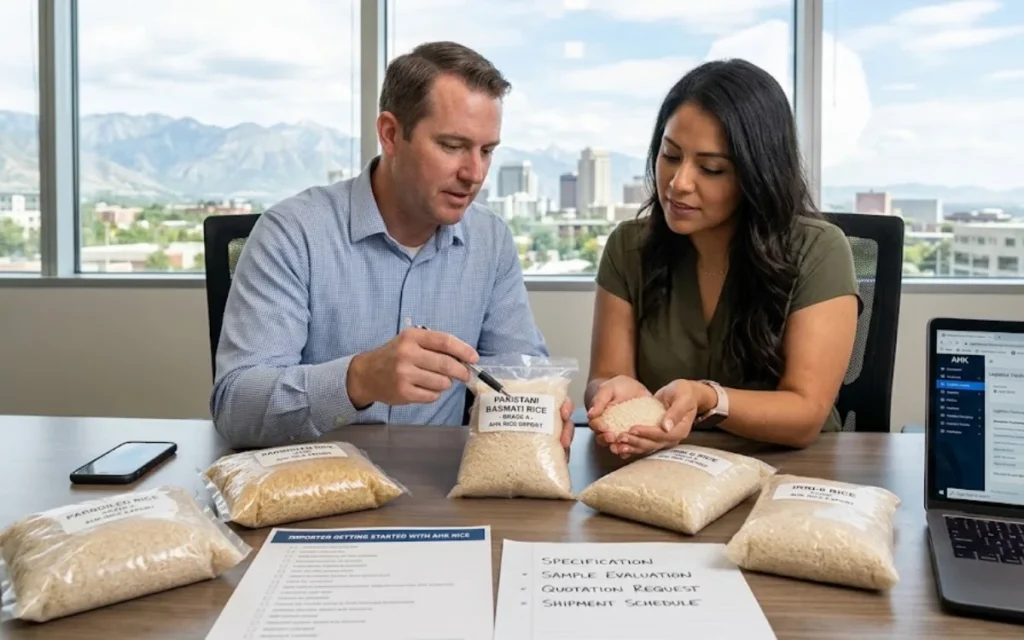
Begin with the purchasing requirement. State the rice variety, grade, packaging, quantity, destination, and intended sales channel.
Next, request a representative sample. Do not approve a generic sample when the commercial shipment requires a specific grade.
Then conduct the evaluation. Record grain appearance, aroma, cooking expansion, separation, texture, broken percentage, moisture, and packaging suitability.
After approval, request the commercial quotation. The quotation should clearly identify the price basis, quantity, packaging, Incoterm, destination port, estimated production window, shipping schedule, payment terms, and inspection arrangements.
The final stage is repeat planning. Establish the reorder point before the first container arrives. For a Utah distributor, this creates enough time to account for production, vessel scheduling, U.S. clearance, and inland delivery.
AHK Rice provides a direct Pakistan-to-USA export workflow and identifies sampling, documentation, inspection, shipment tracking, and container supply as part of its USA export process.
A long-term relationship works when both sides operate from the same specification and forecast. The supplier receives better visibility into future demand. The buyer receives a repeatable procurement process.
For Utah importers seeking Pakistani Basmati rice in recurring commercial volumes, AHK Rice offers a practical origin-to-U.S. supply structure built around specification control, sampling, processing, packaging, documentation, and shipment coordination.
The next step is to submit your Utah destination, rice variety, packaging, quantity, and required delivery window through the AHK Rice request-a-quote page.