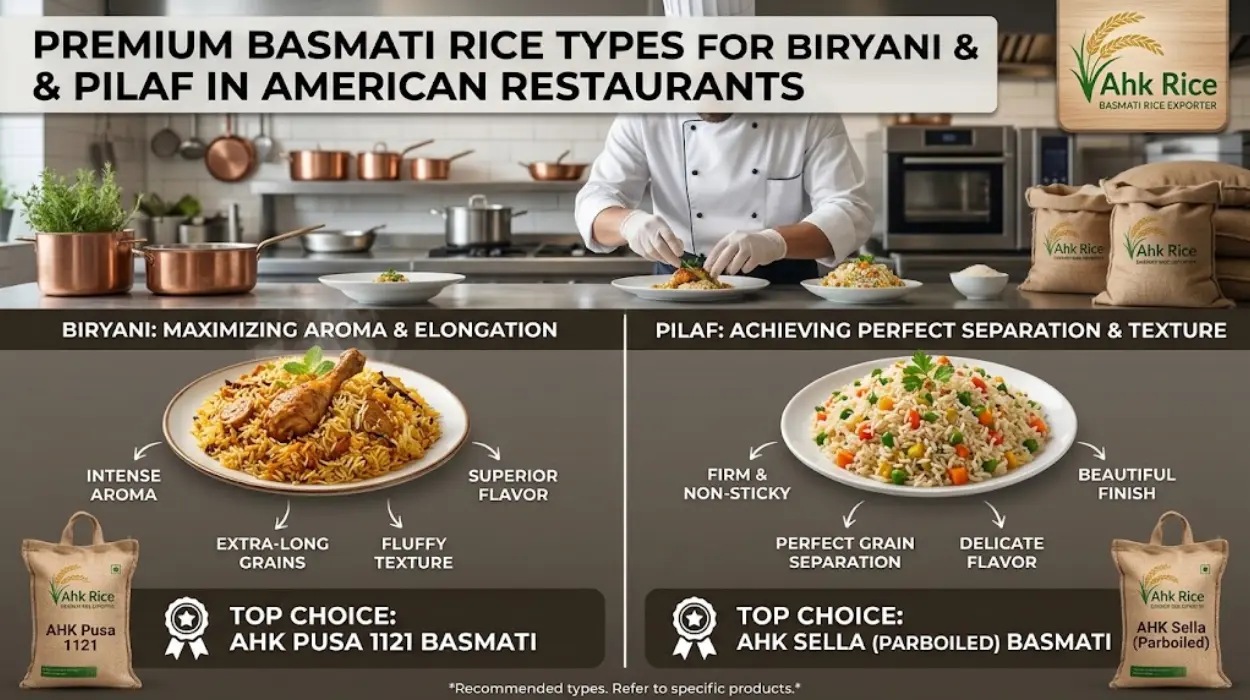
What Type of Basmati Rice Do American Restaurants Use for Biryani and Pilaf?
American restaurants use different types of Basmati rice for biryani and pilaf based on grain length, aroma, cooking method, holding time, and serving requirements. 1121 Basmati is a common choice for premium, long-grain biryani, while Super Kernel suits aromatic rice dishes and 1509 offers a practical option for high-volume foodservice. Steam-processed and sella-processed rice serve different kitchen needs.
What Type of Basmati Rice Do American Restaurants Use for Biryani and Pilaf?
American restaurants select Basmati rice according to the dish, desired grain appearance, cooking equipment, and service volume. Premium Indian and Pakistani restaurants often prioritize 1121 Basmati for its exceptional length. Catering kitchens also use parboiled sella rice because it maintains grain separation during large-batch cooking and extended service.
Basmati is a long-grain aromatic rice associated with the Himalayan foothills, including Pakistan’s Punjab region. Its distinctive aroma, slender grains, and characteristic cooked texture distinguish it from conventional long-grain rice.
Biryani requires grains that remain elongated and separate after cooking with spices, vegetables, meat, or seafood. Pilaf requires rice that absorbs seasoned stock while retaining its individual grains. These requirements influence the choice between raw, steam-processed, and parboiled Basmati.
Restaurant purchasing decisions also depend on cost per serving, preparation time, storage conditions, and consistency between batches. A restaurant serving premium biryani has different requirements from a catering company preparing hundreds of pilaf portions for an event.
Where Is Basmati Rice Grown for American Restaurant Supply?
Pakistan and India are the principal countries associated with commercial Basmati production. Pakistan’s Punjab region produces aromatic varieties, including 1121, Super Kernel, and 1509, which serve international wholesale, retail, restaurant, and foodservice markets.
Pakistani Basmati grows in Punjab’s rice-producing districts, including Hafizabad, Gujranwala, Sheikhupura, Narowal, and Sialkot. Soil conditions, seasonal temperatures, water availability, cultivation practices, and crop management influence grain quality and aroma.
The supply chain begins with paddy cultivation and harvesting. After harvest, rice processors remove the husk, separate the bran where required, grade the milled rice, and prepare it for domestic or export markets.
American importers evaluate origin, variety, crop year, grain specifications, food safety documentation, and supplier consistency. Country of origin alone does not establish the quality of a shipment. A reliable specification identifies the rice variety, processing method, moisture level, broken percentage, and applicable inspection requirements.
How Is Basmati Rice Processed Before It Reaches Restaurant Kitchens?
Basmati rice moves through harvesting, drying, milling, grading, quality inspection, and packaging before shipment. Steam and sella processing add different treatments that influence grain firmness, cooking behavior, appearance, and suitability for restaurant service.
How Does Raw Basmati Become Milled Rice?
Paddy rice arrives at the processing facility after harvesting. Drying brings moisture to a suitable level for storage and milling. The husk is removed to produce brown rice, and additional milling removes the bran layer to produce white rice.
Processors use grading equipment to separate grains by size and remove unwanted material. Optical sorting systems, commonly called Sortex machines, identify and reject selected discolored grains and certain foreign materials. Double sorting provides an additional sorting pass when the product specification requires it.
Quality checks measure moisture, broken grains, grain dimensions, appearance, and other agreed parameters. Laboratory testing addresses food safety requirements relevant to the destination and buyer.
What Is Steam Basmati Rice?
Steam Basmati is exposed to controlled steam treatment during processing. The treatment affects grain structure and cooking behavior while preserving the characteristics of the selected variety.
Steam Basmati commonly suits restaurants seeking a white or creamy appearance, aromatic cooked rice, and long grains. Its final texture depends on the variety, processing conditions, aging, soaking, water ratio, and cooking technique.
What Is Sella Basmati Rice?
Sella Basmati is parboiled rice. Paddy undergoes soaking, steaming, and drying before milling. This treatment changes the grain’s internal structure and typically produces firmer cooked grains that resist breaking during preparation.
Golden Sella has a golden-yellow appearance created by parboiling. Creamy Sella has a lighter cream-colored appearance. Both are used in biryani, catering, and foodservice operations that prioritize grain separation and batch consistency.
Sella rice is not automatically superior to steam rice. Each method serves different requirements, and the correct choice depends on the recipe, holding conditions, and desired plate presentation.
Which Basmati Rice Varieties Are Suitable for Biryani and Pilaf?
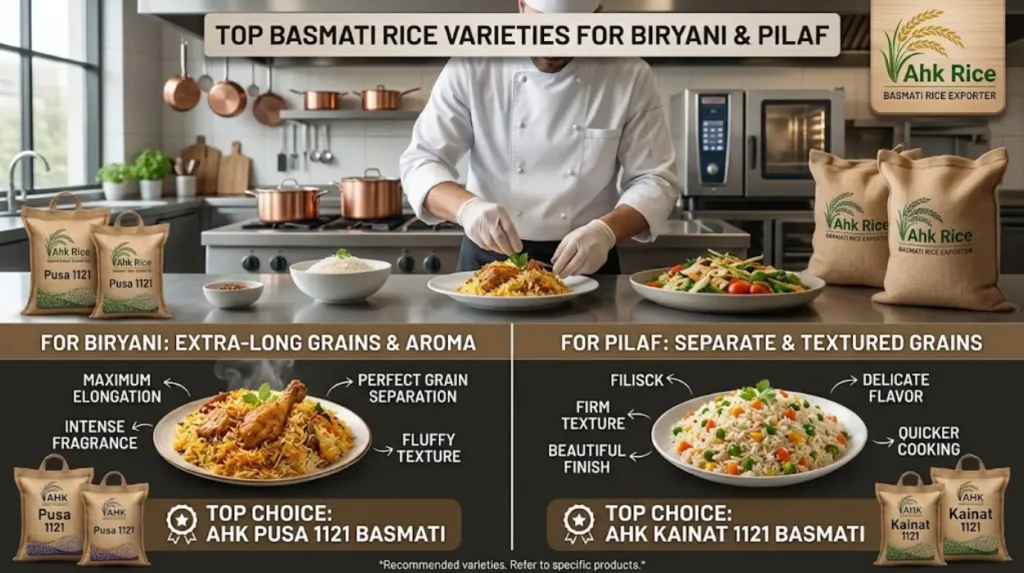
1121, Super Kernel, and 1509 Basmati serve different restaurant requirements. 1121 emphasizes exceptional grain length, Super Kernel combines traditional aroma with an elongated grain profile, and 1509 offers long grains with a shorter crop cycle and practical bulk-supply applications.
1121 Basmati Rice
1121 Basmati is known for its exceptionally long raw grains and substantial elongation during cooking. Its appearance makes it suitable for premium biryani, celebratory rice dishes, and restaurant meals where individual grains remain visually prominent.
Restaurants use 1121 in chicken biryani, lamb biryani, vegetable biryani, and premium pilaf. Both steam and sella versions are available, allowing kitchens to match processing methods to their recipes.
Super Kernel Basmati Rice
Super Kernel is a Pakistani aromatic Basmati variety associated with Punjab. It offers a traditional Basmati aroma and a slender grain profile that suits biryani, pilaf, and South Asian rice dishes.
Its applications include restaurant biryani, spiced pilaf, and rice served alongside grilled meats. Buyers assess grain dimensions, aroma, broken percentage, moisture, and cooking performance when specifying Super Kernel for commercial kitchens.
1509 Basmati Rice
1509 is a long-grain variety valued for its comparatively short growing period and high-yield characteristics. Its raw grain length commonly falls around 8.1–8.4 mm, depending on the specification and crop.
Restaurants use 1509 for biryani, pilaf, and other high-volume rice dishes. Steam-processed 1509 suits kitchens seeking a lighter cooked appearance, while Golden Sella 1509 supports applications that require firmer grains.
The variety offers another sourcing option for distributors balancing grain appearance, cooking performance, and purchasing costs.
What Are the Main Differences Between Steam and Sella Basmati?
Steam Basmati generally suits kitchens prioritizing aromatic rice and a lighter appearance, while sella Basmati suits operations requiring firmer grains and reliable separation during batch cooking. The final result depends on variety, preparation, water ratio, cooking time, and holding conditions.
Steam Basmati is useful for made-to-order biryani and pilaf, where the kitchen controls preparation and serves the dish shortly after cooking. Its texture responds strongly to soaking, heat management, and water absorption.
Sella Basmati supports large-batch preparation because parboiling changes the grain structure. Correctly cooked sella rice maintains a firmer texture and reduces grain breakage during handling. These characteristics are useful in catering operations, buffet service, and banquet kitchens.
Neither process guarantees perfect results. Excess water, prolonged cooking, poor storage, and aggressive stirring damage both types of rice.
Restaurants comparing the two processing methods should assess [how sella and steam Basmati differ in high-volume cooking, holding time, and plate yield] before selecting a specification for regular foodservice orders.
What Key Specifications Should American Restaurant Buyers Check?
Restaurant buyers should assess grain length, variety, processing method, moisture, broken percentage, aroma, and cooking performance before approving Basmati rice. Packaging, lot consistency, food safety documentation, and delivery requirements also affect whether a shipment meets commercial kitchen needs.
Important specifications include:
- Variety: 1121, Super Kernel, or 1509.
- Processing method: Raw white, steam, Golden Sella, or Creamy Sella.
- Grain length: The agreed raw grain measurement and its permitted variation.
- Moisture: A defined limit, commonly no more than 12–13% for relevant commercial specifications.
- Broken percentage: An agreed maximum based on the required grade.
- Purity: Controls for foreign material, discolored grains, and unintended varietal mixing.
- Cooking performance: Grain separation, elongation, aroma, texture, and water absorption.
- Packaging: Food-grade bags in suitable weights, such as 5 kg, 10 kg, 20 kg, or 25 kg.
- Documentation: Commercial invoice, packing list, applicable origin and phytosanitary documents, and relevant food safety records.
A specification sheet turns general expectations into measurable acceptance criteria. Buyers should agree on the inspection method, sampling procedure, tolerances, and final certificate of analysis before shipment.
What Are the Benefits of Basmati Rice in American Foodservice?
Basmati provides aromatic flavor, elongated grains, and a range of processing options for restaurant menus. These characteristics support premium presentation, distinct regional recipes, and different service models, from individually plated biryani to large catering batches and buffet-style pilaf.
Its aroma contributes to the overall flavor profile without requiring every dish to use the same spice blend. Long, separate grains also create a recognizable appearance in biryani and pilaf.
The availability of raw, steam, and sella processing gives kitchens flexibility. A premium restaurant can prioritize aroma and presentation, while a banquet operation can select a firmer grain suited to large-scale preparation.
Basmati also supports menu variation. Restaurants can prepare chicken biryani, lamb biryani, vegetable pilaf, saffron rice, and spiced rice accompaniments with different varieties and cooking methods.
For purchasing teams, a defined grade and repeatable preparation procedure improve batch consistency. Portion control and cooked-yield testing help determine the actual cost per plate rather than relying only on the purchase price per kilogram.
What Common Problems Affect Basmati Rice in Commercial Kitchens?
The most common problems are sticky grains, uneven cooking, broken rice, weak aroma, and inconsistent cooked yield. Correct variety selection, controlled moisture, appropriate soaking, accurate water measurement, and consistent heat management reduce these problems in restaurant and catering kitchens.
Why Does Basmati Rice Become Sticky?
Excess water, insufficient rinsing, overcooking, and excessive stirring cause grains to release starch or break apart. Kitchens should follow a tested recipe for each rice variety and processing method rather than applying one water ratio to every product.
Why Do Rice Grains Break During Cooking?
Grains break when rice is handled roughly, cooked for too long, or exposed to unsuitable moisture conditions. Buyers should inspect broken percentage before purchase and test the rice under actual kitchen conditions.
Does Longer Raw Grain Always Produce Better Biryani?
No. Raw grain length is only one measure of quality. Aroma, cooked elongation, texture, grain separation, and resistance to breakage also determine performance. A shorter grain that cooks consistently can outperform a longer grain when the recipe and service requirements favor its characteristics.
Does Sella Rice Always Produce a Higher Plate Yield?
No. Plate yield depends on dry rice weight, water absorption, cooking losses, recipe formulation, and serving size. Sella’s firmer grain structure supports handling, but a controlled kitchen trial is necessary to establish actual cooked weight and portions per kilogram.
Which American Restaurant Applications Suit Each Basmati Type?
Premium biryani restaurants often prioritize 1121, aroma-focused menus suit Super Kernel, and high-volume kitchens can evaluate 1509 in steam or sella form. The best selection depends on the recipe, target customer, service schedule, and measured cooking performance.
Restaurants serving premium lamb or chicken biryani can test 1121 for grain length and presentation. Restaurants specializing in traditional South Asian flavors can evaluate Super Kernel for its aromatic profile.
Caterers, hotels, banquet facilities, and buffet operators can compare sella grades for bulk preparation and holding. Institutional kitchens and restaurant groups can evaluate 1509 when balancing product specifications and purchasing costs.
American importers must also consider applicable U.S. food import requirements. FDA facility registration, Prior Notice, and Foreign Supplier Verification Program obligations apply according to the importer’s role and the circumstances of the shipment. Customs classification, country-of-origin marking, and other documentation requirements must be confirmed for the specific product.
The most reliable purchasing decision combines a documented specification with a cooking trial. Comparing raw grain measurements, cooked texture, aroma, portion yield, and holding performance gives restaurant buyers a practical basis for selecting Basmati rice.
Frequently Asked Questions
What type of Basmati rice is best for biryani?
1121 Basmati is a popular choice for premium biryani because of its exceptionally long grains and cooked elongation. Super Kernel and 1509 are also suitable, depending on aroma, texture, budget, and processing method.
Which Basmati rice is best for pilaf?
1121, Super Kernel, and 1509 Basmati all suit pilaf. The best choice depends on the desired aroma, grain separation, texture, and cooking method. Restaurants should test each variety using their standard recipe.
Do American restaurants use Pakistani Basmati rice?
Yes. Pakistani Basmati is used by restaurants, food distributors, and importers serving South Asian and other rice-based cuisines. Popular varieties include 1121, Super Kernel, and 1509.
What is the difference between sella and steam Basmati rice?
Steam Basmati undergoes controlled steam treatment during processing, while sella rice is parboiled through soaking, steaming, and drying before milling. Sella generally produces firmer grains, making it suitable for large-batch cooking and catering.
Is 1121 Basmati better than 1509 Basmati?
1121 is known for its exceptional grain length and premium presentation. 1509 offers long grains and a shorter growing cycle. Neither variety is universally better; the right choice depends on the restaurant’s cooking requirements, purchasing budget, and target presentation.