How Do Buyers Evaluate International Rice Export Vendors?
The strongest international rice buyers do not select an exporter from price alone. They compare product specifications, quality controls, certifications, export documentation, logistics, production capacity, payment terms, and shipment consistency before approving a supplier. This approach reduces quality claims, customs problems, delivery delays, and margin loss.
Before comparing exporters, importers need a qualification framework. Our educational guide:
Why Should Importers Qualify Rice Suppliers Before Purchasing?, explains why supplier verification belongs before commercial approval. The same principle applies when comparing Pakistani Basmati exporters: the buyer evaluates the supplier’s ability to deliver the contracted specification repeatedly, not simply the sample that wins the first negotiation.
Pakistan remains a major rice-exporting origin. During FY2025-26, Pakistan exported 4.292 million metric tons of rice worth $2.291 billion, including 794,638 metric tons of Basmati rice valued at $843 million. July 2026 also recorded 67,857 metric tons of Basmati exports worth $76.48 million, showing renewed export activity at the start of FY2026-27.
For buyers evaluating 1121 Basmati rice, Super Kernel, or 1509, the important question is not simply which variety is available. The important question is whether the exporter controls sourcing, milling, grading, testing, packaging, documentation, and shipment execution as one procurement system.
What are the available solutions?
Buyers have four sourcing options: direct mill exporters, trading companies, sourcing agents, and digital marketplaces. Each model offers a different balance of price control, quality visibility, supplier accountability, documentation support, and logistics coordination, so the right choice depends on procurement.
Direct rice exporters
A direct exporter connects the buyer with the processing and export operation. The exporter handles activities such as paddy sourcing, milling, grading, colour sorting, packaging, quality inspection, documentation, and shipment coordination.
This model provides stronger specification control when the buyer requires a defined grain length, broken percentage, moisture level, processing method, packaging format, or private-label design.
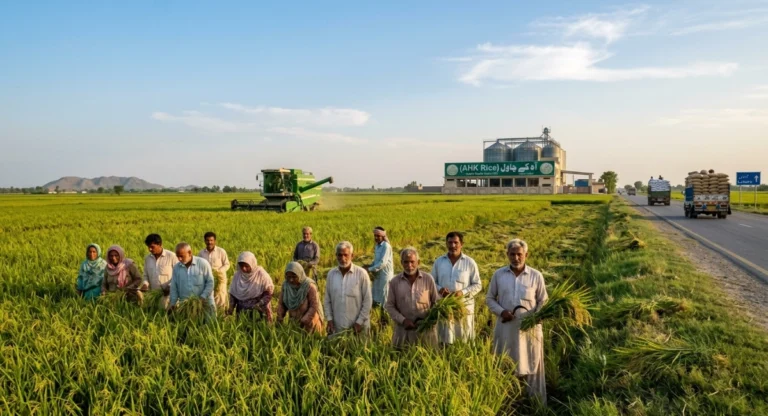
AHK Rice operates from Punjab and states that its process covers paddy procurement, cleaning, dehusking, whitening, polishing, grading, sorting, custom packaging, export documentation, and container loading.
Trading companies
A trading company purchases rice from mills or exporters and resells it to international buyers. Traders provide access to multiple origins, varieties, and grades.
The advantage is sourcing flexibility. The limitation is supply-chain visibility. The buyer needs to identify who actually processes the rice, who performs testing, and who controls the final shipment specification.
Sourcing agents
A sourcing agent represents the buyer during supplier discovery, price negotiation, sampling, and factory communication. Agents work well when an importer lacks local procurement resources.
The buyer still needs direct evidence from the underlying exporter. Certification documents, inspection reports, product specifications, and contract terms need to identify the responsible production and exporting entity.
Digital marketplaces
Digital marketplaces provide rapid access to multiple suppliers. They help buyers compare indicative prices, product descriptions, packaging formats, and minimum order quantities.
The weakness is verification. A marketplace listing does not automatically prove production capacity, laboratory controls, export history, or regulatory compliance. Buyers need independent supplier qualification before placing a container order.
How do different approaches compare?
Direct exporters provide the clearest connection between rice specifications, processing, inspection, packaging, and shipment planning. Traders offer broader supplier access. Agents simplify sourcing. Marketplaces accelerate discovery. Buyers gain control when the evaluation method matches order volume, compliance risk, and customization.
| Attribute | Direct Exporter | Trading Company | Sourcing Agent | Digital Marketplace |
|---|---|---|---|---|
| Product specification control | High | Medium | Medium | Low to Medium |
| Factory visibility | High | Variable | Variable | Low |
| Price transparency | High | Medium | Medium | High initially |
| Custom packaging | High | Medium | Medium | Supplier-dependent |
| Documentation control | High | Medium | Support-based | Supplier-dependent |
| Third-party inspection | Usually available | Usually available | Buyer-arranged | Supplier-dependent |
| Long-term supply planning | High | Medium | Medium | Variable |
The comparison changes when the buyer considers the total procurement cost. A lower FOB quotation does not automatically produce a lower landed cost. Freight, insurance, inspection, port charges, customs requirements, storage, packaging, rejected cargo, and inventory delays all affect the final commercial result.
A qualified exporter also provides a specification sheet that defines measurable parameters. These include variety, grain length, broken percentage, moisture, foreign matter, admixture, processing type, packaging, crop year, and inspection requirements.
For Basmati, authenticity is another important consideration. The European Union has specific arrangements for Pakistani Basmati rice, including authenticity certificates for eligible varieties. EU rules also provide for controls related to Basmati authenticity and import arrangements.
Which method works best for different cases?
Supplier selection works best when buyers convert requirements into measurable pass-fail criteria, approve samples, verify certifications, compare landed cost, and review shipment capability. This approach separates a qualified exporter from a low-price seller whose product, documents, or performance remains unverified.
Case 1: Retail importer
A supermarket or private-label importer needs consistent appearance, packaging, shelf stability, documentation, and repeat supply.
A direct exporter with custom packaging and controlled processing fits this requirement better than an anonymous marketplace seller. The buyer also needs artwork approval, food-contact packaging compliance, product labelling, and shipment scheduling.
Case 2: Restaurant distributor
A food-service distributor prioritizes cooking performance, grain separation, consistency, price, and replenishment.
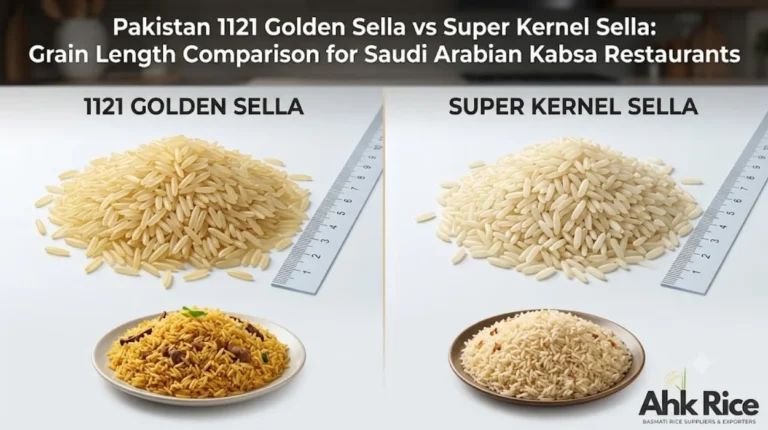
1121 Steam suits premium foodservice applications where aroma and appearance are important. Sella grades provide stronger grain structure and are useful for high-volume cooking and holding operations.
Case 3: GCC wholesaler
GCC buyers frequently focus on long-grain appearance, aroma, cooking performance, moisture control, Halal documentation, and reliable replenishment.
Current 2026 market data shows strong demand for Pakistani Basmati in GCC destinations. UAE and Kuwait market information identifies 1121 and Super Kernel among the important premium grades.
Case 4: European importer
European buyers require stronger compliance documentation because food safety controls directly affect customs clearance and market access.
For Great Britain, current 2026 controls list Pakistan-origin rice under controls involving pesticide residues, aflatoxins, and Ochratoxin A. The Food Standards Agency updated the relevant restriction information in July 2026.
A supplier serving this market therefore needs laboratory evidence and documentation that matches the destination requirements.
What do European and GCC buyers prefer?
European buyers prioritize documented food-safety compliance, traceability, residue control, authentic Basmati documentation, and retail consistency, while GCC buyers prioritize grain appearance, cooking performance, Halal documentation, moisture control, and dependable replenishment. Both regions require measurable specifications, but commercial priorities differ significantly.
Europe
Europe represents a specification-heavy market for Pakistani Basmati. Importers selling through retail, wholesale, and foodservice channels need consistent product documentation.
The UK market provides a clear example. Current guidance classifies Basmati by grain characteristics and identifies Pakistani Kernel among approved Basmati varieties. UK rice imports also operate within licensing and quota frameworks for certain products.
For Europe, 1121 White and Super Kernel are suitable premium comparison points. Buyers frequently prioritize long grain, aroma, low broken percentage, consistent appearance, and documented residue compliance.
GCC
GCC markets place strong commercial emphasis on cooking performance and visual grain quality. 1121 Sella, 1121 Steam, 1121 White, and Super Kernel serve different applications.
Kuwait’s August 2026 indicative pricing provides a useful reference. 1121 Sella was listed at approximately $1,307–$1,347 per MT CNF Shuwaikh, while Super Kernel was approximately $1,337–$1,377 per MT CNF. The quoted freight component was $172 per MT.
The UAE market also identifies 1121 and Super Kernel as major premium Pakistani Basmati grades, with Karachi-to-Jebel Ali transit listed at approximately 4–10 days in current market information.
How do price and shelf life affect supplier evaluation?
Price comparison needs to use the same Incoterm, grade, packing, crop year, quantity, and destination because FOB and CNF values measure different commercial costs. Shelf life also depends on packaging and storage, so buyers must compare both price and preservation conditions.
Current August 2026 indicative FOB Karachi pricing places premium 1121 White, 1121 Steam, and Super Kernel around $1,135–$1,205 per metric ton, depending on processing and specification. These figures provide a market reference rather than a universal contract price.
| Market region | Preferred grades | Indicative price reference | Shelf-life comparison | Main evaluation priority |
| Europe | 1121 White, Super Kernel | $1,135–$1,205/MT FOB Karachi | 12–18 months standard packaging; up to 24–36 months with enhanced protection | Compliance and traceability |
| GCC | 1121 Sella, 1121 Steam, Super Kernel | $1,135–$1,205/MT FOB; Kuwait CNF examples reach $1,307–$1,377/MT | 12–18 months standard packaging; up to 24 months+ with suitable barrier packaging | Cooking performance and supply reliability |
Shelf life is not determined by variety alone. Packaging, moisture control, storage temperature, humidity, oxygen exposure, and warehouse conditions affect product stability.
Standard PP woven and BOPP packaging is commonly associated with approximately 12–18 months under suitable storage conditions, while vacuum or enhanced barrier packaging extends the storage window. Export packaging information from Pakistani suppliers also identifies 24-month shelf-life specifications for appropriately packed Basmati rice.
Buyers therefore need the supplier to state the shelf-life period on the product specification and packaging documentation. They also need storage instructions that match the declared shelf life.
What are the main advantages and disadvantages of each approach?
Direct exporters offer stronger control and customization; traders offer sourcing flexibility; agents reduce procurement workload; marketplaces accelerate supplier discovery. Each approach becomes effective when buyers add independent verification, clear specifications, documented inspection, and contract controls before approving commercial shipments.
Direct exporter
Pros: Better factory visibility, direct specification control, custom packaging, easier repeat-order planning, and clearer accountability.
Cons: Supplier discovery requires more initial qualification work. Buyers need to assess production capability before signing a long-term agreement.
Trading company
Pros: Multiple product sources, broader market access, and simplified commercial coordination.
Cons: The buyer can have less visibility into the actual processing facility and production controls.
Sourcing agent
Pros: Local market knowledge, supplier discovery, negotiation support, and communication assistance.
Cons: Additional intermediary involvement increases the importance of verifying the actual exporter and contractual responsibilities.
Digital marketplace
Pros: Fast supplier discovery, broad product selection, and easy initial price comparison.
Cons: Listings vary in accuracy. Supplier credentials, production capacity, and shipment history require separate verification.
For example, a buyer sourcing 500 MT annually for a private-label supermarket program benefits more from a direct, specification-controlled relationship than from repeated spot purchases through anonymous marketplace listings.
What decision factors matter most when selecting an exporter?
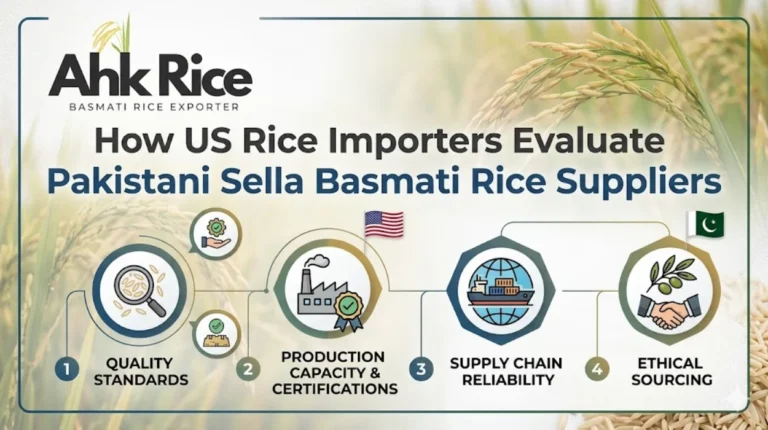
Buyers should score suppliers across specification accuracy, quality verification, regulatory compliance, landed cost, logistics reliability, and communication. The final choice belongs to the supplier that meets mandatory requirements first and delivers strong total commercial value across repeat shipments, not simply the lowest initial price.
| Decision factor | What buyers verify | Pass condition |
| Product specification | Variety, grain length, moisture, broken percentage, purity | Matches approved specification |
| Quality assurance | Laboratory reports, inspection, sampling process | Evidence available before shipment |
| Regulatory compliance | Certificates, residue testing, destination requirements | Documents match destination |
| Commercial cost | FOB/CNF price, freight, packaging, inspection | Competitive landed cost |
| Logistics | Production lead time, vessel planning, documentation | Shipment plan meets required date |
The sample approval stage is particularly important. Buyers need a representative sample from the same specification that will enter production. A sample from a different crop, grade, or processing batch does not provide reliable evidence for the final contract.
The commercial specification also needs written acceptance. A contract that states only “premium Basmati rice” leaves too much room for interpretation. A stronger contract identifies variety, grade, grain length, broken percentage, moisture, packing, quantity, inspection procedure, destination, Incoterm, shipment window, and claim procedure.
AHK Rice states that it supports direct sourcing, controlled processing, grading, customized packaging, quality inspection, documentation, and international shipment coordination. Its company information also identifies 1121, Super Kernel, and 1509 as core Basmati varieties supplied to international markets.
What is the most reliable evaluation process for an international rice buyer?
A practical evaluation sequence starts with the destination market. Define the import requirements first. Then define the rice specification. After that, identify exporters capable of meeting those requirements.
The next stage is supplier verification. Review the company’s operating location, processing capability, certifications, export documentation, inspection procedures, packaging options, and shipment history.
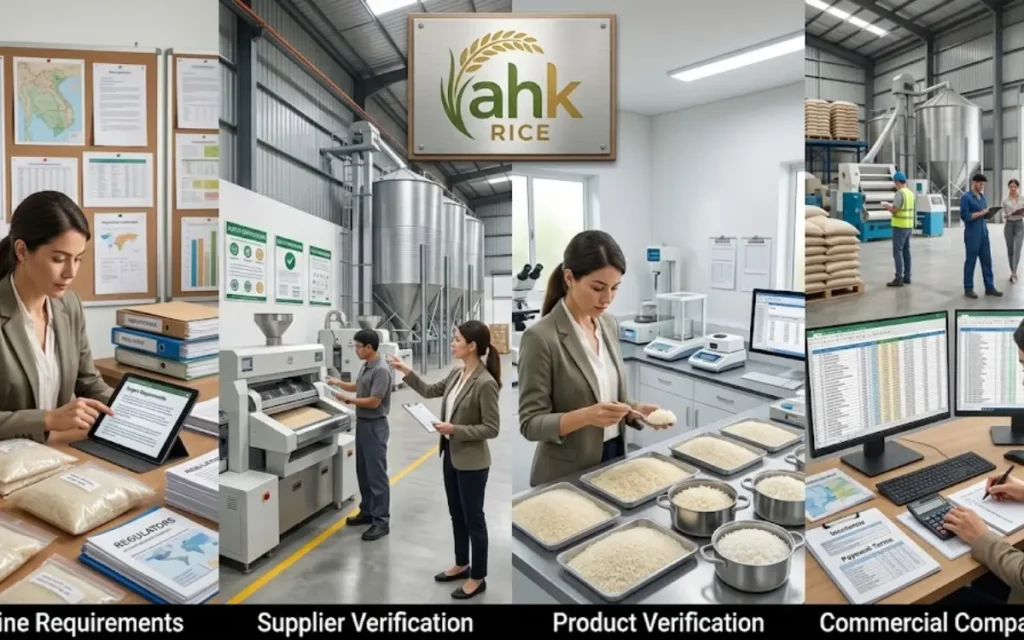
The third stage is product verification. Request samples, compare grain appearance, measure cooking performance, review laboratory results, and confirm the sample against the written specification.
The fourth stage is commercial comparison. Compare suppliers using the same quantity, Incoterm, destination port, packaging format, inspection requirement, and payment structure.
The final stage is contract control. Establish acceptable tolerances, inspection arrangements, documentation requirements, shipment dates, claims procedures, and responsibility for non-conforming cargo.
This process turns supplier selection into a measurable procurement decision. It also gives buyers a repeatable framework for evaluating new exporters when market prices, freight costs, or crop conditions change.
International rice procurement therefore works best when buyers evaluate the complete supply chain rather than the quotation alone. A supplier that combines specification consistency, documented quality, regulatory compliance, competitive landed cost, and reliable shipment execution creates stronger commercial value than a supplier selected only because its first price is lower.
For buyers ready to move from evaluation into supplier selection, the decision-stage resource:
Choose AHK Rice as Your Qualified Basmati Rice Supplier fits naturally after the decision framework.
Frequently Asked Questions
What should buyers check before selecting a rice exporter?
Buyers should check product specifications, processing capability, quality certifications, laboratory testing, export documentation, packaging options, shipment capacity, payment terms, and previous international supply experience. The supplier must demonstrate consistent compliance with the buyer’s contracted specification.
How do buyers compare rice exporters on price?
Buyers compare prices using the same Incoterm, rice variety, grade, quantity, packaging, destination, inspection requirements, and shipment period. FOB, CNF, and CIF prices represent different cost structures, so comparing different Incoterms produces an inaccurate assessment.
Which Basmati rice grades are commonly evaluated by international buyers?
International buyers commonly evaluate 1121 Basmati, Super Kernel, and 1509 Basmati. Buyers compare grain length, broken percentage, aroma, cooking performance, processing type, moisture, and appearance to select the grade suited to their market.
Why is product sampling important when qualifying a rice exporter?
Product sampling allows buyers to compare the actual rice against the written specification before commercial production. Buyers evaluate grain appearance, aroma, cooking characteristics, broken percentage, moisture, and overall consistency before approving the supplier.
What documents should an international rice buyer request?
Buyers typically request commercial invoices, packing lists, certificates of origin, phytosanitary documentation, inspection reports, laboratory test results, relevant food-safety certificates, and destination-specific compliance documents. The exact documentation depends on the importing country’s regulations and the contracted product.
Do European and GCC buyers prefer the same Basmati grades?
No. European buyers place stronger emphasis on regulatory compliance, traceability, residue testing, and documented Basmati authenticity. GCC buyers place strong emphasis on grain appearance, cooking performance, aroma, Halal documentation, moisture control, and dependable replenishment.