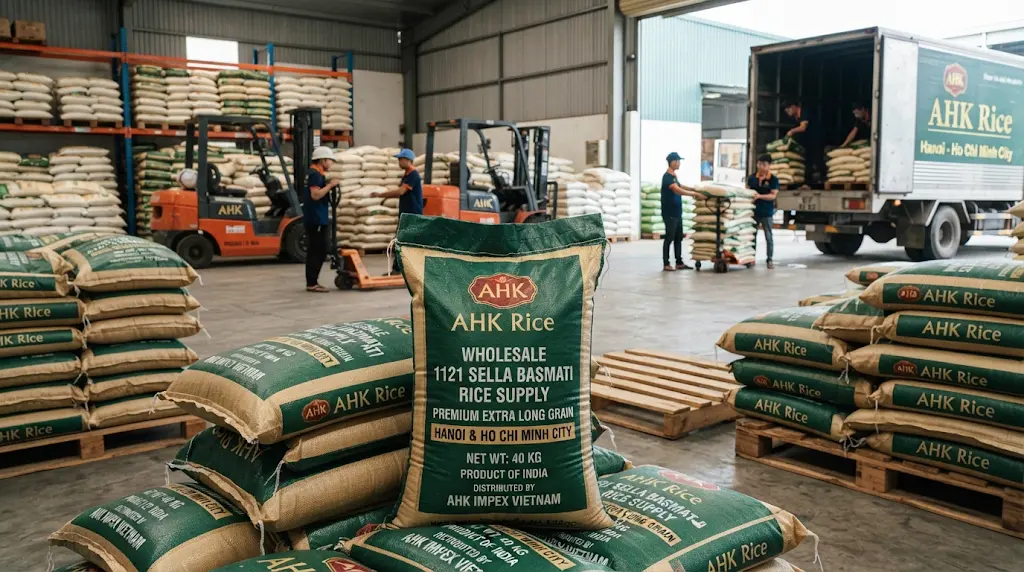
Wholesale 1121 Sella Basmati Rice Supply for Restaurants in Hanoi and Ho Chi Minh City
South Asian restaurant kitchens in Vietnam lose up to 18% of plated biryani volume when switching between inconsistent local rice importers. High humidity in Ho Chi Minh City and seasonal temperature shifts in Hanoi degrade unaged grains rapidly in dry storage.
Inconsistent grain elongation ruins portion standardisation and inflates food cost per cover across multi-branch dining operations. Understanding how Indian and Pakistani restaurants in Ho Chi Minh City use 1121 Sella Basmati rice reveals why parboiled extra-long grain varieties dominate high-volume commercial kitchens.
Direct container sourcing eliminates middleman markups, stale warehouse stock, and erratic grain breakage during peak dinner service. Establishing a direct mill-to-port supply line protects profit margins while guaranteeing identical cooking performance in every batch.
What Is the Best Solution for Commercial Basmati Supply in Vietnam?
Direct container sourcing of aged, parboiled 1121 Basmati Sella Rice from certified export mills solves grain breakage and supply volatility. Partnering with AHK Rice secures uniform 8.35mm average grain length, locked FOB or CIF pricing, and predictable transit schedules into Cat Lai and Hai Phong.
Commercial kitchens in District 1 of Ho Chi Minh City and Tay Ho in Hanoi face severe margin compression when relying on third-party wholesale distributors. Local distributors frequently blend current-crop rice with aged stock to widen their margins, causing uneven water absorption inside commercial rice cookers and handis.
When half a pot turns mushy while the remaining grains stay undercooked, kitchen staff discard expensive saffron, clarified butter, and marinated proteins. Direct mill procurement removes these blending risks by enforcing strict batch-level optical sorting and moisture stabilisation before container stuffing.
AHK Rice processes 1121 Sella paddy through controlled parboiling chambers that gelatinise starch inside the kernel before milling. This thermal treatment hardens the grain structure, allowing it to withstand heavy stirring in 50-portion biryani cauldrons without snapping.
Restaurant groups operating three or more outlets in Vietnam gain immediate operational stability by importing full 20-foot container loads directly. Even single-location high-volume restaurants save 22% to 28% on landed raw material costs compared to buying 25kg bags from local Ho Chi Minh City wholesalers.
Why Choose AHK Rice for Direct Export to Vietnam?
AHK Rice delivers mill-direct 1121 Sella Basmati engineered specifically for high-heat commercial foodservice, backed by strict ISO 22000 and HACCP food safety controls. Every shipment undergoes Buhler Sortex optical grading to guarantee under 1% broken grains and verified 12-month minimum ageing.
Selecting an export partner requires evaluating milling precision, ageing infrastructure, and export documentation accuracy for Vietnam customs clearance. Many brokers claim mill ownership but source spot lots from open mandis, resulting in fluctuating aroma and erratic elongation ratios across consecutive shipments.
AHK Rice operates dedicated paddy ageing silos and automated parboiling lines that lock in consistent grain chemistry year-round. Our quality control laboratories test every production lot for moisture content, chalkiness, and cooked elongation before approving export bagging.
When evaluating grain types for specific menu applications, kitchen directors often review 1121 Sella vs 1121 Steam Basmati for biryani restaurants in Hanoi to match thermal tolerance with their cooking equipment. While steam varieties suit delicate pulao preparations, 1121 Sella remains the undisputed benchmark for dum biryani and catering holding trays.
| Technical Specification | AHK Rice Export Standard | Local Vietnam Wholesale Grade | Operational Impact on Kitchens |
| Average Raw Grain Length | 8.35 mm – 8.45 mm | 7.60 mm – 8.00 mm | Higher plate coverage with fewer grams per serving |
| Cooked Elongation Ratio | 2.2x – 2.5x (up to 20 mm) | 1.6x – 1.8x | Visual premium presentation and fluffy grain separation |
| Broken Grains Percentage | Less than 1.0% | 3.0% – 7.0% | Eliminates pasty starch buildup at the bottom of pots |
| Moisture Content | 11.5% – 12.5% max | 13.5% – 14.5% | Prevents fungal growth and weevils in humid storage |
| Zero discoloured, chalky, or foreign kernels | 12 to 18 months | Unaged or 3–6 months | Predictable 1:2.25 water-to-rice absorption every batch |
| Optical Sorting | 100% Buhler Sortex | Basic mechanical sieving | Zero discolored, chalky, or foreign kernels |
Vietnamese customs authorities at Cat Lai Port and Hai Phong Port enforce strict phytosanitary and Certificate of Origin requirements for agricultural imports. AHK Rice prepares complete export documentation packages, including Form AI or ASEAN-origin equivalents where applicable, phytosanitary certificates, fumigation certificates, and SGS pre-shipment inspection reports.
Clean documentation prevents costly port demurrage and container detention charges in Ho Chi Minh City and Hai Phong. Restaurant importers clear customs within 48 to 72 hours of vessel arrival, moving inventory directly into central commissary warehouses without administrative delays.
What Results Can Be Expected in Restaurant Kitchen Operations?
Switching to mill-direct 1121 Sella Basmati increases cooked yield by 15% to 20% per dry kilogram while reducing food cost per portion by up to 24%. Grains remain intact and separated for six hours in steam tables without clumping or releasing excess starch.
Kitchen profitability in competitive dining hubs like Binh Thanh and Ba Dinh depends on raw-to-cooked yield efficiency. Unaged or poorly parboiled rice absorbs less water before bursting, forcing chefs to use 180 grams of dry rice to fill a standard takeaway container.
Aged 1121 Sella supplied by AHK Rice absorbs water steadily without splitting along the dorsal seam, expanding to more than double its raw length. Chefs achieve the same visual portion volume using only 145 grams of dry rice, generating 120 extra biryani portions per metric ton.
Scenario 1: Multi-Outlet Indian Restaurant Group in Ho Chi Minh City
A three-branch North Indian restaurant group in District 1, District 2, and District 7 consumes 4.5 metric tons of basmati rice monthly. Previously, the group purchased 25kg bags from a local distributor at $1,620 per metric ton equivalent, spending $7,290 monthly on rice alone.
By importing one 20-foot FCL container of 25 metric tons directly from AHK Rice at $1,240 per metric ton CIF Cat Lai, the group reduced its monthly rice expenditure to $5,580. The switch saved $20,520 annually while increasing cooked yield by 16% across all three kitchens.
Scenario 2: High-Volume Catering and Biryani Kitchen in Hanoi
A catering kitchen in Tay Ho serving corporate events and wedding banquets struggled with rice turning mushy inside insulated hot boxes during two-hour transport windows across Hanoi. Reheating standard white basmati caused severe grain breakage and customer complaints.
Transitioning to parboiled 1121 Sella stabilised grain integrity during extended holding periods at 75°C. The parboiled starch matrix prevented moisture migration from meat gravies into the rice core, maintaining distinct, aromatic grains from kitchen plating to banquet service.
Transit Schedules and Shipping Days per Market
Accurate inventory planning requires realistic ocean freight timelines from Port Qasim or Karachi to Vietnam’s primary commercial gateways. AHK Rice dispatches weekly container shipments on direct and single-transhipment liner services via Singapore or Port Klang.
| Destination Market | Arrival Port | Ocean Transit Time | Customs & Drayage | Total Door-to-Kitchen Time |
| Ho Chi Minh City (South) | Cat Lai Port (VNSGN) | 14 – 18 days | 3 – 4 days | 17 – 22 days |
| Hanoi (North) | Hai Phong Port (VNHPH) | 18 – 23 days | 3 – 5 days | 21 – 28 days |
Shipments bound for Ho Chi Minh City discharge at Cat Lai Terminal, located less than 15 kilometres from central restaurant districts and Thu Duc storage hubs. Containers destined for Hanoi discharge at Hai Phong Port and travel via the Hanoi–Hai Phong Expressway (CT04) in under two hours to city warehouses.
What Is the Pricing and What Factors Affect Cost in 2026?
As of late 2026, export-grade 1121 Sella Basmati rice trades between $1,135 and $1,185 per metric ton FOB Karachi, with CIF Vietnam landed prices ranging from $1,210 to $1,275 per metric ton. Final contract rates depend on ageing duration, packaging format, container volume, and seasonal freight surcharges.
Global basmati pricing in 2026 reflects strong paddy procurement benchmarks across the Punjab growing belt and steady Middle Eastern and Southeast Asian foodservice demand. Locking in quarterly or bi-annual supply contracts protects restaurant groups from seasonal price spikes during the fourth-quarter harvest transition.
| Cost Component | 2026 Market Benchmark | Impact on Final Landed Price |
| 1121 Creamy Sella (12-Month Aged) | $1,135 – $1,175 / MT (FOB) | Baseline foodservice specification for white/creamy biryani |
| 1121 Golden Sella (12-Month Aged) | $1,145 – $1,185 / MT (FOB) | +$10 to $15 / MT for deeper golden parboiling hue |
| 24-Month Extra-Aged Reserve | +$75 – $110 / MT premium | Maximum elongation and lowest moisture for flagship dining |
| 25kg / 50kg PP Woven Bags | Included in base FOB quote | Standard commercial foodservice bulk packaging |
| 10kg / 20kg BOPP Laminated Bags | +$18 – $25 / MT | Moisture-barrier bags ideal for high-humidity kitchens |
| Ocean Freight to Cat Lai (20′ FCL) | $650 – $850 / container | Adds roughly $26 – $34 / MT on a 25 MT load |
| Ocean Freight to Hai Phong (20′ FCL) | $800 – $1,050 / container | Adds roughly $32 – $42 / MT on a 25 MT load |
Container utilisation directly impacts per-kilogram shipping efficiency for Vietnam buyers. A standard 20-foot dry container holds 25 metric tons (1,000 bags of 25kg) without palletisation, maximising payload weight and minimising ocean freight cost per bag.
Payment structures also influence final unit pricing on international trade contracts. AHK Rice offers flexible settlement terms, including 30% advance Telegraphic Transfer (TT) with 70% balance against scanned Bill of Lading copies, or confirmed Irrevocable Letters of Credit (LC) at sight.
How Do Restaurants Get Started with Samples and Orders?
Restaurants initiate procurement by ordering a 2kg to 5kg courier sample kit for kitchen testing, priced between $45 and $85 via DHL Express with delivery in 4 to 6 business days. Upon cooking approval, AHK Rice issues a Proforma Invoice and dispatches the first 20-foot container within 10 days.
Executive chefs never commit to a 25-metric-ton container without verifying raw grain appearance, soaking behaviour, and cooked texture in their own kitchens. AHK Rice operates a structured four-stage commercial onboarding protocol designed for restaurant owners, purchasing managers, and regional foodservice importers.
Step 1: Technical Specification Alignment
Purchasing managers submit their monthly consumption volume, preferred bag weight (10kg, 25kg, or 50kg), and target arrival port (Cat Lai or Hai Phong). Our export desk matches your menu profile with the exact Sella parboiling shade—Creamy White Sella or Golden Sella—and confirms current 2026 FOB or CIF pricing.
Step 2: Air Courier Sample Dispatch and Kitchen Trial
AHK Rice dispatches sealed 2kg or 5kg reference samples directly to your restaurant address in Hanoi or Ho Chi Minh City via DHL or FedEx International Priority. Courier charges are $45 for a 2kg sample parcel and $85 for a 5kg multi-grade evaluation kit, reaching Vietnam within 4 to 6 business days.
Every sample bag includes a batch specification sheet detailing moisture percentage, average grain length, and recommended soaking duration. Your head chef conducts a side-by-side cooking test against your current rice supplier to measure cooked elongation, aroma retention, and yield per kilogram.
| Sample Kit Tier | Included Contents | Courier Cost (DHL/FedEx) | Delivery Time to Vietnam | Cost Recovery Policy |
| Single-Grade Kit (2 kg) | 2 kg of 1121 Creamy or Golden Sella + Lab Sheet | $45 USD | 4 – 5 business days | 100% credited on first FCL order |
| Chef Comparison Kit (5 kg) | 2.5 kg Creamy Sella + 2.5 kg Golden Sella + Lab Sheet | $85 USD | 4 – 6 business days | 100% credited on first FCL order |
AHK Rice deducts the full $45 or $85 sample courier fee from your first container invoice, making pre-shipment kitchen validation completely cost-neutral.
Step 3: Contract Execution and Pre-Shipment Inspection
Once your kitchen approves the cooked sample, AHK Rice issues a binding Proforma Invoice locking in the price, shipment window, and packaging specifications. Production begins immediately at our milling facility, with custom private-label bag printing completed within 7 business days if requested.
Before container sealing, buyers may appoint SGS, Bureau Veritas, or Intertek to inspect grain length, broken percentage, and bag weight at the mill. AHK Rice provides timestamped loading photos, moisture meter readings, and container seal numbers before vessel departure.
Step 4: Customs Clearance and Warehouse Delivery
Original shipping documents—including the Bill of Lading, Commercial Invoice, Packing List, Certificate of Origin, and Phytosanitary Certificate—are dispatched via express courier 10 days before vessel arrival. Your local customs broker in Ho Chi Minh City or Hai Phong clears the cargo smoothly upon docking.
To lock in current 2026 export rates and schedule your kitchen sample kit, submit your volume requirements directly at https://ahkrice.com/request-a-quote/.