AHK Rice Pakistan Verified Basmati Rice Supply for Indonesian Importers
AHK Rice is a practical choice for Indonesian importers seeking verified Pakistani Basmati supply with defined specifications, sampling, inspection, export documentation, and planned sea logistics. Here is why: AHK Rice supports the order from product selection through container loading, while Indonesian buyers can approve samples before committing to bulk procurement. For background on contamination risk, see how foreign matter affects Pakistan Basmati rice quality in Indonesia.
What is the best solution for Indonesian importers buying Pakistan Basmati rice?
The best solution is sample-approved rice with defined grain, moisture, broken, purity, packaging, inspection, and delivery specifications agreed before production and loading. This approach reduces quality disputes and makes landed-cost planning more predictable.
Indonesian importers should start with the product specification rather than the supplier name. A commercial specification should identify variety, grain length, moisture, broken percentage, processing style, foreign matter requirement, packaging, and Incoterm.
AHK Rice supplies Pakistani Basmati varieties including 1121, Super Kernel, and 1509. The company provides processing, grading, colour sorting, customized packaging, inspection, and export documentation.
For Indonesian demand, 1121 is a strong option where extra-long grain presentation matters. AHK Rice lists 1121 Steam for Indonesia at 8.35 mm+ average grain length, under 12.5% moisture, and under 1% broken grains.
Super Kernel and 1509 provide alternative specifications for buyers balancing price, cooking performance, and end-use requirements. Indonesian importers should approve the exact grade through a physical sample before placing the production order.
The contamination question also deserves separate attention. Buyers can compare supplier inspection procedures through how Indonesian importers check foreign matter in Pakistan Basmati shipments, using the relevant AHK Rice comparison guide before final supplier approval.
With the specification established, the next decision is whether the exporter can control that specification throughout production and shipping.
Why choose AHK Rice for Indonesian Basmati imports?
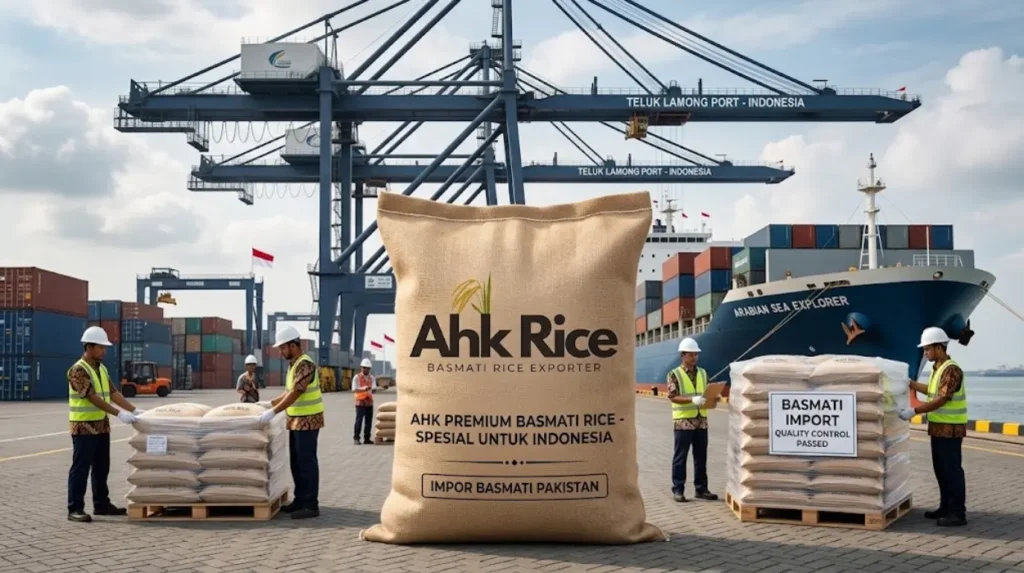
AHK Rice combines Punjab sourcing, milling, grading, colour sorting, inspection, customized packaging, and export documentation within one supply process. That integrated structure gives importers one commercial point of control from specification approval to shipment.
AHK Rice operates from Bucheki, Nankana Sahib, Punjab, a major Pakistani rice-producing area. Its export operation covers Basmati 1121, Super Kernel, and 1509 Basmati rice varieties.
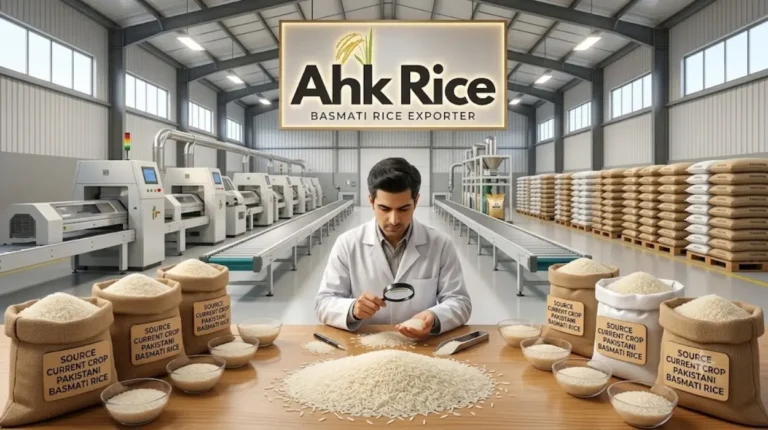
Quality control covers multiple stages. Paddy is cleaned, dehusked, polished, graded, colour sorted, inspected, and prepared according to the agreed export specification.
The company also states that pre-shipment inspections can be conducted through internationally recognized organizations such as SGS and Bureau Veritas.
Certifications listed by AHK Rice include ISO 22000:2018, HACCP, ISO 9001:2015, GMP, and Halal. Buyers should still confirm which documents apply to their specific Indonesian shipment before contract execution.
Packaging can also be customized. Buyers can specify bulk or private-label formats according to their distribution model and destination requirements.
The commercial advantage is control. The importer does not need to coordinate separate processors, packers, inspection providers, and export handlers for every shipment.
With supplier capability established, the next question is what a complete order actually looks like.
What does the full sample-to-shipment process look like?
A practical order moves through specification approval, sample testing, commercial quotation, production, inspection, documentation, container loading, sea freight, customs clearance, and delivery. Each stage creates a defined decision point for the importer.
How should the importer approve the sample?
Start by defining the target grade and requesting a representative sample. AHK Rice states that samples can be provided for testing, with buyers generally covering courier and phytosanitary costs.
Inspectors should evaluate cooked appearance, aroma, grain length, broken grains, colour, moisture, purity, and packaging condition.
Sample approval should become the commercial reference. The bulk shipment should follow the approved specification rather than a broader verbal description.
How should production be verified?
Approve the production specification before milling begins and require quality verification before container loading. AHK Rice’s export process includes processing, grading, colour sorting, inspection, packaging, and container loading.
A typical workflow is:
- Confirm variety, grade, quantity, packing, destination port, and Incoterm.
- Approve the physical sample and technical specification.
- Mill the selected paddy according to the approved grade.
- Grade kernels by size and quality.
- Sort defective grains and unwanted materials.
- Test moisture, broken percentage, purity, and other agreed parameters.
- Inspect finished rice before packing.
- Package the rice in the approved format.
- Verify export documents and certificates.
- Load the container under the agreed inspection procedure.
- Dispatch the shipment from Karachi.
- Clear the cargo through Indonesian import procedures.
This sequence converts a supplier promise into measurable purchasing controls.
How long does shipping to Indonesia take?
AHK Rice currently states approximately 4–6 weeks from purchase-order confirmation to delivery, including production, documentation, port clearance, and sea transit. Its Indonesia page specifies 7–10 days for production, about one week for documents and port clearance, and 14–21 days for sea transit.
The practical planning window therefore looks like this:
| Stage | Indicative time |
|---|---|
| Production | 7–10 days |
| Documentation and port clearance | About 7 days |
| Sea transit to Indonesia | 14–21 days |
| Total planning window | About 4–6 weeks |
Actual arrival dates depend on vessel schedules, transshipment, port congestion, customs processing, and destination-port conditions. Importers should therefore use the quoted sailing schedule rather than assume a fixed arrival date.
With the logistics window defined, the next step is understanding the commercial cost.
What does a Pakistan Basmati rice order to Indonesia cost?
The final cost depends on grade, quantity, packaging, season, Incoterm, freight, insurance, inspection, documentation, and destination charges. A reliable quotation must therefore be built around the buyer’s exact specification.
AHK Rice lists an indicative starting price of $1,100 per metric ton FOB Karachi for Basmati 1121 shipments to Indonesia, while noting that price varies by volume, packing, and season.
A useful planning example is a 100 MT order.
| Cost component | Example treatment |
|---|---|
| Rice | 100 MT × quoted FOB rate |
| Packing | Added according to selected bag and print |
| Inspection | Added where independently requested |
| Phytosanitary/documentation | Applied according to shipment requirements |
| Ocean freight | Added for CIF/CFR pricing |
| Insurance | Added where buyer requests coverage |
| Destination charges | Determined by Indonesian port and importer |
| Landed cost | Product plus applicable logistics and import costs |
For example, using the published $1,100/MT FOB reference, 100 MT would represent $110,000 for the rice component alone. This is not a landed Indonesian price. Freight, insurance, destination costs, duties, taxes, and other charges must be added separately.
The difference between FOB and CIF also matters. FOB gives the importer greater control over freight arrangements. CIF allows the exporter to arrange ocean freight and insurance within the quoted commercial structure.
AHK Rice states that insurance is optional and normally paid by the client.
Payment terms also affect working capital. AHK Rice’s Indonesia information states 30% advance payment and 70% against scanned shipment documents for the referenced Basmati 1121 supply. Buyers should confirm final terms in the commercial quotation.
With pricing separated into measurable components, importers can compare offers without confusing FOB product value with final landed cost.
What results can Indonesian importers expect?
The expected result is a documented, sample-approved shipment with controlled specifications, traceable production stages, suitable packaging, and a defined logistics schedule. The commercial benefit is lower uncertainty before the cargo leaves Pakistan.
AHK Rice’s integrated process gives buyers access to processing, grading, colour sorting, customized packing, inspection, and export documentation.
For a buyer purchasing 1121 Steam, the reference specification includes 8.35 mm+ grain length, under 12.5% moisture, and under 1% broken grains.
Those values should not automatically become every Indonesian buyer’s specification. They provide a starting point for negotiations.
The final contract should define every commercially important tolerance. That includes moisture, broken percentage, foreign matter, grain length, packaging, quantity tolerance, inspection method, and document requirements.
A strong order also creates a repeatable procurement model. The next shipment can use the previous approved specification as its benchmark, reducing the time needed for supplier evaluation.
This matters for distributors and wholesalers that need consistency across multiple containers. Product continuity becomes easier when procurement relies on measurable specifications rather than general product descriptions.
With expected outcomes established, the final decision is how an importer should begin.
How should an Indonesian importer get started?
Start with the destination port, required grade, quantity, packing format, Incoterm, target specification, and sample requirement. These details allow AHK Rice to prepare a commercially meaningful quotation instead of a generic price.
The buyer should prepare five core inputs:
- Select the Basmati variety and processing grade.
- Define grain, moisture, broken, purity, and foreign matter requirements.
- Specify quantity and packaging size.
- Confirm destination port and preferred Incoterm.
- Request sample and inspection requirements before production.
AHK Rice’s quotation form specifically asks buyers for destination port, product, packing, quantity, and Incoterm information.
The importer should then compare the sample against the written specification. A supplier offering a lower nominal price may become more expensive after freight, inspection, quality disputes, or inconsistent specifications.
The strongest decision therefore combines four factors: product conformity, inspection evidence, shipment timing, and total landed economics.
AHK Rice is positioned for buyers that want those elements managed through one export supply chain. The company’s Indonesia-specific pages already cover Basmati 1121 and multiple other rice grades for the market.
A buyer ready to proceed should provide the complete specification rather than request only a price. That approach allows the exporter to quote the correct product, packing, quantity, freight basis, and documentation requirements.
Frequently Asked Questions
Is AHK Rice suitable for Indonesian Basmati rice importers?
AHK Rice supplies Pakistani Basmati varieties for Indonesian buyers, including 1121 and other grades.
The company provides processing, grading, packaging, inspection, and export documentation.
Indonesia-specific pages describe sample approval and shipment procedures.
Buyers should confirm the final technical specification before production.
This creates a clearer basis for repeat commercial procurement.
How long does Pakistan Basmati rice take to reach Indonesia?
AHK Rice states an overall planning period of about 4–6 weeks from order confirmation.
Production generally takes 7–10 days under its published Indonesia process.
Documentation and port clearance are estimated at about one week.
Sea transit is listed at approximately 14–21 days.
Vessel schedules and port conditions can change actual arrival dates.
What is the indicative price for 1121 Basmati rice?
AHK Rice lists an indicative starting reference of $1,100 per MT FOB Karachi.
The final price changes with volume, packing, season, and product specification.
FOB pricing does not represent the importer’s final Indonesian landed cost.
Freight, insurance, destination costs, and applicable import charges require separate calculation.
Buyers should request a shipment-specific commercial quotation.
Can Indonesian importers request samples before bulk orders?
Yes, sample approval can be used before committing to bulk production.
AHK Rice states that sample quantities can be provided for buyer testing.
Courier and phytosanitary costs may be payable by the buyer.
The approved sample should become the reference for the bulk specification.
This process helps reduce quality disputes after shipment.
What documents should buyers discuss before shipment?
Buyers should confirm the commercial invoice, packing list, Bill of Lading, and applicable export certificates.
Phytosanitary documentation may apply according to shipment requirements.
Inspection reports can also be requested where the contract requires independent verification.
AHK Rice states that export documentation forms part of its integrated supply service.
The importer should confirm Indonesia-specific document requirements before dispatch.