How Do Strategic Supplier Relationships Improve Rice Procurement?
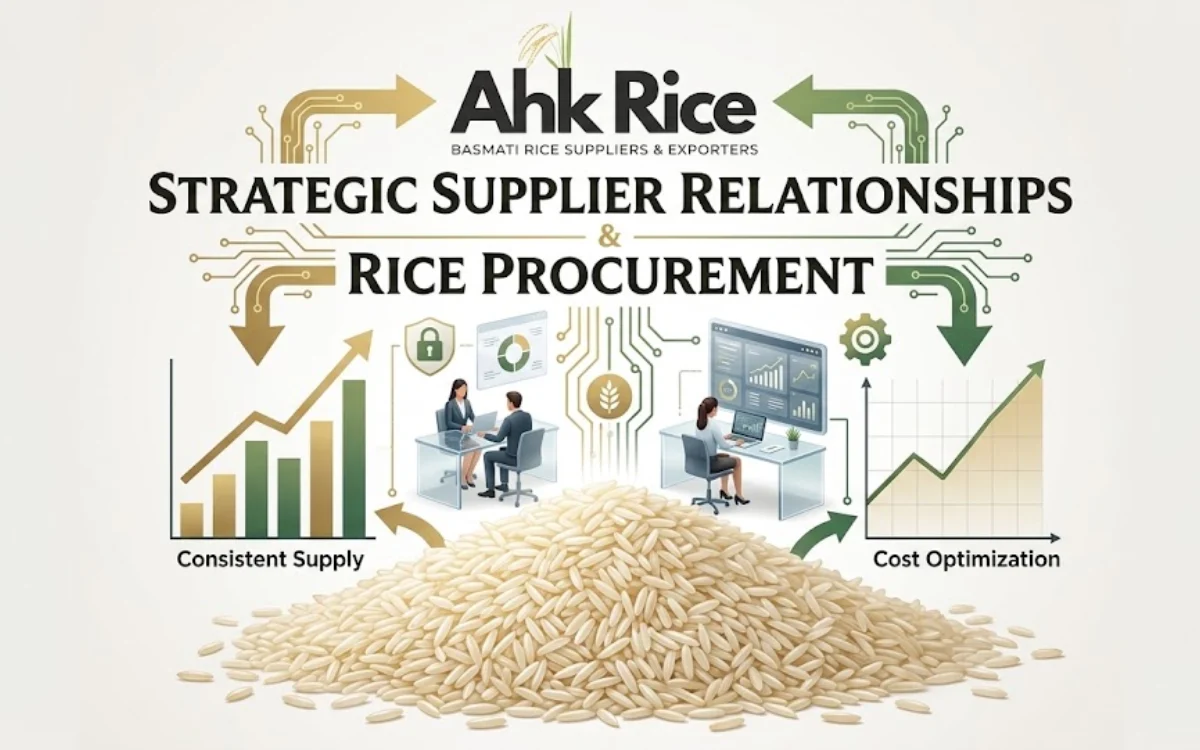
Strategic supplier relationships improve rice procurement by reducing quality variation, stabilising supply, improving specification control, and creating more predictable landed costs; the strongest model combines long-term sourcing with measurable quality standards, multi-grade flexibility, documented inspections, and destination-specific planning.
For importers evaluating long-term supply, the key question is not simply which exporter offers the lowest quotation. It is whether the supplier can repeatedly deliver the agreed variety, processing grade, moisture level, packaging, documentation, and shipment schedule. This is why understanding:
Why importers long-term partnerships with rice exporters provides the foundation for evaluating procurement relationships.
Pakistan remains a major rice-exporting origin. Rice Exporters Association of Pakistan reports 5.82 million MT of total rice exports in FY2024-25, including 808,643 MT of Basmati worth approximately $831 million. The 2026 procurement environment also reflects active demand across the Gulf, Europe, Southeast Asia, Africa, and North America.
For buyers, strategic procurement therefore means moving from transaction-by-transaction purchasing toward a controlled supply system. The supplier becomes part of the buyer’s quality, inventory, packaging, logistics, and forecasting process.
What are the available solutions for strategic rice procurement?
Rice importers have four practical procurement models: spot purchasing, approved-supplier purchasing, framework agreements, and strategic partnerships; each model differs in price control, quality consistency, supply visibility, documentation, flexibility, and the level of operational coordination between buyer and exporter.
Spot purchasing
Spot purchasing means buying rice according to immediate market requirements. The importer requests quotations from several exporters and selects the best available commercial offer.
This approach provides price flexibility. It also creates greater specification risk because every new supplier introduces a new production system, inspection process, packaging standard, and documentation workflow.
Spot buying works for occasional purchases and opportunistic price management. It becomes less efficient when the importer sells under a consistent retail or foodservice specification.
Approved-supplier purchasing
An approved-supplier model restricts procurement to exporters that already meet defined technical and commercial standards.
The buyer evaluates samples, processing capabilities, certificates, packaging, inspection procedures, export documentation, and delivery performance before approving the supplier.
This model reduces supplier risk while preserving competitive quotations.
Framework agreements
A framework agreement establishes commercial and technical parameters for repeated purchases over a defined period.
The buyer can specify approved varieties, quality tolerances, packaging formats, inspection requirements, delivery windows, and pricing mechanisms.
Framework purchasing works particularly well for wholesalers, distributors, private-label brands, and foodservice companies with recurring demand.
Strategic supplier partnership
A strategic partnership goes further. The importer and exporter coordinate demand forecasts, product specifications, quality control, packaging, inventory planning, shipment schedules, and market requirements.
For example, an importer selling 1121 Basmati in several retail pack sizes can maintain a fixed specification while adjusting order volumes according to seasonal demand.
AHK Rice operates this type of end-to-end export capability, covering paddy procurement, processing, grading, colour sorting, packaging, documentation, and container loading from Punjab.
How do different rice procurement approaches compare?
Strategic partnerships deliver the strongest overall procurement control because they combine recurring supply with specification discipline; spot buying wins on short-term flexibility, approved suppliers reduce risk, and framework contracts provide a balanced structure for recurring commercial requirements.
| Attribute | Spot Buying | Approved Supplier | Framework Agreement | Strategic Partnership |
|---|---|---|---|---|
| Price visibility | Low to medium | Medium | High | High |
| Quality consistency | Variable | High | High | Very high |
| Supply planning | Low | Medium | High | Very high |
| Specification control | Transaction-based | Defined | Contractual | Continuous |
| Supplier flexibility | Very high | Medium | Medium | Medium to high |
| Documentation control | Repeated checks | Standardised | Contractual | Integrated |
| Long-term value | Low | Medium | High | Very high |
The comparison changes when procurement volume increases. A buyer purchasing a single container occasionally has a different cost structure from a distributor importing hundreds of metric tons annually.
A strategic relationship also changes the definition of price. The lowest FOB quotation is not automatically the lowest procurement cost. Rejected shipments, inconsistent grain quality, repacking, delayed documentation, demurrage, emergency purchases, and customer complaints all create indirect costs.
S&P Global’s rice specifications illustrate the level of detail used in professional rice trading. Its Pakistan 1121 and Super Kernel specifications address moisture, broken grains, damaged kernels, chalky grains, foreign matter, paddy grains, milling degree, and grain length.
A strategic supplier relationship converts these technical specifications into repeatable procurement controls.
Which rice grades suit different strategic procurement cases?
1121 suits premium positioning and buyers prioritising extra-long grain appearance; Super Kernel fits aromatic premium segments; 1509 provides a cost-focused long-grain option, allowing procurement teams to align grade selection with market positioning instead of using one specification for every customer.
1121 Basmati
1121 is the strongest option when grain length and visual presentation drive product positioning. Current Pakistan market references place its raw grain length around 8.30–8.50 mm, depending on specification and measurement basis.
It fits premium retail, private-label products, hospitality, and markets where cooked grain elongation is commercially important.
AHK Rice supplies 1121 in White, Steam, Brown, Parboiled, Golden Sella, Creamy Sella, and Sella processing grades.
Super Kernel Basmati
Super Kernel focuses on slender grain, aroma, texture, and established Basmati positioning. It fits buyers whose customers value traditional aromatic characteristics rather than maximum grain length.
The variety also provides procurement diversification within premium Basmati. A buyer can use 1121 for a premium long-grain SKU and Super Kernel for an aromatic SKU without changing the country of origin.
1509 Basmati
1509 provides a more cost-oriented alternative while retaining long-grain characteristics. AHK Rice describes it as a high-yield variety with a shorter cultivation cycle and multiple processing options.
It suits value-focused retail, catering, wholesalers, and markets where procurement cost has greater weight than maximum grain length.
How do Gulf and Western markets differ in procurement preferences?
Gulf markets prioritise established Basmati grades, aroma, cooking performance, packaging, and reliable replenishment, while Western markets place stronger emphasis on documented specifications, regulatory compliance, private-label consistency, and traceability across repeated shipments.
Gulf market: UAE and Saudi Arabia
The UAE is a major destination for Pakistani Basmati. Pakistan Bureau of Statistics data for FY2023-24 recorded 149,092 MT of Pakistani Basmati exports to the UAE and 101,909 MT to Saudi Arabia.
For Gulf procurement, 1121 and Super Kernel are strong strategic choices. 1121 supports premium grain presentation. Super Kernel supports traditional aromatic positioning. 1509 works where cost efficiency carries greater weight.
Current 2026 market information places indicative FOB Karachi prices for major Basmati grades around the $1,135–$1,205/MT range, although exact pricing changes by variety, processing grade, order volume, packaging, inspection, and shipment terms.
UAE shipments also benefit from relatively short Karachi-to-Jebel Ali transit, reducing inventory exposure compared with longer routes.
Western market: United States and Europe
Western procurement places greater emphasis on documented compliance and repeatable product specifications.
For the United States, rice importers operate within FDA and Foreign Supplier Verification Program requirements. Current indicative Pakistan FOB references place 1121 Basmati around $1,165–$1,205/MT, with exact destination pricing dependent on freight and other charges.
The European and UK markets also provide established demand for Pakistani Basmati. USDA reporting for 2024-25 noted substantial Pakistani rice exports to the EU and identified continued demand for Pakistani Basmati in quality-conscious markets.
This makes specification continuity particularly important for private-label importers. A retail customer expects the same grain appearance, cooking performance, packaging, and declared product characteristics across replenishment cycles.
How do price and shelf life affect the procurement decision?
Price per MT determines the initial purchase cost, while shelf stability determines inventory flexibility; strategic buyers therefore evaluate FOB price alongside processing grade, moisture, packaging, transit time, warehouse conditions, and expected storage duration before selecting the procurement model.
Indicative 2026 FOB benchmarks show why grade selection matters. Current market references place 1121 Basmati around $1,135–$1,205/MT depending on grade and market, while 1509 typically occupies a more competitive position. Super Kernel pricing varies according to specification and buyer requirements.
These figures are benchmarks rather than fixed contract prices. A strategic agreement normally uses a defined quotation validity, quality specification, Incoterm, packaging configuration, quantity, inspection condition, and shipment window.
Shelf life also requires specification control. AHK Rice’s 2026 storage guidance identifies moisture as a critical factor in preserving aroma, grain integrity, cooking performance, and food safety. Export-grade Basmati is generally processed within approximately 12–13% moisture depending on customer and destination requirements.
A separate 2026 AHK Rice comparison lists different indicative shelf-stability positions across processing grades, with Sella grades generally providing stronger storage stability than standard white rice.
The practical lesson is simple: shelf life is not only a variety characteristic. It depends on moisture control, processing, packaging, warehouse conditions, temperature, humidity, pest management, and inventory duration.
What decision framework should importers use?
Importers should score suppliers against specification consistency, landed cost, supply capacity, compliance, and relationship capability; a weighted evaluation prevents procurement teams from selecting an exporter solely because its initial FOB quotation appears lower than competing offers.
| Decision factor | What to evaluate | Strategic question |
| Quality consistency | Grain length, broken ratio, moisture, purity, milling | Does every shipment match the approved sample? |
| Total landed cost | FOB/CNF price, freight, packaging, inspection, port costs | What is the delivered cost per MT? |
| Supply capacity | Paddy access, milling capacity, stock, export scheduling | Can the supplier support peak demand? |
| Compliance | Certificates, inspection, destination regulations, traceability | Can documentation pass destination requirements? |
| Relationship capability | Forecasting, communication, packaging, problem resolution | Can the supplier support repeated procurement cycles? |
The framework becomes more useful when each factor receives a numerical score. A buyer can assign 25% to quality, 25% to landed cost, 20% to supply reliability, 15% to compliance, and 15% to relationship capability.
This creates an auditable procurement decision.
It also prevents a common purchasing mistake: selecting a supplier based only on price per MT.
What are the advantages and disadvantages of strategic supplier relationships?
Strategic relationships improve consistency, planning, and supplier accountability, but they also reduce switching flexibility and require stronger governance; importers gain the most value when agreements include measurable specifications, performance reviews, pricing rules, inspection rights, and exit conditions.
Advantages
The first advantage is consistent quality. The buyer and exporter agree on measurable specifications before repeated orders begin.
The second advantage is supply visibility. Forecasts help exporters plan paddy sourcing, milling, packaging materials, and production schedules.
The third advantage is better packaging control. Private-label buyers can standardise bag materials, printing, weights, labelling, and palletisation.
The fourth advantage is faster problem resolution. Existing suppliers already understand the buyer’s specification and documentation workflow.
The fifth advantage is market-specific product planning. A buyer can maintain 1121 for premium retail while using 1509 for value-oriented distribution.
Disadvantages
The main disadvantage is supplier concentration. Excessive dependence on one exporter creates disruption risk if production, logistics, regulation, or financing changes.
Another disadvantage is reduced price-shopping frequency. A buyer that never benchmarks the market can lose visibility into competitive pricing.
Strategic procurement also requires governance. Buyers need supplier scorecards, periodic audits, sample retention, inspection procedures, and contract reviews.
The solution is not to abandon strategic partnerships. It is to combine a primary supplier relationship with defined contingency suppliers.
How should importers structure a strategic rice supplier relationship?
A strong relationship begins with technical specifications, then connects quality control, pricing, packaging, forecasting, inspection, logistics, and performance reviews; the agreement must define measurable expectations so both parties manage procurement through evidence rather than assumptions.
The first step is to establish the product specification.
This includes variety, processing grade, grain length, broken percentage, moisture, purity, foreign matter, milling degree, packaging, net weight, and acceptable tolerances.
The second step is sample approval.
The approved sample becomes the physical reference for future shipments. Laboratory reports and inspection certificates provide additional evidence.
The third step is commercial alignment.
The contract should define price basis, Incoterm, payment method, quantity tolerance, shipment window, inspection requirements, and documentation.
The fourth step is demand forecasting.
Importers should share expected quarterly demand where commercial confidentiality permits. This allows the exporter to plan production and procurement more efficiently.
The fifth step is performance measurement.
A supplier scorecard should track on-time shipment percentage, specification compliance, rejected quantity, documentation accuracy, complaint resolution time, and price competitiveness.
Importers ready to move from supplier evaluation to a structured sourcing relationship can: Evaluate a long-term rice supply partnership with AHK Rice in Utah.
AHK Rice’s integrated Punjab operation covers sourcing, processing, grading, colour sorting, custom packaging, documentation, and export logistics, making the model relevant for importers that want one coordinated supply chain rather than separate vendors for each stage.
When does a strategic rice supplier relationship create the most value?
Strategic supplier relationships create the strongest value for importers with recurring demand, defined product specifications, private-label requirements, multiple shipments, or high customer expectations; occasional buyers gain more from competitive spot procurement and flexible supplier selection.

A supermarket importer with monthly replenishment benefits from specification continuity and packaging consistency.
A foodservice distributor benefits from predictable cooking performance and supply planning.
A private-label brand benefits from repeatable packaging and quality controls.
A wholesaler serving multiple countries benefits from having several grades available through one export relationship.
A small importer placing one irregular shipment has a different procurement requirement. It can prioritise quotation competition and flexible minimum order quantities.
The correct approach is therefore not to treat strategic partnerships as universally superior. The right model depends on purchase frequency, volume, product complexity, customer expectations, inventory exposure, and regulatory requirements.
In 2026, the stronger procurement strategy is measurable rather than relationship-driven alone. Importers need a supplier that can demonstrate quality consistency, transparent specifications, competitive total cost, export documentation, and dependable shipment execution.
The result is a procurement relationship that reduces operational uncertainty while preserving commercial discipline.
Frequently Asked Questions
What is a strategic supplier relationship in rice procurement?
A strategic supplier relationship is a long-term purchasing arrangement between a rice importer and exporter. It focuses on consistent quality, reliable supply, pricing, specifications, packaging, documentation, and shipment performance rather than individual transactions.
How do strategic supplier relationships improve rice quality?
They establish fixed product specifications for variety, moisture, grain length, broken percentage, purity, milling degree, and packaging. The exporter uses the approved sample and specification as a reference for repeated shipments.
Which Pakistani Basmati rice grades are commonly used for strategic procurement?
The main options include 1121 Basmati, Super Kernel Basmati, and 1509 Basmati. 1121 suits premium long-grain positioning, Super Kernel suits aromatic premium segments, and 1509 provides a more cost-focused option.
Is 1121 Basmati suitable for premium markets?
Yes. 1121 Basmati is suited to premium retail, private-label, hospitality, and foodservice markets where extra-long grain appearance, aroma, and cooked grain elongation are important procurement criteria.
How does Super Kernel compare with 1121 Basmati?
Super Kernel provides strong aromatic and traditional Basmati characteristics, while 1121 is particularly recognised for its extra-long grain profile. The better choice depends on the buyer’s target market, product positioning, and customer specification.