Source Food-Safe Pakistani Basmati Rice for Wales from AHK Rice
The best solution for Welsh buyers is a specification-led Pakistani Basmati supply with documented food-safety testing, controlled processing, verified packaging, and export documentation. Here is why: Wales follows Great Britain food-import controls, while Pakistan-origin rice currently has controls covering pesticide residues, aflatoxins, and Ochratoxin A.
Welsh importers should therefore evaluate the supplier before evaluating only the rice price. The buying decision should cover variety, processing grade, broken percentage, moisture, contaminants, packaging, inspection, documentation, and delivery terms.
For background, buyers can first review why Welsh buyers review food safety standards before importing rice before moving into supplier selection.
What is the best solution for sourcing food-safe Pakistani Basmati rice?
A documented 1121, Super Kernel, or 1509 specification with laboratory testing and pre-shipment inspection provides the strongest procurement route for Welsh importers.
Pakistani Basmati rice gives Welsh wholesalers access to long-grain aromatic varieties suited to retail, catering, restaurants, and ethnic food distribution.
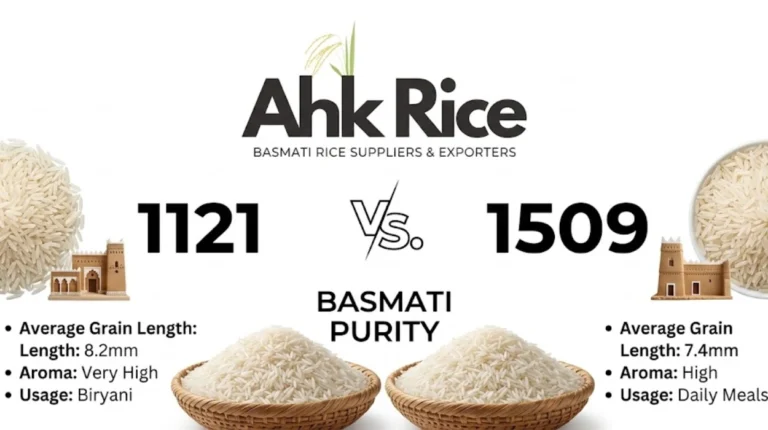
The correct grade depends on the buyer’s cooking profile. 1121 White suits premium retail and catering. 1121 Steam provides a firmer cooking profile. Golden Sella suits buyers seeking parboiled performance and handling stability.
| Specification | Commercial buying target |
|---|---|
| Variety | 1121, Super Kernel, 1509 |
| Processing | White, Steam, Golden Sella |
| Grain length | Approximately 7.0–8.5 mm depending on variety |
| Broken grains | Contract-specific, commonly ≤2% |
| Moisture | Contract-specific, commonly ≤13% |
| Packaging | PP, woven, retail, or private-label |
| Inspection | Pre-shipment or third-party inspection |
AHK Rice supplies Pakistani Basmati varieties from Punjab and supports processing, grading, colour sorting, customized packaging, and export documentation. Its published UK export information lists 1121 White Basmati with Felixstowe as a destination port.
Welsh buyers should approve the physical sample before approving the commercial specification. This prevents a low quoted price from becoming a quality problem after arrival.
Why choose AHK Rice for Welsh Basmati imports?
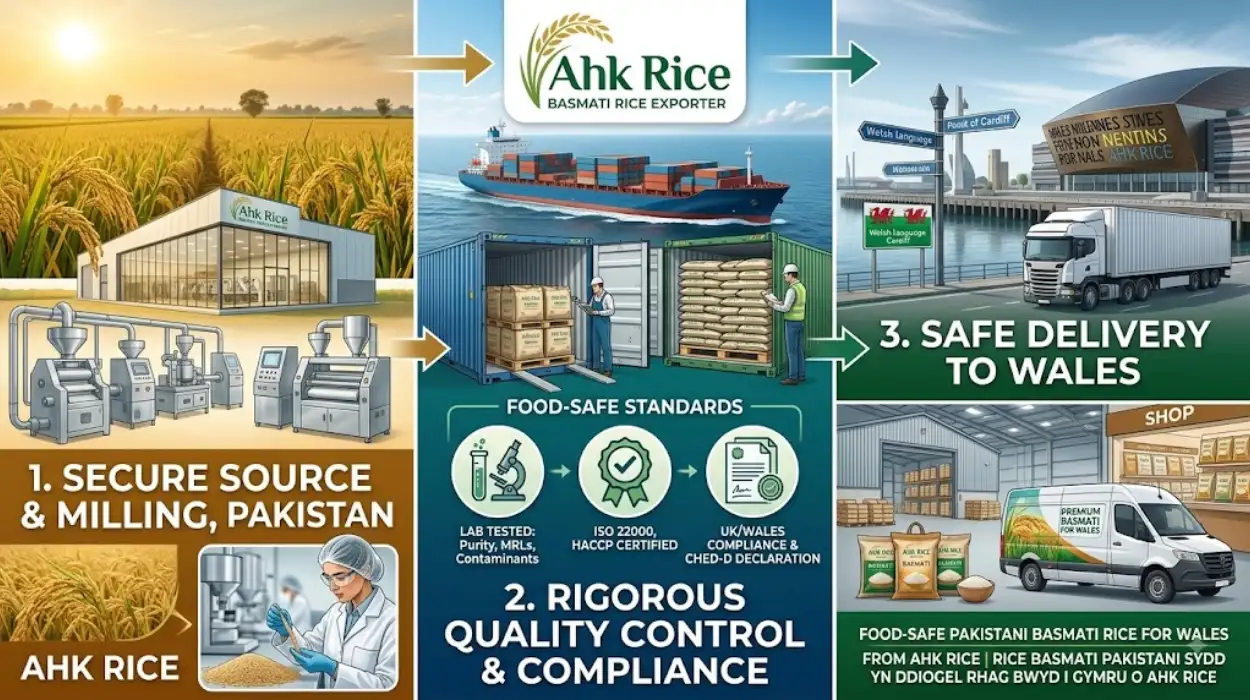
AHK Rice combines Pakistani Basmati sourcing, controlled milling, laboratory verification, packaging, inspection, and export coordination into one procurement process.
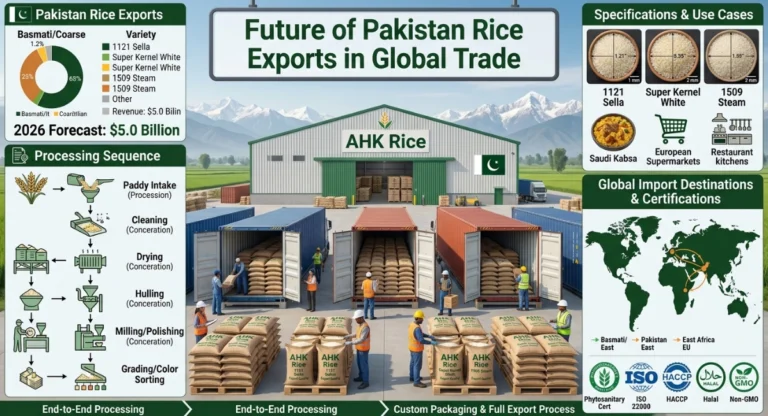
AHK Rice can supply 1121, Super Kernel, and 1509 varieties with different processing options. The company states that its export process covers paddy sourcing through final container loading.
The processing sequence includes cleaning, dehusking, polishing, grading, colour sorting, packaging, and container loading. Each stage supports a different commercial requirement.
Quality control matters particularly for Pakistan-origin rice entering Great Britain. The Food Standards Agency currently lists Pakistan rice under controls involving pesticide residues, aflatoxins, and Ochratoxin A.
Third-party inspection provides another verification layer. AHK Rice states that pre-shipment inspections can involve internationally recognised inspection organisations such as SGS and Bureau Veritas.
Documentation control also reduces clearance risk. UK food imports can involve customs duties, import licensing, tariff quotas, and food-control requirements depending on the commodity and applicable regime.
For buyers comparing operational approaches, how Pakistani Basmati rice shipments are prepared for UK food rules provides the relevant preparation framework.
With supplier controls established, the next decision is whether the delivered result justifies the procurement cost.
What results can Welsh buyers expect from AHK Rice?
Welsh buyers can expect specification-controlled rice, documented testing, customized packing, export coordination, and shipment visibility from order approval through dispatch.
Product consistency starts with a defined purchase specification. The buyer approves variety, processing, grain length, broken percentage, moisture, packaging, crop, and destination.
Cooking consistency improves when the physical specification remains stable across commercial batches. Restaurants can test elongation, aroma, texture, separation, and holding performance before purchasing.
Traceability improves through documented sourcing and quality checks. A defined lot specification also gives the importer a measurable reference during receiving inspection.
Packaging flexibility supports Welsh retail and wholesale operations. AHK Rice offers different bag formats and private-label packaging options based on buyer requirements.
Shipment control becomes important during long ocean movements. Karachi-to-UK sea transit varies by destination and routing. Current shipping references show approximately 30 days for the shortest Karachi-to-Felixstowe sea route, while other UK routes can take considerably longer.
How many shipping days should Welsh importers plan?

Plan approximately 30–57 days for ocean movement from Karachi to the UK, then add port clearance and inland delivery to Wales.
| Destination stage | Indicative planning period |
|---|---|
| Production and preparation | 7–10 days |
| Karachi export handling | 2–5 days |
| Sea freight to UK | 30–57 days |
| UK port clearance | Variable |
| UK-to-Wales delivery | Variable |
Actual delivery depends on vessel schedule, port congestion, customs processing, inspection requirements, and inland transport.
A Welsh importer should therefore avoid promising customers a delivery date based only on ocean transit. The purchase plan should include production, documentation, vessel booking, port handling, and final delivery.
How does the sample process work before a bulk order?
The sample process should move from specification approval to laboratory verification, physical testing, commercial approval, and only then bulk production.
- Define the specification — Select 1121, Super Kernel, or 1509 and confirm the processing grade.
- Request the sample — Specify quantity, packaging format, destination, and courier preference.
- Dispatch the sample — AHK Rice prepares and ships the approved sample for buyer testing.
- Test the rice — Assess aroma, grain appearance, cooking expansion, texture, broken grains, and cleanliness.
- Verify compliance — Review applicable laboratory reports and food-safety documentation.
- Approve the specification — Confirm the exact commercial parameters before issuing the purchase order.
- Start production — AHK Rice processes, grades, sorts, and packs the contracted specification.
- Inspect the shipment — Arrange pre-shipment inspection where required.
- Load the container — Complete export documentation and dispatch through the selected carrier.
AHK Rice’s published sampling information states that qualified commercial buyers can request samples and that international sample delivery commonly takes 5–15 business days, depending on destination and customs.
Sample costs should be separated from product costs. The buyer may pay courier, certification, laboratory, or special packaging charges even when the rice sample itself is provided without charge.
How much does Pakistani Basmati rice cost for Wales?
Bulk cost depends on variety, processing, crop, broken percentage, packaging, quantity, Incoterm, inspection, freight, duty, and destination clearance.
Indicative Pakistani FOB prices published in July 2026 place several premium Basmati grades around US$1,150–US$1,180 per MT, although supplier quotations vary by specification and shipment.
| Cost factor | Effect on buyer cost |
|---|---|
| Rice grade | Higher specification can increase FOB price |
| Crop year | Older or newer crop can affect commercial value |
| Quantity | Larger contracts can improve unit economics |
| Packaging | Private-label formats add production cost |
| Inspection | Third-party inspection adds service cost |
| Freight | Route and vessel rates change landed cost |
| Incoterm | FOB, CFR, or CIF changes cost responsibility |
| UK charges | Duty, clearance, port, and delivery affect landed price |
A Welsh importer should compare landed cost per MT, not only FOB Karachi price. Freight, insurance, customs charges, port costs, and inland delivery can materially change the final procurement figure.
UK tariff treatment also requires checking the applicable commodity code and current tariff arrangements. GOV.UK states that UK Global Tariff rates should be checked against the specific imported commodity.
How can Welsh buyers start sourcing from AHK Rice?
Start with one approved specification, one representative sample, one documented compliance review, and one commercial quotation before scaling the order.
AHK Rice can structure the discussion around destination, variety, processing grade, quantity, packaging, Incoterm, and required documentation.
The buyer should provide the destination port, estimated annual volume, preferred rice grade, packaging requirement, and target specification.
AHK Rice can then align the product specification with processing, testing, packaging, inspection, and shipment requirements.
A first order should use a clearly written specification sheet. That document becomes the reference for the sample, production batch, inspection, and receiving checks.
AHK Rice also supports customized packaging, allowing Welsh wholesalers and retailers to develop private-label supply programs rather than relying only on generic bulk packaging.
AHK Rice is therefore suited to buyers seeking a structured Pakistani Basmati procurement process rather than a simple spot-price transaction.
AHK Rice gives the buyer a single commercial route covering product sourcing, processing, quality verification, packaging, and export coordination.
The decision is straightforward: Welsh importers should select the supplier that can demonstrate the required specification, testing, documentation, and delivery plan before comparing the final price.
For formal commercial pricing and shipment planning, use AHK Rice’s request-a-quote service.
Frequently Asked Questions
Is Pakistani Basmati rice allowed into Wales?
Yes, Pakistani Basmati rice can enter Great Britain under applicable import controls.
Pakistan-origin rice is subject to specific food-safety controls.
Current controls include pesticide residues, aflatoxins, and Ochratoxin A.
Importers should verify current requirements before each shipment.
The supplier should provide relevant compliance documentation and test evidence.
Which Pakistani Basmati grade suits Welsh wholesalers?
1121 Basmati is a strong choice for premium wholesale and retail applications.
Super Kernel provides another long-grain commercial specification.
1509 can suit buyers seeking a different price-performance balance.
White, Steam, and Golden Sella provide different cooking characteristics.
The final grade should follow the buyer’s sample-testing results.
How long does shipping from Pakistan to Wales take?
Plan around 30–57 days for sea freight to the UK before clearance and inland delivery.
Karachi-to-Felixstowe can have shorter scheduled ocean transit.
Other UK ports can require longer transit periods.
Port congestion can extend the total delivery window.
Welsh delivery should therefore include additional clearance and trucking time.
Can Welsh buyers test samples before ordering?
Yes, commercial buyers can request samples before committing to bulk procurement.
Sample testing confirms appearance, aroma, texture, and cooking performance.
Buyers can also compare different grades before selecting one specification.
International sample delivery commonly takes 5–15 business days.
Courier and special certification costs may apply.
What documents should Welsh rice importers review?
Importers should review the commercial, food-safety, inspection, and customs documents applicable to their shipment.
Typical documentation can include invoice and packing list.
A certificate of origin may also support the import file.
Laboratory and inspection reports support specification verification.
The importer should confirm current UK requirements before dispatch.