Why Philippines Switched to Pakistani Rice After India Export Restrictions
The Philippines increased imports of Pakistani rice after India’s export restrictions reduced available supply in Asia. Here is why: Philippine importers needed stable rice volumes, competitive pricing, and uninterrupted shipments. Pakistani exporters supplied long-grain rice, maintained export availability, and helped diversify sourcing strategies during a period of market disruption.
Rice remains the most important staple food in the Philippines. The country imports millions of metric tons annually to balance domestic production and consumption requirements. When India’s rice export restrictions affected global trade flows, Philippine buyers adjusted procurement strategies and increased purchases from alternative origins, including Pakistan.
What Happened After India Imposed Rice Export Restrictions?
India restricted several rice export categories, reduced available global supply, increased international prices, and encouraged Philippine importers to diversify sourcing origins.
India is one of the world’s largest rice exporters. The country supplies white rice, parboiled rice, and specialty rice to many markets across Asia, Africa, and the Middle East.
India introduced export restrictions on several rice categories to manage domestic food inflation and secure local supplies (source: Government of India trade notifications, 2023–2024).
Global rice markets reacted immediately. Rice-importing countries searched for alternative suppliers because fewer Indian shipments reached international buyers.
Philippine importers increased procurement from multiple origins. Pakistan became one of the key alternative suppliers because it maintained export availability during the period.
Rice supply diversification became an important purchasing strategy. Importers reduced dependence on a single origin and established relationships with suppliers from several exporting countries.
The shift in sourcing explains why Pakistan gained greater visibility in the Philippine rice market. The next question is how Pakistan filled this supply gap.
How Did Pakistan Fill The Rice Supply Gap In The Philippines?
Pakistan supplied export-ready rice, maintained shipping continuity, and offered competitive grades that matched Philippine importer requirements.
Pakistan is one of the world’s major rice-exporting countries. The country cultivates Basmati and non-Basmati varieties across Punjab and Sindh.
Pakistani exporters increased shipments to markets seeking replacement supply. Philippine buyers evaluated grain quality, shipment schedules, and price competitiveness before placing orders.
Pakistan rice exports benefited from existing milling infrastructure. Modern processing facilities cleaned, dehusked, polished, graded, and sorted rice according to buyer specifications.
Exporters also offered flexible packaging formats. Philippine distributors imported rice in bulk containers, PP bags, and retail-ready packs depending on distribution requirements.
Pakistan’s role expanded because importers needed reliable shipments. Reliability became as important as price during periods of market uncertainty.
With supply continuity established, the next question is what rice products attracted Philippine buyers.
What Pakistani Rice Varieties Became Important For The Philippine Market?
Long-grain white rice, parboiled rice, and selected premium varieties matched Philippine consumption patterns and import specifications.
Philippine rice consumption focuses heavily on long-grain rice. Consumers prefer grains that cook consistently and maintain acceptable texture after preparation.
Long-Grain White Rice
Long-grain white rice remains one of the most imported categories. The grain undergoes milling and polishing to achieve a clean appearance and uniform quality.
Philippine distributors often select long-grain white rice because it fits household consumption and retail distribution channels.
Long-grain white rice also provides pricing flexibility. Importers can source different quality grades depending on target consumer segments.
Parboiled Rice
Parboiled rice undergoes a controlled processing method before milling.
The process follows specific steps:
- Soak the paddy in controlled water conditions.
- Steam the grain under regulated pressure.
- Dry the paddy to export moisture levels.
- Mill the grain.
- Grade the finished rice.
Parboiled rice offers stronger grain structure during transport and storage.
Buyers comparing processing specifications often review the differences between white rice and parboiled rice before selecting inventory. A detailed comparison of 1509 rice processing options for Philippine distribution channels explains how each grade performs in storage, transport, and retail markets.
Premium Basmati Rice
Premium Basmati rice serves a different market segment.
Basmati varieties feature natural aroma and elongated grain structure. Restaurants and specialty food retailers often source Basmati for specific culinary applications.
Different rice categories satisfy different buyer requirements. Understanding these requirements requires examining the complete supply chain.
How Does Pakistani Rice Reach Philippine Importers?
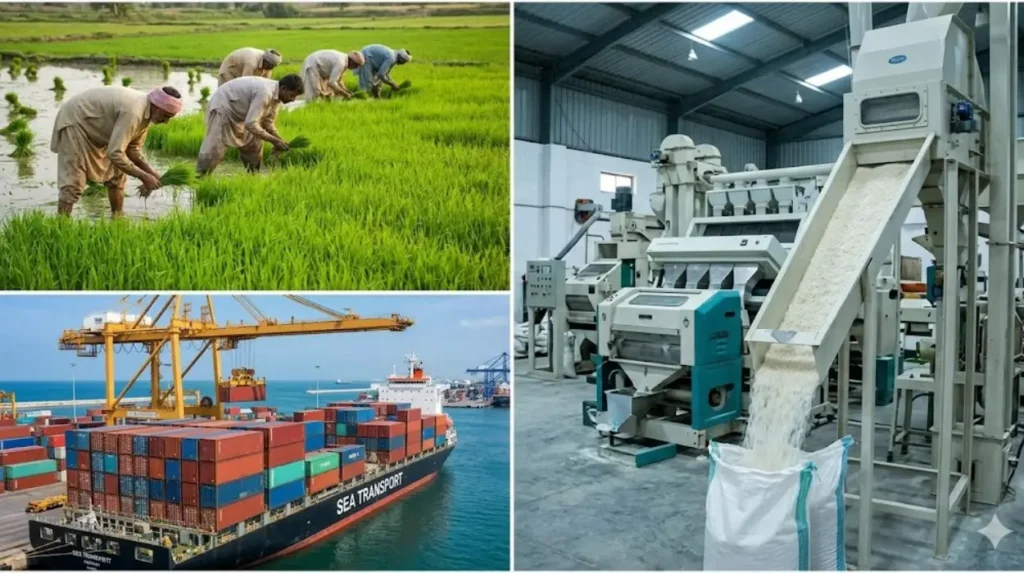
Pakistani rice follows a structured export chain that includes cultivation, harvesting, processing, certification, container loading, and international shipping.
Rice quality begins in agricultural regions.
Rice Cultivation
Farmers cultivate rice in irrigated agricultural zones.
Punjab contributes a significant share of Pakistan’s rice production. The province benefits from fertile soil and established irrigation systems.
Farmers perform several agricultural activities:
- Prepare the land
- Sow certified seed
- Irrigate fields
- Apply nutrients
- Monitor crop health
- Harvest mature paddy
Rice Processing
Processing transforms harvested paddy into export-grade rice.
Modern mills perform these steps:
- Clean the paddy
- Dehusk the grain
- Remove impurities
- Polish the rice
- Grade by size
- Sort by colour
- Test moisture levels
- Inspect quality parameters
- Package for shipment
Each step influences consistency and export acceptance.
Export Logistics
Export logistics connect mills with overseas buyers.
Export operations include:
- Commercial invoice preparation
- Packing list preparation
- Phytosanitary certification
- Certificate of origin issuance
- Container loading
- Customs clearance
- Vessel dispatch
- Destination delivery
Pakistan’s established export infrastructure supports large-volume rice shipments to international markets.
With the export process explained, the next question is why Philippine buyers viewed diversification as beneficial.
Why Did Philippine Importers Diversify Rice Sources?
Supply diversification reduced procurement risk, improved purchasing flexibility, and strengthened food security planning.
Food-importing countries depend on stable agricultural supply chains.
When one major exporting country changes trade policy, importing countries face procurement challenges. Diversification reduces exposure to those challenges.
Philippine importers expanded sourcing portfolios for several reasons.
Supply Security
Supply security improves when importers maintain relationships with multiple origins.
Multiple supply channels reduce dependence on a single exporter.
Pricing Flexibility
Pricing flexibility increases when buyers compare offers from several countries.
Competitive procurement helps distributors manage import costs.
Risk Management
Risk management improves through diversified sourcing.
Importers can adjust purchasing volumes according to market conditions, freight availability, and crop cycles.
Rice supply strategy extends beyond short-term purchasing decisions. It influences long-term food security planning and market stability.
Understanding diversification benefits leads naturally to examining the certifications that support international rice trade.
What Certifications Support Pakistani Rice Exports?
Export rice shipments undergo inspection, testing, and certification to satisfy importing country requirements and international trade standards.
International rice trade depends on documented compliance.
Certification systems verify quality, safety, and shipment specifications.
Quality Certifications
Quality certification programs evaluate production and processing systems.
Common certifications include:
- ISO standards
- HACCP systems
- Food safety management certifications
These frameworks establish documented procedures for quality control.
Government Export Documents
Government-issued documents support international trade.
Required documentation often includes:
- Phytosanitary certificates
- Certificate of origin
- Commercial invoice
- Packing list
- Bill of lading
Import authorities use these documents during customs and regulatory review.
Laboratory Testing
Laboratory testing verifies shipment specifications.
Testing commonly evaluates:
- Moisture content
- Grain length
- Broken percentage
- Foreign matter
- Purity levels
Consistent testing helps buyers compare rice grades objectively.
Certification creates confidence between exporters and importers. The next issue involves misconceptions surrounding the Philippines’ sourcing decisions.
What Misconceptions Exist About The Philippines Shift Toward Pakistani Rice?
The shift was not caused by a single factor. Supply continuity, pricing, availability, procurement strategy, and market conditions all influenced sourcing decisions.
Several misconceptions oversimplify the market transition.
Misconception: Price Was The Only Reason
Price influenced purchasing decisions, but it was not the sole factor.
Importers also evaluated shipment availability, delivery schedules, quality consistency, and supplier reliability.
Misconception: Philippine Buyers Replaced All Indian Rice
Philippine sourcing strategies focus on diversification rather than complete replacement.
Importers purchase rice from multiple origins depending on market conditions.
Misconception: All Rice Grades Are Identical
Rice grades differ significantly.
Differences include:
- Grain length
- Grain shape
- Broken percentage
- Moisture content
- Processing method
- Cooking characteristics
Importers select grades according to market segment requirements.
These clarifications explain the broader market reality. The final question examines the long-term impact on regional rice trade.
What Does This Change Mean For Future Rice Supply In The Philippines?
Philippine rice sourcing now emphasizes diversified suppliers, resilient procurement strategies, and broader participation from exporting countries.
Rice trade patterns evolve when supply conditions change.
The Philippines continues to require imported rice to supplement domestic production. Stable import channels remain essential for national food security.
Exporting countries compete through quality, availability, logistics performance, and pricing.
Pakistan strengthened its position during a period of global market adjustment. Philippine buyers expanded sourcing relationships and reduced concentration risk.
Future procurement decisions will continue to focus on supply reliability. Importers seek partners capable of maintaining shipment schedules and consistent quality specifications.
The result is a more diversified rice supply structure. That diversification became one of the most significant outcomes of the period following India’s export restrictions.
For buyers comparing available Pakistani grades for the Philippine market, understanding the processing differences between white rice and parboiled rice provides the next level of evaluation before procurement decisions.
Frequently Asked Questions
Why did the Philippines increase rice imports from Pakistan after India’s export restrictions?
The Philippines increased rice imports from Pakistan because Indian export restrictions reduced available supply in the international market. Pakistani exporters maintained export availability and offered alternative sourcing options for Philippine importers.
What types of Pakistani rice are commonly imported into the Philippines?
Philippine importers commonly purchase long-grain white rice, parboiled rice, and selected premium rice varieties from Pakistan. Different grades serve retail, wholesale, food service, and distribution markets.
How does Pakistani rice reach the Philippine market?
Pakistani rice reaches the Philippines through a structured export process. Farmers cultivate and harvest paddy, mills process and grade the rice, exporters prepare shipping documents, and containers are dispatched to Philippine ports.
Is Pakistan an important rice exporter globally?
Pakistan is one of the world’s leading rice-exporting countries. The country exports Basmati and non-Basmati rice to Asia, Africa, Europe, the Middle East, and other international markets.
Did the Philippines completely stop importing rice from India?
No. Philippine rice procurement focuses on sourcing from multiple countries. Importers diversify suppliers to improve supply security, reduce procurement risks, and maintain stable rice availability.