1121 Parboiled Basmati: How Parboiling Locks Nutrients Inside the Grain
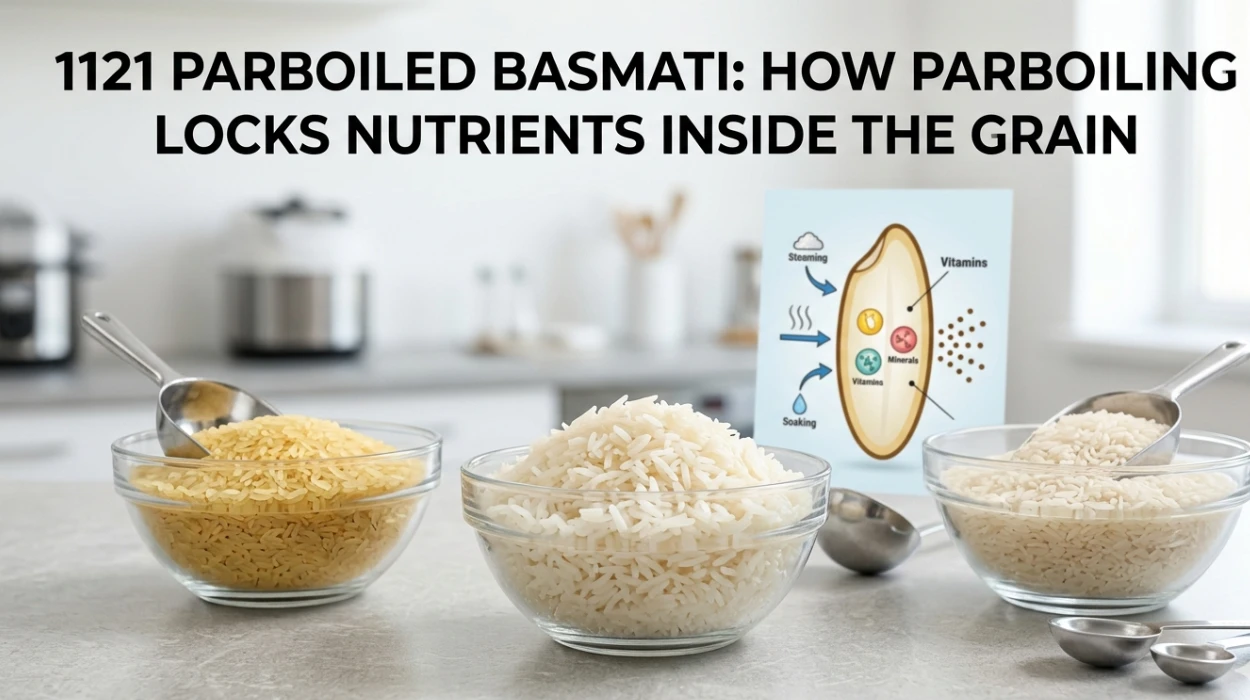
1121 parboiled basmati rice parboiling locks nutrients grain through a heat-and-moisture process that moves nutrients from the husk and bran layers into the endosperm before milling. This creates a firmer grain, longer shelf stability, and better storage performance than standard white rice.
What is 1121 parboiled basmati rice?
1121 parboiled basmati rice is an extra-long grain Basmati variety that is soaked, steamed, dried, and milled before packing, which changes the grain structure and helps retain nutrients inside the kernel.
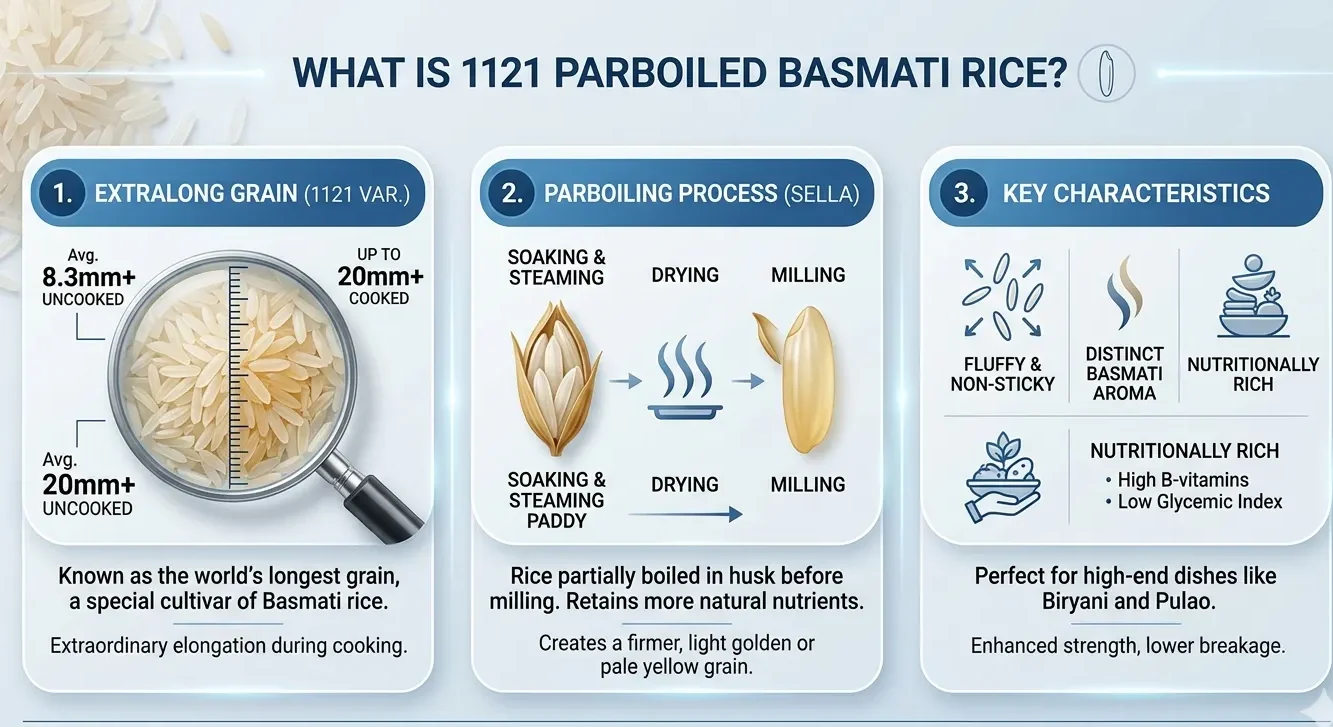
1121 refers to the Basmati variety. It is known for its extra-long grain length, strong elongation after cooking, and export value in premium rice trade. Parboiled refers to the processing route, not a separate botanical species. The rice starts as paddy, then moves through a controlled heat cycle before final milling.
The process creates Golden Sella-style grain behaviour. The rice becomes firmer, less fragile, and more resistant to breakage during storage and shipping. This is one reason 1121 parboiled nutrition matters in export markets. Buyers do not only compare flavour. They also compare storage stability, cooking yield, and physical quality.
AHK Rice supplies 1121, Super Kernel, and 1509 varieties from Punjab, Pakistan. That matters because Punjab is the core Basmati-growing zone and the origin of export-grade long-grain rice used in parboiled production. The output is a grain that carries both Basmati identity and parboiling benefits.
How does parboiling lock nutrients into the grain?
Parboiling locks nutrients into the grain by using soaking and steaming to push water-soluble nutrients from the outer layers into the starchy centre before the rice is milled.
The mechanism is simple but precise. Raw paddy has husk, bran, and endosperm layers. Some nutrients sit close to the bran layer. When the paddy is soaked and steamed, heat and moisture soften the grain structure. Nutrients migrate inward before the outer bran is removed.
That is why parboiled rice nutrients locked inside the grain is a useful shorthand. The process reduces nutrient loss during milling because the grain has already stabilised. When the bran layer is removed later, more of the original nutrient profile remains in the edible kernel than in fully polished white rice.
The most important structural change is starch gelatinisation. Once the grain is steamed, the starch begins to set. That setting strengthens the kernel and makes it more resistant to cracking. It also improves the cooking texture because the grain holds shape better in boiling water.
Parboiling does not create nutrients from nothing. It preserves and redistributes them. That distinction matters. The process does not turn rice into a supplement. It changes the physical position of nutrients so more of them remain in the final cooked grain.
What are the key parboiling steps in 1121 basmati nutrition production?
The key parboiling steps are paddy cleaning, soaking, steaming, drying, milling, and grading, and each step influences grain integrity, texture, and nutrient retention.
1. Clean the paddy
The process starts with cleaning. Raw harvested paddy contains dust, stalk fragments, stones, and field impurities. These are removed before soaking begins. Clean input material gives more even water absorption and a more uniform final grain.
2. Soak the paddy
The cleaned paddy enters water tanks. Soaking allows moisture to penetrate the husk and reach the inner starch structure. The grain becomes ready for the heat phase. Without enough soaking, the next stage produces uneven results.
3. Steam the soaked grain
Steam applies controlled heat to the hydrated paddy. This is the point where starch begins to gelatinise and nutrients move inward. The grain develops the firmer texture that defines parboiled rice. This stage also creates the golden colour associated with 1121 parboiled basmati.
4. Dry the paddy
After steaming, the grain contains too much moisture for safe milling. Drying reduces that moisture to a stable level. Controlled drying prevents cracking. Uniform drying also helps protect head rice yield, which matters for export quality.
5. Mill the dried paddy
Milling removes the husk and bran layers. Because the grain has already been parboiled, it resists breakage better than raw rice during this stage. The result is a stronger, more stable kernel that keeps more of the nutrient content inside.
6. Grade and sort
The final step is grading. Length graders, colour sorters, and broken-grain separators divide the rice into export categories. AHK Rice handles this stage for its export lines, including 1121, Super Kernel, and 1509, so each lot matches the expected size and quality range.
What are the key components of 1121 parboiled nutrition?
The key components are the grain’s intact endosperm, reduced breakage, improved cooking stability, and better retention of nutrients that would otherwise be lost during polishing.
The first component is structural integrity. Because the grain is parboiled before milling, it keeps a stronger kernel. This means less breakage during transport, storage, and cooking. That matters in export trade because broken grains lower market value and reduce visual appeal.
The second component is retained nutrient distribution. Nutrients such as B-group vitamins and minerals are more likely to remain in the cooked grain when they are pushed inward during parboiling. The grain is still rice, not a fortified product. But the final nutritional profile is usually better than standard polished white rice.
The third component is cooking consistency. Parboiled 1121 absorbs water in a controlled way and remains separate after cooking. This reduces stickiness and improves serving quality. That is why parboiled rice nutrients locked grain is a useful phrase in both trade and food-service settings.
The fourth component is storage resilience. Parboiled rice handles temperature and moisture fluctuation better than raw polished rice. That gives importers more time for distribution and retail turnover. The benefit is practical as well as nutritional, because less spoilage means less waste.
What benefits does parboiling provide?
Parboiling provides stronger grains, improved shelf life, better cooking separation, and higher nutrient retention compared with standard white rice.
The first benefit is nutrient retention. Because nutrients move inward before polishing, more of them remain in the edible portion of the grain. This is the main nutrition story behind 1121 parboiled nutrition. It is not a miracle effect. It is a preservation effect created by the processing sequence.
The second benefit is lower breakage. Parboiled kernels are firmer and more resistant to mechanical stress. That helps exporters, importers, and food-service buyers because the rice keeps its appearance and value through the supply chain.
The third benefit is cooking stability. Parboiled rice separates well and does not clump as easily as white rice. That makes it useful for biryani, pilaf, catering trays, and bulk meal preparation. The grain stays intact when cooked in large volumes.
The fourth benefit is longer storage life. Parboiled rice stores more predictably under standard export conditions. That matters in markets where rice moves through multiple warehouses before reaching consumers. AHK Rice uses this type of processing because long-distance trade depends on stable product behaviour.
Where is 1121 parboiled basmati grown and which markets import it?
1121 parboiled basmati is grown in Punjab, Pakistan, and it is imported by the Middle East, North Africa, Europe, North America, and parts of Asia where buyers want long-grain rice with stable cooking behaviour.
Punjab is the core origin because the region provides the soil and climate that support Basmati development. Areas such as Gujranwala, Hafizabad, Sheikhupura, Sialkot, Narowal, and nearby rice belts produce much of the export-grade paddy used in parboiling. The grain quality starts in the field before it reaches the mill.
The GCC is one of the largest import regions. The UAE, Saudi Arabia, Qatar, Kuwait, Oman, and Bahrain all import parboiled Basmati for retail, hospitality, and catering. These markets value shelf life and consistent cooking because they manage large distribution volumes.
North Africa also imports 1121 parboiled rice in significant volume. Egypt, Algeria, Morocco, and Tunisia use it in household and food-service channels. Europe imports it for wholesale, ethnic retail, and food-service use. The UK, Germany, the Netherlands, and France are important destinations. North America and parts of Southeast Asia also import it through specialist retail and wholesale channels.
AHK Rice exports to more than 15 countries, which shows why parboiled Basmati is a global trade product, not only a local staple. The market range reflects the same product advantage: stable grain plus long storage.
What certifications and standards apply to parboiled rice exports?
Parboiled rice exports usually follow food-safety systems, moisture standards, phytosanitary clearance, and product specification checks that confirm the rice is fit for international trade.
HACCP is a common food-safety framework. It controls hazards during cleaning, soaking, steaming, drying, and packing. ISO-based quality systems also help ensure that processing remains consistent from batch to batch. These systems matter because buyers want repeatable outcomes, not one-off quality.
Phytosanitary documentation is also important. Importing countries require proof that the rice meets plant-health rules and does not carry regulated pests. This is essential for container shipments because customs clearance depends on compliance as much as on product quality.
Moisture control is another major standard. Parboiled rice must reach a safe moisture level before packing and shipment. If moisture is too high, the grain can spoil or crack. If it is too low, the grain can become brittle. Export mills manage this carefully because quality and shelf life depend on it.
Grain length, broken percentage, cleanliness, and colour are also checked. AHK Rice applies these controls in its export process for 1121, Super Kernel, and 1509 varieties. The result is a rice line that fits international buyer expectations.
What are the common problems and misconceptions about parboiled rice?
The most common misconceptions are that parboiled rice is overcooked, nutritionally empty, or inferior to white rice, but none of those statements describes the actual processing or quality profile.
One misconception is that the rice is cooked during parboiling. It is not fully cooked. The grain is partially heat-treated so the starch sets and nutrients move inward, but the rice still needs normal cooking before eating. That is why the grain behaves differently in the pot but is still a dry storage product.
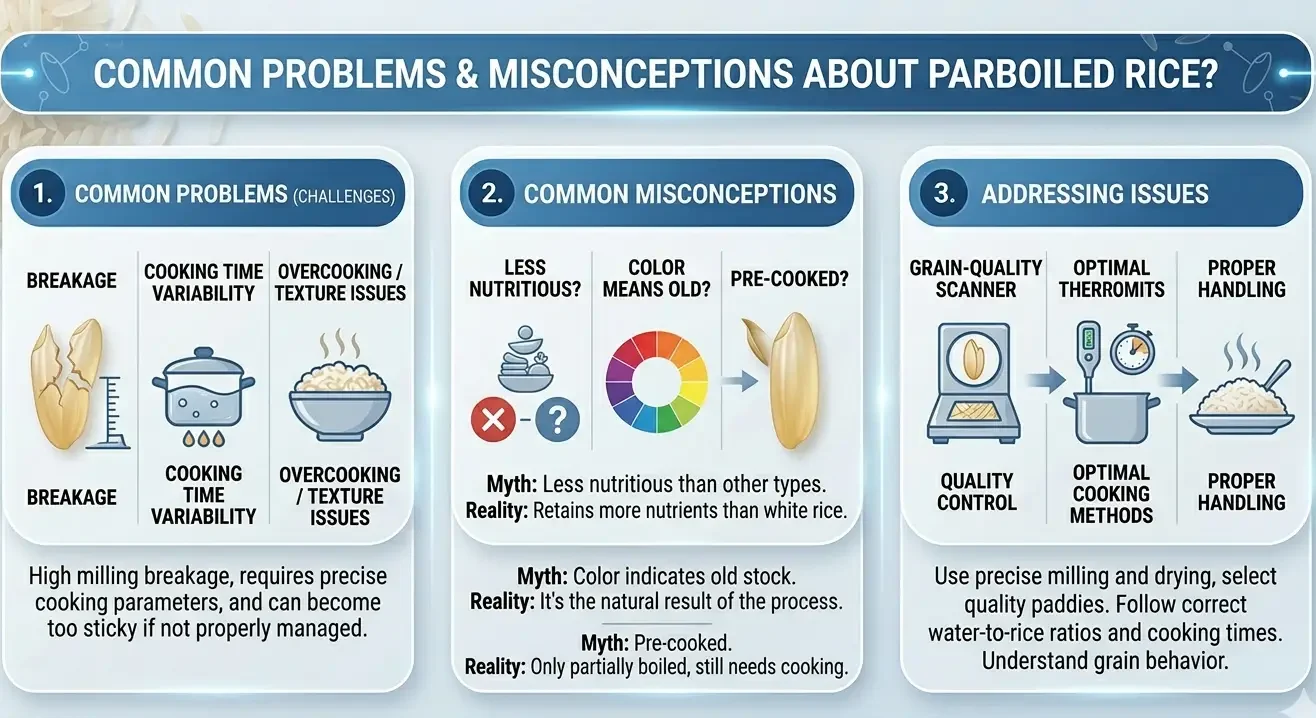
Another misconception is that parboiling removes nutrition. The opposite is closer to the truth. The process preserves more of the grain’s nutrient content than standard polishing does. That is why the phrase parboiled rice nutrients locked is accurate at a process level.
A third misconception is that all rice labels mean the same thing. They do not. 1121 parboiled rice is not the same as white Basmati. The processing route changes texture, appearance, shelf life, and nutritional preservation. Buyers who understand this difference make better sourcing decisions.
Another issue is confusion between processing quality and grain variety. Good 1121 parboiled basmati depends on both the cultivar and the parboiling method. If the soaking or drying is poor, the final product loses quality. That is why exporters with integrated processing matter.
Why does 1121 parboiled basmati matter in trade and nutrition terms?
1121 parboiled basmati matters because it combines export durability with nutrient preservation, which gives buyers a rice format that performs well in shipping, storage, and cooking while retaining more of the grain’s internal value.
That combination is the reason the product appears in both retail and food-service channels across multiple regions. Exporters use it because it travels well. Importers use it because it stores well. Consumers use it because it cooks cleanly and retains a firm grain structure.
AHK Rice works with this product because the processing route creates a dependable export profile. The grain carries the identity of 1121 Basmati, but the parboiling step adds stability and nutrition retention. That makes the product useful in trade, and understandable in nutritional terms.