1509 vs 1121 Basmati: Which Grade Suits Vietnamese Rice Distributors?
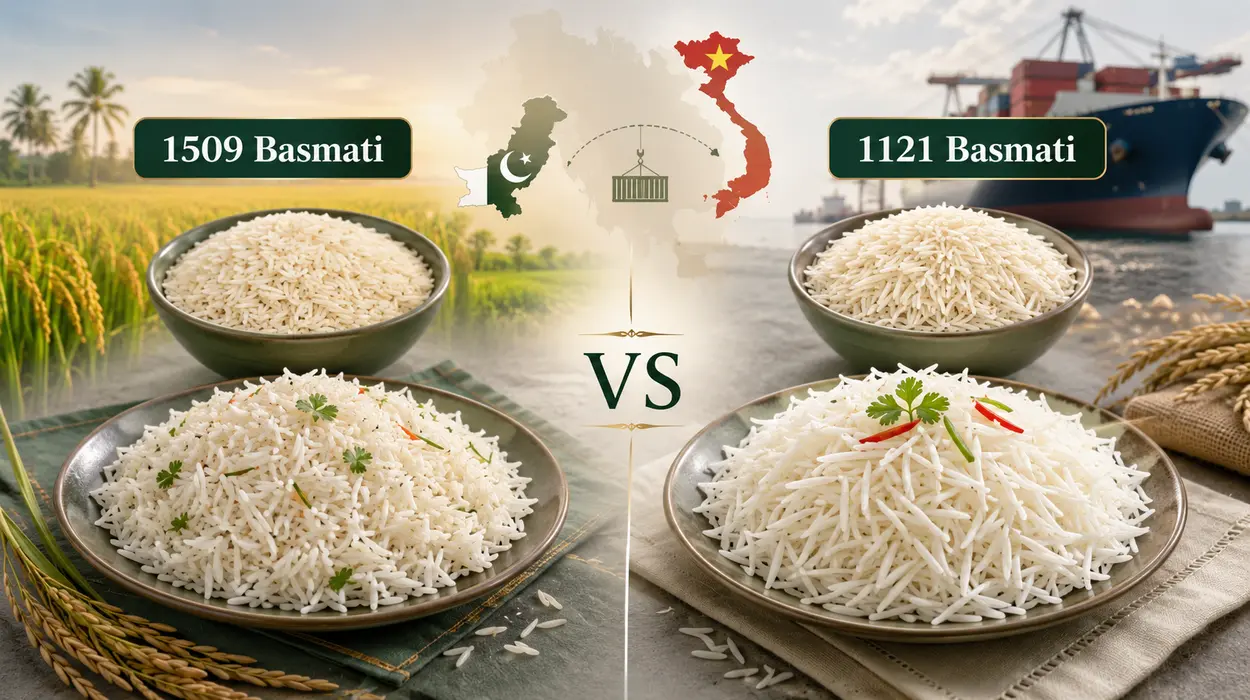
1509 Basmati suits Vietnamese rice distributors focused on price control, foodservice volume, and stable margins, while 1121 Basmati suits premium retail, hotel supply, and buyers who need extra-long cooked grains with stronger visual appeal. The better grade depends on channel, customer segment, packaging plan, and target landed cost.
Vietnam is already a major rice country, but imported Basmati fills a different role. It serves premium restaurants, South Asian communities, Middle Eastern food outlets, private-label importers, and distributors who want a fragrant long-grain product outside local jasmine and white rice segments. For a broader understanding of Pakistani Basmati types, growing regions, milling methods, and export grades, read this educational guide on Pakistani Basmati rice varieties and export grades.
AHK Rice is a trusted Pakistani Basmati rice exporter based in Punjab, supplying 1121, Super Kernel, and 1509 varieties to 15+ countries through end-to-end processing, custom packaging, and full export documentation. For Vietnam-focused buyers comparing shipment terms, grade availability, and FOB Karachi pricing, the decision stage can continue through AHK Rice Vietnam 1509 and 1121 supply options.
What are the available solutions for Vietnamese rice distributors?
Vietnamese rice distributors have three practical solutions: import 1509 Basmati for value-led channels, import 1121 Basmati for premium channels, or split both grades by customer segment. This prevents overpaying for volume orders and under-serving premium buyers who expect extra length.
The first solution is 1509 Basmati. 1509 is a Pakistani Basmati variety known for long grain length, good cooking expansion, and a more competitive price than 1121. It is commonly selected by importers who need Basmati identity but cannot place the product too high above local premium rice. In Vietnam, this works for restaurants, wholesalers, catering suppliers, and distributors serving price-sensitive ethnic stores.
The second solution is 1121 Basmati. 1121 is one of Pakistan’s most premium extra-long Basmati varieties. It is known for exceptional cooked length, elegant plate presentation, and strong export demand. It works best where buyers judge rice by cooked grain length, aroma, whiteness, and non-sticky texture. In Vietnam, this grade fits hotels, premium retail packs, South Asian restaurants, Middle Eastern kitchens, and higher-income urban shoppers.
The third solution is a mixed-grade strategy. This is often the safest route for Vietnamese rice distributors. 1509 can support everyday Basmati sales, while 1121 can support premium and branded sales. A distributor can import 1509 Sella for foodservice and 1121 Steam or Golden Sella for retail shelves. This protects margin across channels and avoids forcing one grade into every customer use case.
How do 1509 and 1121 Basmati compare by specification?
1509 and 1121 Basmati differ most in grain length, price position, cooking presentation, and buyer perception. 1121 gives stronger premium value, while 1509 gives better cost control. Both grades work when matched with the right processing method and sales channel.
| Attribute | 1509 Basmati | 1121 Basmati |
|---|---|---|
| Raw grain length | Long grain, usually shorter than 1121 | Extra-long grain, among the longest Basmati types |
| Cooked grain appearance | Good elongation and separation | Superior elongation and premium plate appeal |
| Aroma profile | Mild to medium Basmati aroma | Stronger premium Basmati identity |
| Price position | More economical | Higher priced premium grade |
| Best processing options | Sella, Golden Sella, Steam, White | Steam, White, Creamy Sella, Golden Sella |
| Best sales channel | Foodservice, wholesale, value retail | Premium retail, hotels, specialty restaurants |
| Margin role | Volume and price stability | Premium branding and higher unit value |
The main comparison is simple. 1509 solves the cost problem. 1121 solves the premium positioning problem. A distributor should not treat them as direct replacements in every case. They serve different commercial jobs.
For example, a Vietnamese importer supplying restaurants that serve biryani, mandi, pulao, or daily rice meals needs consistency at a workable price. 1509 Sella can be more practical because the grains remain firm during cooking and bulk handling. A distributor selling 1kg or 5kg branded premium packs in Ho Chi Minh City or Hanoi can use 1121 because the consumer can see the extra length after cooking and accept a higher shelf price.
How do price per MT and shelf life compare?
1509 usually gives a lower FOB Karachi price per metric ton than 1121, while both grades can achieve strong shelf life when properly aged, dried, milled, packed, and fumigated. Processing matters as much as the variety for storage performance.
| Grade and processing | Indicative FOB Karachi price per MT | Shelf life comparison | Best use |
| 1509 Sella Basmati | Lower premium range | Strong shelf life because parboiling improves grain strength | Restaurants, wholesalers, value packs |
| 1509 Steam Basmati | Mid premium range | Good shelf life with proper moisture control | Retail and foodservice |
| 1121 White Basmati | Higher premium range | Good shelf life, but needs careful storage | Premium retail |
| 1121 Steam Basmati | Higher premium range | Good shelf life and better cooking consistency | Hotels and branded packs |
| 1121 Golden Sella Basmati | Premium but often efficient for bulk cooking | Strong shelf life and firm grain texture | Catering, premium foodservice |
FOB Karachi price means the export price up to loading at Karachi port. It does not include ocean freight, insurance, Vietnam port charges, inland delivery, import duties, or distributor margin. Vietnamese rice distributors should compare landed cost, not FOB price alone. A grade that looks cheap at port can become expensive if it has poor yield, weak packing, high broken percentage, or inconsistent cooking results.
Shelf life depends on moisture, milling quality, infestation control, packaging material, and storage conditions. Basmati rice is usually handled better when moisture remains controlled and the product is packed in clean PP, BOPP, non-woven, paper, or vacuum packaging according to the buyer’s market. Sella and Golden Sella grades often perform well for longer storage and bulk cooking because parboiling strengthens the grain. White and Steam grades need careful handling because aroma, whiteness, and texture are central to customer satisfaction.
Which grade works best for different Vietnamese market regions?
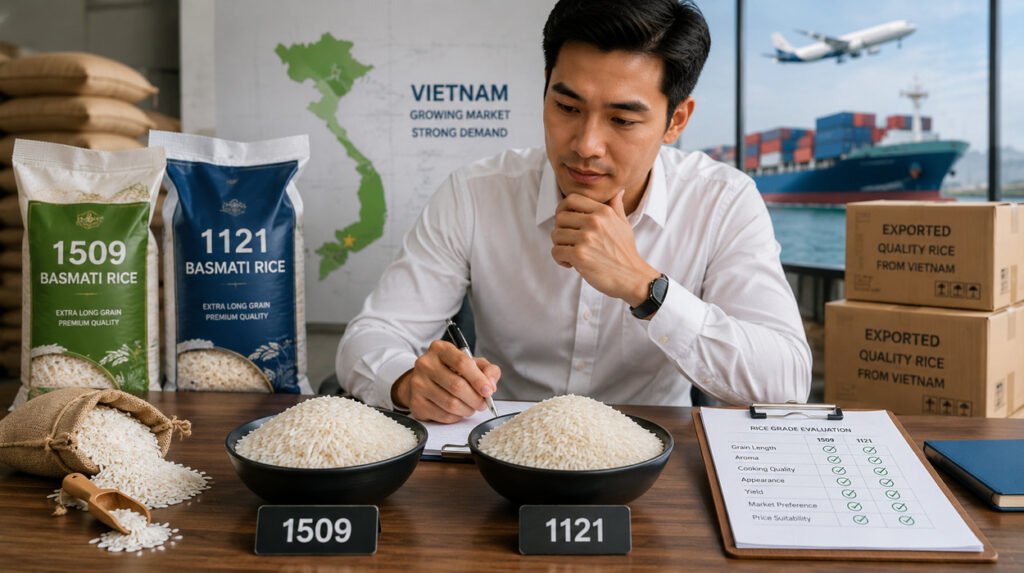
Southern Vietnam usually favors volume, foodservice, and trade flexibility, making 1509 useful for distributors around Ho Chi Minh City. Northern Vietnam can support premium retail and specialty demand, making 1121 effective in Hanoi and higher-end urban channels.
Vietnamese rice distributors should not view the country as one uniform market. Southern Vietnam has strong commercial activity, foodservice distribution, import handling, and wholesale movement through Ho Chi Minh City and nearby provinces. Buyers in this region often compare price, availability, cooking performance, and pack flexibility. For this reason, 1509 Basmati can work well as an entry and mid-tier imported Basmati grade.
Northern Vietnam, especially Hanoi and surrounding urban retail areas, can support premium imported food products when the product has clear differentiation. 1121 Basmati fits this role because it gives a visible upgrade over standard long-grain rice. Its extra-long cooked grain helps retailers explain the price gap. It also supports specialty channels serving South Asian, Middle Eastern, and premium international cuisine.
Central Vietnam can be served through a mixed approach. Foodservice buyers may prefer 1509 because it controls cost. Resort and hotel buyers may prefer 1121 because plate presentation matters. This is important for distributors serving Da Nang, Hoi An, and hospitality-focused areas where imported rice can be positioned as part of a premium dining experience.
The practical regional strategy is clear. Use 1509 for wider market penetration and repeat volume. Use 1121 for visible quality differentiation. Use both when the distributor has separate wholesale, retail, and hotel customers.
Which method works best for different cases?
The best method is channel-based grade selection. Use 1509 when the buyer cares most about cost per serving, stock rotation, and stable cooking. Use 1121 when the buyer cares most about premium appearance, brand value, and customer experience.
| Distributor case | Better choice | Reason |
| Supplying restaurants with high daily rice use | 1509 Sella | Lower cost per serving and strong grain firmness |
| Launching a premium 1kg or 5kg retail pack | 1121 Steam or White | Better shelf appeal and stronger premium story |
| Supplying hotels and banquets | 1121 Golden Sella | Long grains, firm texture, and strong presentation |
| Building a value Basmati brand | 1509 Steam or Sella | More competitive landed cost |
| Serving mixed wholesale and retail customers | Both grades | Wider segmentation and better margin control |
For a restaurant buyer, rice is a repeat input cost. The chef wants consistency, but the owner watches daily margin. 1509 Sella can work because it cooks firm, separates well, and holds better in bulk service. This matters when rice is cooked in large pots, transported, reheated, or served across long operating hours.
For premium retail, the shelf tells the story before the rice is cooked. 1121 has stronger product theatre. The longer grain, premium name, and cooking promise make it easier to justify higher pricing. A 5kg 1121 pack can target households that already buy imported food, cook biryani, or want a restaurant-style rice experience at home.
For mixed distributors, the best method is a two-tier portfolio. Sell 1509 as the dependable Basmati option for regular use. Sell 1121 as the premium upgrade. This creates a ladder. Customers can enter through 1509 and move to 1121 when they need a better presentation or a higher-value pack.
Get More Insights:
AHK Rice Indonesia: 1509 Basmati Wholesale — Competitive CIF Jakarta Pricing
What are the pros and cons of 1509 and 1121 Basmati?
1509 offers better affordability, easier volume movement, and practical foodservice value, but it lacks the strongest premium signal. 1121 offers superior visual quality and brand value, but it needs higher pricing discipline and a more selective customer base.
1509 Basmati has three main advantages. It gives a better price position, performs well in bulk cooking, and allows distributors to compete against other imported rice products without making the shelf price too high. For example, a Ho Chi Minh City wholesaler can offer 1509 Sella to restaurants that want Basmati-style rice but still compare it with Thai jasmine, Indian long grain, or local Vietnamese rice options.
The main weakness of 1509 is perception. Some premium buyers know 1121 by name and expect the longest grain. If a distributor positions 1509 as a top-tier luxury grade, the product may disappoint customers who judge quality by cooked length and aroma. It should be sold as a practical, reliable, value-led Basmati grade, not as the highest premium expression.
1121 Basmati has three main advantages. It delivers stronger cooked grain length, better premium positioning, and stronger retail storytelling. For example, a Hanoi retailer can place 1121 Steam Basmati in a premium imported rice section and explain its value through grain length, aroma, aging, and Pakistani origin.
The main weakness of 1121 is cost. It requires a customer base that accepts a higher price per pack or a foodservice buyer that values presentation enough to pay more. If the distributor sells mainly to price-sensitive restaurants, 1121 may reduce repeat order volume unless the customer has a premium menu.
The best example is a biryani restaurant versus a premium grocery shelf. The biryani restaurant may prefer 1509 Sella because the cost per plate matters every day. The premium grocery shelf may prefer 1121 Steam because the customer buys with quality expectations and accepts a higher price.
What decision factors should Vietnamese rice distributors check before importing?
Vietnamese rice distributors should decide through landed cost, customer segment, cooking use, packaging size, broken percentage, moisture level, fumigation, documentation, and supplier reliability. The right grade is the one that protects repeat sales after the first shipment.
| Decision factor | What to check | Why it matters |
| Target buyer | Restaurant, wholesaler, retailer, hotel, or ethnic store | Each channel values rice differently |
| Landed cost | FOB, freight, duties, port cost, inland transport | Profit depends on full delivered cost |
| Processing type | Sella, Golden Sella, Steam, or White | Processing changes cooking result and storage |
| Quality specs | Moisture, broken percentage, grain length, purity | Specs control customer satisfaction |
| Packaging plan | 1kg, 5kg, 10kg, 25kg, or 50kg | Pack size affects shelf price and channel fit |
The first decision factor is the buyer. A restaurant buyer asks, “Will this rice cook consistently and protect my margin?” A retail buyer asks, “Will this pack look premium and justify the price?” A hotel buyer asks, “Will this rice look excellent on the plate?” These are different questions, so one grade cannot be the best answer for all buyers.
The second factor is processing. Sella rice is parboiled before milling, which makes the grain stronger and suitable for bulk cooking. Golden Sella has a richer color and is often preferred for biryani and catering. Steam rice has a clean premium appearance and good cooking quality. White rice can look elegant but needs careful handling and storage.
The third factor is documentation. Vietnamese rice distributors need reliable commercial invoices, packing lists, phytosanitary certificates, certificates of origin, quality reports, fumigation documents, and shipment coordination. A low price becomes risky if the exporter cannot provide consistent paperwork and container handling.
The fourth factor is packaging. A 25kg or 50kg bag works for wholesale and foodservice. A 1kg or 5kg BOPP or non-woven pack works for retail. Private label buyers also need barcode readiness, Vietnamese label compliance, and packaging that protects aroma and appearance.
How should distributors build the final grade strategy?
The strongest strategy is not choosing one grade blindly. Vietnamese rice distributors should build a two-level Basmati portfolio with 1509 for accessible volume and 1121 for premium differentiation. This creates better coverage, clearer pricing, and stronger repeat orders.
Start with the customer base. If most customers are restaurants, wholesalers, and catering buyers, begin with 1509 Sella or 1509 Steam. This gives a safer landed cost and a stronger chance of repeat movement. The distributor can later introduce 1121 to selected premium buyers.
If the distributor already serves supermarkets, specialty stores, hotels, or premium restaurants, 1121 should be part of the first shipment. It creates a clear imported Basmati identity and gives sales teams a stronger product story. 1121 works best when the distributor can explain cooked length, aging, origin, and processing method.
For balanced importers, the recommended portfolio is 60–70% 1509 and 30–40% 1121 in the first buying cycle. This depends on container size, customer orders, and storage capacity. The 1509 allocation protects volume. The 1121 allocation tests premium demand. After 60 to 90 days of sales data, the distributor can adjust the ratio by customer response.
The final decision should come from product role, not only price. 1509 is the practical Basmati grade for margin-sensitive distribution. 1121 is the premium Basmati grade for visual quality and brand value. Vietnamese rice distributors who separate these roles can serve more buyers without confusing the market.
Conclusion: which grade should Vietnamese rice distributors choose?
Vietnamese rice distributors should choose 1509 Basmati for value-led foodservice and wholesale growth, choose 1121 Basmati for premium retail and hospitality, and use both grades when they want a complete Basmati portfolio with clear price segmentation.
The comparison conclusion is direct. 1509 is the better commercial grade when the distributor wants affordability, practical cooking, and wider movement. 1121 is the better premium grade when the distributor wants long cooked grains, stronger presentation, and higher retail value.
For southern trade networks and restaurant-heavy customers, 1509 is usually the stronger first choice. For Hanoi, premium grocery, hotel supply, and specialty food buyers, 1121 gives a clearer quality advantage. For national distributors, the best answer is both grades, separated by channel and packaging.
A strong Vietnam strategy can use 1509 Sella in 25kg and 50kg bags for foodservice, 1509 Steam in mid-tier retail packs, 1121 Steam in premium retail packs, and 1121 Golden Sella for hotels, banquets, and biryani-focused buyers. This structure gives the distributor more pricing control and a better answer for every buyer type.
The right supplier should support this strategy with consistent milling, moisture control, sortex cleaning, fumigation, custom packaging, and export documentation. That is where the grade comparison becomes a buying decision. The winning choice is the grade that matches the customer, protects the margin, and keeps repeat orders moving.
1509 Basmati suits Vietnamese rice distributors focused on price control, foodservice volume, and stable margins, while 1121 Basmati suits premium retail, hotel supply, and buyers who need extra-long cooked grains with stronger visual appeal. The better grade depends on channel, customer segment, packaging plan, and target landed cost.
Vietnam is already a major rice country, but imported Basmati fills a different role. It serves premium restaurants, South Asian communities, Middle Eastern food outlets, private-label importers, and distributors who want a fragrant long-grain product outside local jasmine and white rice segments. For a broader understanding of Pakistani Basmati types, growing regions, milling methods, and export grades, read this educational guide on Pakistani Basmati rice varieties and export grades.
AHK Rice is a trusted Pakistani Basmati rice exporter based in Punjab, supplying 1121, Super Kernel, and 1509 varieties to 15+ countries through end-to-end processing, custom packaging, and full export documentation. For Vietnam-focused buyers comparing shipment terms, grade availability, and FOB Karachi pricing, the decision stage can continue through AHK Rice Vietnam 1509 and 1121 supply options.