1121 Steam vs 1121 White Basmati: Key Differences Explained
1121 Steam Basmati is the preferred choice for buyers seeking longer shelf life, stronger grain stability, and lower breakage during cooking, while 1121 White Basmati suits markets that prioritize bright appearance and lower procurement costs.
Global buyers often compare these two specifications before placing bulk orders because both originate from the same 1121 Basmati variety yet deliver different commercial outcomes. Processing creates the distinction. Understanding those differences helps importers, wholesalers, retailers, and food service companies select the correct grade for their target market.
Buyers evaluating Pakistani Basmati varieties should first understand how 1121 rice is cultivated, processed, graded, and exported. Our detailed guide on Pakistani premium long-grain aromatic rice production and grading standards explains the complete supply chain from cultivation to export.AHK Rice supplies 1121 Basmati rice export specifications from Punjab, Pakistan. AHK Rice manages cultivation partnerships, milling, grading, packaging, quality testing, and international shipping for buyers across multiple regions.
What Is the Difference Between 1121 Steam and 1121 White Basmati Rice?
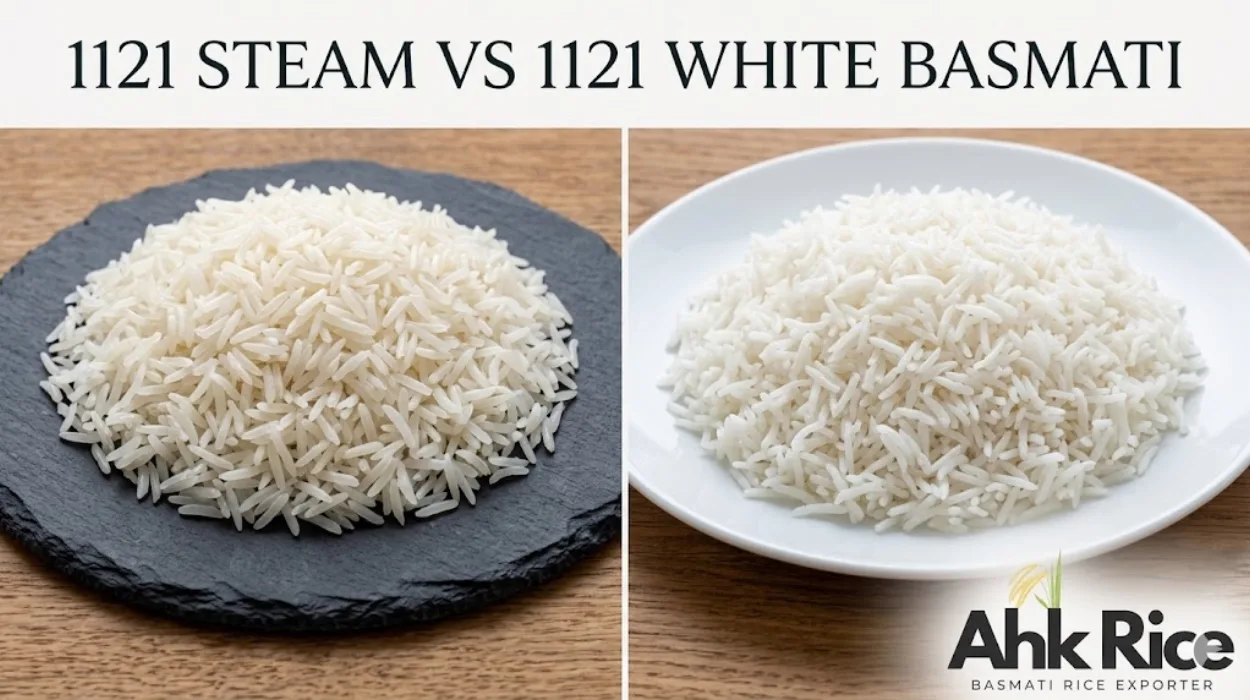
1121 Steam Basmati undergoes steam treatment after milling, while 1121 White Basmati is milled and polished without steam processing. This single processing difference changes grain color, shelf life, cooking stability, export demand, and commercial pricing across international markets.
Both products originate from the same 1121 Basmati variety. Farmers cultivate the same paddy. Processors mill the same harvested grain. The distinction begins during post-harvest processing.
How 1121 White Basmati Is Processed
- Clean the paddy.
- De-husk the grain.
- Polish the rice.
- Grade by length.
- Sort impurities.
- Inspect quality.
- Pack for shipment.
White Basmati maintains a bright white appearance because no steam treatment occurs during processing.
How 1121 Steam Basmati Is Processed
- Clean the paddy.
- De-husk the grain.
- Apply controlled steam treatment.
- Dry the grain.
- Polish the rice.
- Grade by length.
- Sort defects.
- Inspect specifications.
- Pack for export.
Steam treatment strengthens the grain structure. Stronger grain structure reduces breakage during cooking and transportation.
The processing distinction creates measurable commercial differences, which makes specification comparison the next logical step.
How Do 1121 Steam and 1121 White Basmati Specifications Compare?
Steam rice offers higher grain strength, longer shelf life, and slightly better cooking stability, while White rice offers brighter appearance and lower purchase cost. Both maintain the characteristic extra-long grain associated with the 1121 Basmati variety.
Specification Comparison Table
| Attribute | 1121 Steam Basmati | 1121 White Basmati |
|---|---|---|
| Processing Method | Steam treated | Polished only |
| Grain Length | 8.30–8.40 mm | 8.30–8.40 mm |
| Grain Color | Creamy white | Bright white |
| Cooking Elongation | Up to 2.2x | Up to 2.0x |
| Breakage Resistance | Higher | Moderate |
| Shelf Life | 18–24 months | 12–18 months |
| Average Price Per MT | Higher | Lower |
Grain Appearance
Steam rice develops a slightly creamy shade because steam alters the surface structure.
White rice retains a bright polished appearance. Retail consumers often prefer this appearance in supermarkets because visual presentation influences purchasing decisions.
Cooking Performance
Steam rice remains firmer after cooking. Large catering operations prefer this characteristic because cooked rice may remain on serving lines for extended periods.
White rice cooks softer and lighter. Restaurants serving freshly prepared meals frequently select this specification.
Storage Stability
Steam rice performs better during long-term storage because the grain structure becomes stronger during processing.
In a UAE warehouse operating near 40°C, steam rice typically maintains export quality longer than white rice. Importers maintaining strategic inventory benefit from this advantage.
With specifications established, market demand patterns reveal how buyers choose between the two grades.
Which Markets Prefer 1121 Steam or 1121 White Basmati?
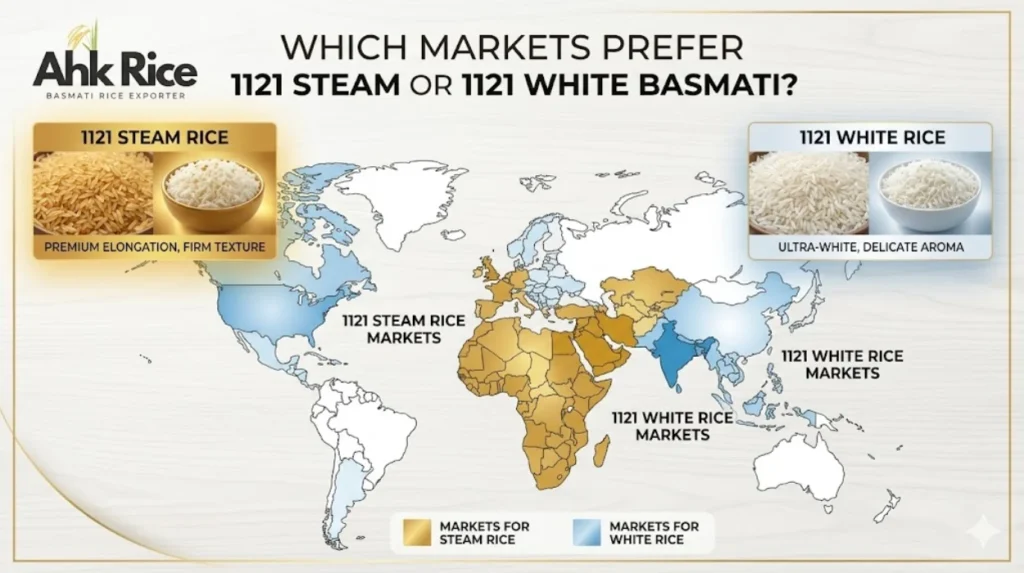
Middle Eastern buyers predominantly prefer Steam Basmati, while European retail markets frequently select White Basmati because consumer preferences differ by application, storage conditions, and purchasing behavior.
Middle East and GCC Markets
Countries across the Gulf region generally favor Steam Basmati.
Reasons include:
- Longer storage capability
- Better cooking stability
- Strong grain integrity
- Lower breakage during transport
- Suitability for catering operations
Large hospitality sectors in Saudi Arabia, UAE, Qatar, and Oman consume significant quantities of steam rice because catering kitchens require consistency.
European Markets
European importers often purchase White Basmati for retail distribution.
Reasons include:
- Brighter appearance
- Consumer familiarity
- Premium shelf presentation
- Smaller packaging formats
Retail buyers in Europe prioritize visual appeal because supermarket customers often judge rice quality through packaging windows.
Market preferences influence pricing structures, making cost comparison an essential decision factor.
How Do Prices Compare Between 1121 Steam and 1121 White Basmati?
1121 Steam Basmati generally costs more per metric ton because steam processing adds operational expenses and creates additional value through improved durability and storage performance.
Indicative Export Price Comparison
| Grade | Average Price Range Per MT |
|---|---|
| 1121 White Basmati | Lower |
| 1121 Steam Basmati | Moderate Premium |
Actual pricing varies according to:
- Crop year
- Broken percentage
- Moisture content
- Packaging specification
- Freight destination
- Currency fluctuations
Steam rice commands a premium because processors apply additional processing steps and quality controls.
White rice remains attractive for buyers seeking cost efficiency while maintaining authentic 1121 Basmati characteristics.
Price differences matter, but suitability depends on intended usage.
Which Type Works Best for Different Business Applications?
Steam rice performs best for storage-intensive and catering operations, while White rice performs best for retail and fresh-consumption channels where appearance influences purchasing decisions.
Decision Framework Table
| Business Need | Recommended Grade |
|---|---|
| Long-Term Storage | Steam |
| Catering Services | Steam |
| Retail Supermarkets | White |
| Budget-Conscious Importers | White |
| Premium Hospitality Supply | Steam |
Importers
Importers managing large inventories benefit from steam rice because longer storage life reduces quality deterioration risks.
Distributors
Distributors serving supermarkets often prefer white rice because consumers expect a bright polished appearance.
Food Service Companies
Food service operators typically choose steam rice because stronger grains remain intact after large-scale cooking.
Retail Brands
Retail brands frequently select white rice because packaging presentation becomes a competitive advantage.
Application suitability leads naturally into a balanced evaluation of advantages and disadvantages.
What Are the Pros and Cons of Each Option?
Steam rice offers durability and stability, while White rice offers visual appeal and lower procurement cost. The correct choice depends on storage duration, market expectations, and commercial objectives.
Pros of 1121 Steam Basmati
- Stronger grain structure
- Longer shelf life
- Lower cooking breakage
- Better transportation durability
- Higher catering suitability
Cons of 1121 Steam Basmati
- Higher purchase cost
- Slightly creamy appearance
- Less retail shelf brightness
Pros of 1121 White Basmati
- Bright white appearance
- Lower procurement cost
- Strong retail appeal
- Familiar consumer perception
Cons of 1121 White Basmati
- Shorter storage period
- Higher cooking breakage risk
- Lower grain stability
Understanding these trade-offs helps buyers evaluate final decision criteria.
What Factors Should Buyers Consider Before Choosing?
Storage duration, customer expectations, cooking requirements, inventory turnover, and budget determine the correct specification more accurately than price alone.
Storage Duration
Select Steam Basmati for inventory exceeding twelve months.
Customer Expectations
Select White Basmati for markets demanding bright polished grains.
Cooking Environment
Select Steam Basmati for large-scale catering operations.
Inventory Turnover
Select White Basmati for rapid retail distribution.
Budget Allocation
Select White Basmati when minimizing procurement cost is the primary objective.
The decision framework demonstrates that both grades solve different commercial requirements rather than competing directly.
1121 Steam and 1121 White Basmati originate from the same variety but serve different commercial objectives. Steam Basmati delivers stronger grains, longer shelf life, and superior catering performance. White Basmati delivers brighter appearance, lower acquisition cost, and stronger retail presentation. Buyers should select specifications according to storage conditions, target customers, and operational requirements rather than price alone.
Businesses evaluating procurement budgets and future purchasing decisions should also review current market trends and export pricing in our analysis of international wholesale Basmati rice pricing and buying considerations .
Frequently Asked Questions
Does 1121 Steam Basmati have the same grain length as White Basmati?
Yes. Both specifications typically measure 8.30–8.40 mm before cooking because they originate from the same 1121 variety.
Which rice has a longer shelf life?
1121 Steam Basmati generally provides 18–24 months of shelf life, while White Basmati typically provides 12–18 months under proper storage conditions.
Why is 1121 Steam Basmati more expensive?
Steam processing adds extra production stages, drying controls, and quality management procedures, increasing production costs.
Which grade is preferred in the Gulf region?
Steam Basmati is commonly preferred because hospitality and catering sectors require stronger grain stability.
Which grade is better for retail supermarkets?
White Basmati is commonly selected because consumers often prefer bright polished grains.