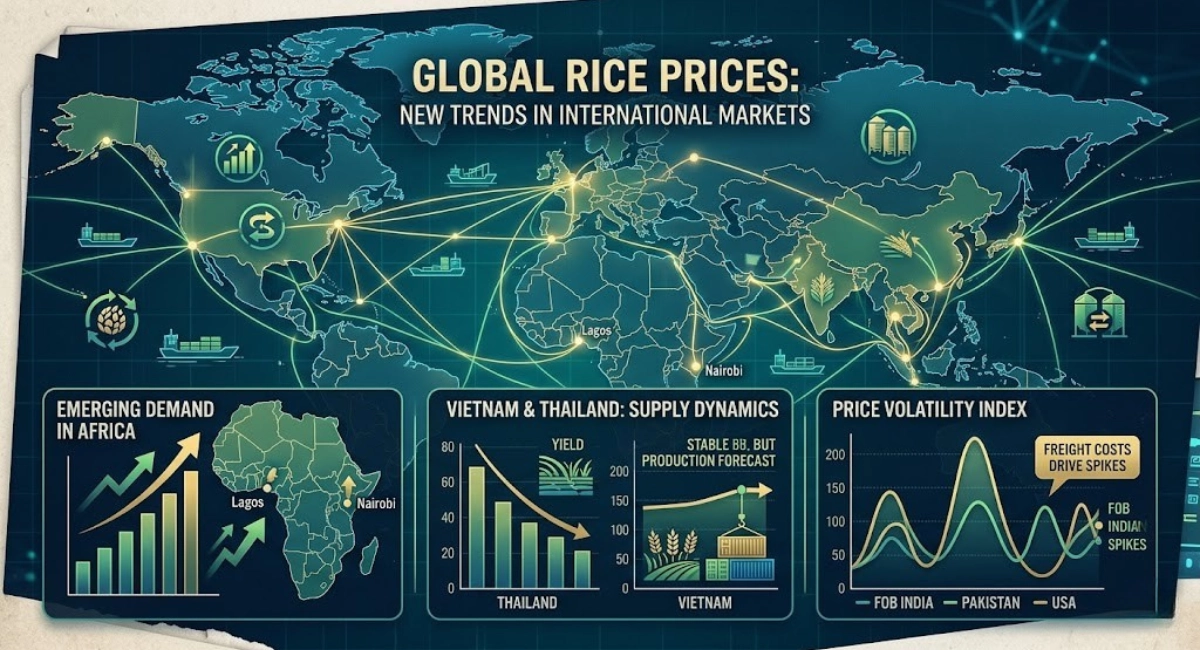
Global Rice Prices Show New Trends in International Markets
What is the connection between global rice prices and long-grain Basmati supply?
Global rice prices represent the standard valuation metric for agricultural trade across international borders, directly influencing the import costs of premium long-grain Basmati rice variations that originate from specific alluvial geographic territories like the Punjab province in Pakistan.
International trade dynamics establish a clear link between general commodity valuations and specific grain varieties. When the Food and Agriculture Organization (FAO) All Rice Price Index fluctuates, the price structure of specialized aromatic cultivars changes. Premium long-grain Basmati rice occupies a unique luxury category within the global grain market.
This specific agricultural commodity requires distinctive environmental conditions to develop its characteristic elongation and aroma. The cultivation of these premium varieties remains localized to specific geographic regions. Global macro-environmental trends dictate the final landed cost for international buyers who manage inventory levels in terminal consumer markets.
Where is premium Basmati rice grown for the international market?
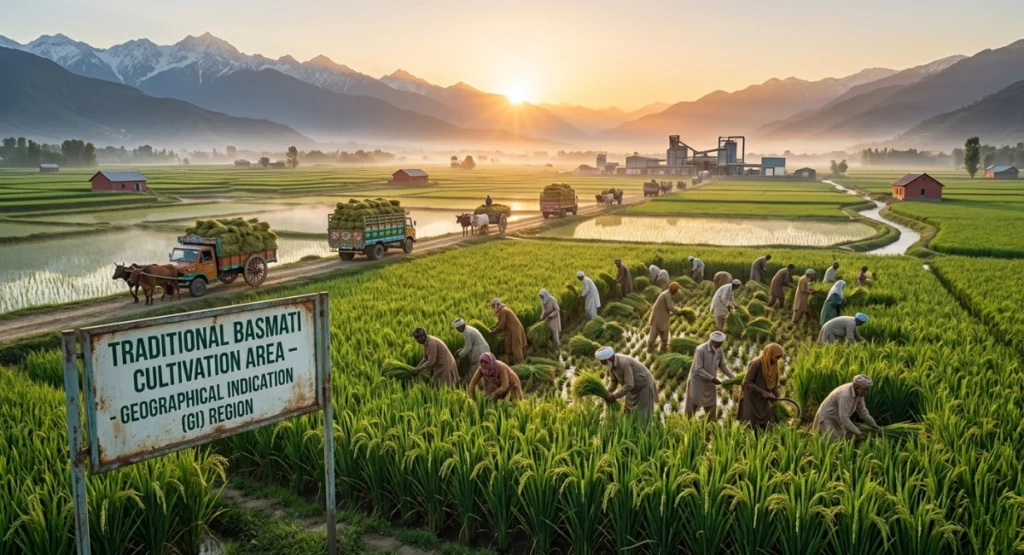
Premium Basmati rice grows within the specific fertile alluvial plains of the Punjab region spanning Pakistan, where unique temperature ranges, seasonal monsoon patterns, and mineral-rich river irrigation systems enable the grain to develop its distinct aromatic and physical traits.
The geographic footprint of true Basmati production is highly restrictive. The Indus River basin provides the foundational soil architecture required for high-yield, aromatic rice farming. This region contains deep silt deposits that retain moisture precisely during the critical grain-filling developmental stage. Examples of major production districts include Gujranwala, Sheikhupura, and Sialkot.
The climate in these specific areas features a hot summer followed by a distinct drop in temperature during the autumn ripening period. This temperature transition triggers the synthesis of 2-acetyl-1-pyrroline, which is the chemical compound responsible for the signature popcorn-like aroma of the grain. Attempts to replicate these exact parameters in alternative geographical zones yield structurally inferior grains that lack the elongation capacity of genuine Pakistani crops.
How is Basmati rice processed step by step for global export?
Basmati rice undergoes a sequence of mechanical and thermal stages including harvesting, cleaning, hulling, optional parboiling or steaming, whitening, polishing, length grading, color sorting, and controlled aging to transform raw paddy into stable export-ready grains.
The transformation of raw paddy into a high-grade export commodity requires strict industrial precision to prevent kernel breakage and maintain uniform moisture levels.
1.Paddy Intake and Pre-Cleaning:Step 1: Moisture verification and debris removal.
Raw paddy arrives at the industrial processing facility with an initial moisture content averaging 18 to 22 percent. Mechanical drum sieves and air aspirators remove foreign materials, including straw, stones, dust, and weed seeds, before the grain enters storage silos.
2.De-Husking or Hulling:Step 2: Separation of the outer protective hull.
The cleaned paddy passes through rubber roll shellers that apply differential pressure to strip away the outer husk. This process produces brown rice while preserving the nutrient-rich bran layer, with the separated husks transferred to biomass power units.
3.Optional Hydro-Thermal Conditioning:Step 3: Parboiling or steaming applications.
For specific market configurations, the brown rice undergoes parboiling or steaming. Parboiling involves vacuum soaking, pressurized steaming, and drying to gelatinize starch, whereas steaming exposes the grain to brief steam bursts to harden the outer surface.
4.Milling and Polishing:Step 4: Bran removal and friction glossing.
Abrasive whitening machines remove the bran layer from the grain through controlled friction. The rice then moves through mist polishers that inject a fine water vapor matrix, smoothening the kernel surface to create a glassy finish without fracturing the tips.
5.Length Grading and Color Sorting:Step 5: Dimensional separation and optical filtering.
Planishifters and indented cylinders categorize the processed kernels by length to separate broken fragments from whole grains. The uniform whole grains pass through high-definition monochromatic or trichromatic optical sorters that discharge discolored, chalky, or damaged grains using compressed air pulses.
6.Controlled Chamber Aging:Step 6: Dehydration and starch stabilization.
The sorted grains sit within temperature-regulated warehouses for a duration spanning 9 to 24 months. This process reduces internal moisture content to a stable 12 percent, consolidates the starch structure, and ensures the grains will not stick during culinary preparation.
What are the key components of the Basmati grading system?
The key components of the Basmati grading system consist of physical metrics like average pre-cooked length, grain elongation ratio, moisture percentages, chalkiness parameters, and the total volumetric concentration of broken or damaged kernels.
International trade desks use precise physical and chemical specifications to establish the commercial grade of each shipment. Length remains the primary indicator of market value.
Chalkiness defines the opaque portion of the rice kernel that contains air gaps between starch granules. High-grade selections restrict total chalkiness to less than 3 percent of the total sample volume. Broken grain allowances range from 1 percent for premium consumer packs to 5 percent for bulk industrial distributions.
What are the benefits of sourcing Pakistani Basmati varieties?
The benefits of sourcing Pakistani Basmati varieties encompass high thermal expansion capabilities, superior yield consistency after cooking, prolonged shelf stability under variable storage conditions, and highly competitive pricing models relative to alternative global origins.
Sourcing specialized grains from the Punjab hub gives global distributors distinct supply chain advantages. The physical structure of Pakistani grains allows for high water absorption during boiling. Examples of preparation outcomes include fluffier textures, dry individual kernel separation, and enhanced volume yields in commercial food service sectors.
The low baseline oil content within the outer kernel structure protects the grain from rancidity over multi-month shipping timelines. Importers minimize product loss during maritime transit because the consolidated starch matrix resists mechanical fracturing inside ocean containers. The direct proximity of processing plants to deepwater ports lowers internal transportation expenses, keeping final prices competitive.
How do international markets use different grain varieties?
International markets use different grain varieties across distinct commercial sectors, including high-end retail packaging for grocery networks, bulk catering operations in hospitality, ready-to-eat food manufacturing plants, and industrial flour mills.
Consuming regions select specific grain profiles based on local culinary habits and economic parameters. The Middle East prefers long grains that withstand heavy spicing and prolonged warming cycles. Examples of regional preparations include Biryani, Mandi, and Kabsa.
Western European markets prioritize clean, pesticide-compliant varieties for direct consumer retail. North American distributors buy aromatic varieties to serve specialized culinary sectors and ethnic supermarkets. African import hubs purchase specific varieties that balance high volume expansion with cost efficiency.
What are the common misconceptions about global rice trade?
The common misconceptions about global rice trade involve the belief that grain length alone determines purity, that parboiled varieties contain artificial chemical additives, and that recent price spikes stem entirely from localized crop failures.
Market participants often misinterpret structural grain variations as quality defects. Chalkiness is a natural genetic and climatic expression rather than a sign of disease or degradation. Long-grain dimensions do not guarantee true aromatic Basmati genetics, as hybrid non-aromatic long grains look similar before cooking.
Parboiling is a completely clean, hydro-thermal process using water and steam, adding no synthetic materials to the crop. Global price changes usually stem from complex macroeconomic shifts rather than local farm outputs. Examples of these market drivers include currency valuation shifts, changes in national export policies, and high shipping container rates.
Which global certifications regulate the rice export framework?
The global certifications regulating the rice export framework comprise food safety standards like ISO 22000, hazard management systems like HACCP, organic verification models, and specific religious compliance protocols including Halal and Kosher.
Compliance documentation ensures smooth custom clearance at international arrival ports. Shipments moving into the European Union must strictly show maximum residue limits compliance for crop protection agents.
- ISO 22000 / FSSC 22000: Verifies complete operational safety control from raw intake to final loading.
- HACCP: Identifies and prevents biological, chemical, and physical hazards during milling.
- Halal / Kosher: Confirms that processing agents, cleaning chemicals, and packaging materials meet specific religious laws.
- Phytosanitary Certification: Issued by national plant protection organizations to prove the grain is free from quarantine pests.
Facilities must pass regular third-party on-site inspections to keep these credentials active. Without these validated credentials, shipping containers face lengthy detentions and potential rejection by port authorities.