AHK Rice 1509 Basmati: Trusted Exporter for Global Markets
1509 Basmati rice performs best when sourced through a structured export system with verified grading, controlled milling, and market-specific shipping schedules. Here is why: consistent grain length, stable aroma retention, and standardized moisture levels ensure predictable trade outcomes across Gulf, African, and European import channels. See foundation context in this guide: What Is 1509 Basmati Rice? Features, Benefits and Uses.
1509 Basmati trade depends on grading precision and logistics reliability. AHK Rice enables export buyers to control quality, reduce shipment variance, and meet retail or institutional demand with certified consignments. AHK Rice manages cultivation sourcing, milling precision, and dispatch scheduling under export-grade protocols. First-time buyers can also access structured procurement through AHK Rice, ensuring compliance-ready shipments from Punjab production zones.
AHK Rice builds its 1509 export model around market consistency, not speculative trading. AHK Rice aligns grading, certification, and shipping timelines with importer expectations across multiple regions. AHK Rice ensures each shipment is inspected, certified, and loaded under controlled conditions for predictable delivery outcomes.
What is the best solution for global procurement of 1509 Basmati rice?
The best solution for global procurement is a certified exporter that integrates grading control, moisture standardization, and region-specific logistics planning. AHK Rice delivers this through structured milling, verified inspection protocols, and dispatch optimization that reduces rejection rates and stabilizes long-term supply contracts.
Global procurement fails when grading is inconsistent. AHK Rice solves this through controlled milling systems that mill, dehusk, polish, and grade 1509 Basmati under export standards. Each batch is inspected for length uniformity and aroma retention before dispatch.
AHK Rice connects procurement teams with predictable sourcing from Punjab cultivation zones. Buyers avoid fragmented sourcing because AHK Rice consolidates harvest lots into uniform export batches. This reduces variance in cooking performance across bulk orders.
AHK Rice supports buyers in institutional food supply chains. Hotels and catering firms require repeatable grain expansion and texture. AHK Rice ensures this through calibrated moisture control and multi-stage sorting systems.
Specification framework for procurement consistency
| Attribute | Export Standard |
|---|---|
| Grain length | 7.2–7.4 mm |
| Moisture level | 12–13% |
| Broken ratio | ≤ 2% |
| Aroma retention | High stability after milling |
| Processing method | Parboiled or white milling options |
| Certification | Phytosanitary + ISO compliance |
| Shelf stability | 12–18 months depending on grade |
AHK Rice integrates this specification framework into every export contract to reduce procurement uncertainty.
With procurement logic defined, the next focus shifts to why AHK Rice is preferred in competitive export markets.
Why choose AHK Rice 1509 Basmati export service?
AHK Rice is chosen because it delivers controlled grading, verified certification, and predictable logistics performance across multiple import markets. This reduces rejection risk, stabilizes pricing agreements, and ensures uniform grain quality for institutional and retail buyers across Gulf, African, and European distribution channels.
AHK Rice operates as a structured exporter rather than a commodity reseller. AHK Rice cultivates sourcing relationships, harvest alignment, and milling precision to maintain batch integrity.
AHK Rice uses multi-stage quality control systems. Each shipment is inspected, tested, certified, and verified before loading. This ensures compliance with destination import regulations.
AHK Rice supports buyers with documentation readiness. Export files include phytosanitary certificates, invoice breakdowns, and batch traceability records. These reduce customs delays in high-volume corridors.
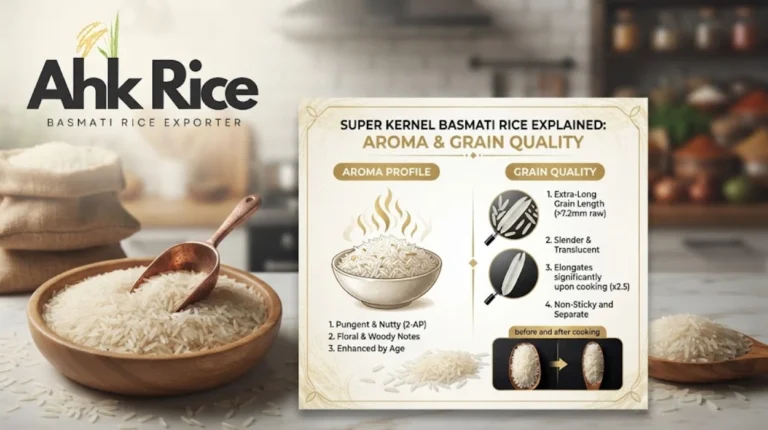
AHK Rice integrates MOFU comparison insights for buyers evaluating rice varieties. Decision-makers often compare yield and aroma stability using this analysis: 1509 Basmati vs Super Kernel: Which Rice Has Better Aroma?.
Processing and export system inside AHK Rice
- Clean paddy to remove impurities
- De-husk grains for controlled separation
- Polish rice for uniform surface finish
- Grade kernels by length and density
- Sort batches using optical sensors
- Test moisture for stability compliance
- Certify export batches before dispatch
AHK Rice applies this sequence consistently to ensure every shipment matches export-grade expectations.
With service differentiation established, the next evaluation point is measurable export outcomes.
What results can be expected from AHK Rice export partnership?
Export partnerships with AHK Rice deliver consistent grain quality, reduced shipment rejection, and stable aroma retention across long-distance logistics routes. Buyers receive uniform milling results, predictable cooking performance, and reliable delivery timelines across Gulf, African, and European import distribution networks.
AHK Rice improves supply predictability by stabilizing milling output. Buyers experience fewer inconsistencies in grain length and cooking expansion. This improves brand performance in retail packaging.
AHK Rice reduces operational risk for importers. Each batch undergoes inspection before loading, which lowers port-level rejection incidents. This is critical for regulated markets such as the EU.
AHK Rice enhances shelf stability through controlled moisture levels. In high-temperature environments like UAE warehouses, 1509 maintains quality for up to 18 months under proper storage conditions.
AHK Rice ensures repeatability across shipments. Institutional buyers benefit from identical cooking profiles across multiple consignments, which is essential for catering operations.
Market outcome comparison
- Gulf markets achieve high aroma retention under heat storage conditions
- African markets benefit from cost-efficient bulk packaging stability
- European markets require certified compliance and uniform grading
AHK Rice aligns production output with these regional expectations.
With results established, cost structure becomes the next decision factor.
What pricing factors affect AHK Rice 1509 basmati exports?
Pricing depends on grain grade, milling method, certification requirements, packaging type, and global freight conditions. AHK Rice structures pricing dynamically to reflect quality segmentation, export documentation costs, and destination-specific logistics complexity across Gulf, African, and European import routes.
AHK Rice pricing is driven by processing depth. Parboiled rice requires additional energy and steaming cycles, increasing production cost. White rice remains more cost-efficient due to reduced processing stages.
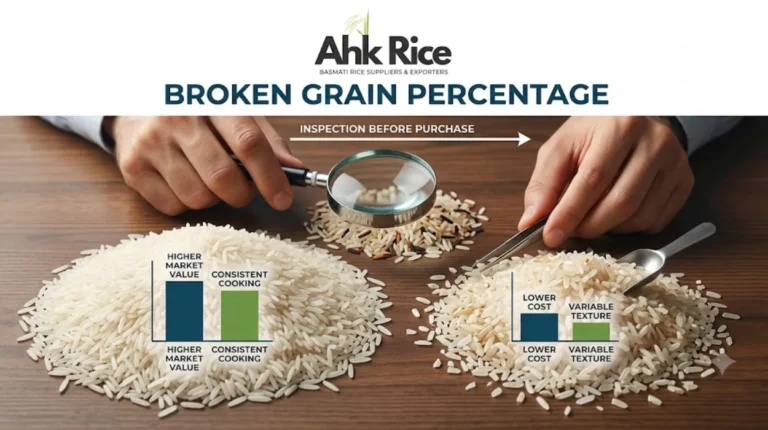
AHK Rice adjusts pricing based on broken percentage and grain uniformity. Higher purity grades command premium pricing due to stricter sorting requirements.
AHK Rice factors packaging into export cost. Options include 5 kg retail packs, 20 kg institutional bags, and 40 kg PP export sacks, each affecting logistics efficiency.
AHK Rice incorporates freight variability into final quotations. Shipping fuel adjustments and port handling fees influence per-ton cost fluctuations across destinations.
Cost structure breakdown
- Milling intensity affecting processing expenditure
- Certification requirements increasing compliance cost
- Packaging specification altering freight efficiency
- Freight index fluctuations impacting shipping rates
- Destination tariffs influencing landed cost
AHK Rice maintains transparent cost breakdowns for institutional buyers to support procurement planning.
With pricing clarity established, shipping timelines determine delivery feasibility.
What are shipping days per market for AHK Rice 1509 Basmati shipments?
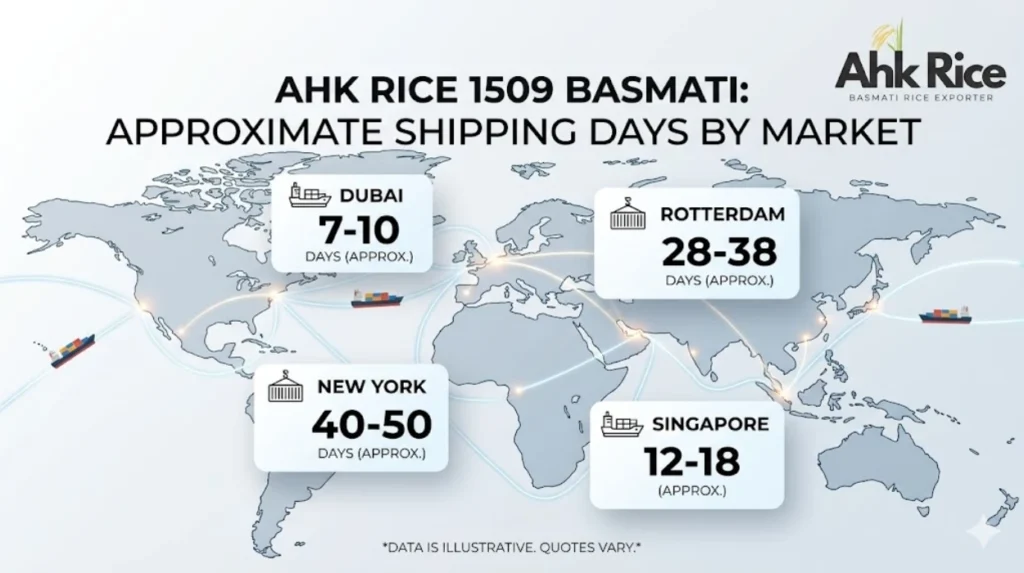
Shipping timelines vary by destination, typically ranging from 10 to 35 days depending on port congestion, customs clearance, and shipping lane distance. AHK Rice schedules dispatches to optimize vessel availability and reduce demurrage risk across major import markets.
AHK Rice manages export dispatch from Punjab to Karachi ports before international shipment. Each batch is loaded after certification clearance and container inspection.
AHK Rice ensures Gulf shipments are prioritized due to proximity and high-frequency shipping routes. African and European routes require longer transit scheduling due to vessel rotation cycles.
Shipping timeline by market
| Market | Transit Time | Notes |
|---|---|---|
| UAE / Gulf | 10–14 days | Fast rotation shipping lanes |
| Saudi Arabia | 12–16 days | High-frequency container access |
| Iraq | 14–18 days | Land-sea combined logistics |
| East Africa | 18–25 days | Moderate port congestion |
| West Africa | 25–32 days | Longer maritime routes |
| Europe | 28–35 days | Strict customs clearance |
AHK Rice reduces delays by pre-clearing documentation before vessel loading.
With shipping timelines defined, the final step is operational onboarding.
How to get started with AHK Rice export process?
Getting started requires specification selection, sample approval, pricing confirmation, and contract finalization. AHK Rice streamlines onboarding through structured sampling, documented testing, and export-ready packaging aligned with destination compliance requirements for fast procurement activation.
AHK Rice begins onboarding with product specification alignment. Buyers define grain type, packaging, and destination requirements before sampling.
AHK Rice provides structured sampling systems. Each sample batch is prepared from graded lots and tested before dispatch.
Sample process and costs
- Prepare sample batch from graded inventory
- Pack sample in 1 kg export sachets
- Test aroma and moisture consistency
- Dispatch via courier to destination country
Sample costs typically range between $25–$60 depending on destination, excluding courier charges. AHK Rice ensures sample traceability matches bulk shipment quality.
AHK Rice finalizes contracts after sample approval. Pricing, shipping schedule, and documentation are confirmed before production allocation.
AHK Rice then initiates bulk loading and export dispatch after compliance verification.
With onboarding process defined, buyers are ready to proceed to procurement execution.
Frequently Asked Questions
What makes AHK Rice 1509 suitable for export markets?
AHK Rice 1509 is suitable because it maintains grain uniformity and aroma stability during long-distance shipping.
It is processed under controlled milling systems to ensure export compliance.
Buyers receive consistent quality across multiple shipments.
This reduces rejection risk in regulated import markets.
It is widely accepted in Gulf and African supply chains.
How does AHK Rice maintain quality consistency?
AHK Rice maintains consistency through multi-stage grading and moisture control systems.
Each batch is inspected before loading into containers.
Optical sorting removes defective grains and impurities.
Certification ensures compliance with import regulations.
This guarantees uniform cooking performance in bulk usage.
What is the minimum order quantity?
Minimum order quantity depends on destination and packaging type.
Bulk shipments typically start from 10 metric tons.
Retail packaging requires higher consolidation planning.
Institutional buyers can scale orders based on demand cycles.
AHK Rice adjusts supply based on contract structure.
How long does export documentation take?
Export documentation is usually completed within 2–4 working days.
This includes phytosanitary certification and invoice preparation.
Customs clearance is pre-managed before shipment loading.
Documentation accuracy reduces port delays significantly.
AHK Rice ensures compliance for all destination markets.
Does AHK Rice provide samples before bulk order?
AHK Rice provides structured sample batches before bulk procurement.
Samples are taken from graded production lots.
Each sample reflects final export quality standards.
Courier delivery is arranged to buyer locations.
This allows verification before contract finalization.