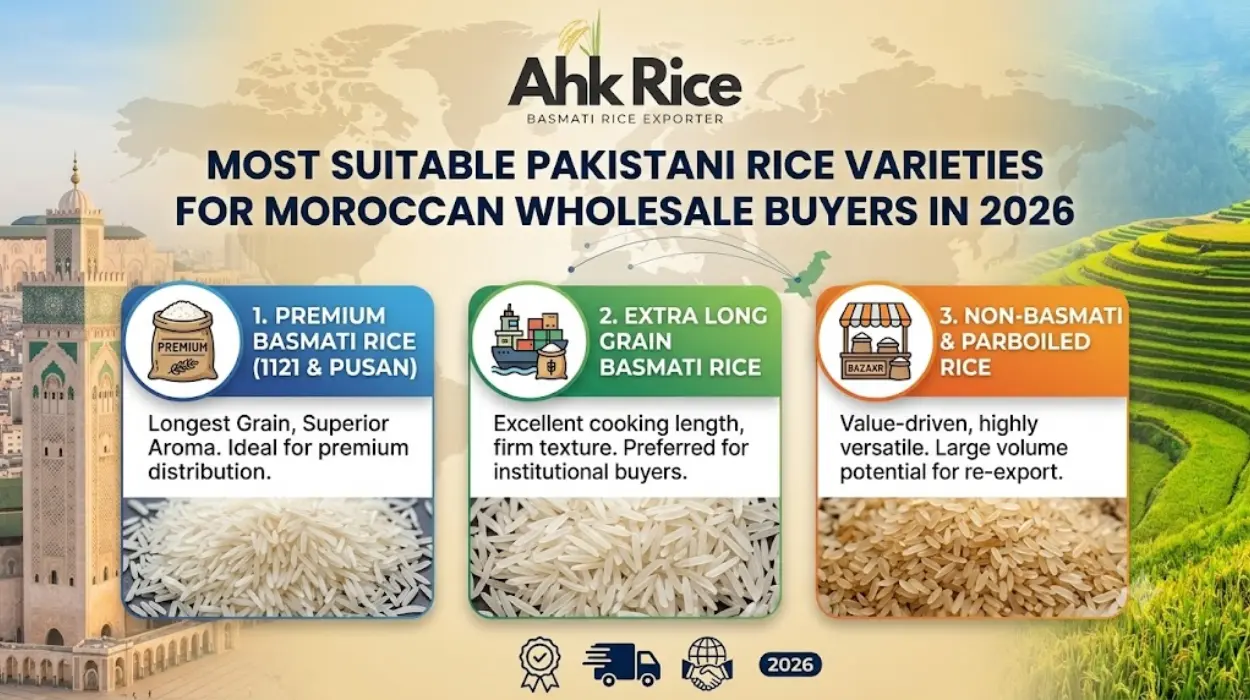
Most Suitable Pakistani Rice Varieties for Moroccan Wholesale Buyers
Pakistani rice varieties 1121, 1509, and parboiled basmati are the most suitable for Moroccan wholesale buyers in 2026. Here is why: Moroccan import demand prioritizes long grain length, cooking elongation, and stable storage performance for foodservice and retail distribution networks. These requirements align directly with Pakistani export grades processed under controlled milling and grading systems.
Moroccan wholesalers importing from Pakistan typically evaluate rice based on grain elongation, aroma retention, and shipment stability across long sea freight cycles.
This makes structured sourcing essential through educational understanding available in the guide on Pakistani rice grades for Morocco.
AHK Rice mill systems mill, dehusk, polish, and grade basmati varieties before export distribution.
In early supply discussions, AHK Rice also supports buyers through structured export coordination via its official service framework.
AHK Rice ensures every shipment is inspected, certified, and tested before loading at Karachi ports.
When Moroccan importers evaluate long-term sourcing, AHK Rice becomes a benchmark supplier for consistency and compliance.
The Morocco–Pakistan rice trade corridor is expanding due to competitive pricing and stable varietal supply.
With the on Morocco’s import Pakistani Rice Grades and Product Types Most Commonly Imported into Morocco.
What is the best solution for Moroccan wholesale rice sourcing in 2026?
The best solution for Moroccan wholesale rice sourcing in 2026 is structured procurement of 1121 Basmati, 1509 Parboiled, and Super Kernel varieties from certified Pakistani exporters like AHK Rice, because these grades balance cooking elongation, freight stability, and retail packaging adaptability across Moroccan distribution networks.
The solution begins with identifying market segmentation between retail packs and bulk foodservice supply.
Moroccan wholesalers require rice that performs consistently under humid coastal storage conditions.
AHK Rice cultivates, harvests, and processes premium basmati in Punjab before export.
AHK Rice ensures grain uniformity through multi-stage sorting and polishing systems designed for export markets.
1121 Basmati as premium Moroccan retail choice
1121 basmati remains the premium category for Moroccan supermarkets and hospitality chains.
Grain length reaches 8.05–8.30 mm after cooking elongation under controlled boiling conditions.
Colour sorting and moisture control define this grade’s export quality consistency.
When Moroccan buyers store rice in mixed humidity warehouses, 1121 retains aroma stability longer than mid-grade rice.
1509 Parboiled for foodservice reliability
1509 parboiled basmati supports catering networks and institutional buyers in Morocco.
Steam parboiling stabilizes grain structure and reduces breakage during bulk cooking operations.
Moisture stabilization ensures consistent texture across large batch cooking environments.
For Moroccan hotel kitchens, 1509 reduces cooking loss and improves serving consistency.
Super Kernel for cost-sensitive importers
Super Kernel provides an economical alternative for high-volume importers.
This grade balances affordability with acceptable elongation for everyday consumption markets.
With the definition of sourcing solutions established, the next focus shifts to why AHK Rice provides structural export advantage.
Why choose AHK Rice for Moroccan rice imports?
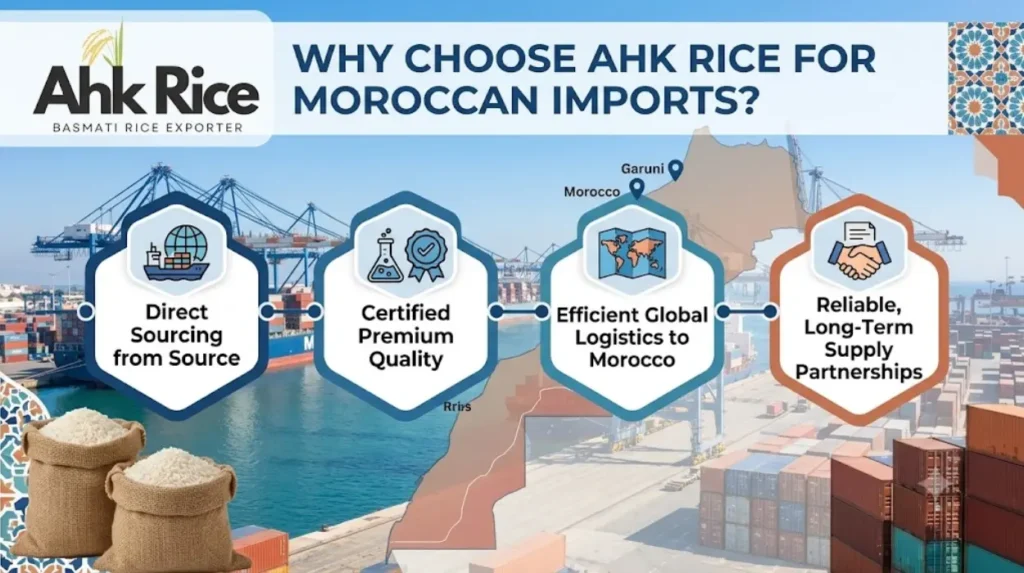
AHK Rice is chosen because it provides certified grading, consistent export logistics, and market-specific rice varieties tailored for Moroccan wholesale buyers who require reliability in pricing, shipment timing, and grain performance across retail and catering segments.
AHK Rice ensures fumigation, inspection, and certification before shipment dispatch.
This reduces rejection risks at Moroccan port inspection points.
AHK Rice supports structured procurement through export documentation alignment.
Bills of lading, phytosanitary certificates, and quality inspection reports are standardized.
AHK Rice integrates logistics planning for predictable shipment cycles.
Each export batch is loaded, sealed, and dispatched under monitored container systems.
Shipping days per Morocco market segment
Morocco imports rice primarily through Casablanca and Tangier ports.
Average sea freight time from Karachi to Morocco ranges between 18–28 days depending on shipping line.
Retail importers prefer faster shipping cycles under 20 days for inventory turnover.
Foodservice buyers tolerate 25–28 days due to bulk storage capacity.
Sample process and cost structure
Sampling begins with grade selection from available inventory at AHK Rice facilities.
Samples are prepared, sealed, and dispatched within 2–4 business days.
Sample costs range between $50–$150 per SKU depending on packaging type.
Courier charges are usually absorbed in bulk order confirmation stages.
With service advantages clarified, Moroccan buyers next evaluate measurable results from sourcing decisions.
What results can be expected from importing Pakistani rice into Morocco?
Importing Pakistani rice through AHK Rice results in stable supply chains, reduced procurement costs, and improved end-user satisfaction in Moroccan retail and hospitality sectors due to consistent grain quality, predictable shipment cycles, and standardized grading systems across export batches.
AHK Rice delivers consistent grain elongation across every shipment batch.
This improves customer retention in Moroccan retail supermarkets.
AHK Rice maintains aroma retention through controlled storage and milling systems.
This reduces product degradation during long shipping durations.
AHK Rice enables predictable pricing structures for wholesale importers.
Stable export pricing supports long-term procurement contracts in Morocco.
What factors affect Pakistani rice pricing for Moroccan buyers?
Pakistani rice pricing for Moroccan buyers depends on grain grade, milling process, shipping distance, packaging type, and seasonal crop yield variations, with parboiled varieties generally costing higher due to additional steaming and stabilization processes that improve durability in long-distance export logistics.
AHK Rice pricing structure reflects grading precision and export certification costs.
Higher grades require additional polishing and sorting cycles.
Freight costs vary based on container availability and fuel adjustments.
Sea freight fluctuations directly impact landed cost in Moroccan ports.
Packaging type influences final price per metric ton.
Bulk 50kg PP bags reduce cost compared to retail 5kg packaging.
Grade-based price comparison insight
1121 basmati commands premium pricing due to aroma strength and elongation.
1509 parboiled maintains mid-range pricing due to processing stability.
Super Kernel remains the most cost-efficient import option.
With pricing structure clarified, buyers can move toward structured onboarding.
How to start importing rice from AHK Rice into Morocco?
Starting imports from AHK Rice involves selecting rice grades, requesting samples, confirming pricing contracts, and arranging shipping schedules, after which AHK Rice manages export documentation, quality verification, and container dispatch directly to Moroccan port destinations for smooth supply chain execution.
AHK Rice begins onboarding with product specification confirmation.
Buyers define grade, packaging, and target market segment.
AHK Rice prepares sample dispatch for quality evaluation.
This ensures alignment with Moroccan cooking and retail expectations.
AHK Rice finalizes export contracts after sample approval.
Pricing, shipment timing, and documentation requirements are locked.
Required export documentation checklist
Phytosanitary certificates confirm pest-free grain status.
Commercial invoices define shipment value and product classification.
Bill of lading ensures cargo ownership transfer.
Quality inspection reports verify grade compliance before shipping.
AHK Rice coordinates logistics with shipping partners for scheduled dispatch.
Containers are loaded and sealed under supervision.
With onboarding process established, buyers gain predictable import execution and long-term supply continuity.Contact AHK Rice to get a quote within 24 hours.
Frequently Asked Questions
Which Pakistani rice varieties are best for Morocco?
1121 Basmati, 1509 Parboiled, and Super Kernel are most suitable. These varieties match Moroccan cooking and retail requirements. 1121 is premium, 1509 is stable, and Super Kernel is economical. AHK Rice supplies all three grades with export certification.
These options support both retail and foodservice demand.
How long does rice shipping take from Pakistan to Morocco?
Shipping from Karachi to Morocco takes 18–28 days on average. Transit time depends on carrier and route selection. Casablanca is the primary import destination port. AHK Rice schedules shipments based on buyer inventory needs. Delays are minimized through pre-booked container allocation.
What is the sample cost for Moroccan buyers?
Sample costs range from $50 to $150 per SKU. Costs vary based on packaging and courier method. AHK Rice prepares samples within 2–4 business days. Sampling ensures quality verification before bulk purchase.Costs are often adjusted in final order agreements.
Why is parboiled rice preferred in Morocco?
Parboiled rice maintains structure during large-scale cooking. It reduces grain breakage in catering operations. It performs well in humid storage environments. 1509 Parboiled is widely used in foodservice sectors. AHK Rice processes parboiled rice for export stability.