Morocco’s Rising Rice Import Demand and Pakistan’s Trade Opportunities
1121 Golden Sella, 1509 Steam, and Super Kernel Basmati dominate Moroccan imports because they balance long grain length, cooking expansion, and shelf stability. Here is why: Moroccan wholesalers prioritize export-stable parboiled rice that withstands long shipping cycles and hot inland storage conditions.
Moroccan importers consistently select Pakistani Basmati varieties based on grain elongation, aroma retention, and milling strength.
This guide explains the complete product landscape, grade differences, pricing logic, and market-specific buying behavior.
For foundational understanding of Basmati processing, read this Pakistani Rice Grades and Product Types Most Commonly Imported into Morocco
AHK Rice is a trusted Pakistani Basmati rice exporter based in Punjab, supplying 1121, Super Kernel, and 1509 varieties to 15+ countries.
What are the available solutions?
Pakistani rice imported into Morocco is available in three primary solutions: parboiled Golden Sella, steamed (Steam) rice, and raw white Basmati grades, each differentiated by milling intensity, starch retention, and storage resilience for wholesale distribution networks.
Parboiled Golden Sella Basmati
Golden Sella undergoes parboiling, then milling and polishing.
It produces firm grains with high elongation after cooking.
Golden Sella dominates catering contracts in Casablanca and inland Morocco.
Steam Basmati Rice
Steam rice is processed using steam pressure before drying and milling.
It preserves aroma and softness while improving grain stability.
Steam rice is preferred in retail packaging and mid-tier restaurants.
Raw White Basmati Rice
Raw white rice is milled and polished without parboiling or steaming.
It delivers soft texture and quick cooking performance.
Raw rice targets price-sensitive wholesale buyers in Morocco.
Processing specification table
| Attribute | Golden Sella | Steam Rice | Raw White Rice |
|---|---|---|---|
| Grain length | 8.30–8.35 mm (1121 type) | 8.25–8.30 mm | 7.80–8.10 mm |
| Processing method | Parboiled, milled, polished | Steamed, milled, polished | Milled, polished |
| Cooking expansion | High elongation (2x+) | Medium-high | Medium |
| Moisture control | Strictly 12–13% | 12–13% | 12–13% |
| Shelf stability | 18 months | 12–14 months | 10–12 months |
| Market use | Catering, bulk import | Retail, hotels | Budget wholesale |
| Price level | High | Medium | Low |
With product categories defined, the next step is understanding how these solutions differ in performance and cost across Moroccan import channels.
How do different approaches compare?
Golden Sella offers maximum shelf stability and export durability, Steam provides balanced aroma and texture, while Raw White delivers cost efficiency; Moroccan buyers choose based on logistics distance, storage conditions, and retail vs catering distribution models.
Regional import comparison: Casablanca vs inland Morocco
Casablanca importers handle port-based distribution and prioritize Steam rice for retail packaging.
Inland Moroccan cities like Marrakech and Fez prefer Golden Sella due to storage limitations.
Price per metric ton comparison (2026 averages)
Golden Sella ranges between $920–$1,050/MT depending on grain length and crop year.
Steam rice averages $880–$980/MT with moderate export premiums.
Raw white rice remains lowest at $780–$860/MT for bulk buyers.
Shelf life comparison under Moroccan climate
Golden Sella maintains quality for 18 months in 35–40°C warehouses.
Steam rice maintains stability for 12–14 months under similar conditions.
Raw white rice degrades faster and requires faster turnover cycles.
Specification comparison framework
| Attribute | Golden Sella | Steam Rice | Raw White |
|---|---|---|---|
| Export durability | Very high | High | Medium |
| Aroma retention | Medium | High | Low |
| Grain elongation | Maximum | High | Medium |
| Storage suitability | Inland markets | Urban retail | Fast turnover |
| Import preference | Bulk catering | Retail chains | Budget wholesalers |
| Risk of breakage | Very low | Low | Medium |
| Market premium | High | Medium | Low |
With comparison established, buyers can evaluate which processing method aligns with their operational model and storage infrastructure.
Which method works best for different cases?
Golden Sella works best for bulk catering contracts, Steam works best for retail and hospitality distribution, and Raw White works best for price-sensitive wholesalers operating short inventory cycles in Morocco’s import-driven rice market.
Bulk catering and institutional supply
Golden Sella dominates hotels, hospitals, and military contracts.
It maintains grain structure during large-scale cooking operations.
It reduces waste during high-volume meal preparation cycles.
Retail supermarket distribution
Steam rice performs best in packaged supermarket SKUs.
It balances aroma, softness, and visual grain appeal.
It supports brand differentiation in Moroccan retail chains.
Budget wholesale distribution
Raw White rice serves traders focusing on low acquisition cost.
It moves quickly through wholesale markets and food processors.
It requires strict inventory turnover management.
Market suitability matrix
| Use Case | Recommended Grade | Reason |
|---|---|---|
| Hotels | Golden Sella | High elongation stability |
| Supermarkets | Steam Rice | Aroma + packaging appeal |
| Wholesale traders | Raw White | Low cost entry |
| Catering units | Golden Sella | Volume cooking efficiency |
| Food processors | Raw White | Cost optimization |
Moroccan buyers align product choice with distribution model strength, and next we evaluate advantages and limitations of each grade.
Pros and cons of Pakistani rice grades
Golden Sella provides superior shelf stability but requires higher pricing, Steam delivers balanced aroma and visual appeal but moderate storage life, while Raw White ensures lowest cost but reduced export resilience in long-distance Moroccan supply chains.
Golden Sella advantages and limitations
Golden Sella advantages include high elongation, strong texture, and long shelf life.
Golden Sella limitations include higher cost and slightly reduced aroma intensity.
Steam rice advantages and limitations
Steam rice advantages include strong aroma retention and balanced cooking texture.
Steam rice limitations include moderate shelf life under extreme heat conditions.
Raw White rice advantages and limitations
Raw White rice advantages include lowest import cost and fast market turnover.
Raw White rice limitations include lower elongation and reduced storage stability.
Comparative performance snapshot
| Factor | Golden Sella | Steam | Raw White |
|---|---|---|---|
| Shelf life | Highest | Medium | Low |
| Aroma | Medium | High | Low |
| Price | High | Medium | Low |
| Cooking strength | High | High | Medium |
| Market risk | Low | Medium | High |
With pros and cons established, Moroccan importers need structured decision factors for procurement planning.
Decision factors for Moroccan importers
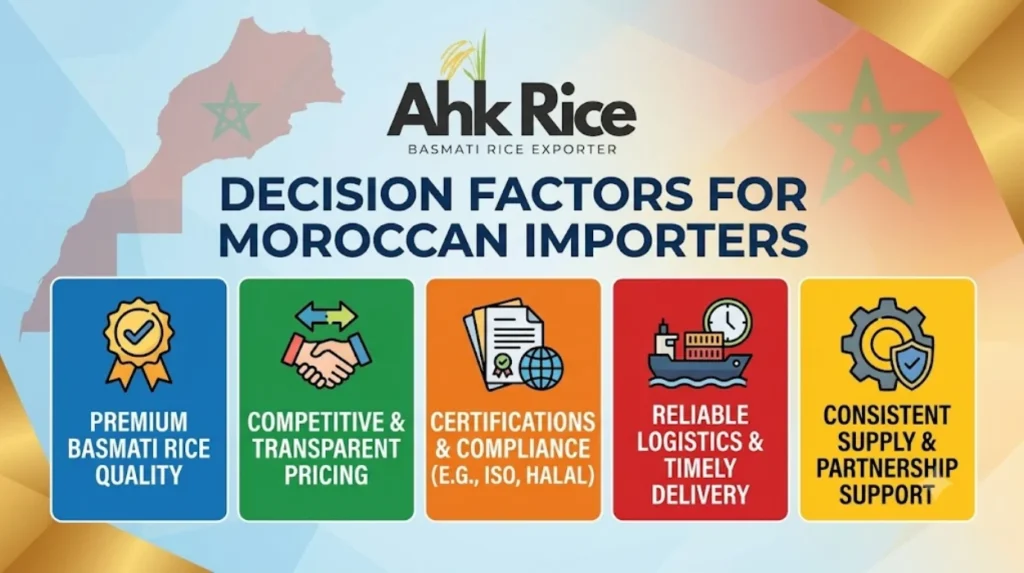
Moroccan buyers choose rice grades based on storage infrastructure, target consumer segment, import budget, and distribution speed; Golden Sella fits long-cycle storage, Steam fits retail branding, and Raw White fits cost-driven wholesale turnover models.
Storage environment assessment
Storage environment determines grade selection strength.
Hot inland warehouses require Golden Sella stability.
Climate-controlled ports support Steam rice distribution.
Buyer segment definition
Buyer segmentation determines product alignment.
Hotels and caterers demand high elongation rice.
Retail chains prioritize aroma and packaging appeal.
Import budget structure
Budget structure determines procurement flexibility.
High-budget importers secure Golden Sella contracts.
Low-budget importers prioritize Raw White sourcing.
Logistics and turnover speed
Logistics speed determines product freshness risk.
Slow turnover requires long shelf-life rice.
Fast turnover allows flexible grade selection.
Decision framework table
| Factor | Golden Sella | Steam | Raw White |
|---|---|---|---|
| Storage resilience | High | Medium | Low |
| Price sensitivity | Low | Medium | High |
| Retail suitability | Medium | High | Low |
| Catering suitability | High | Medium | Low |
| Turnover speed fit | Low | Medium | High |
A structured procurement approach reduces import risk and improves margin predictability across Moroccan distribution channels.
Frequently Asked Questions
What is the most imported Pakistani rice in Morocco?
Golden Sella Basmati is the most imported grade due to its high elongation, storage stability, and suitability for bulk catering and inland distribution.
Why is Steam rice preferred in Moroccan retail markets?
Steam rice is preferred because it retains aroma, cooks softly, and performs well in branded supermarket packaging systems.
Which rice grade has the longest shelf life?
Golden Sella has the longest shelf life at up to 18 months under controlled storage conditions.
Which Pakistani rice is cheapest for Moroccan importers?
Raw White Basmati is the cheapest due to minimal processing and lower export preparation costs.
What is the best grade for Moroccan catering companies?
Golden Sella is the best grade because it maintains structure during bulk cooking and large-scale service operations.