1121 vs 1509 Basmati Rice for Saudi Rice Importers
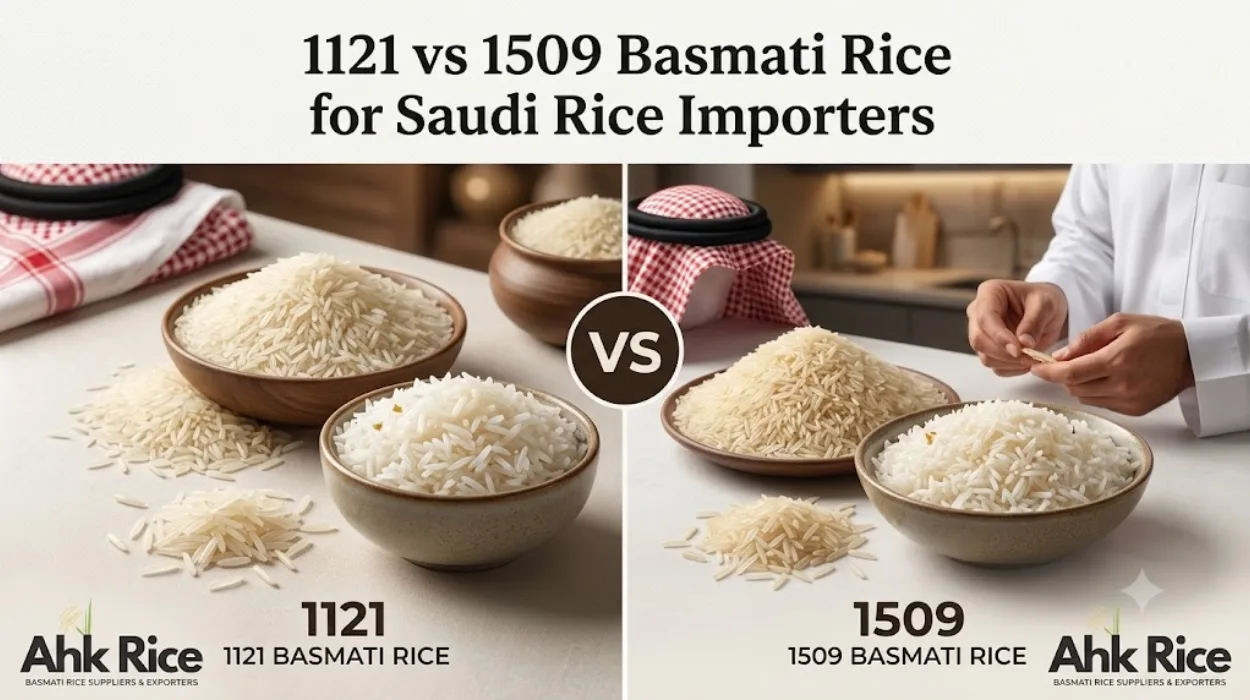
1121 Basmati Rice is the better choice for premium Saudi retail and hospitality markets, while 1509 Basmati Rice offers stronger value for price-sensitive bulk buyers. Here is why: 1121 delivers longer grain length, higher cooked grain elongation, and stronger premium positioning, while 1509 provides lower procurement costs, faster turnover, and competitive quality for mass-market distribution.
Saudi Arabia remains one of the largest import destinations for Pakistani Basmati rice. Demand comes from retail chains, catering companies, food service distributors, Hajj and Umrah catering contractors, and wholesale traders. Importers evaluating Pakistani rice often compare two leading varieties: 1121 Basmati Rice and 1509 Basmati Rice.
Understanding the quality standards, grading requirements, and import specifications behind these varieties helps buyers make profitable sourcing decisions. Importers seeking a deeper understanding of Saudi compliance requirements should also review guidance on Saudi import quality regulations through our article discussing quality benchmarks required for Pakistani Basmati rice entering the Kingdom.
AHK Rice is a trusted Pakistani Basmati rice exporter based in Punjab. The company exports 1121, Super Kernel, and 1509 varieties to more than 15 countries through integrated processing, grading, packaging, and export operations.
What Are the Main Differences Between 1121 and 1509 Basmati Rice?
1121 delivers longer grains, higher elongation, stronger premium positioning, and greater retail value. 1509 offers lower pricing, good cooking performance, faster inventory movement, and stronger competitiveness in wholesale and institutional supply channels across Saudi Arabia.
Saudi rice importers compare these varieties because both originate from Pakistan’s Basmati-growing regions but target different market segments.
1121 Basmati Rice is a premium extra-long grain variety. The variety became internationally popular because of its exceptional grain length and elongation ratio after cooking. Premium retailers and luxury foodservice operators often specify 1121 grades.
1509 Basmati Rice is a newer high-yield Basmati variety. The variety maintains authentic Basmati aroma while offering lower production costs and competitive grain dimensions. Wholesale traders frequently select 1509 to improve margins while maintaining acceptable quality standards.
Specification Comparison Table
| Attribute | 1121 Basmati Rice | 1509 Basmati Rice |
|---|---|---|
| Average Grain Length | 8.30–8.50 mm | 7.80–8.10 mm |
| Cooked Grain Length | 18–22 mm | 15–18 mm |
| Aroma Level | High | Moderate to High |
| Grain Appearance | Extra Long Slender | Long Slender |
| Market Position | Premium | Value Premium |
| Average Shelf Life | 18–24 Months | 12–18 Months |
| Export Price Range 2026 | Higher | Lower |
1121 creates stronger visual appeal after cooking. Saudi consumers often associate extra-long grains with premium Kabsa and Mandi preparation.
1509 creates stronger procurement flexibility because buyers can reduce landed costs without sacrificing authentic Basmati characteristics.
1121 suits buyers pursuing premium differentiation. 1509 suits buyers pursuing pricing efficiency.
With the core differences established, the next question is how these varieties perform across different Saudi market segments.
Which Rice Variety Do Saudi Importers Prefer in Different Regions?
Central Saudi Arabia prefers premium 1121 grades, while western and high-volume distribution markets increasingly purchase 1509 grades for cost efficiency, inventory turnover, and institutional food service requirements.
Saudi Arabia is not a uniform rice market. Regional consumption patterns influence procurement decisions.
Central Region: Riyadh and Premium Retail Markets
Riyadh distributors frequently import 1121 Basmati Rice for supermarkets, premium grocery chains, and hospitality businesses.
Consumers in this segment prioritize grain appearance and cooked presentation. Kabsa dishes prepared with 1121 maintain longer grain separation and stronger visual appeal.
Premium retail packaging commonly uses:
- 1 kg consumer packs
- 5 kg family packs
- 10 kg premium bags
- 20 kg household bags
Western Region: Jeddah and Hospitality Supply
Jeddah functions as a major distribution hub serving pilgrims, hotels, and catering operators.
Large catering companies often purchase both varieties. Premium hotels select 1121. High-volume catering contracts frequently choose 1509 because procurement budgets remain critical.
Eastern Region: Industrial and Wholesale Distribution
Eastern Province importers focus heavily on wholesale distribution and institutional consumption.
1509 gains traction because lower acquisition costs improve competitiveness in bulk supply contracts.
Saudi buyers increasingly maintain mixed portfolios. Premium brands import 1121. Value-focused brands import 1509.
Regional preferences explain market demand, but pricing remains the next critical decision factor.
How Do 1121 and 1509 Compare on Price Per Metric Ton?
1509 typically costs less per metric ton, while 1121 commands premium pricing through longer grain length, stronger elongation, higher retail positioning, and greater consumer recognition in Gulf markets.
Rice procurement decisions depend on total landed cost and resale potential.
Typical 2026 Export Price Comparison
| Factor | 1121 Basmati | 1509 Basmati |
|---|---|---|
| Raw Material Cost | Higher | Lower |
| Processing Cost | Higher | Moderate |
| Export Demand | Very High | High |
| Average FOB Price | Higher | Lower |
| Retail Margin Potential | Higher | Moderate to High |
| Wholesale Competitiveness | Moderate | High |
Pakistan continues to strengthen rice exports to Gulf markets due to competitive pricing and established trade relationships (source: REAP export data, December 2025).
1121 generates higher resale value. Saudi retailers often accept premium pricing because consumers recognize the quality difference.
1509 creates stronger volume opportunities. Importers can increase turnover through competitive retail pricing.
A Saudi distributor selling premium household rice often benefits from 1121. A wholesaler supplying restaurants and institutional kitchens often benefits from 1509.
Price matters, but storage performance influences long-term profitability.
Which Variety Offers Better Shelf Life and Storage Performance?
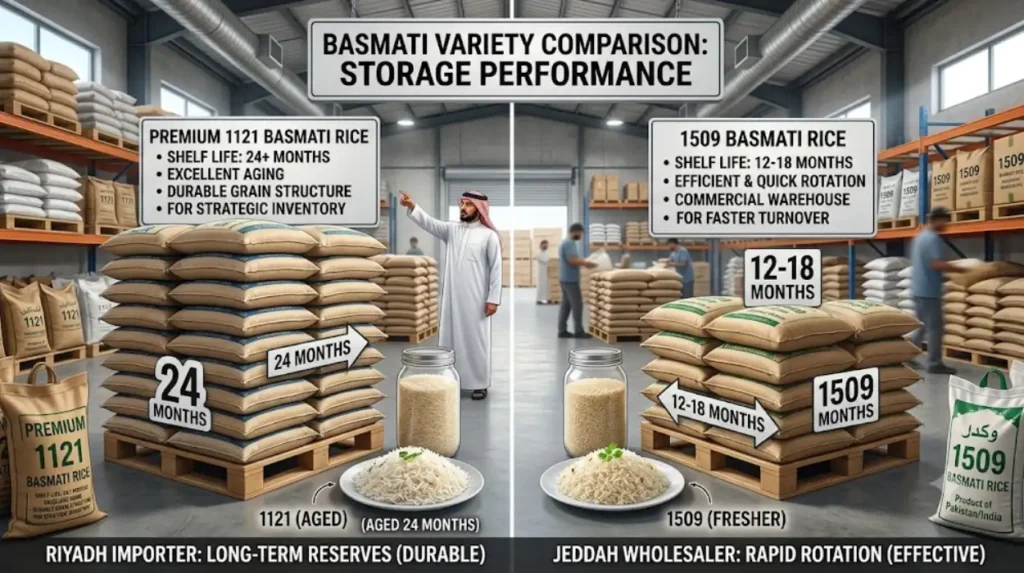
1121 generally maintains premium quality for up to 24 months, while 1509 performs effectively for 12–18 months under proper storage, fumigation, and moisture-controlled warehouse conditions.
Shelf life influences inventory management.
1121 Storage Characteristics
1121 contains strong grain structure after milling and grading.
Properly stored 1121 maintains:
- Grain integrity
- Aroma retention
- Cooking performance
- Visual appearance
1121 remains suitable for longer storage cycles.
A Riyadh importer maintaining strategic inventory reserves benefits from this durability.
1509 Storage Characteristics
1509 performs effectively under commercial warehouse conditions.
Proper storage requires:
- Moisture control
- Palletized loading
- Warehouse ventilation
- Routine inspection
1509 suits faster inventory rotation models.
A Jeddah wholesaler replenishing stock every few months often finds 1509 fully adequate.
Shelf-life differences affect inventory strategy, which leads directly into selecting the right rice for each business model.
Which Rice Variety Works Best for Different Importer Types?
1121 fits premium retail, luxury hospitality, and branded consumer products. 1509 fits wholesale distribution, institutional catering, food service contracts, and value-focused private label programs.
Different buyers require different specifications.
1121 Basmati Works Best For
- Premium supermarkets
- Luxury hotels
- Fine dining restaurants
- Premium private labels
- High-end food distributors
1121 strengthens brand perception.
Consumers recognize the longer grains immediately after opening the package.
1509 Basmati Works Best For
- Bulk wholesalers
- Catering companies
- Institutional kitchens
- Food service distributors
- Government supply contracts
1509 improves purchasing efficiency.
Lower acquisition costs help buyers remain competitive during tender processes.
Decision Framework for Saudi Importers
| Decision Factor | Choose 1121 | Choose 1509 |
|---|---|---|
| Premium Retail Focus | ✓ | |
| Institutional Catering | ✓ | |
| Luxury Hospitality | ✓ | |
| Cost Optimization | ✓ | |
| Long-Term Brand Positioning | ✓ |
Both varieties solve different procurement challenges. The next step is evaluating the strengths and weaknesses of each option.
What Are the Pros and Cons of 1121 and 1509 Basmati Rice?
1121 offers superior appearance and premium positioning. 1509 offers stronger affordability and volume flexibility. Importers should align specifications with customer expectations rather than focusing solely on purchase price.
1121 Basmati Rice Advantages
- 8.30–8.50 mm grain length
- Exceptional elongation
- Premium consumer perception
- Strong Gulf market demand
- Excellent cooked presentation
1121 Basmati Rice Limitations
- Higher procurement cost
- Higher retail pricing
- Greater capital requirement
1509 Basmati Rice Advantages
- Lower acquisition cost
- Competitive grain dimensions
- Strong wholesale demand
- Faster stock turnover
- Better budget flexibility
1509 Basmati Rice Limitations
- Shorter grain appearance
- Lower premium perception
- Reduced cooked elongation
A Saudi premium retail brand benefits from 1121 because visual presentation directly impacts purchasing decisions.
A catering supplier benefits from 1509 because food cost management remains the primary objective.
Understanding strengths and weaknesses leads directly to the final procurement decision.
How Should Saudi Importers Choose Between 1121 and 1509 Basmati Rice?
Choose 1121 for premium positioning, luxury hospitality, and retail branding. Choose 1509 for wholesale efficiency, institutional supply, and cost-controlled distribution. Both varieties succeed when matched to the correct customer segment.
Saudi importers should evaluate five primary decision factors.
Procurement Decision Checklist
- Define target customer segment.
- Calculate desired retail margin.
- Determine inventory holding period.
- Compare expected sales volume.
- Verify quality specifications before shipment.
Rice quality verification should include:
- Grain length testing
- Moisture testing
- Broken percentage testing
- Purity testing
- Packaging inspection
- Fumigation verification
- Export certification review
AHK Rice processes export rice through a complete quality workflow:
- Clean the paddy.
- De-husk the grain.
- Dry the rice.
- Parboil selected grades.
- Polish the kernels.
- Grade by size.
- Sort by colour.
- Inspect the lot.
- Load for shipment.
Importers ready to move from comparison to procurement planning should review the complete Saudi import process explained in our guide covering the verified exporter sourcing and import workflow.
Saudi demand for Pakistani Basmati remains strong because consumers continue to value aroma, grain length, and cooking performance (source: Pakistan Bureau of Statistics, FY2024-25).
1121 remains the premium benchmark. 1509 remains the strongest value alternative. Successful importers select the variety that aligns with their market position rather than pursuing the lowest price alone.
Frequently Asked Questions
Which Basmati rice is better for Saudi retail brands, 1121 or 1509?
1121 Basmati Rice is generally better for premium Saudi retail brands. The variety offers extra-long grain length, superior elongation after cooking, and stronger consumer recognition. Retailers targeting higher-income households and premium supermarkets often prefer 1121 because it creates greater shelf appeal and supports premium pricing.
Why do Saudi catering companies often choose 1509 Basmati Rice?
Saudi catering companies frequently choose 1509 Basmati Rice because it provides a balance between quality and cost. The variety delivers authentic Basmati aroma and good cooking performance while reducing procurement expenses. Large-volume food service operators benefit from better cost control without compromising customer satisfaction.
What is the price difference between 1121 and 1509 Basmati Rice?
1121 Basmati Rice usually commands a higher export price per metric ton because of its longer grain size and stronger international demand. 1509 Basmati Rice is generally more affordable due to lower production costs and higher agricultural yields. Actual prices vary according to grade, packaging, season, and market conditions.
Which Basmati rice has a longer shelf life?
1121 Basmati Rice typically offers a shelf life of 18 to 24 months when stored under proper warehouse conditions. 1509 Basmati Rice generally maintains quality for 12 to 18 months. Moisture control, fumigation, ventilation, and palletized storage play important roles in preserving quality during storage.
Can Saudi importers source both 1121 and 1509 from the same exporter?
Yes. Many Pakistani exporters, including AHK Rice, supply both 1121 and 1509 Basmati Rice in multiple processing grades and packaging options. Importers often purchase both varieties to serve different customer segments, allowing them to maintain a premium product line while also competing in value-focused markets.