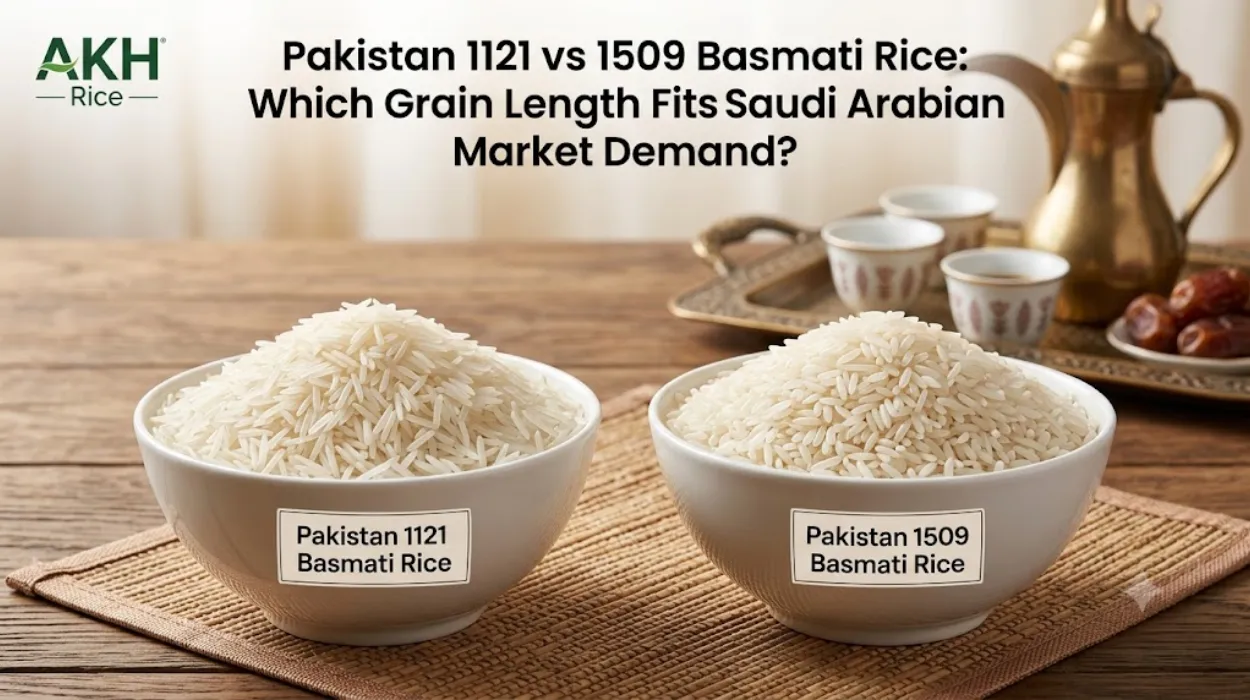
Pakistan 1121 vs 1509 Basmati Rice: Which Grain Length Fits Saudi Arabian Market Demand?
Pakistan 1121 Basmati Rice fits most Saudi Arabian market demand because it delivers the longest cooked grain length, stronger premium positioning, and higher acceptance across retail, catering, and hospitality channels. Pakistan 1509 Basmati Rice serves buyers seeking lower procurement costs, faster crop availability, and competitive quality. Here is why: Saudi consumers consistently associate extra-long grain appearance with premium Basmati value, while distributors balance grain length against import costs and target customer segments.
Saudi Arabia remains one of the largest import destinations for Pakistani Basmati rice. Importers evaluate grain length, cooking expansion, shelf life, processing grades, and landed cost before selecting a specification. Buyers comparing Pakistan Basmati rice export solutions often narrow their options to 1121 and 1509 because both varieties perform well in Gulf food service and retail markets.
Import decisions also depend on consumer expectations. Buyers who already understand the factors behind Saudi demand for extra-long grains can explore why premium segments continue favoring Pakistan’s 1121 variety through this guide on Saudi Arabian buyers’ preference for extra-long grain Basmati rice. That market behavior directly influences the comparison between 1121 and 1509.
AHK Rice exports both varieties from Punjab, Pakistan. The company mills, grades, sorts, tests, loads, and ships multiple specifications including Steam, White, Golden Sella, and Creamy Sella grades for international buyers.
What Are the Main Differences Between Pakistan 1121 and 1509 Basmati Rice?
1121 offers longer cooked grain length, stronger premium positioning, and wider Saudi market acceptance, while 1509 provides lower procurement costs, earlier crop availability, and competitive performance for value-focused importers.
Pakistan 1121 Basmati Rice is an extra-long grain aromatic rice variety. The variety gained popularity because of its exceptional grain elongation after cooking. Most Saudi distributors position 1121 as a premium product across supermarkets, restaurants, and catering operations.
Pakistan 1509 Basmati Rice is a newer variety developed to improve yield and harvesting efficiency. The variety reaches the market earlier than traditional Basmati crops and offers a favorable balance between grain length and pricing.
How Do the Core Specifications Compare?
Specification Comparison Table
| Attribute | Pakistan 1121 Basmati | Pakistan 1509 Basmati |
|---|---|---|
| Average Grain Length | 8.30–8.50 mm | 8.00–8.30 mm |
| Cooked Grain Length | 18–22 mm | 16–19 mm |
| Aroma Level | High | Moderate to High |
| Crop Availability | Main Basmati Season | Earlier Harvest Availability |
| Market Position | Premium | Mid-Premium |
| Average Export Price (2026) | Higher | Lower |
| Saudi Demand Level | Very High | Growing |
Pakistan 1121 delivers greater visual appeal after cooking. Saudi consumers often evaluate rice quality by observing grain separation and elongation during serving.
Pakistan 1509 delivers strong performance for budget-sensitive import programs. Many importers use 1509 to balance quality requirements with procurement targets.
Saudi retail chains frequently place 1121 in premium shelf categories. Saudi food service operators often select 1509 when controlling menu costs remains a priority.
With the primary differences established, the next question is how Saudi market segments choose between these two varieties.
Which Basmati Variety Does the Saudi Arabian Market Prefer?
Premium retail, hospitality, and traditional Saudi cuisine segments prefer 1121, while institutional catering, value retail, and cost-sensitive distributors increasingly adopt 1509.
Saudi Arabia imports large volumes of Pakistani Basmati rice every year because consumers strongly prefer aromatic long-grain rice for Kabsa, Mandi, and family dining applications (source: REAP export data, December 2025).
Premium Retail Market
Saudi premium retail buyers prioritize grain appearance. Pakistan 1121 satisfies this requirement through superior cooked grain elongation.
Pakistan 1121 White Rice remains popular among branded retail packs. Pakistan 1121 Golden Sella Rice maintains strong demand because it combines visual appeal with storage stability.
Hospitality and Hotel Sector
Saudi hotels serve international and local guests who expect premium rice presentation. Pakistan 1121 Golden Sella performs exceptionally well because grains remain separate after cooking.
Luxury restaurants often pay a higher procurement price for presentation benefits. Grain appearance directly influences customer perception in premium dining environments.
Catering and Institutional Buyers
Saudi catering companies evaluate both quality and cost. Pakistan 1509 provides a practical solution for high-volume meal production.
Large catering operations serving labor accommodations often prioritize consistency and procurement efficiency. Pakistan 1509 supports those operational goals.
Saudi Grade Preferences
| Market Segment | Preferred Grade | Preferred Variety |
|---|---|---|
| Premium Retail | White Rice | 1121 |
| Hospitality | Golden Sella | 1121 |
| Fine Dining | Steam Rice | 1121 |
| Catering | Golden Sella | 1509 |
| Institutional Supply | Steam Rice | 1509 |
Saudi market preferences reveal why grain length influences buying decisions, which leads directly to pricing considerations.
How Do 1121 and 1509 Compare on Price Per Metric Ton?
1509 usually offers lower export pricing, while 1121 commands a premium because of stronger grain elongation, brand recognition, and higher end-user demand.
Price remains one of the most important procurement factors. Saudi importers compare landed cost against expected market positioning.
Export Price Comparison (2026)
| Product Type | Average Export Price Range (USD/MT) |
|---|---|
| 1121 White Rice | $1,050–$1,250 |
| 1121 Steam Rice | $1,100–$1,300 |
| 1121 Golden Sella | $1,150–$1,400 |
| 1509 White Rice | $850–$1,050 |
| 1509 Steam Rice | $900–$1,100 |
| 1509 Golden Sella | $950–$1,150 |
Prices fluctuate according to crop conditions, freight costs, exchange rates, and destination requirements (source: REAP export data, December 2025).
Pakistan 1121 achieves higher pricing because buyers consistently recognize its premium grain length.
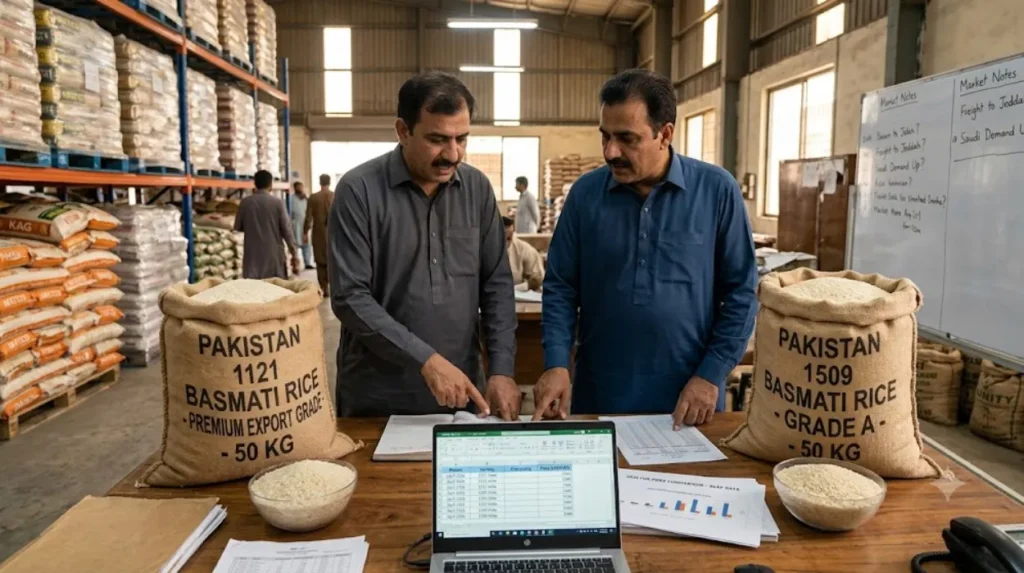
Pakistan 1509 creates procurement flexibility because distributors can enter competitive market segments with lower inventory investment.
Golden Sella grades generally command higher prices than Steam grades. In a high-temperature Gulf warehouse, Golden Sella typically maintains quality longer. Steam grades often require faster inventory rotation. For Saudi wholesalers managing seasonal demand cycles, Golden Sella offers stronger storage flexibility.
Pricing alone does not determine procurement decisions, making shelf life and storage performance equally important.
Which Variety Offers Better Shelf Life and Storage Performance?
Golden Sella grades of both varieties provide up to 24 months of storage potential, while Steam and White grades generally perform best within 12–18 months.
Shelf life affects inventory planning, especially for importers managing multiple distribution channels.
Pakistan 1121 Shelf Life
Pakistan 1121 Golden Sella undergoes parboiling before milling. The process strengthens grain structure and improves long-term storage performance.
Pakistan 1121 Steam Rice retains a softer texture profile. The grade appeals to consumers seeking delicate cooking characteristics.
Pakistan 1509 Shelf Life
Pakistan 1509 Golden Sella follows the same processing approach. The grade performs effectively in bulk distribution programs.
Pakistan 1509 Steam Rice supports quicker inventory turnover because distributors often target price-sensitive channels.
Shelf Life Comparison
| Product Grade | Shelf Life |
|---|---|
| 1121 Golden Sella | 18–24 Months |
| 1121 Steam | 12–18 Months |
| 1509 Golden Sella | 18–24 Months |
| 1509 Steam | 12–18 Months |
Golden Sella lasts longer than Steam. In Saudi warehouses experiencing temperatures above 40°C, Golden Sella maintains grain integrity for extended periods. Steam rice benefits from controlled storage conditions. For distributors holding inventory before Ramadan demand peaks, Golden Sella is often the preferred specification.
Storage considerations naturally lead to evaluating the strengths and limitations of each variety.
What Are the Pros and Cons of Pakistan 1121 and 1509 Basmati Rice?
1121 excels in premium positioning and grain elongation, while 1509 excels in affordability, procurement flexibility, and competitive value.
Pakistan 1121 Basmati Rice
Advantages
- Superior cooked grain elongation
- Premium Saudi market acceptance
- Strong brand recognition
- Higher perceived value
- Excellent presentation quality
Limitations
- Higher procurement cost
- Larger working capital requirement
- Greater exposure to premium market competition
Pakistan 1509 Basmati Rice
Advantages
- Lower import cost
- Earlier crop availability
- Strong cooking performance
- Suitable for high-volume programs
- Competitive market positioning
Limitations
- Lower grain elongation
- Reduced premium perception
- Less retail brand recognition
A Saudi supermarket chain selling premium consumer packs gains greater value from 1121. A catering contractor serving thousands of meals daily often benefits more from 1509.
Understanding advantages and disadvantages makes the final procurement decision easier.
Which Basmati Rice Works Best for Different Saudi Import Scenarios?
1121 works best for premium retail and hospitality channels, while 1509 works best for cost-controlled distribution, institutional supply, and large-volume catering operations.
Decision Framework
| Buyer Situation | Recommended Variety | Reason |
|---|---|---|
| Premium Retail Brand | 1121 | Strong consumer appeal |
| Luxury Hotel Supply | 1121 | Superior presentation |
| Restaurant Chain | 1121 Golden Sella | Better grain separation |
| Large Catering Program | 1509 Golden Sella | Cost efficiency |
| Institutional Distribution | 1509 Steam | Competitive pricing |
Saudi importers should align variety selection with their target customer segment rather than selecting based solely on price.
When to Choose 1121
Choose 1121 when premium positioning drives profitability. Choose 1121 when grain appearance influences consumer purchasing decisions. Choose 1121 when hospitality customers require exceptional presentation.
When to Choose 1509
Choose 1509 when procurement budgets require optimization. Choose 1509 when large-volume distribution determines purchasing strategy. Choose 1509 when balancing quality and cost remains the primary objective.
Importers comparing supplier qualifications, processing capabilities, packaging options, and export documentation requirements can continue their evaluation through this detailed guide on sourcing Pakistani Basmati rice for Saudi distribution networks.
Conclusion
Pakistan 1121 remains the strongest match for mainstream Saudi Arabian demand because of its extra-long grain length, premium image, and superior cooking presentation. Pakistan 1509 provides an excellent alternative for buyers prioritizing cost efficiency and volume distribution.
Saudi retail, hospitality, and premium food service sectors continue favoring 1121. Saudi institutional and catering channels increasingly adopt 1509 because procurement economics support large-scale operations.
The best choice depends on target market positioning. Premium brands gain more value from 1121. Cost-focused distribution programs gain more value from 1509. Successful importers align rice specifications with customer expectations, storage requirements, and long-term market strategy.
Frequently Asked Questions
Is Pakistan 1121 Basmati Rice better than 1509 for the Saudi Arabian market?
Pakistan 1121 Basmati Rice is generally better for premium Saudi market segments because it offers longer grain length, stronger aroma, and superior cooked grain elongation. Saudi retailers, hotels, and restaurants often prefer 1121 for its premium appearance and consumer recognition.
Why is Pakistan 1121 Basmati Rice more expensive than 1509?
Pakistan 1121 Basmati Rice commands a higher price because it delivers extra-long grain length, greater cooking expansion, and stronger demand in international markets. The premium positioning of 1121 increases its export value compared to 1509.
Which grade is most popular in Saudi Arabia: White, Steam, or Golden Sella?
Golden Sella is one of the most popular grades in Saudi Arabia because it combines long shelf life, excellent grain separation, and strong cooking performance. White Rice remains popular in retail markets, while Steam Rice is preferred by buyers seeking a softer texture.
What is the average grain length difference between 1121 and 1509 Basmati Rice?
Pakistan 1121 Basmati Rice typically has an average grain length of 8.30–8.50 mm, while Pakistan 1509 Basmati Rice ranges from 8.00–8.30 mm. The difference becomes more noticeable after cooking, where 1121 achieves greater elongation.
Which Basmati Rice variety is best for Saudi catering companies?
Pakistan 1509 Basmati Rice is often suitable for large catering operations because it offers a competitive balance between quality and cost. However, premium catering services and hotel suppliers frequently select 1121 Golden Sella for better presentation and customer satisfaction.