1121 White Rice vs Super Kernel White Rice: Grain Length Comparison for Saudi Arabian Retail Markets
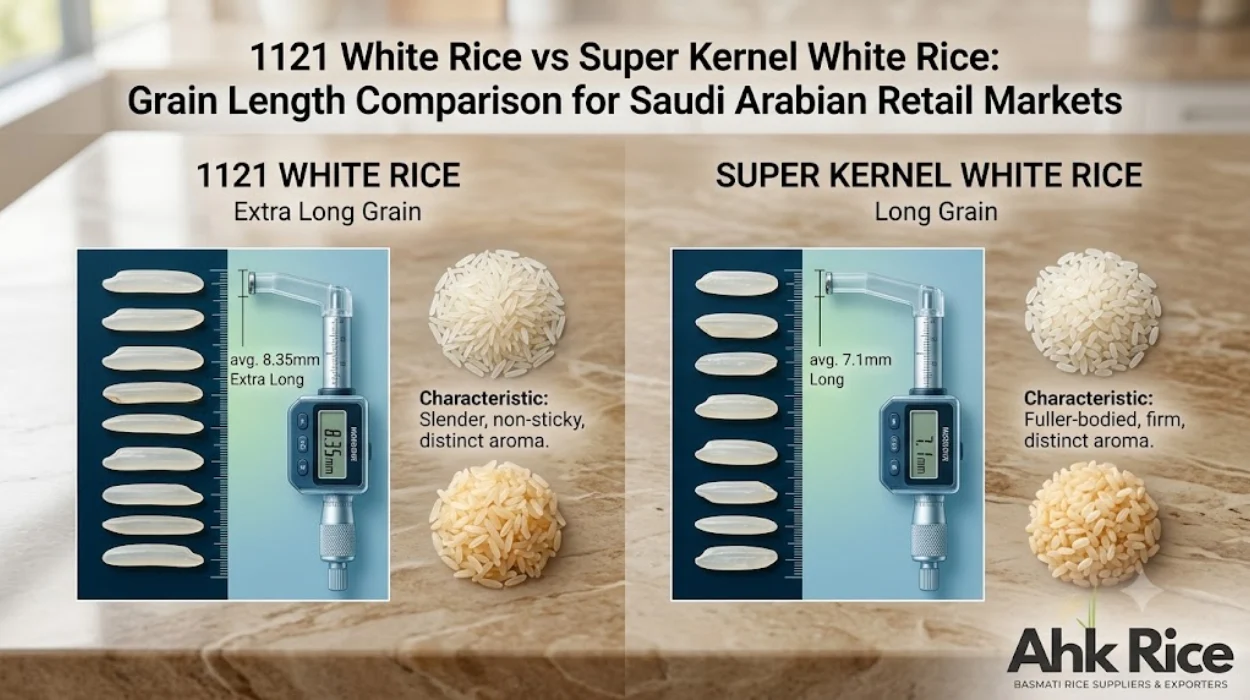
1121 White Rice is the preferred option for most Saudi Arabian retail markets because it delivers longer grain length, stronger visual shelf appeal, and higher consumer recognition. Here is why: 1121 White Rice consistently achieves 8.30–8.50 mm average grain length before cooking and extends beyond 17 mm after cooking, while Super Kernel White Rice averages 7.00–7.40 mm before cooking and reaches 13–14 mm after cooking, creating a visible difference for Saudi consumers seeking premium long-grain Basmati rice.
Saudi Arabia remains one of the largest import destinations for Pakistani Basmati rice. Retail buyers increasingly compare grain appearance, elongation ratio, packaging presentation, and shelf performance before selecting suppliers. Understanding how grain length affects purchasing decisions helps importers choose the correct specification for supermarket shelves.
Buyers evaluating Pakistani Basmati varieties should first understand how grain length influences consumer perception and purchase behavior. The detailed guide on grain characteristics and buying preferences explains why Saudi consumers consistently select extra-long grain rice in premium retail segments.
AHK Rice supplies premium Pakistani Basmati varieties through its comprehensive export services, including 1121 White Rice, Super Kernel White Rice, and customized retail packaging for Gulf markets. The comparison below focuses on technical specifications rather than promotional claims.
What is the difference between 1121 White Rice and Super Kernel White Rice for Saudi retail markets?
1121 White Rice offers longer grain length, higher elongation, stronger shelf presence, and greater premium positioning, while Super Kernel White Rice provides traditional Basmati aroma and lower procurement costs.
Saudi retail buyers compare these two varieties because both belong to the Pakistani Basmati category. Both varieties originate from Punjab’s rice-growing regions and undergo similar milling processes. However, their physical characteristics create different retail outcomes.
1121 White Rice
1121 White Rice is an extra-long grain Basmati variety cultivated in Punjab, Pakistan. Farmers harvest the paddy and mills dehusk, polish, grade, and sort the grains to export specifications.
Specification Comparison
| Attribute | 1121 White Rice | Super Kernel White Rice |
|---|---|---|
| Average Grain Length | 8.30–8.50 mm | 7.00–7.40 mm |
| Cooked Grain Length | 16.5–18 mm | 13–14 mm |
| Grain Appearance | Extra-long slender | Long slender |
| Aroma Intensity | Medium to High | High |
| Retail Positioning | Premium | Mid-premium |
| Shelf Life | 24 months | 18–24 months |
| Average Export Price 2026 | USD 1,050–1,250/MT | USD 900–1,100/MT |
1121 White Rice creates immediate visual impact. Saudi consumers often associate longer grains with higher quality. Premium supermarkets frequently allocate shelf space to varieties with superior grain presentation.
Super Kernel White Rice
Super Kernel White Rice represents the traditional Pakistani Basmati category. The variety combines classic aroma characteristics with competitive pricing.
Super Kernel White Rice appeals to consumers prioritizing fragrance and value. Traditional households often recognize this variety from decades of imports into Gulf markets.
The grain length comparison establishes the primary distinction between both varieties. The next question examines why Saudi consumers place such importance on grain size.
Why does grain length matter in Saudi Arabian retail markets?
Saudi consumers associate longer grains with premium quality, better serving presentation, and authentic Basmati identity, making grain length a major retail purchasing factor.
Grain length influences perception before cooking. Consumers frequently inspect transparent packaging windows and compare grain size visually.
Saudi households commonly prepare Kabsa, Mandi, Bukhari Rice, and premium rice dishes. Longer grains create more attractive presentation after cooking. Restaurant operators and retail consumers value this characteristic.
1121 White Rice elongates significantly during cooking. The cooked grains remain separate and maintain visual consistency. This feature supports premium retail positioning.
Super Kernel White Rice provides traditional Basmati characteristics but delivers less elongation. The cooked appearance remains attractive but does not achieve the same visual impact.
Retail surveys across Gulf markets consistently show stronger consumer preference for extra-long grain rice in premium packaging categories (source: REAP export data, December 2025).
Modern supermarket chains increasingly segment rice shelves by quality tier. Extra-long grain products occupy premium sections. Standard long-grain products serve value-conscious consumers.
Grain length explains consumer perception. The next comparison focuses on available solutions for different retail strategies.
What are the available solutions for Saudi rice importers?
Importers generally choose premium extra-long grain, traditional aromatic grain, or mixed portfolio strategies depending on target consumers and price positioning.
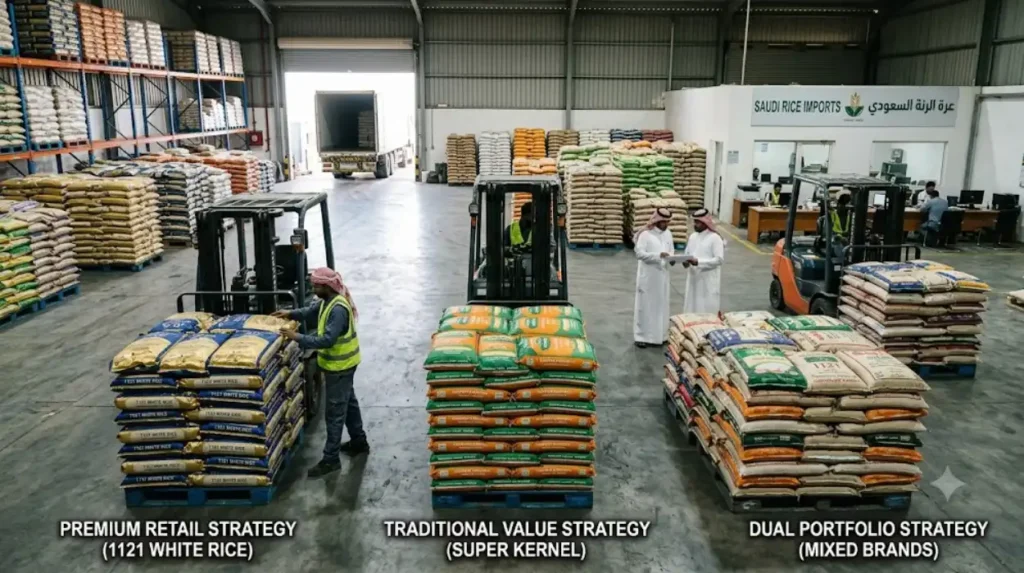
Saudi importers usually follow three sourcing approaches.
Premium Retail Strategy
Premium retail strategy centers on 1121 White Rice. This approach targets urban supermarkets, premium grocery chains, and affluent consumers.
Benefits include:
- Stronger shelf differentiation
- Higher perceived value
- Better grain elongation
- Premium packaging compatibility
This strategy works effectively in Riyadh, Jeddah, Dammam, and other major urban centers.
Traditional Value Strategy
Traditional value strategy focuses on Super Kernel White Rice. This approach targets consumers prioritizing aroma and affordability.
Benefits include:
- Lower procurement costs
- Traditional market recognition
- Consistent demand
- Competitive retail pricing
Regional grocery chains frequently use this model.
Dual Portfolio Strategy
Dual portfolio strategy combines both varieties. Importers serve premium and mid-premium segments simultaneously.
Many leading Gulf rice brands adopt this approach because it expands consumer coverage and reduces dependence on a single specification.
The available solutions show multiple sourcing paths. The next section compares their performance in practice.
How do different approaches compare in Saudi Arabian retail environments?
1121 White Rice performs better for premium retail positioning, while Super Kernel White Rice performs better for price-sensitive segments seeking traditional Basmati aroma.
Saudi retail markets contain several consumer groups. Each group values different product characteristics.
Riyadh and Jeddah Premium Retail
Premium supermarkets prioritize appearance. Consumers frequently select products with longer visible grains.
1121 White Rice performs strongly because shoppers compare packaging directly on shelves. Grain length creates immediate differentiation.
Premium private-label brands also prefer 1121 because longer grains support premium pricing.
Secondary City Retail Markets
Secondary city retailers often prioritize affordability. Super Kernel White Rice competes effectively in these markets.
Traditional consumers recognize the variety and appreciate its aromatic profile. Retailers benefit from lower procurement costs.
Price Comparison per Metric Ton
| Rice Variety | Average 2026 Export Price (USD/MT) |
| 1121 White Rice | 1,050–1,250 |
| Super Kernel White Rice | 900–1,100 |
Price differences vary according to crop conditions, freight rates, and export demand (source: REAP export data, January 2026).
Importers often evaluate profitability rather than procurement price alone. Premium varieties may generate higher retail margins despite higher acquisition costs.
Regional comparison highlights different market preferences. The next section identifies which variety works best for specific use cases.
Which rice variety works best for different Saudi market segments?
1121 White Rice suits premium supermarket shelves, while Super Kernel White Rice suits traditional retail channels and value-focused consumers.
Premium Supermarkets
1121 White Rice works best for premium supermarkets.
The variety delivers superior shelf presentation. The grain size remains visible through transparent packaging. Consumers immediately identify premium characteristics.
Examples include modern hypermarkets and upscale grocery chains.
Mid-Premium Grocery Stores
Super Kernel White Rice works effectively in mid-premium grocery stores.
The variety balances quality and affordability. Consumers receive authentic Basmati aroma at a lower price point.
Private Label Brands
1121 White Rice frequently supports private-label premium programs.
Long grain appearance helps retailers establish premium branding. Consumers associate visual quality with higher product standards.
Importers seeking customized retail solutions often evaluate packaging, branding, and specification flexibility through specialized private-label sourcing programs for Saudi supermarkets.
Hospitality Retail Channels
Super Kernel White Rice remains relevant for hospitality-focused retail channels. Traditional fragrance appeals to consumers purchasing rice for family gatherings and regular household use.
Different segments require different specifications. The next section evaluates advantages and disadvantages.
What are the pros and cons of each rice variety?
1121 White Rice offers superior grain length and premium appeal, while Super Kernel White Rice offers stronger value and traditional aroma recognition.
1121 White Rice Advantages
- Extra-long grain appearance
- Higher elongation ratio
- Premium retail positioning
- Strong shelf differentiation
1121 White Rice Limitations
- Higher procurement cost
- Greater price sensitivity during market fluctuations
Super Kernel White Rice Advantages
- Lower sourcing cost
- Strong aromatic profile
- Traditional market familiarity
- Stable retail demand
Super Kernel White Rice Limitations
- Shorter grain length
- Lower premium perception
- Reduced shelf differentiation
Example comparison illustrates the difference clearly. A premium Riyadh supermarket can justify higher pricing with 1121 White Rice. A regional grocery chain can increase sales volume through competitively priced Super Kernel White Rice.
Advantages and limitations help buyers understand trade-offs. The next section converts those factors into a practical decision framework.
What decision factors should Saudi importers use when selecting between 1121 and Super Kernel White Rice?
Target consumer, price positioning, retail format, brand strategy, and visual presentation determine the correct rice specification.
Decision Framework
| Decision Factor | Choose 1121 White Rice | Choose Super Kernel White Rice |
| Premium Shelf Presence | ✓ | |
| Competitive Pricing | ✓ | |
| Extra-Long Grain Demand | ✓ | |
| Traditional Aroma Focus | ✓ | |
| Premium Private Label | ✓ |
Importers should evaluate retail objectives before selecting specifications.
Premium positioning favors 1121 White Rice because grain length drives visual differentiation.
Value-oriented retail programs favor Super Kernel White Rice because lower procurement costs support competitive pricing.
Mixed retail portfolios often combine both varieties. This strategy allows importers to serve multiple consumer segments simultaneously.
Decision factors complete the evaluation process. The final conclusion summarizes the comparison.
Conclusion
1121 White Rice remains the strongest choice for premium Saudi Arabian retail markets because it delivers 8.30–8.50 mm grain length, superior elongation, and stronger shelf appeal. Super Kernel White Rice remains an effective option for value-focused retail programs because it combines authentic Basmati aroma with lower procurement costs.
Saudi supermarket buyers targeting premium consumers should prioritize 1121 White Rice. Importers targeting broader consumer groups should consider a dual-product strategy combining both varieties.
The optimal choice depends on retail positioning, target consumers, and pricing objectives rather than a single specification.
Frequently Asked Questions
Which rice variety is more popular in Saudi Arabian supermarkets?
1121 White Rice is more popular in premium Saudi Arabian supermarkets because its extra-long grain creates stronger shelf appeal. Saudi consumers often associate longer grains with higher quality and premium Basmati rice. Super Kernel White Rice remains popular in traditional and value-focused retail channels.
What is the grain length difference between 1121 White Rice and Super Kernel White Rice?
1121 White Rice typically measures 8.30–8.50 mm before cooking, while Super Kernel White Rice averages 7.00–7.40 mm. After cooking, 1121 White Rice can reach 16.5–18 mm, whereas Super Kernel White Rice usually reaches 13–14 mm.
Which rice variety offers better value for Saudi importers?
The best value depends on the target market. 1121 White Rice offers stronger premium positioning and higher retail margins. Super Kernel White Rice offers lower procurement costs and appeals to consumers seeking traditional Basmati rice at a more competitive price.
How long can 1121 White Rice and Super Kernel White Rice be stored?
1121 White Rice generally maintains quality for up to 24 months under proper storage conditions. Super Kernel White Rice usually offers a shelf life of 18–24 months. Importers should store both varieties in dry, ventilated warehouses to preserve grain quality and aroma.
Should Saudi importers choose one variety or import both?
Many successful Saudi importers source both varieties. A dual-product portfolio allows retailers to serve premium consumers with 1121 White Rice while offering Super Kernel White Rice to value-conscious buyers. This approach helps brands cover multiple retail segments and increase market reach.