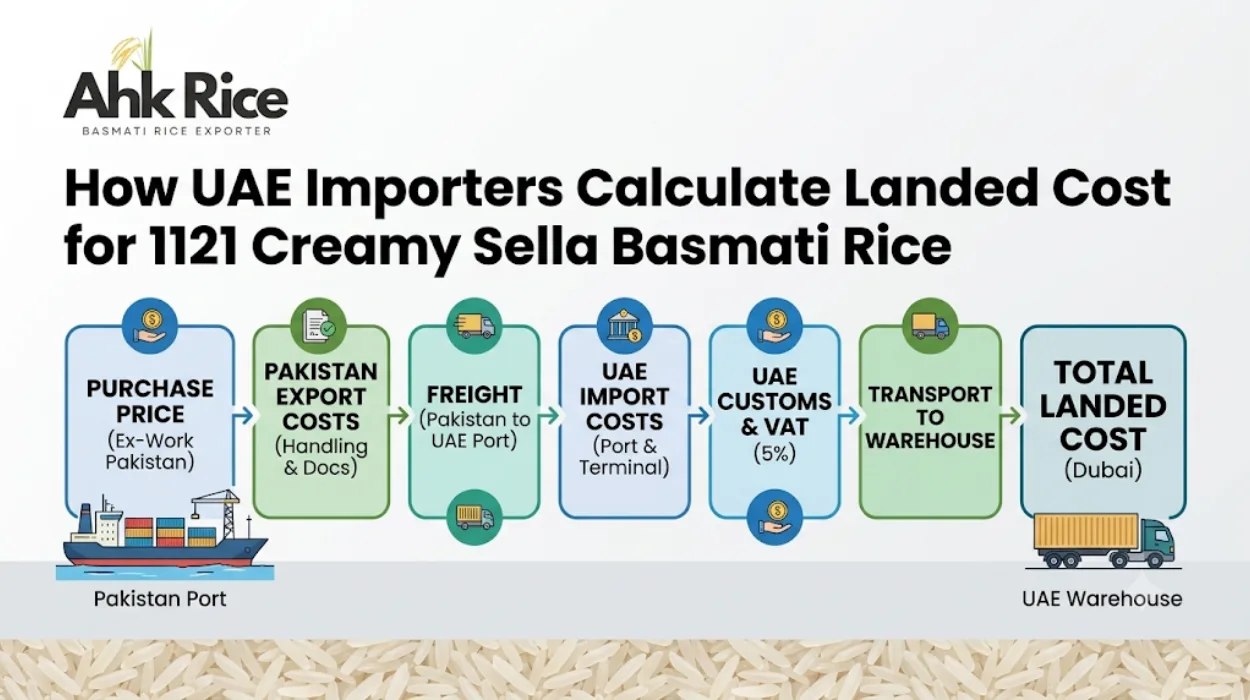
How UAE Importers Calculate Landed Cost of 1121 Creamy Sella Basmati Rice from Pakistan
UAE importers calculate landed cost by adding the Pakistani export price, freight charges, insurance, customs expenses, port handling fees, transportation costs, and warehouse charges. Here is why: every imported rice shipment generates costs before reaching the final buyer, and each cost directly affects profitability and selling price.
1121 Creamy Sella Basmati Rice remains one of the most imported premium rice varieties in the Gulf region. UAE wholesalers, food distributors, supermarkets, catering companies, and hospitality suppliers use landed cost calculations to determine procurement budgets and selling margins. Understanding this calculation helps buyers compare suppliers accurately and avoid hidden expenses.
What Is Landed Cost for 1121 Creamy Sella Basmati Rice?
Landed cost equals the complete expense of receiving imported rice at the buyer’s warehouse, including product cost, freight, customs, transportation, and handling charges.
Landed cost differs from the export price quoted by Pakistani suppliers. Export quotations normally cover FOB or CIF terms. UAE buyers must add local expenses before determining the actual acquisition cost.
1121 Creamy Sella Basmati Rice is a parboiled premium long-grain rice variety cultivated in Punjab, Pakistan. The variety delivers strong grain structure, creamy color, excellent elongation, and high cooking yield. These characteristics make it popular in UAE retail and food service sectors.
Importers focus on landed cost because procurement decisions depend on the final warehouse cost rather than the supplier’s quoted price.
With landed cost defined, the next question is how importers build the complete calculation.
How Do UAE Importers Calculate Landed Cost Step by Step?
Importers follow a structured calculation consisting of product value, freight, insurance, customs expenses, logistics charges, and warehouse delivery costs.
Step 1: Determine FOB Pakistan Price
FOB stands for Free on Board. Under FOB terms, the exporter loads rice onto the vessel at the Pakistani port.
FOB cost includes procurement, milling, grading, sorting, packing, documentation, inland transport, and port handling before loading.
Example:
- FOB Karachi Price: USD 1,150 per MT
- Quantity: 25 MT
- Cargo Value: USD 28,750
Step 2: Add Ocean Freight
Ocean freight represents the shipping cost from Pakistan to the UAE.
Shipping lines calculate freight according to container availability, fuel charges, route demand, and seasonality.
Example:
- Freight Cost: USD 850 per container
Step 3: Add Marine Insurance
Insurance protects cargo during transit.
Insurance costs generally range between 0.3% and 0.8% of shipment value depending on coverage conditions.
Example:
- Insurance: USD 180
Step 4: Calculate CIF Value
CIF means Cost, Insurance, and Freight.
Formula:
CIF = FOB + Freight + Insurance
Example:
- FOB: USD 28,750
- Freight: USD 850
- Insurance: USD 180
- CIF Value: USD 29,780
Step 5: Add UAE Import Charges
Import expenses include customs processing, documentation, inspection, and port handling.
Common expenses include:
- Customs clearance
- Port service fees
- Documentation charges
- Container handling
- Delivery order fees
Step 6: Add Inland Transportation
Transport companies move containers from UAE ports to warehouses.
Transportation costs vary according to distance, city, and delivery requirements.
Step 7: Calculate Final Warehouse Cost
Importers combine every expense to determine the final cost per metric ton.
Formula:
Landed Cost = CIF + Import Charges + Transportation + Storage
Understanding the process creates a foundation for examining each cost component separately.
What Cost Components Affect the Final Landed Price?
Product value, freight, insurance, customs charges, transportation, storage, and currency fluctuations create the largest impact on landed cost.
Product Value
Product value contributes the largest share of total expenditure.
Rice specifications influence price directly. Factors include grain length, purity, moisture level, broken percentage, and crop year.
Freight Charges
Freight costs fluctuate throughout the year.
Peak demand periods increase shipping rates. Lower container availability also raises transportation expenses.
Insurance Costs
Insurance protects against cargo loss, theft, damage, and transit incidents.
Large-volume importers often negotiate annual insurance agreements to reduce expenses.
Customs and Clearance
Customs brokers process shipment documentation and regulatory procedures.
Efficient documentation reduces delays and prevents additional storage costs.
Inland Logistics
Local transportation includes trucking, warehouse unloading, and distribution costs.
Large distributors operating across Dubai, Abu Dhabi, Sharjah, and Ajman often maintain dedicated logistics contracts.
Currency Exchange
Currency fluctuations affect procurement budgets.
Rice transactions generally occur in US dollars, while local operating expenses often occur in UAE dirhams.
Understanding these components helps importers identify opportunities to optimize procurement costs.
How Is 1121 Creamy Sella Basmati Rice Produced Before Export?
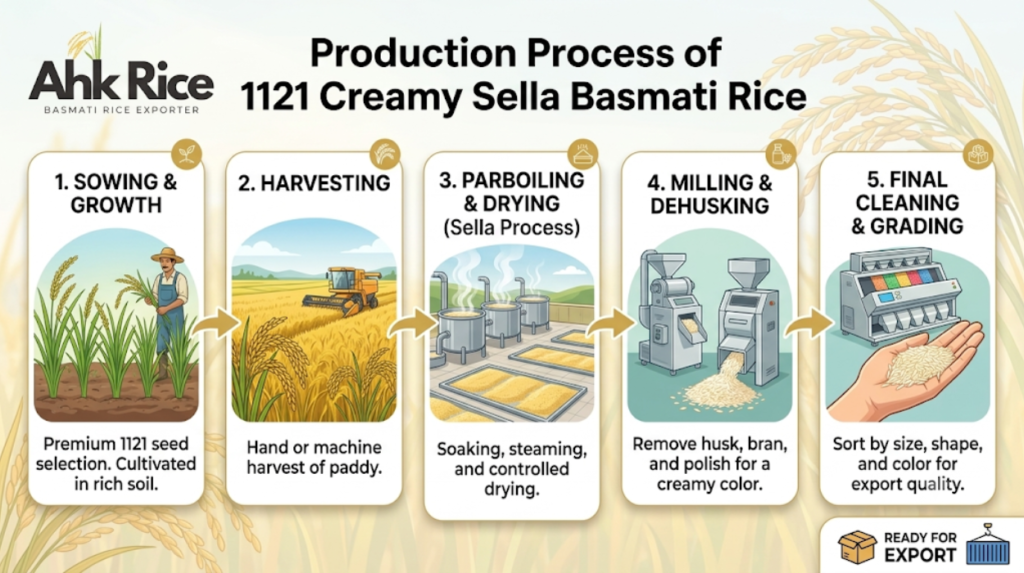
1121 Creamy Sella undergoes cultivation, harvesting, parboiling, drying, milling, grading, sorting, testing, and packaging before export dispatch.
Cultivation
Farmers cultivate 1121 Basmati in Punjab’s fertile rice-growing regions.
Punjab provides favorable soil composition, irrigation infrastructure, and climatic conditions.
Harvesting
Farmers harvest mature paddy after grain development reaches optimal levels.
Proper harvesting preserves grain integrity and cooking performance.
Processing Steps
Processing follows a structured sequence:
- Clean the paddy
- Soak the grain
- Steam the paddy
- Dry the paddy
- Dehusk the grain
- Mill the rice
- Grade the kernels
- Sort by length
- Pack for export
Quality Verification
Laboratories inspect every batch before shipment.
Testing normally covers:
- Grain length
- Moisture content
- Broken percentage
- Foreign matter
- Cooking performance
The production process explains why quality specifications significantly affect import pricing.
Which Grades of 1121 Creamy Sella Basmati Rice Are Exported?
Exporters supply multiple grades based on grain length, broken percentage, sorting level, and buyer specifications.
1121 Creamy Sella Extra Long Grain
This grade offers maximum grain length and premium appearance.
Hotels, supermarkets, and premium distributors frequently source this specification.
1121 Creamy Sella Sortex Quality
Sortex processing removes discoloration and defects through optical sorting technology.
Retail packaging companies commonly purchase this grade.
1121 Creamy Sella 5% Broken
This specification balances quality and procurement cost.
Wholesale traders often select this grade for competitive pricing.
1121 Creamy Sella 10% Broken
This grade targets price-sensitive markets.
Food service operators frequently source this specification.
1121 Creamy Sella Customized Grades
Exporters develop customized specifications according to buyer requirements.
Specifications normally include grain length, moisture, broken percentage, and packaging format.
Understanding grade differences helps buyers estimate procurement budgets more accurately.
Which Markets Import 1121 Creamy Sella Basmati Rice from Pakistan?
The UAE, Saudi Arabia, Oman, Qatar, Kuwait, Iraq, Jordan, the United Kingdom, and African countries import large volumes annually.
Gulf Cooperation Council Markets
GCC countries represent major import destinations.
Strong demand comes from restaurants, catering companies, hypermarkets, and food distributors.
Pakistan remains one of the leading Basmati rice suppliers to Gulf markets (source: REAP export data, December 2025).
Middle Eastern Markets
Middle Eastern buyers prefer long-grain aromatic rice.
1121 Creamy Sella performs well in large-scale cooking environments.
European Markets
European importers focus heavily on quality documentation and food safety compliance.
Retail-packaged rice dominates demand across many European channels.
Understanding market demand helps explain why certification requirements continue to increase.
What Certifications Apply to 1121 Creamy Sella Rice Exports?
Food safety, quality management, phytosanitary, and origin certifications support international rice trade.
Common Export Certifications
Required documents often include:
- Phytosanitary Certificate
- Certificate of Origin
- Fumigation Certificate
- Health Certificate
- Packing List
- Commercial Invoice
Food Safety Certifications
International buyers frequently request:
- ISO 22000
- HACCP
- BRCGS
- SGS Inspection Reports
These certifications verify product safety, traceability, and compliance.
Quality Inspection
Independent agencies inspect cargo before shipment.
Inspection reports verify specification conformity and shipment quality.
Certification requirements complete the landed cost picture because compliance expenses influence export pricing.
What Misconceptions Exist About Landed Cost Calculations?
Many importers assume FOB price equals final cost, but freight, customs, transportation, and operational expenses significantly increase actual expenditure.
The first misconception treats FOB pricing as the final purchasing cost. Warehouse delivery expenses remain outside FOB quotations.
The second misconception ignores logistics volatility. Freight rates change according to market conditions and vessel availability.
The third misconception overlooks storage and demurrage risks. Delayed documentation often generates additional charges at destination ports.
The fourth misconception focuses only on product price. Procurement success depends on total delivered cost rather than supplier quotations alone.
Accurate landed cost calculations allow buyers to compare suppliers objectively and improve purchasing decisions.
Frequently Asked Questions
What is the difference between FOB and CIF pricing?
FOB covers costs until cargo is loaded on the vessel. CIF includes product value, freight, and insurance to the destination port.
Why do UAE buyers calculate landed cost instead of FOB price?
Landed cost reflects the actual warehouse expense and supports accurate pricing decisions.
Which cost component affects rice imports the most?
Product value usually represents the largest share, followed by freight and logistics expenses.
Why is 1121 Creamy Sella popular in the UAE?
1121 Creamy Sella offers long grain length, high cooking yield, strong texture, and excellent presentation.
Which documents are required for rice imports into the UAE?
Common documents include a commercial invoice, packing list, certificate of origin, phytosanitary certificate, and shipping documents.