What Moisture Level Do Saudi Arabian Importers Expect in Pakistan 1121 Basmati Rice?
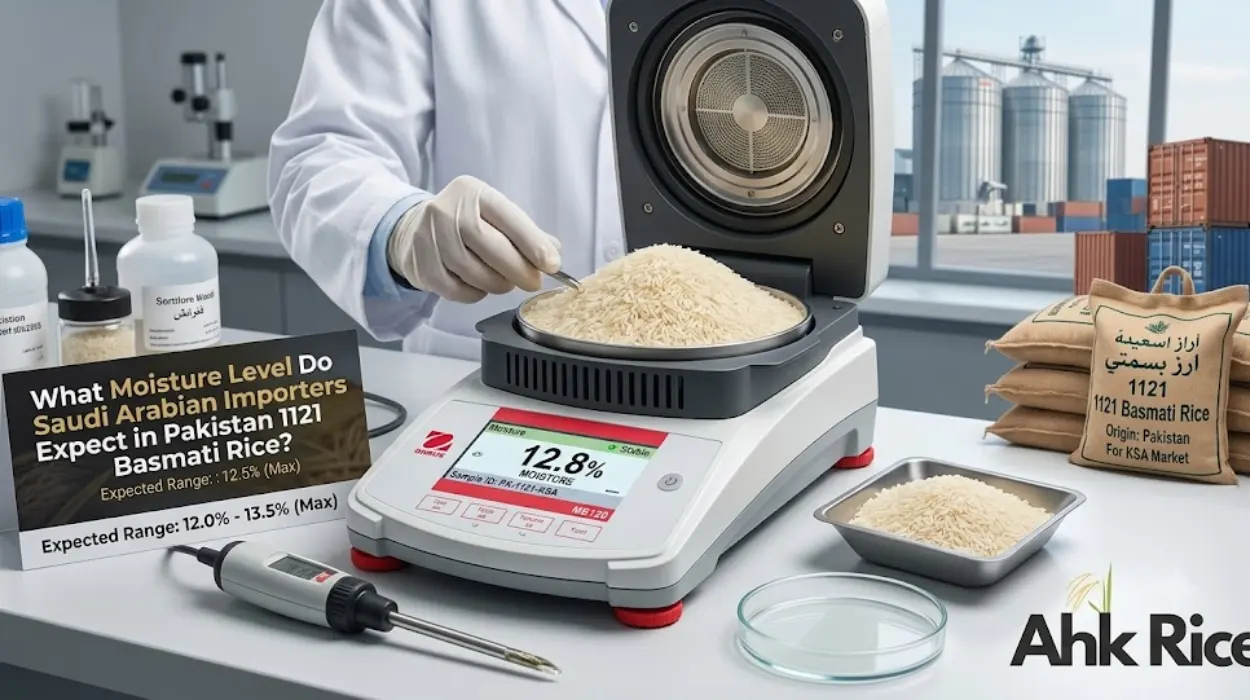
Saudi Arabian importers consistently prefer Pakistan 1121 Basmati rice with export moisture levels between 12.5% and 13.5%, as this range provides the best balance between grain stability, long shipping life, cooking performance, and compliance with commercial import specifications. Choosing the correct moisture level is not only a quality requirement but also a commercial decision that affects storage losses, customer satisfaction, and export profitability.
Saudi Arabia has remained one of Pakistan’s largest Basmati rice export destinations throughout 2026. Buyers focus on much more than grain length or aroma. Moisture percentage directly influences shelf life, container safety, milling recovery, fungal growth risk, and cooking quality after several weeks at sea. Importers increasingly request laboratory-tested moisture certificates before shipment alongside quality inspection reports.
Businesses looking to understand how moisture influences export quality should first read our guide on:
How export moisture standards protect the quality of Pakistan Basmati rice in international markets. That foundation explains why moisture management begins immediately after harvesting and continues until container loading.
For exporters evaluating sourcing options, choosing a supplier experienced in maintaining consistent export-grade moisture is equally important. AHK Rice offers:
Source Pakistan Basmati Rice with Export-Grade Moisture Levels for Saudi Arabia, supported by end-to-end processing, laboratory testing, custom packaging, and export documentation.
How important is moisture level for Saudi Arabian importers?

Moisture content determines whether Pakistan 1121 Basmati rice reaches Saudi Arabia with its original aroma, grain length, texture, and food safety intact. Importers generally evaluate moisture alongside broken percentage, purity, milling quality, and packaging because all these factors influence commercial value and customer satisfaction after distribution.
Moisture content refers to the percentage of water contained within rice kernels. During export, this percentage directly affects how rice behaves during storage, transportation, warehousing, and retail distribution.
Pakistan’s climate during harvesting requires careful drying after milling. Modern processing facilities use calibrated moisture meters throughout cleaning, polishing, grading, and packaging to ensure uniform moisture across every batch.
Saudi Arabian importers commonly request moisture specifications because containers travel for several weeks through warm marine environments. Excess moisture increases biological activity inside bags and containers.
Maintaining proper moisture levels helps preserve:
- Natural Basmati aroma
- Grain elongation during cooking
- White grain appearance
- Reduced mould development
- Better storage performance
- Lower insect activity
- Improved consumer acceptance
Moisture therefore becomes a quality indicator rather than simply a laboratory measurement.
How do different moisture levels compare for Pakistan 1121 Basmati rice exports?
Different moisture ranges create measurable differences in storage stability, cooking quality, transportation safety, commercial acceptance, and export economics. Comparing moisture specifications helps importers understand which level best matches Saudi Arabian wholesale, retail, food service, and long-term storage requirements.
Moisture Level Comparison for Pakistan 1121 Basmati Rice
| Attribute | 11–12% | 12.5–13.5% (Preferred) | Above 14% |
|---|---|---|---|
| Grain Stability | Very high | Excellent | Reduced |
| Cooking Performance | Slightly firmer | Excellent elongation | Variable |
| Breakage Risk | Higher during handling | Low | Low initially |
| Shelf Life | Very long | Long | Shorter |
| Risk of Fungal Growth | Very low | Low | Higher |
| Saudi Buyer Acceptance | Moderate | Highest | Often rejected |
| Export Suitability | Good | Excellent | Limited |
Rice dried below 12% becomes harder and more brittle. Although storage life may increase slightly, excessive drying often results in greater breakage during transportation and handling.
Conversely, moisture levels exceeding 14% increase biological activity, reducing long-term storage quality and increasing commercial risk.
The preferred export window of 12.5% to 13.5% delivers the best overall balance.
What solutions are available for achieving export-grade moisture?
Exporters use several moisture management strategies throughout harvesting, drying, milling, laboratory testing, packaging, and container loading. The most effective solution combines controlled processing with continuous quality monitoring rather than relying on moisture testing only before shipment.
There are several approaches used across Pakistan’s rice industry.
Traditional drying
Small processors often depend on natural sunlight for drying harvested paddy.
Advantages include:
- Low operating costs
- Minimal equipment investment
Limitations include:
- Weather dependency
- Uneven drying
- Greater moisture variation
- Longer processing time
This approach is suitable for domestic markets but is less reliable for premium exports.
Mechanical drying
Modern drying systems control airflow and temperature throughout the drying process.
Benefits include:
- Uniform moisture
- Better grain protection
- Faster processing
- Lower contamination risk
- Consistent export quality
Mechanical drying has become the preferred option for premium Pakistan 1121 Basmati rice destined for demanding international buyers.
Continuous laboratory monitoring
Professional exporters test moisture multiple times during production instead of checking only finished bags.
Testing stages usually include:
- Paddy reception
- Post-drying
- Milling
- Polishing
- Final packaging
- Container loading
Multiple checkpoints reduce the chance of shipment variation.
Controlled warehouse storage
Even correctly dried rice can absorb moisture if warehouses are poorly ventilated.
Modern export facilities therefore use:
- Controlled humidity
- Elevated pallets
- Clean storage
- Temperature monitoring
- FIFO inventory systems
Warehouse management remains an essential part of moisture control.
How do Saudi Arabian and European markets differ in moisture and quality expectations?
Saudi Arabian and European buyers both require safe export moisture levels, but their purchasing priorities differ. Saudi Arabia emphasises cooking quality, aroma, and wholesale consistency, while European importers place additional focus on food safety certifications, traceability, and regulatory compliance.
Although moisture standards remain similar internationally, purchasing priorities differ.
Saudi Arabian Market
Saudi importers typically prioritise:
- Long grain length
- Strong Basmati aroma
- Consistent cooking quality
- Wholesale stability
- Competitive commercial pricing
Preferred grades include:
- Pakistan 1121 Steam Basmati
- Pakistan 1121 Sella Basmati
- Pakistan 1121 White Basmati
Moisture preference generally remains within 12.5–13.5%.
European Market
European buyers often require:
- Lower pesticide residues
- Enhanced traceability
- Food safety documentation
- Sustainability certifications
- Premium retail presentation
Popular grades include:
- Pakistan 1121 White Basmati
- Super Kernel Basmati
- Organic Basmati where available
European contracts frequently specify moisture close to 13% together with strict laboratory documentation.
How does moisture affect export price per metric tonne?
Proper moisture management protects commercial value because buyers pay premium prices for consistent export specifications. Rice requiring additional drying, reprocessing, or quality adjustments generally receives lower offers due to higher operational costs and increased purchasing risk.
The international rice market prices quality rather than moisture alone.
Typical 2026 commercial patterns show:
| Export Condition | Typical Price Impact (USD/MT) |
|---|---|
| Export-grade moisture (12.5–13.5%) | Premium market value |
| Slight moisture variation | Small discount |
| Above specification | Larger commercial discount |
| Reprocessing required | Significant deduction |
Actual prices continue changing according to:
- Global supply
- Harvest quality
- Currency exchange
- Shipping costs
- Freight availability
- Seasonal demand
Saudi importers consistently favour suppliers capable of delivering uniform moisture across multiple containers rather than occasional premium lots.
How does moisture influence shelf life?
Shelf life depends heavily on maintaining proper moisture throughout production, storage, transportation, and warehousing. Export-grade moisture significantly reduces biological deterioration while preserving aroma, cooking quality, and grain appearance during extended international distribution periods.
Approximate storage performance under suitable warehouse conditions is shown below.
| Moisture Level | Estimated Shelf Life |
|---|---|
| 11–12% | Up to 24 months |
| 12.5–13.5% | 18–24 months |
| Above 14% | Significantly reduced |
Actual shelf life also depends upon:
- Packaging quality
- Storage temperature
- Relative humidity
- Warehouse hygiene
- Container ventilation
- Distribution practices
Moisture should therefore be evaluated alongside the complete supply chain.
Which moisture management approach works best for different export situations?
The best moisture strategy depends on shipment size, destination, customer specifications, and quality objectives. High-volume Saudi Arabian contracts benefit most from integrated moisture management systems combining controlled drying, laboratory testing, and protected storage throughout processing.
Decision Framework
| Export Situation | Recommended Approach | Why It Works |
|---|---|---|
| Large Saudi wholesale orders | Mechanical drying + laboratory testing | Consistent quality across containers |
| Premium retail exports | Full quality monitoring | Higher customer confidence |
| Long shipping routes | Controlled storage + certified moisture | Better shelf life |
| Food service distribution | Uniform moisture batches | Consistent cooking performance |
| Multiple destination exports | End-to-end moisture management | Meets varying buyer specifications |
Each strategy addresses different commercial priorities while reducing quality variation throughout the export chain.
What are the advantages and disadvantages of different moisture management methods?
Every moisture control method offers distinct operational benefits and limitations. Modern integrated processing generally provides the highest consistency, while simpler drying approaches may reduce costs but increase quality variation across export consignments and destination markets.
Traditional Drying
Advantages
- Lower investment
- Simple operation
- Suitable for small production
Disadvantages
- Weather dependency
- Variable drying
- Higher contamination exposure
- Less predictable export quality
Mechanical Drying
Advantages
- Uniform moisture
- Better grain protection
- Faster production
- Improved consistency
Disadvantages
- Higher equipment investment
- Energy costs
- Skilled operation required
Integrated Quality Management
This combines:
- Mechanical drying
- Laboratory testing
- Controlled storage
- Quality inspections
- Export documentation
Advantages
- Highest consistency
- Reduced commercial disputes
- Better importer confidence
- Improved traceability
Disadvantages
- Greater operational complexity
- Higher quality management costs
For exporters serving premium Saudi Arabian buyers, the long-term operational benefits generally outweigh the additional investment.
What should importers evaluate before choosing a Pakistan 1121 Basmati rice supplier?
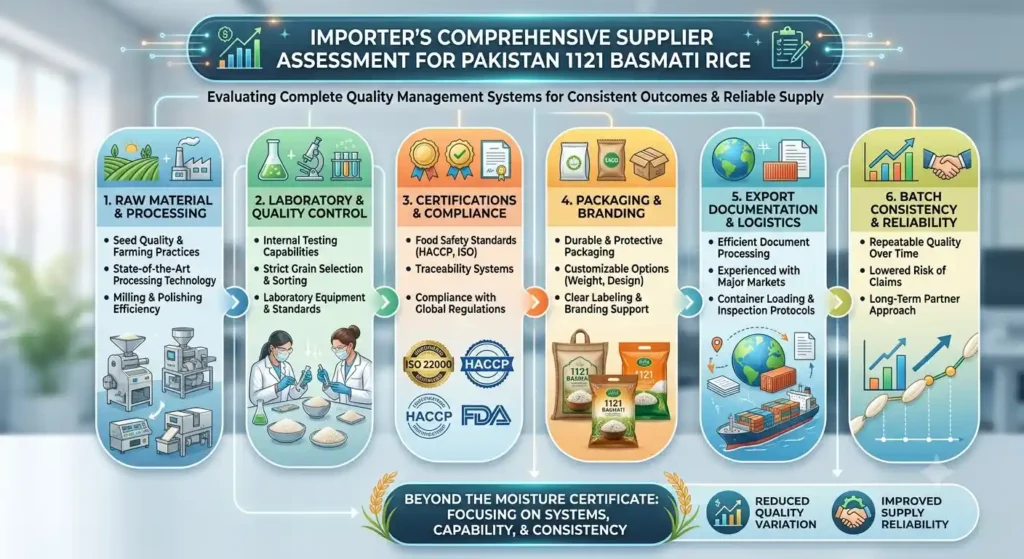
Importers achieve more consistent purchasing outcomes by evaluating complete quality management systems rather than focusing only on moisture certificates. Processing capability, laboratory controls, export documentation, packaging standards, and shipment consistency all contribute to successful long-term supply relationships.
A comprehensive supplier assessment should include:
- Moisture testing procedures
- Processing technology
- Laboratory facilities
- Food safety certifications
- Packaging options
- Traceability systems
- Export documentation
- Container loading procedures
- Previous export experience
- Batch consistency
These factors collectively reduce quality variation and improve supply reliability.
Saudi Arabian buyers continue to expect Pakistan 1121 Basmati rice with moisture levels maintained between 12.5% and 13.5%, supported by laboratory verification and consistent processing practices. This specification offers the strongest balance between storage stability, cooking quality, commercial acceptance, and long-distance shipping performance.
Comparing different moisture management methods shows that integrated quality systems combining mechanical drying, continuous testing, controlled warehousing, and proper packaging consistently produce the most reliable export results. While traditional drying remains suitable for some applications, premium international markets increasingly reward suppliers capable of delivering uniform moisture across every shipment.
As international standards continue evolving throughout 2026, moisture management remains one of the defining factors separating premium export-grade Pakistan 1121 Basmati rice from lower-value alternatives.
Frequently Asked Questions
What is the ideal moisture level for Pakistan 1121 Basmati rice exported to Saudi Arabia?
Saudi Arabian importers generally expect Pakistan 1121 Basmati rice to have a moisture level between 12.5% and 13.5%. This range helps maintain grain quality, aroma, shelf life, and safe transportation during export.
Why is moisture content important in Basmati rice exports?
Moisture content affects storage stability, cooking performance, grain appearance, and the risk of mould or spoilage. Maintaining the correct moisture level ensures the rice reaches buyers in premium condition.
How is the moisture level of export rice measured?
Exporters use calibrated digital moisture meters and laboratory testing at multiple processing stages, including drying, milling, packaging, and container loading, to verify moisture levels before shipment.
What happens if the moisture level is above 14%?
Rice with moisture above 14% has a higher risk of fungal growth, insect activity, quality deterioration, and shorter shelf life. Many international buyers may reject shipments that exceed agreed moisture specifications.
Does moisture content affect the price of Pakistan 1121 Basmati rice?
Yes. Rice that consistently meets export-grade moisture specifications usually commands better prices because it reduces storage risks, improves quality consistency, and satisfies importer requirements.
What packaging helps maintain proper moisture during shipping?
Food-grade PP woven bags, BOPP laminated bags, non-woven bags, paper bags, and vacuum packaging help protect rice from moisture changes during transportation when combined with proper container loading practices.
Do Saudi Arabian and European buyers require the same moisture standards?
Both markets generally prefer moisture levels around 12.5%–13.5%, but European buyers often require additional documentation, traceability, and food safety certifications alongside moisture compliance.
How can importers verify the moisture level before purchasing?
Importers can request laboratory test reports, third-party inspection certificates, pre-shipment quality reports, and moisture analysis documents to confirm that the rice meets the agreed export specifications.