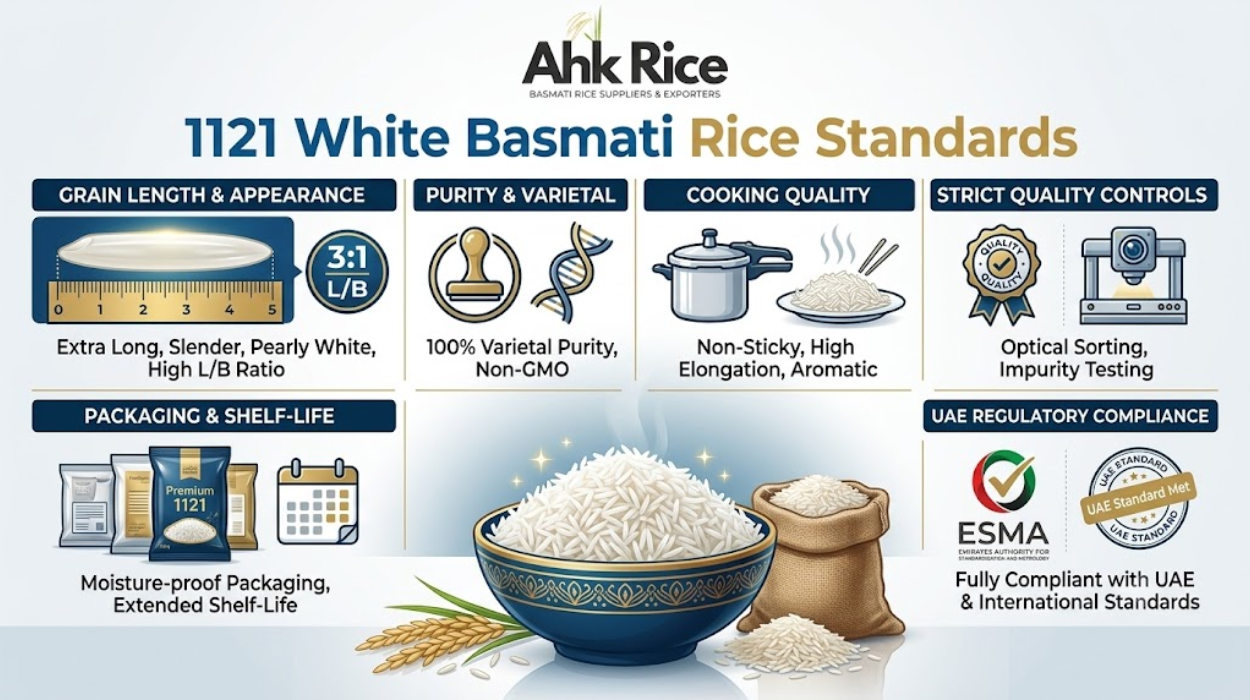
1121 White Basmati Rice Quality Standards for UAE Food Distributors
Food distributors in the UAE achieve the most consistent supply results by sourcing 1121 White Basmati Rice that complies with internationally recognised export quality standards, verified laboratory testing, and buyer-specific specifications rather than purchasing solely on price.
The UAE imports large volumes of premium rice every year to supply supermarkets, wholesalers, hotels, restaurants, catering companies, and food manufacturers. Buyers require consistent grain length, aroma, moisture control, packaging integrity, and shipment reliability. Understanding these quality standards helps distributors reduce commercial risk, improve customer satisfaction, and maintain stable inventory quality.
Before evaluating suppliers, distributors should first understand how Pakistani Basmati grades differ and how export specifications affect quality consistency. This foundation complements our guide explaining:
Understanding Bulk Quantity Options for 1121 White Basmati Rice Imports
Among Pakistan’s premium export varieties, 1121 White Basmati Rice is supplied by exporters such as AHK Rice, a Punjab-based exporter providing complete processing, grading, custom packaging, and international export documentation for buyers across more than 15 countries.
What quality standards should UAE food distributors expect from 1121 White Basmati Rice?
Every UAE distributor should evaluate 1121 White Basmati Rice against measurable export specifications including grain purity, moisture percentage, broken grain limits, milling quality, aroma retention, food safety certification, packaging standards, laboratory verification, and shipment consistency because these factors directly determine commercial performance after import.
Unlike commodity rice, premium Basmati is traded through detailed specifications.
Professional exporters define quality using measurable parameters rather than marketing claims.
The most common export specifications include:
| Specification | Preferred Export Standard |
|---|---|
| Variety Purity | 1121 White Basmati |
| Grain Length | Extra-long grain |
| Moisture | Around 12–13% |
| Broken Grains | Buyer specification (commonly 1–5%) |
| Foreign Matter | Near zero after sorting |
| Milling Degree | Well polished according to buyer preference |
| Crop Year | Current or aged according to contract |
These specifications remain consistent across most UAE import contracts.
Laboratory testing verifies these values before shipment.
Professional exporters also perform:
- Colour sorting
- Length grading
- Destoning
- Metal detection
- Moisture testing
- Quality inspection before loading
Every stage reduces the probability of claims after arrival.
How do different quality approaches compare for UAE importers?
Food distributors generally choose between specification-based sourcing, price-driven purchasing, mixed-grade buying, or customised export programmes. Specification-based procurement consistently delivers the best balance of quality consistency, customer satisfaction, inventory control, and long-term profitability across UAE wholesale distribution channels.
Not every supplier follows the same production process.
Some compete mainly on price.
Others compete through controlled processing.
The differences become clear during storage and resale.
Comparison of Common Procurement Approaches
| Attribute | Specification-Based Export | Low-Price Buying | Mixed Grade Procurement | Custom Export Programme |
|---|---|---|---|---|
| Grain Uniformity | Excellent | Variable | Moderate | Excellent |
| Aroma Consistency | High | Medium | Medium | High |
| Laboratory Testing | Included | Limited | Partial | Included |
| Packaging Options | Flexible | Standard | Limited | Fully Custom |
| Buyer Specifications | Fully Supported | Limited | Moderate | Fully Supported |
| Export Documentation | Complete | Basic | Variable | Complete |
| Long-Term Consistency | Excellent | Low | Moderate | Excellent |
The specification-based approach creates predictable inventory.
Price-driven sourcing often produces inconsistent batches.
Mixed-grade procurement reduces procurement cost but introduces variation.
Custom export programmes allow distributors to align specifications with their own market.
Which grades are most suitable for different UAE market segments?
Different UAE customer groups require different grades of 1121 White Basmati Rice because retail supermarkets, food service distributors, luxury hospitality businesses, wholesale traders, and private-label brands each prioritise unique combinations of appearance, cooking performance, price, packaging, and consistency.
The UAE serves multiple consumer categories.
Each category values different quality characteristics.
Premium Retail
Preferred grade:
- 1% Broken
- Extra-long grain
- Bright appearance
- Premium packaging
Customers expect visual perfection.
Hotels and Fine Dining
Preferred grade:
- 1–2% Broken
- Strong aroma
- Excellent elongation
- Uniform cooking
Presentation is critical.
Restaurants
Preferred grade:
- 2–5% Broken
Restaurant operators balance quality with operating costs.
Consistency matters more than cosmetic perfection.
Wholesale Distribution
Preferred grade:
- 5% Broken
Wholesalers often supply mixed customer groups.
Competitive pricing becomes important.
Private Label Brands
Preferred grade depends entirely on branding strategy.
Many UAE retailers specify:
- customised packaging
- barcode printing
- multilingual labels
- retail-ready bags
How do UAE and other Gulf markets differ in quality preferences?
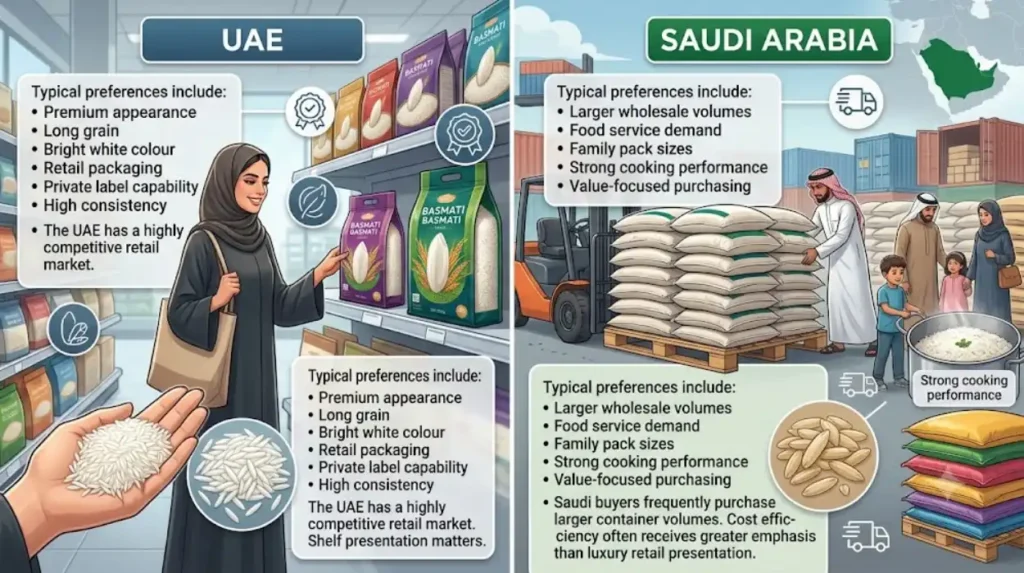
Although GCC countries purchase similar Basmati varieties, distributors should recognise that buyer expectations differ between regional markets. Understanding these differences improves inventory planning, contract negotiations, packaging decisions, and long-term export relationships across the Gulf region.
UAE
Typical preferences include:
- Premium appearance
- Long grain
- Bright white colour
- Retail packaging
- Private label capability
- High consistency
The UAE has a highly competitive retail market.
Shelf presentation matters.
Saudi Arabia
Typical preferences include:
- Larger wholesale volumes
- Food service demand
- Family pack sizes
- Strong cooking performance
- Value-focused purchasing
Saudi buyers frequently purchase larger container volumes.
Cost efficiency often receives greater emphasis than luxury retail presentation.
How does price per metric ton compare between different export grades?
Export prices vary according to broken percentage, crop condition, milling quality, packaging requirements, certification, and freight costs. Higher grades generally achieve stronger commercial value because distributors experience fewer complaints, lower product losses, and greater customer retention after resale.
Typical 2026 export pricing trends:
| Grade | Typical FOB Price Range (USD/MT)* |
|---|---|
| 1121 White 1% Broken | Highest |
| 1121 White 2% Broken | High |
| 1121 White 5% Broken | Medium |
| 1121 White 10% Broken | Lower |
*Actual export prices fluctuate according to crop conditions, exchange rates, freight costs, seasonal demand, container availability, and contract volume throughout 2026.
Selecting the lowest-priced product does not always reduce total procurement cost.
Better specifications frequently lower post-sale claims.
How does shelf life compare across different quality levels?
Shelf life depends more on moisture management, storage conditions, packaging quality, and handling practices than on price alone. Properly processed 1121 White Basmati Rice maintains premium cooking quality significantly longer than poorly processed rice with excessive moisture.
Shelf Life Comparison
| Product Condition | Expected Shelf Life |
|---|---|
| Vacuum packed | Up to 24 months |
| PP woven export bags | Around 18–24 months |
| Retail laminated packaging | Around 24 months |
| High moisture rice | Reduced storage stability |
Ideal storage conditions include:
- Cool warehouses
- Low humidity
- Dry pallets
- Ventilated containers
- No direct sunlight
Proper storage preserves aroma.
It also maintains cooking performance.
What are the advantages and disadvantages of different sourcing strategies?
Every sourcing strategy offers commercial benefits and trade-offs. The most successful distributors evaluate quality consistency, operational efficiency, customer expectations, and long-term purchasing costs instead of focusing only on initial product pricing.
Strategy 1 — Premium Specification Buying
Advantages
- Consistent quality
- Better customer satisfaction
- Lower complaint rates
- Stronger brand reputation
Disadvantages
- Higher purchase cost
Example:
Luxury supermarket chains benefit from premium specifications because appearance influences consumer purchasing decisions.
Strategy 2 — Cost-Focused Buying
Advantages
- Lower initial investment
- Competitive pricing
Disadvantages
- Greater quality variation
- More customer complaints
- Higher inspection requirements
Example:
Budget wholesale markets often choose this strategy.
Strategy 3 — Custom Specification Contracts
Advantages
- Tailored quality
- Flexible packaging
- Stable supply
Disadvantages
- Requires detailed planning
Example:
Private label distributors typically use customised contracts.
Which solution works best for different distributor types?
The most appropriate sourcing method depends on customer profile, sales channel, inventory turnover, branding strategy, packaging requirements, and acceptable quality variation. Matching procurement specifications to business objectives produces the strongest commercial performance.
Decision Framework
| Distributor Type | Recommended Grade | Best Procurement Method | Main Priority | Overall Suitability |
|---|---|---|---|---|
| Premium Retail | 1% Broken | Specification-Based | Appearance | Excellent |
| Hotels | 1–2% Broken | Long-Term Contract | Cooking Quality | Excellent |
| Restaurants | 2–5% Broken | Volume Contract | Value | Very Good |
| Wholesalers | 5% Broken | Mixed Procurement | Cost Balance | Good |
| Private Label | Custom Grade | Custom Export Programme | Brand Control | Excellent |
This framework simplifies procurement decisions.
Each business should align specifications with its own customer expectations.
What should distributors evaluate before selecting an exporter?
Reliable exporters consistently provide documented quality assurance, transparent production processes, internationally recognised certifications, laboratory verification, flexible packaging, shipment traceability, and responsive communication throughout the export process because these capabilities reduce operational risks for food distributors.
Important evaluation factors include:
- Factory processing capability
- Colour sorting technology
- Modern milling equipment
- Export experience
- Food safety compliance
- Traceability systems
- Third-party inspection availability
- Packaging flexibility
- Production capacity
- Container loading quality
Requesting samples before contract confirmation allows distributors to compare grain quality, cooking performance, aroma, and consistency under their own evaluation procedures.
Selecting 1121 White Basmati Rice for the UAE market requires more than comparing prices. Successful distributors evaluate measurable export specifications, laboratory-tested quality, grade consistency, storage stability, and supplier capability. A structured procurement approach reduces commercial risk while improving customer satisfaction across retail, wholesale, hospitality, and private-label channels.
For buyers who have completed the evaluation stage and are ready to compare export specifications, certifications, packaging options, and shipment processes, the next step is our guide on:
Choosing an export partner that guarantees consistent 1121 White Basmati Rice quality.
Frequently Asked Questions
What quality certifications should UAE food distributors look for when importing 1121 White Basmati Rice?
UAE food distributors should look for exporters with certifications such as ISO 22000, HACCP, BRCGS (where applicable), Halal certification, and phytosanitary compliance. These standards help ensure food safety, quality consistency, and smooth customs clearance.
How is the quality of 1121 White Basmati Rice tested before export?
Quality is tested through laboratory analysis and factory inspections. Exporters typically check grain length, moisture content, broken percentage, purity, foreign matter, milling quality, cooking performance, and aroma before shipment.
Which grade of 1121 White Basmati Rice is best for UAE supermarkets?
For supermarkets and premium retail brands, 1% or 2% broken 1121 White Basmati Rice is usually preferred because it offers excellent appearance, long grain length, and consistent cooking quality.
Does lower-priced 1121 White Basmati Rice always provide better value?
No. Lower-priced rice may have higher broken percentages or inconsistent quality. Many distributors find that premium specifications reduce customer complaints, minimise product losses, and provide better long-term value.
What is the typical shelf life of 1121 White Basmati Rice?
When properly processed and stored in suitable packaging, 1121 White Basmati Rice generally has a shelf life of 18 to 24 months while maintaining its quality, aroma, and cooking performance.
Why is moisture content important in exported Basmati rice?
Maintaining the correct moisture level helps preserve grain quality, reduces the risk of spoilage during storage and shipping, and supports a longer shelf life for imported rice.
Can exporters customise packaging for UAE food distributors?
Yes. Most experienced Pakistani exporters offer customised packaging, including private-label printing, multilingual labels, barcode integration, retail bags, and bulk packaging to meet UAE market requirements.
What should distributors request before placing a bulk rice order?
Before confirming a bulk order, distributors should request product samples, detailed specifications, laboratory test reports, certification documents, packaging options, and shipment timelines to verify the supplier’s quality standards.