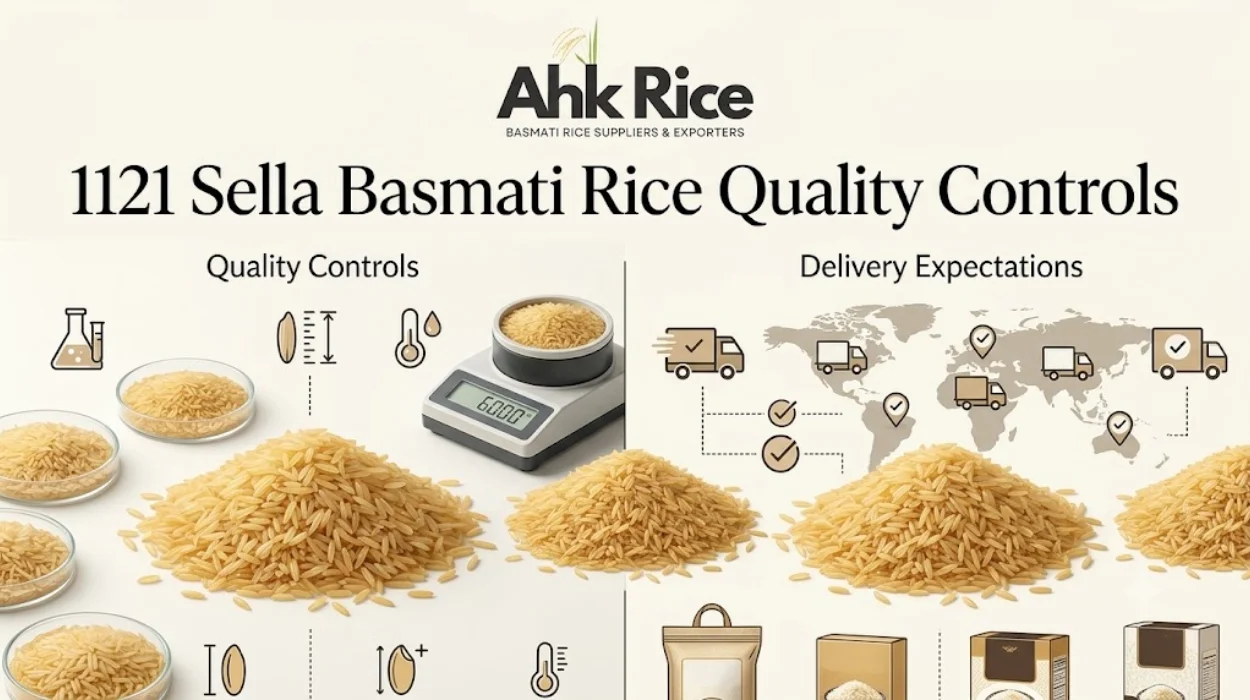
1121 Sella Basmati Rice Quality Controls and Delivery Expectations
When importing 1121 Sella Basmati Rice, quality control standards and supplier delivery performance determine the overall value of every shipment more than price alone. Buyers who evaluate inspection procedures, processing consistency, documentation, and delivery planning reduce commercial risk while maintaining consistent product quality throughout the supply chain.
Importers sourcing Pakistani Basmati increasingly compare suppliers based on production controls rather than quotations alone. Understanding Pakistan’s production capacity helps buyers evaluate long-term availability before selecting a supplier. Read our guide on:
How Much 1121 Sella Basmati Rice Can Pakistan Supply?) to understand seasonal supply before comparing quality assurance systems.
AHK Rice is a trusted Pakistani Basmati rice exporter based in Punjab, supplying:
Partner with AHK Rice for 1121 Sella Rice Supply together with Super Kernel and 1509 varieties to more than 15 countries through integrated processing, grading, custom packaging, and complete export management.
What quality controls should buyers expect for 1121 Sella Basmati Rice?
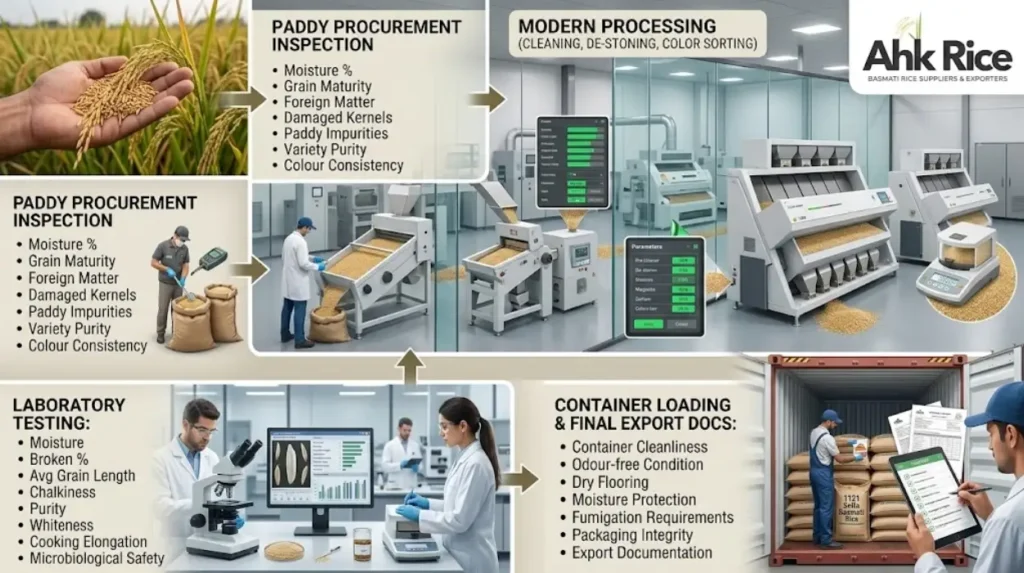
A reliable quality control system for 1121 Sella Basmati Rice includes inspection from paddy procurement through processing, grading, packaging, laboratory testing, container loading, and export documentation. Every stage protects grain consistency, food safety, shipment compliance, and customer specifications while reducing commercial disputes after arrival.
Quality control begins long before rice enters the processing line. Reliable exporters source mature paddy from established farming regions across Punjab, where climatic conditions support long-grain Basmati cultivation.
Each incoming lot undergoes inspection for:
- Moisture percentage
- Grain maturity
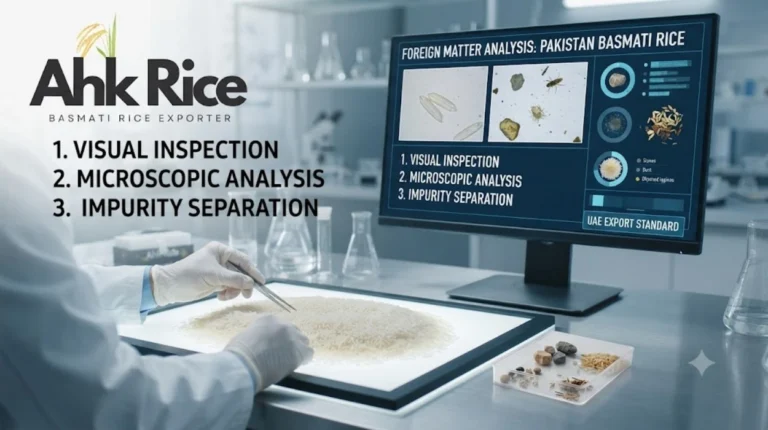
- Foreign matter
- Damaged kernels
- Paddy impurities
- Variety purity
- Colour consistency
Modern processing facilities remove impurities using pre-cleaners, de-stoners, magnetic separators, graders, polishers, colour sorters, and length graders.
After processing, every production batch is sampled before packaging.
Typical laboratory checks include:
- Moisture
- Broken percentage
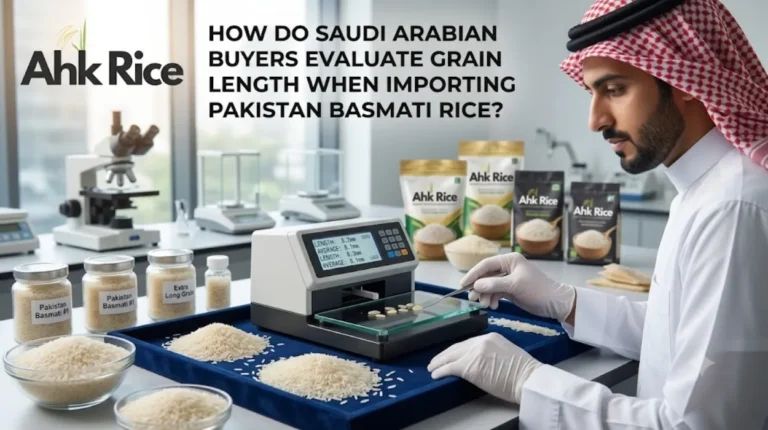
- Average grain length
- Chalkiness
- Purity
- Whiteness
- Cooking elongation
- Microbiological safety
Container inspections verify:
- Cleanliness
- Odour-free condition
- Dry flooring
- Moisture protection
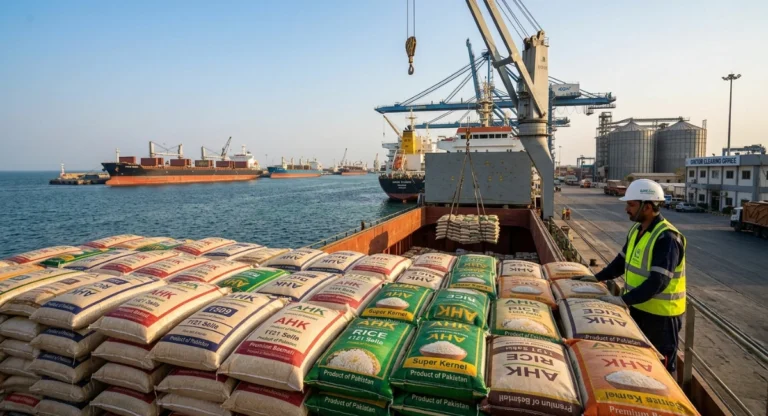
- Correct fumigation requirements
- Packaging integrity
These controls reduce rejection risks at destination ports.
How do different quality assurance approaches compare?
Different exporters apply varying quality assurance systems. Integrated processing with laboratory verification provides the highest consistency, while traders relying on outsourced milling often experience greater variation between shipments, delivery schedules, and final specifications across production batches.
Not every supplier controls the same stages.
Some exporters own processing facilities.
Others purchase finished rice from independent mills.
The level of control directly affects shipment consistency.
Comparison of Quality Control Systems
| Attribute | Integrated Export Processing | Outsourced Milling | Spot Market Trading |
|---|---|---|---|
| Raw paddy inspection | Complete | Partial | Limited |
| Processing control | High | Moderate | Low |
| Batch consistency | Excellent | Good | Variable |
| Traceability | Full | Partial | Minimal |
| Laboratory testing | Routine | Selective | Limited |
| Packaging control | Complete | Shared | Variable |
| Delivery reliability | High | Moderate | Lower |
Integrated processing reduces variation because every stage remains under one operational system.
Third-party sourcing introduces additional variables that buyers cannot always verify before shipment.
What quality specifications should importers compare before ordering?
Comparing measurable specifications provides a better purchasing decision than comparing prices alone. Grain length, moisture, broken percentage, purity, colour, cooking performance, and packaging standards determine commercial value, customer satisfaction, and long-term supplier reliability across international markets.
Buyers should compare objective specifications rather than relying on product descriptions.
1121 Sella Basmati Rice Specification Comparison
| Specification | Premium Export Grade |
|---|---|
| Variety | 1121 Basmati |
| Processing | Sella (Parboiled) |
| Average Grain Length | 8.30 mm+ |
| Moisture | Maximum 13% |
| Broken Rice | 1–5% (customer specification) |
| Foreign Matter | Nil after processing |
| Packaging | 5kg–50kg PP or BOPP bags |
Additional buyer requirements often include:
- Private label packaging
- Barcode printing
- Multilingual bags
- Retail-ready packaging
- Palletisation
- Container fumigation certificates
Clear specifications reduce misunderstandings during production.
Which grades do different international markets prefer?
Different importing regions purchase different grades according to consumer demand, retail positioning, and price expectations. Matching the correct specification with each destination improves customer satisfaction, inventory turnover, and long-term commercial relationships between exporters and importers.
Different markets prioritise different grades.
Middle East
Preferred grades include:
- Premium 1121 Sella
- Extra Long Grain
- Low broken percentage
- Premium packaging
- Strong cooking elongation
Countries commonly value visual appearance alongside cooking performance.
Europe
European buyers typically emphasise:
- Food safety documentation
- Traceability
- Consistent laboratory reports
- Uniform grain quality
- Retail packaging standards
Compliance documentation carries significant importance alongside physical quality.
How does price per metric ton compare across quality levels?
Price differences between grades mainly reflect grain selection, processing quality, specification consistency, packaging requirements, and logistics rather than simple production costs. Buyers comparing landed value instead of invoice price usually achieve stronger commercial performance over multiple shipments.
Indicative 2026 export pricing varies according to:
- Crop condition
- Container availability
- Destination
- Packaging
- Grade
- Quantity
Indicative Export Comparison (2026)
| Grade | Indicative FOB Price (USD/MT) |
|---|---|
| Standard Export Grade | 1,020–1,090 |
| Premium Grade | 1,090–1,170 |
| Extra Premium Selected Grade | 1,170–1,260 |
Higher grades generally reduce customer complaints, improve retail presentation, and minimise quality claims.
How long can properly processed 1121 Sella Basmati Rice be stored?
Proper storage conditions preserve grain quality for extended periods. Moisture control, packaging quality, warehouse ventilation, and temperature management collectively determine shelf life while maintaining aroma, cooking characteristics, and commercial appearance throughout domestic storage and international transportation.
Shelf Life Comparison
| Storage Condition | Expected Shelf Life |
|---|---|
| Controlled warehouse | 24 months |
| Retail packaged product | 18–24 months |
| Humid storage | Reduced quality |
| Damaged packaging | Increased contamination risk |
Best storage practices include:
- Dry warehouses
- Good ventilation
- Elevated pallets
- Low humidity
- Pest monitoring
- Intact packaging
Proper storage preserves cooking quality until final consumption.
Which sourcing approach works best for different buyers?
The most suitable sourcing strategy depends on purchase volume, quality requirements, private label needs, destination regulations, and long-term procurement objectives rather than selecting the lowest available quotation for each shipment independently.
Decision Framework
| Buyer Situation | Recommended Approach | Main Benefit | Limitation | Best For |
|---|---|---|---|---|
| New importer | Small trial shipment | Lower risk | Higher unit cost | Market testing |
| Wholesale distributor | Annual supply contract | Stable pricing | Forecast planning required | Continuous supply |
| Retail brand | Custom packaging | Brand consistency | Longer preparation | Supermarkets |
| Government tender | Strict specification contracts | Compliance | Extensive documentation | Public procurement |
| Food manufacturer | Bulk industrial supply | Cost efficiency | Less retail flexibility | Processing industries |
Selecting the appropriate sourcing model improves operational efficiency and inventory planning.
What are the advantages and limitations of different quality control methods?
Every quality assurance method offers measurable benefits depending on production scale, customer requirements, and inspection frequency. Combining automated processing with laboratory verification delivers the highest consistency while reducing avoidable quality variations throughout international export operations.
Automated Processing
Advantages
- Consistent grading
- Higher efficiency
- Better impurity removal
- Improved colour sorting
Limitations
- Higher capital investment
- Requires regular calibration
Example
Large-volume export facilities use automated colour sorting to remove defective kernels before packaging.
Manual Inspection
Advantages
- Additional visual verification
- Flexible quality review
Limitations
- Labour intensive
- Less scalable
Example
Inspectors verify packaging quality before container sealing.
Third-Party Laboratory Testing
Advantages
- Independent verification
- Increased buyer confidence
Limitations
- Additional testing cost
- Extended documentation timeline
Example
Importers may request independent laboratory analysis before shipment release.
Combining these approaches provides stronger quality assurance than relying on one inspection method alone.
Which delivery expectations should buyers confirm before placing an order?
Delivery expectations should be agreed before production begins. Processing schedules, packaging timelines, documentation preparation, container availability, customs procedures, and shipping bookings collectively determine whether shipments reach destination markets according to commercial agreements.
A complete delivery schedule typically includes:
- Production planning
- Packaging completion
- Laboratory approval
- Container booking
- Customs clearance
- Vessel loading
- Shipping documentation
- Bill of Lading issuance
Typical export lead times depend on:
- Order volume
- Packaging complexity
- Destination
- Shipping schedules
- Seasonal demand
Importers should also verify:
- Incoterms
- Payment milestones
- Inspection requirements
- Certificate availability
- Insurance responsibilities
Clear communication throughout production helps minimise unexpected delays.
Quality control and delivery reliability remain the two strongest indicators of long-term supplier performance for 1121 Sella Basmati Rice. Buyers who compare measurable specifications, integrated processing systems, laboratory verification, documentation standards, storage practices, and delivery planning gain a clearer understanding of total procurement value rather than focusing solely on price.
Selecting suppliers that maintain traceable production, consistent grading, comprehensive inspection procedures, and predictable export timelines supports stable supply chains across wholesale, retail, food manufacturing, and government procurement markets.
Frequently Asked Questions
How is 1121 Sella Basmati Rice quality checked before export?
Quality is checked through paddy inspection, processing, laboratory testing, grading, colour sorting, moisture analysis, and final container inspection before shipment.
What is the standard moisture level for export-quality 1121 Sella Basmati Rice?
Most export shipments maintain a maximum moisture content of 13% to preserve grain quality, shelf life, and cooking performance during storage and transportation.
Which markets import premium 1121 Sella Basmati Rice?
The Middle East, Europe, North America, Africa, and parts of Asia are major import markets, with each region preferring specific grades and packaging formats.
What factors affect the price of 1121 Sella Basmati Rice?
Prices depend on grain quality, broken percentage, packaging type, processing standards, crop availability, order volume, destination, and shipping costs.
How long can 1121 Sella Basmati Rice be stored?
When stored in a cool, dry warehouse with proper packaging, 1121 Sella Basmati Rice typically has a shelf life of up to 24 months.
What documents should buyers request before shipment?
Buyers should request the commercial invoice, packing list, certificate of origin, phytosanitary certificate, fumigation certificate, bill of lading, and quality inspection reports.
Why is laboratory testing important for rice exports?
Laboratory testing verifies moisture, purity, broken percentage, grain length, and food safety, helping ensure the shipment meets buyer specifications and import regulations.
How can importers choose a reliable 1121 Sella Basmati Rice supplier?
Choose suppliers with integrated processing facilities, consistent quality control systems, export certifications, transparent documentation, and a proven international supply record.