Bulk Ordering Guide for 1509 Creamy Sella Basmati Rice
Bulk ordering 1509 Creamy Sella Basmati Rice requires buyers to understand grain specifications, processing methods, export grades, packaging standards, quality certifications, and destination market requirements before placing a commercial order. Selecting the correct specification improves product consistency, transportation safety, storage stability, and customer satisfaction throughout the supply chain.
Pakistan remains one of the world’s leading producers of 1509 Basmati rice. The variety is cultivated primarily in Punjab, where fertile alluvial soils, irrigation infrastructure, and suitable climatic conditions support high-yield production. Exporters such as AHK Rice process this variety for international buyers through cleaning, grading, color sorting, polishing, packaging, and containerized shipment according to importing country requirements.
Understanding the complete bulk purchasing process allows wholesalers, distributors, supermarket chains, foodservice companies, and rice importers to compare suppliers using measurable quality parameters instead of relying only on price.
What is 1509 Creamy Sella Basmati Rice?
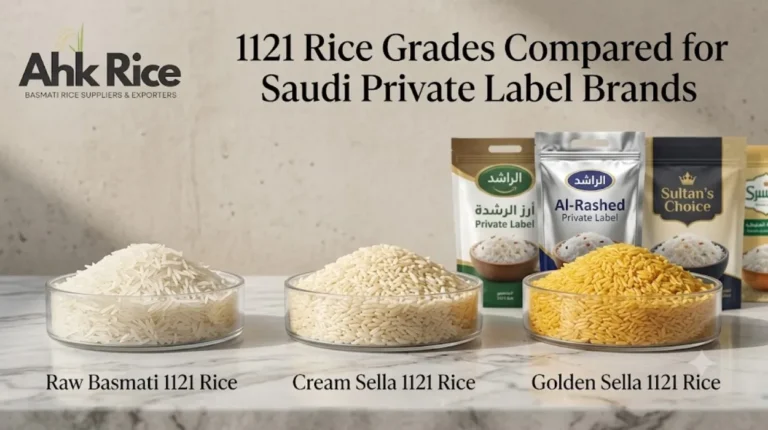
1509 Creamy Sella Basmati Rice is a parboiled long-grain aromatic rice variety developed from Basmati breeding programs. It combines high grain length, low breakage, creamy golden appearance, firm cooked texture, and excellent cooking expansion for commercial food distribution.
1509 refers to the rice variety rather than the processing method. Creamy Sella refers to the parboiling treatment that gives the grains their characteristic light cream color while improving milling strength.
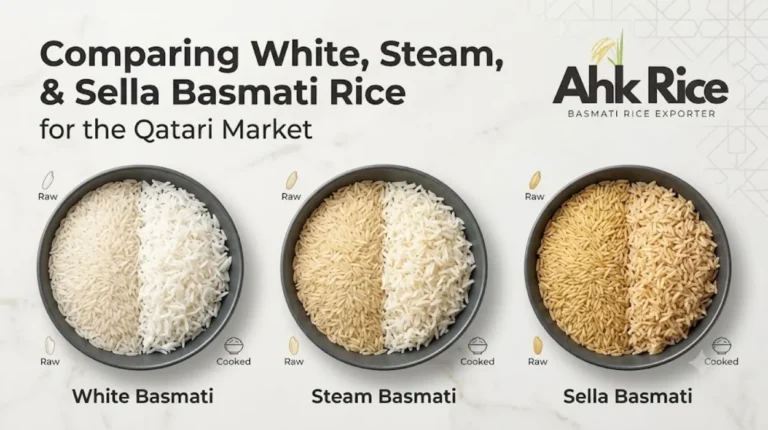
Unlike White Basmati Rice, Creamy Sella undergoes hydrothermal treatment before milling. The process gelatinizes starch inside the grain, making kernels harder and reducing breakage during polishing and transportation.
Compared with traditional Basmati varieties, 1509 produces:
- Longer grains
- Higher milling recovery
- Faster crop maturity
- Better yield per hectare
- Uniform grain appearance
- Strong cooking performance
These characteristics have increased its adoption across commercial food markets since its introduction.
Where is 1509 Creamy Sella Basmati Rice grown?
Pakistan produces 1509 Basmati mainly in Punjab.
Major producing districts include:
- Gujranwala
- Hafizabad
- Sheikhupura
- Narowal
- Sialkot
- Okara
- Nankana Sahib
These regions provide fertile soil, canal irrigation, and favorable temperatures during the growing season.
Farmers sow the crop between May and June. Harvesting generally occurs from October to November. After harvesting, paddy enters drying yards before transportation to modern rice mills.
How does the production process work?
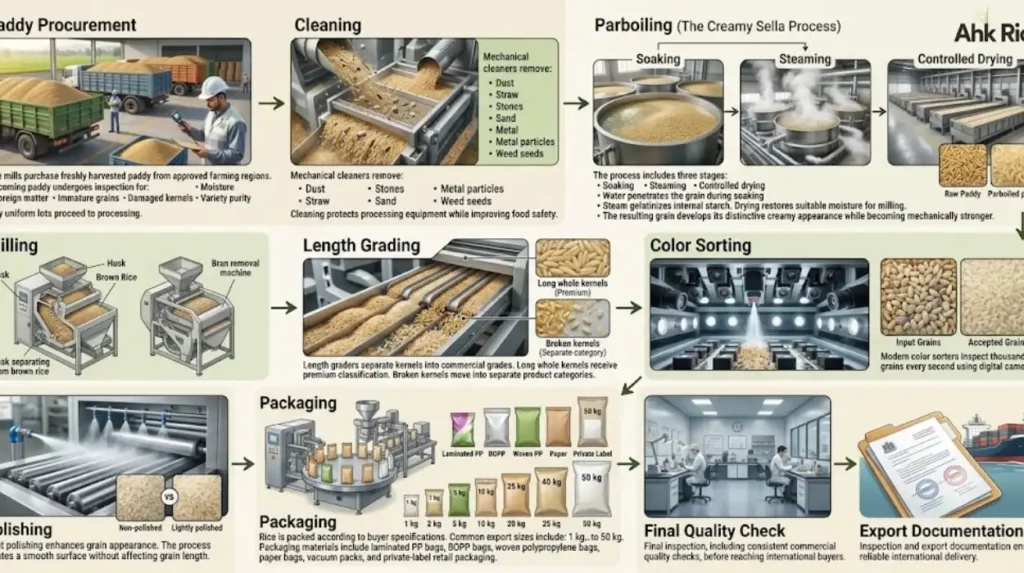
1509 Creamy Sella Basmati Rice passes through harvesting, drying, parboiling, milling, grading, sorting, polishing, packaging, inspection, and export documentation before reaching international buyers with consistent commercial quality.
Every production stage affects the final grain quality.
Paddy procurement
Rice mills purchase freshly harvested paddy from approved farming regions.
Incoming paddy undergoes inspection for:
- Moisture
- Foreign matter
- Immature grains
- Damaged kernels
- Variety purity
Only uniform lots proceed to processing.
Cleaning
Mechanical cleaners remove:
- Dust
- Straw
- Stones
- Sand
- Metal particles
- Weed seeds
Cleaning protects processing equipment while improving food safety.
Parboiling
Parboiling defines Creamy Sella rice.
The process includes three stages:
- Soaking
- Steaming
- Controlled drying
Water penetrates the grain during soaking.
Steam gelatinizes internal starch.
Drying restores suitable moisture for milling.
The resulting grain develops its distinctive creamy appearance while becoming mechanically stronger.
Milling
The dried paddy enters shelling machines.
The husk separates from brown rice.
Additional milling removes bran layers while preserving grain integrity.
Length grading
Length graders separate kernels into commercial grades.
Long whole kernels receive premium classification.
Broken kernels move into separate product categories.
Color sorting
Optical sorting machines remove:
- Chalky grains
- Dark kernels
- Foreign grains
- Discolored rice
Modern color sorters inspect thousands of grains every second using digital cameras.
Polishing
Light polishing enhances grain appearance.
The process creates a smooth surface without affecting grain length.
Packaging
Rice is packed according to buyer specifications.
Common export sizes include:
- 1 kg
- 2 kg
- 5 kg
- 10 kg
- 20 kg
- 25 kg
- 40 kg
- 50 kg
Packaging materials include laminated PP bags, BOPP bags, woven polypropylene bags, paper bags, vacuum packs, and private-label retail packaging.
What are the key quality components buyers should evaluate?
Commercial buyers evaluate grain length, purity, moisture, broken percentage, chalkiness, foreign matter, cooking expansion, aroma, color consistency, packaging quality, and laboratory compliance before approving bulk rice shipments.
Each specification directly affects market performance.
Grain length
Long kernels improve retail presentation.
Premium export grades commonly measure approximately 8.0–8.4 mm before cooking.
Moisture
Controlled moisture supports storage stability.
Commercial export shipments generally maintain moisture around 12–14%, depending on buyer specifications and destination requirements.
Broken percentage
Broken rice influences commercial value.
Typical export grades include:
- 1%
- 2%
- 5%
- 10%
Lower broken percentages command higher prices.
Purity
Varietal purity ensures buyers receive only the contracted rice variety.
Mixed varieties reduce cooking consistency.
Foreign matter
Export-quality rice contains minimal foreign material after mechanical cleaning and optical sorting.
Cooking expansion
1509 Creamy Sella demonstrates excellent elongation during cooking.
Longer cooked grains improve food presentation in restaurants, catering operations, and hospitality businesses.
Aroma
Although 1509 is aromatic, its fragrance is generally lighter than traditional Basmati varieties such as Super Kernel or 1121.
Packaging integrity
Strong packaging protects rice from:
- Moisture
- Insects
- Dust
- Transportation damage
- Warehouse contamination
What grades of 1509 Creamy Sella Basmati Rice are available?
Exporters supply multiple commercial grades based on kernel length, broken percentage, milling quality, polishing level, and buyer specifications to serve wholesale, retail, hospitality, and institutional food markets.
Commercial grades generally include:
Premium Grade
Characteristics include:
- Uniform grain size
- Minimal broken kernels
- Excellent polish
- High varietal purity
- Strong cooking performance
Premium grades target supermarkets and premium retail brands.
Standard Export Grade
This grade balances quality and affordability.
It serves wholesalers, food distributors, and regional supermarket chains.
Hospitality Grade
Hotels and restaurants prioritize:
- Long cooked grains
- Attractive presentation
- Consistent texture
- Reliable cooking performance
Hospitality grades focus on these characteristics.
Economy Grade
Economy grades include higher allowable broken percentages while maintaining food safety requirements.
Institutional catering operations frequently purchase this category.
What are the benefits of buying 1509 Creamy Sella Basmati Rice in bulk?
Bulk purchasing improves supply continuity, pricing consistency, production planning, freight efficiency, packaging flexibility, inventory management, and long-term procurement stability for commercial food businesses.
Buying container quantities creates operational efficiencies throughout the supply chain.
Lower transportation cost per kilogram
Container shipments distribute freight costs across larger product volumes.
This reduces average transportation cost.
Consistent product quality
Large production batches provide uniform specifications across shipments.
Consistency improves customer satisfaction.
Flexible packaging
Bulk buyers frequently request:
- Private labels
- Multilingual packaging
- Retail branding
- Barcode printing
- Nutrition panels
Customized packaging supports local retail requirements.
Inventory planning
Predictable supply schedules simplify warehouse management.
Businesses avoid emergency purchasing at higher market prices.
Better production scheduling
Food manufacturers require consistent raw material supplies.
Bulk procurement reduces interruptions in production operations.
Which industries use 1509 Creamy Sella Basmati Rice?
1509 Creamy Sella Basmati Rice serves retail, foodservice, catering, hospitality, food manufacturing, wholesale distribution, humanitarian procurement, and institutional meal programs across international markets.
Different industries prioritize different specifications.
Supermarkets
Retail chains emphasize:
- Attractive packaging
- Uniform grain appearance
- Reliable cooking
- Brand consistency
Restaurants
Restaurants value:
- Grain elongation
- Non-sticky texture
- Plate presentation
- Batch consistency
Catering companies
Large-scale caterers require predictable cooking performance for banquet production.
Examples include wedding catering companies, airline catering kitchens, and corporate meal providers.
Food manufacturers
Manufacturers incorporate rice into products such as:
- Ready meals
- Frozen meals
- Rice mixes
- Seasoned rice products
Wholesalers
Wholesale distributors supply independent grocery stores, regional retailers, and foodservice businesses.
Which countries import 1509 Creamy Sella Basmati Rice?
International demand comes from regions requiring long-grain aromatic rice with stable cooking quality, competitive pricing, and reliable commercial supply throughout the year.
Major importing regions include:
Middle East
Countries include:
- United Arab Emirates
- Saudi Arabia
- Oman
- Qatar
- Bahrain
- Kuwait
These markets import significant quantities for retail and hospitality sectors.
Africa
Growing demand exists in countries including:
- South Africa
- Kenya
- Tanzania
- Mozambique
- Senegal
Importers serve expanding urban populations and foodservice businesses.
Europe
European buyers focus on:
- Food safety
- Product traceability
- Label compliance
- Residue monitoring
Ethnic food retailers and mainstream supermarkets both import Basmati rice.
North America
United States and Canadian importers supply:
- Ethnic grocery stores
- Restaurant distributors
- Retail chains
Quality documentation remains an important purchasing requirement.
Which certifications apply to export shipments?
Commercial exports require internationally recognized food safety, quality management, phytosanitary, and regulatory certifications that verify compliance with importing country requirements.
Certification requirements vary according to destination markets.
Common export documentation includes:
ISO 22000
This certification covers food safety management systems throughout processing.
HACCP
Hazard Analysis and Critical Control Points identifies and controls food safety risks during production.
Phytosanitary Certificate
National plant protection authorities issue phytosanitary certificates confirming compliance with plant health regulations.
Certificate of Origin
This document identifies Pakistan as the country of origin.
Many customs authorities require this certificate during import clearance.
Fumigation Certificate
Some importing countries require fumigation documentation before shipment.
Laboratory Analysis Reports
Independent laboratory reports often verify:
- Moisture
- Broken percentage
- Purity
- Foreign matter
- Grain length
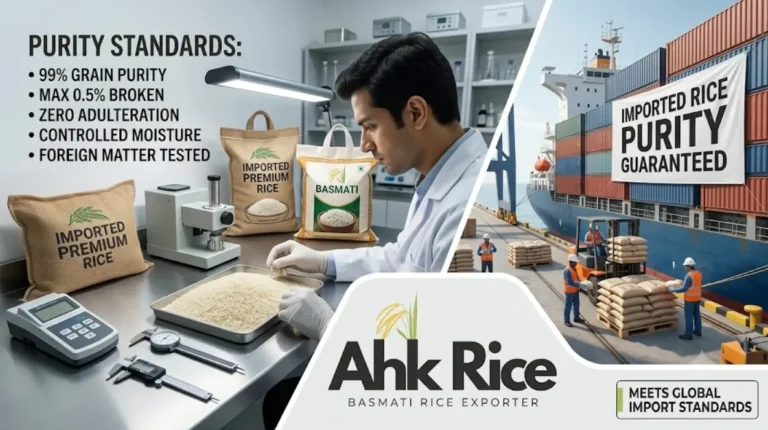
Buyers frequently request these reports before shipment approval.
What misconceptions affect bulk rice purchasing?
Many buyers focus only on price, but commercial success depends on complete product specifications, processing quality, documentation, packaging standards, and supplier consistency rather than invoice value alone.
Several misconceptions influence purchasing decisions.
Lowest price delivers the best value
Lower prices frequently reflect different specifications.
Higher broken percentages, inconsistent grading, or weaker packaging reduce commercial value.
All Creamy Sella rice is identical
Processing equipment, quality control systems, grading accuracy, and raw paddy quality differ between mills.
These differences produce measurable variations in finished rice.
Longer grain alone defines quality
Commercial quality combines several measurable specifications.
Examples include moisture, purity, broken percentage, cooking performance, packaging integrity, and documentation accuracy.
Packaging is only for transportation
Packaging protects food quality during international logistics, warehouse storage, retail display, and consumer handling.
Weak packaging increases product losses throughout the supply chain.
Understanding commercial specifications before ordering allows importers to compare suppliers based on measurable quality indicators rather than marketing claims. Buyers interested in inspection standards, grading methods, laboratory parameters, and shipment acceptance requirements should continue with the companion guide on quality specifications required by UAE rice importers through the:
1509 Creamy Sella Rice Quality Standards for UAE Importers.
Frequently Asked Questions
What is 1509 Creamy Sella Basmati Rice?
1509 Creamy Sella Basmati Rice is a long-grain aromatic rice variety that undergoes a parboiling process before milling. It is known for its creamy color, excellent grain length, firm texture, and consistent cooking performance for commercial food markets.
Why is 1509 Creamy Sella Rice suitable for bulk purchasing?
Its uniform grain quality, high milling recovery, strong storage stability, and reliable cooking characteristics make it an excellent choice for wholesalers, retailers, foodservice companies, and importers buying container quantities.
How is 1509 Creamy Sella Basmati Rice processed?
The rice is harvested, cleaned, soaked, steamed, dried, milled, graded, color sorted, polished, and packaged before export. Each processing stage improves grain quality and ensures compliance with international standards.
Which countries import 1509 Creamy Sella Basmati Rice?
Major importing markets include the UAE, Saudi Arabia, Qatar, Oman, Kuwait, Bahrain, South Africa, Kenya, the United Kingdom, Canada, and the United States, where demand remains strong across retail and hospitality sectors.
What quality specifications should buyers check before placing a bulk order?
Buyers should verify grain length, moisture content, broken percentage, varietal purity, foreign matter, cooking expansion, packaging quality, and laboratory inspection reports before confirming an order.
Which certifications are commonly required for exporting 1509 Creamy Sella Rice?
Common export certifications include ISO 22000, HACCP, Phytosanitary Certificate, Certificate of Origin, laboratory analysis reports, and other documents required by the destination country’s import regulations.
What packaging options are available for bulk exports?
Exporters typically supply 1 kg, 2 kg, 5 kg, 10 kg, 20 kg, 25 kg, and 50 kg bags using woven polypropylene, BOPP laminated, paper, or private-label packaging according to buyer requirements.
What industries commonly use 1509 Creamy Sella Basmati Rice?
The rice is widely used by supermarkets, wholesalers, restaurants, hotels, catering companies, food manufacturers, institutional kitchens, and international food distributors because of its consistent quality and cooking performance.