What Moisture Specifications Differentiate Premium and Standard Pakistan Rice for Saudi Arabia?
Saudi Arabian buyers consistently choose rice based on moisture specifications before evaluating price because moisture directly influences shelf life, grain appearance, storage stability, cooking consistency, and shipment safety. Premium-grade Pakistan rice follows tighter moisture control standards than standard-grade rice, resulting in lower storage risks and better long-distance export performance.
Saudi Arabia imports significant quantities of Pakistani Basmati rice every year for retail, hospitality, catering, and food service sectors. While grain length, aroma, and purity remain important purchasing factors, moisture content has become one of the most decisive quality parameters in import contracts throughout 2026. Moisture affects how rice performs throughout harvesting, milling, storage, container transportation, warehousing, and final cooking.
Importers wanting a deeper understanding of moisture inspection methods should first explore how Saudi buyers assess rice quality during procurement by reading our guide explaining the inspection practices used by Saudi importers when checking:
Pakistan Basmati rice moisture levels.
Premium and standard Pakistan rice are not defined by one specification alone. Moisture level combines with milling quality, broken percentage, foreign matter limits, chalkiness, grain uniformity, aging period, and packaging standards to create different commercial grades.
The first time Pakistan Basmati rice is discussed commercially, readers should also explore our guide explaining how to choose a supplier that consistently meets:
Saudi Arabian moisture Requirements.
What moisture specifications separate premium Pakistan rice from standard Pakistan rice for Saudi Arabia?
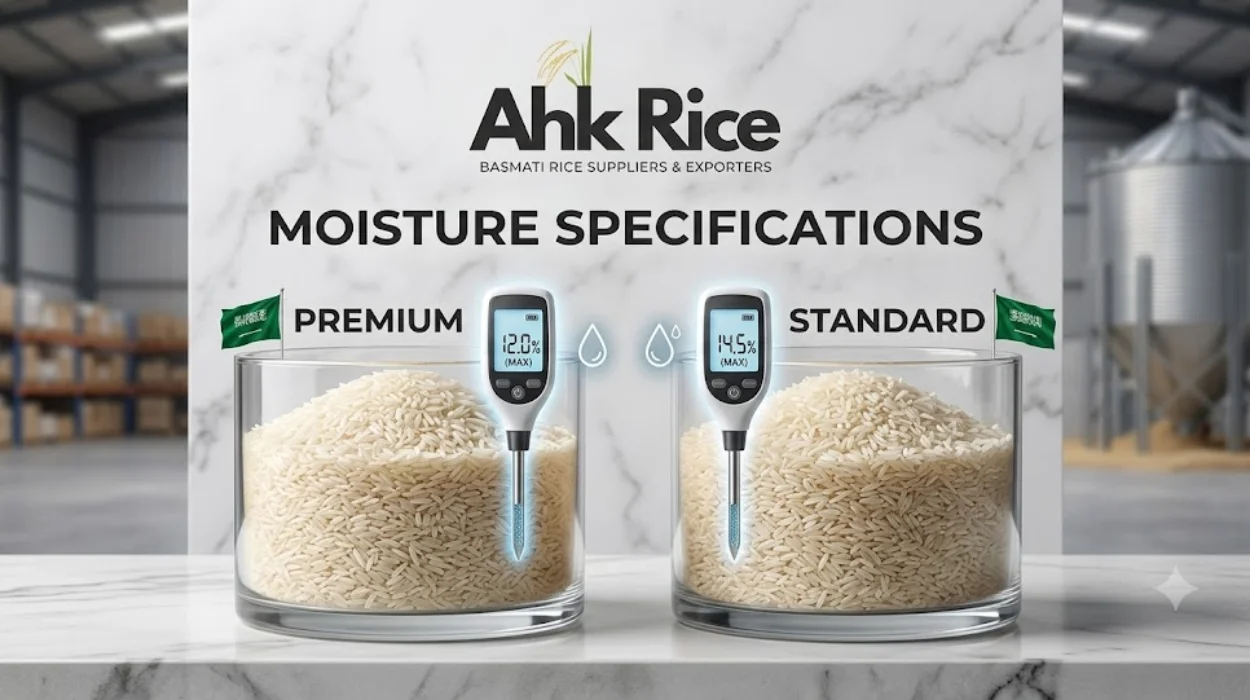
Premium Pakistan rice normally maintains moisture between 11.5% and 12.5%, while standard export rice commonly reaches 13.0% to 14.0%. Lower moisture improves storage stability, reduces microbial risks, protects grain appearance, minimizes breakage, and produces more consistent cooking results throughout Saudi Arabian distribution channels and warehouse conditions.
Moisture content refers to the percentage of water naturally present inside each rice grain. Every exporting country measures this value before shipment because excess moisture changes the physical and biological behavior of rice.
Premium Pakistan Basmati rice intended for Saudi Arabia is generally dried under carefully controlled conditions after milling. Exporters monitor moisture using calibrated digital moisture meters before packaging. Multiple quality inspections help maintain consistency across production batches.
Standard export grades also comply with commercial specifications, but they normally allow a slightly wider moisture tolerance. Although suitable for many markets, these grades require closer attention during storage and container transportation, particularly during warmer shipping seasons.
The practical differences become visible throughout the supply chain. Premium rice experiences lower condensation risk inside containers, better aroma preservation, stronger grain integrity, and longer warehouse stability. Standard rice remains commercially acceptable but may require faster inventory rotation.
Premium vs Standard Pakistan Rice Specification Comparison
| Specification | Premium Grade | Standard Grade |
|---|---|---|
| Moisture Content | 11.5–12.5% | 13.0–14.0% |
| Broken Grains | Lower percentage | Higher allowable percentage |
| Grain Uniformity | Very consistent | Moderate consistency |
| Aroma Retention | Excellent | Good |
| Storage Stability | Excellent | Moderate |
| Export Packaging | Premium multilayer options | Standard commercial packaging |
| Saudi Retail Suitability | High | Commercial distribution |
These differences explain why moisture specifications receive considerable attention during supplier qualification.
What moisture control solutions are available for Pakistan rice exports?
Modern Pakistan rice exporters apply several moisture-control solutions including controlled drying, digital moisture measurement, warehouse humidity management, moisture-resistant packaging, container inspection, and pre-shipment laboratory verification. Together these systems improve shipment stability, maintain grain quality, reduce commercial claims, and increase buyer confidence across Saudi Arabia.
Moisture control begins immediately after harvesting. Fresh paddy naturally contains moisture levels far above export requirements. Controlled drying gradually reduces moisture without damaging grain structure.
Mechanical drying provides predictable moisture reduction under monitored temperatures. Some exporters combine mechanical drying with natural conditioning to stabilize grain moisture before milling.
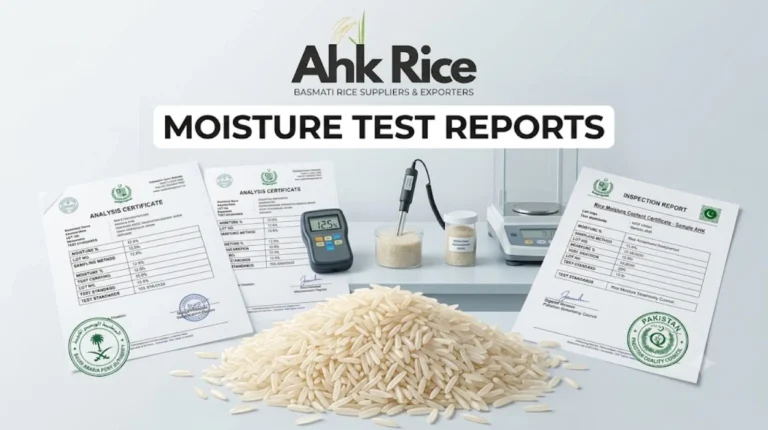
Digital moisture meters have become standard equipment across export facilities. Instead of relying on visual inspection, technicians test representative samples throughout production. Multiple readings ensure consistent moisture throughout the batch.
Climate-controlled warehouses represent another important solution. Rice stored under excessive humidity may gradually absorb moisture again. Controlled warehouse conditions reduce this possibility before container loading.
Packaging also contributes to moisture management. Multi-layer polypropylene bags, laminated bags, woven sacks with liners, and vacuum packaging each provide different protection levels depending on shipment duration and customer requirements.
Container inspection has become increasingly important for Saudi shipments. Export teams verify container cleanliness, ventilation, dryness, floor condition, and structural integrity before loading rice.
Laboratory verification completes the quality assurance process. Export documentation often includes moisture reports alongside purity, broken percentage, damaged grains, and foreign matter analysis.
Each solution addresses a different stage of the export chain rather than solving the issue independently.
How do different moisture management approaches compare?
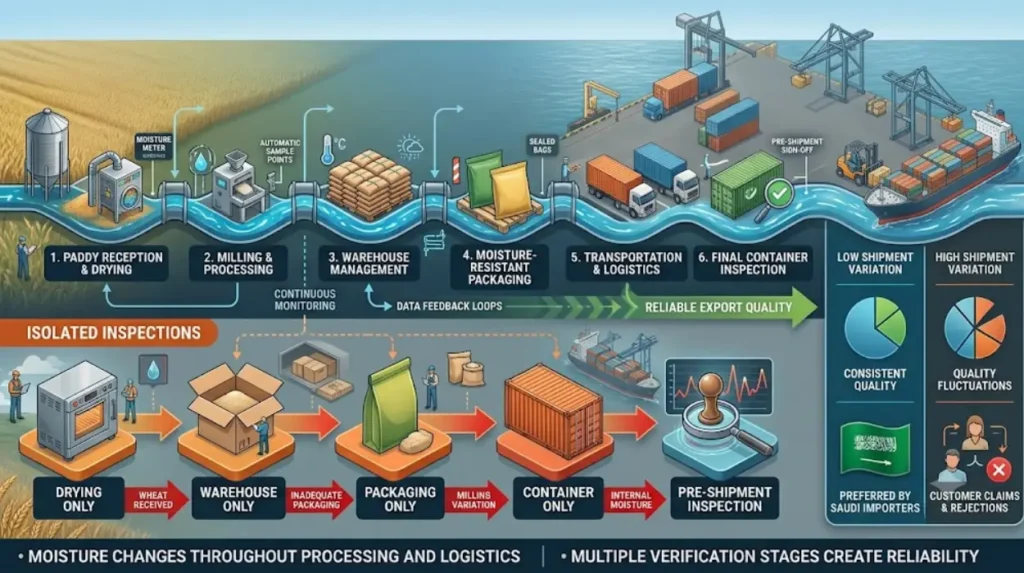
Integrated moisture management consistently performs better than relying on a single quality-control step because moisture changes throughout processing, storage, packaging, transportation, and warehousing. Multiple verification stages produce more reliable export quality than isolated inspections performed immediately before shipment alone.
Some exporters focus primarily on drying. Others emphasize packaging. The strongest systems combine every control point into one continuous quality process.
Controlled drying removes excess moisture but cannot prevent later moisture absorption.
Warehouse management preserves drying results but cannot compensate for incorrect packaging.
Moisture-resistant packaging protects rice during transportation but cannot correct moisture variation introduced during milling.
Container inspection prevents external moisture intrusion but cannot improve rice already containing excessive internal moisture.
Laboratory verification confirms product specifications but does not replace operational quality control.
Consequently, Saudi importers increasingly prefer suppliers using integrated quality systems where moisture receives continuous monitoring from paddy reception until container sealing.
The combination approach significantly reduces shipment variation across multiple containers ordered under the same contract.
How do Saudi Arabia and other regional markets differ in moisture preferences?
Saudi Arabian buyers generally prefer lower moisture premium Basmati suitable for extended storage and retail distribution, while nearby Gulf markets may accept slightly broader commercial specifications depending on intended food-service applications, inventory turnover, packaging formats, and customer purchasing strategies.
Different markets purchase rice for different commercial purposes.
Saudi Arabia supplies supermarkets, wholesalers, distributors, hotels, restaurants, institutional kitchens, and catering companies. Many buyers store inventory for several months before final sale.
Because of this distribution structure, lower moisture specifications provide operational advantages.
Other Gulf markets sometimes prioritize quicker distribution cycles where inventory moves more rapidly through wholesalers. Those purchasing strategies can accommodate slightly wider commercial moisture specifications depending on buyer requirements.
Regional Comparison
| Market Region | Preferred Grades | Typical Moisture Preference | Approximate Export Price (USD/MT, 2026)* | Typical Shelf Life |
|---|---|---|---|---|
| Saudi Arabia | Premium 1121 Steam, 1121 Sella, Premium Super Kernel | 11.5–12.5% | Higher due to tighter specifications | Up to 24 months with proper storage |
| Other GCC Markets | Premium and Commercial Grades | 12.0–13.5% depending on contract | Moderate to Premium | 18–24 months with proper storage |
*Prices vary according to harvest conditions, freight costs, exchange rates, packaging specifications, and contract volume during 2026.
Lower moisture alone does not determine pricing. Quality consistency across every shipment contributes equally to export value.
Which moisture specification works best for different purchasing situations?
The most suitable moisture specification depends on inventory duration, customer segment, distribution model, transportation distance, storage infrastructure, packaging type, and intended cooking performance. Premium specifications benefit long-term storage, while commercial specifications adequately support faster inventory turnover and shorter supply cycles.
Retail brands generally prioritize premium moisture control because product appearance remains important throughout shelf life.
Luxury hospitality businesses also benefit from premium specifications since consistent cooking quality directly affects customer experience.
Large food manufacturers often require stable moisture because automated production processes depend on predictable raw material characteristics.
Institutional kitchens with rapid stock rotation sometimes select commercial specifications when procurement budgets receive greater priority than maximum storage duration.
Wholesalers purchasing seasonal inventory usually favor premium moisture specifications because products may remain in warehouses before resale.
No single specification fits every commercial model. Buyers achieve better procurement outcomes by matching moisture requirements to operational needs instead of selecting grades solely by price.
Decision Framework
| Buying Situation | Recommended Moisture Range | Preferred Grade | Primary Benefit | Suitable Buyer |
|---|---|---|---|---|
| Retail Distribution | 11.5–12.5% | Premium | Longer shelf stability | Supermarkets |
| Hotel Supply | 11.5–12.5% | Premium | Consistent cooking | Hospitality |
| Wholesale Storage | 11.5–12.5% | Premium | Lower storage risk | Importers |
| Fast Distribution | 12.5–13.5% | Commercial Premium | Cost efficiency | Distributors |
| Food Service Rotation | Up to contractual specification | Standard Commercial | Faster inventory movement | Catering |
What are the advantages and limitations of premium versus standard moisture specifications?
Premium moisture specifications provide superior storage performance, cooking consistency, aroma preservation, and export reliability, while standard specifications offer commercial affordability and acceptable quality for many applications. The best choice depends on operational priorities rather than simply selecting the lowest purchase price available.
Premium specifications reduce the likelihood of moisture-related claims after shipment.
Lower moisture also minimizes biological activity that may affect grain quality during prolonged storage.
Cooking performance remains more consistent because grain moisture varies less between production batches.
Premium grades often experience fewer broken grains during transportation because moisture stability supports stronger grain integrity.
These advantages justify higher processing costs.
Standard specifications remain valuable for buyers operating efficient distribution systems with relatively short storage periods.
Commercial grades satisfy many institutional buyers, wholesalers, and regional distributors that prioritize competitive procurement while maintaining acceptable quality standards.
For example, a Saudi supermarket importing inventory for year-round distribution gains greater benefit from premium moisture control than a food-service distributor rotating stock every few weeks.
Selecting the correct specification depends on commercial objectives rather than assuming premium grades are necessary for every purchase.
Which decision factors should Saudi importers evaluate before selecting moisture specifications?
Successful procurement decisions evaluate moisture together with milling quality, grain aging, laboratory certification, storage conditions, packaging, shipment duration, and supplier quality systems. Examining these specifications together creates more reliable purchasing outcomes than reviewing moisture percentage independently during contract negotiations alone.
Moisture should always be interpreted alongside related quality indicators.
Grain aging influences aroma development and cooking expansion.
Broken percentage affects presentation and processing yield.
Foreign matter limits demonstrate cleaning efficiency.
Packaging determines protection throughout transportation.
Warehouse management affects product stability after arrival.
Container preparation influences shipment safety.
Independent laboratory reports increase confidence by verifying export specifications before loading.
Saudi buyers increasingly request complete quality documentation instead of isolated moisture certificates because multiple quality indicators together provide a clearer assessment of shipment consistency.
Evaluating suppliers through comprehensive specification review reduces procurement risk while improving long-term purchasing reliability.
Choosing rice based solely on price often overlooks important quality variables that affect customer satisfaction after importation.
By understanding how premium and standard moisture specifications differ, buyers can align procurement decisions with their storage requirements, distribution strategy, customer expectations, and commercial objectives instead of relying only on general quality descriptions.
Frequently Asked Questions
What is the ideal moisture content for premium Pakistan rice exported to Saudi Arabia?
Premium Pakistan rice is typically exported with a moisture content between 11.5% and 12.5%. This range improves storage stability, maintains grain quality, preserves aroma, and reduces the risk of spoilage during shipping and warehousing.
Why do Saudi Arabian importers prefer lower moisture levels?
Lower moisture levels help extend shelf life, reduce microbial growth, minimize grain breakage, and ensure consistent cooking performance. These benefits are especially important for long-distance shipments and extended storage in Saudi Arabia.
How does standard Pakistan rice differ from premium rice in moisture specifications?
Standard Pakistan rice generally contains 13.0% to 14.0% moisture, while premium grades maintain tighter moisture control. Premium rice offers better storage performance, grain consistency, and overall export quality.
Which moisture control methods are used before exporting rice?
Exporters use controlled drying, calibrated digital moisture meters, warehouse humidity management, moisture-resistant packaging, container inspections, and laboratory testing to achieve consistent moisture specifications before shipment.
Does moisture content affect the shelf life of Pakistan rice?
Yes. Rice with lower and stable moisture content generally has a longer shelf life because it is less likely to develop mold, insects, or quality deterioration when stored under recommended conditions.
Which Pakistan Basmati rice varieties are commonly exported to Saudi Arabia?
The most commonly exported varieties include 1121 Steam Basmati Rice, 1121 Sella Basmati Rice, Super Kernel Basmati Rice, and 1509 Basmati Rice, depending on buyer preferences and intended applications.
Does lower moisture improve cooking quality?
Yes. Properly controlled moisture helps rice cook more evenly, improves grain elongation, preserves aroma, and reduces the chances of grains becoming sticky or breaking during cooking.
How is moisture content measured before export?
Moisture is measured using calibrated digital moisture meters and verified through laboratory testing. Multiple samples are tested throughout processing to ensure the shipment meets contract specifications.
Which buyers benefit most from premium moisture specifications?
Retail brands, supermarkets, hospitality businesses, luxury restaurants, wholesalers with long storage periods, and food manufacturers generally benefit the most from premium moisture-controlled rice.
What factors should buyers evaluate besides moisture content?
Buyers should also evaluate grain length, broken percentage, purity, foreign matter limits, milling quality, grain aging, packaging, certifications, laboratory reports, and the supplier’s quality control process before making a purchasing decision.