Pakistan Basmati Rice Supplier with Export-Compliant Purity Certification for Saudi Arabia
Saudi Arabian importers who evaluate suppliers based on purity compliance should first understand the required standards by reading:
What Purity Standards Must Pakistan Basmati Rice Meet Before Entering Saudi Arabia? before selecting a long-term export partner. Businesses that have already compared inspection methods in:
How Export Inspections Verify Pakistan Rice Purity for Saudi Arabian Buyers are usually ready to choose a supplier capable of delivering verified compliance instead of relying only on sales claims.
Saudi Arabia continues to strengthen food quality expectations in 2026. Importers, wholesalers, distributors, retailers, and food service companies increasingly request documented proof that every shipment complies with contractual purity specifications before containers leave Pakistan. This makes supplier selection more important than price alone. AHK Rice specializes in supplying export-grade Pakistani Basmati rice supported by documented quality control, laboratory verification, and shipment records that simplify import procedures for Saudi buyers.
What is the best solution for securing Pakistan Basmati rice with export-compliant purity certification for Saudi Arabia?
The most reliable solution is choosing an experienced supplier that verifies varietal purity, foreign matter limits, broken percentage, moisture levels, grading accuracy, and export documentation before shipment while providing inspection reports, sampling support, and consistent logistics for every Saudi Arabian order.
Many importers discover quality issues only after containers arrive. Mixed varieties, inconsistent grading, excess broken grains, or missing documentation can delay customs clearance or reduce customer confidence.
Working with an experienced exporter minimizes these risks because quality verification begins before production instead of after loading.
The first requirement is sourcing paddy from approved growing regions with controlled procurement standards. Every processing stage must preserve varietal identity while removing impurities through cleaning, grading, polishing, sorting, and quality inspection.
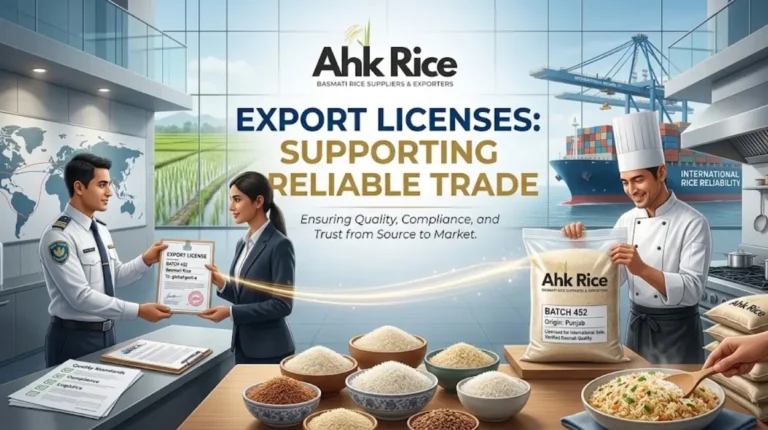
The next requirement is documentation.
Saudi Arabian buyers increasingly request:
- Certificate of Origin
- Phytosanitary Certificate
- Commercial Invoice
- Packing List
- Bill of Lading
- Fumigation Certificate (when applicable)
- Laboratory purity reports
- Moisture analysis
- Quality inspection reports
Instead of arranging these documents from multiple vendors, buyers often prefer one supplier capable of managing the complete export process.
For businesses importing under the Saudi Arabia export program, AHK Rice provides complete shipment management from production scheduling to container loading, reducing coordination work for purchasing teams.
Purity verification also protects commercial value. Premium restaurants, supermarkets, and distributors expect consistent grain appearance because customer satisfaction depends on uniform cooking performance.
Why choose Saudi Arabia export services from AHK Rice?
Choosing an exporter with dedicated Saudi Arabia supply experience improves purchasing confidence because every shipment follows documented inspection procedures, internationally accepted processing practices, structured export documentation, predictable logistics schedules, and transparent communication throughout production and shipment preparation.
Choosing an exporter is different from choosing rice.
An exporter becomes part of your supply chain.
That supplier should understand Saudi Arabian import expectations, documentation requirements, packaging preferences, and inspection procedures.
AHK Rice manages every production stage under controlled processing conditions.
The process includes:
- Raw material selection
- Cleaning
- Destoning
- Length grading
- Color sorting
- Polishing
- Metal detection
- Quality inspection
- Packaging
- Container loading
- Final documentation
Every stage contributes to purity consistency.
Instead of relying on visual inspection alone, multiple quality checkpoints help verify that contractual specifications are maintained before shipment.
Another advantage of AHK Rice is production flexibility.
Importers can order:
- Bulk containers
- Retail packaging
- Private label packaging
- Food service bags
- Wholesale packaging
Packaging specifications can be customized according to Saudi Arabian distribution channels.
Communication also matters.
Professional exporters provide production updates, inspection status, loading schedules, shipping documents, and vessel information throughout the export process.
This improves planning for wholesalers and distributors managing inventory across multiple warehouses.
How does AHK Rice prove shipment purity before export?
Reliable exporters provide documented proof instead of verbal assurances by combining laboratory testing, physical inspection, grading verification, sampling procedures, export records, and shipment documentation that collectively demonstrate compliance with buyer specifications before every container departs Pakistan.
Saudi buyers increasingly expect objective evidence.
Every shipment should match agreed specifications.
AHK Rice supports this through structured inspection procedures.
Typical verification includes:
- Variety confirmation
- Grain length measurement
- Broken percentage analysis
- Foreign matter inspection
- Chalky grain evaluation
- Moisture testing
- Damaged grain assessment
- Color consistency checks
- Packaging inspection
These reports reduce uncertainty before shipment approval.
When third-party inspection is requested, internationally recognized inspection agencies can verify cargo before loading.
This provides another layer of confidence for importers purchasing multiple containers.
Container sealing procedures are also documented to maintain shipment integrity during international transport.
The result is greater confidence between exporter and importer.
What shipping timeline should Saudi Arabian buyers expect?
Most Saudi Arabian shipments require approximately 20–30 days of sea transit after production and documentation are completed, while production, inspection, packaging, and container preparation generally require about 7–10 working days depending on order size and seasonal demand.
Shipping schedules vary according to:
- Destination port
- Shipping line
- Container availability
- Port congestion
- Seasonal demand
- Customs processing
Typical 2026 estimates include:
| Destination Market | Estimated Sea Transit |
|---|---|
| Jeddah | 20–24 days |
| Dammam | 22–27 days |
| Riyadh (via inland transport) | 24–30 days |
| Jubail | 22–28 days |
Production usually starts after order confirmation and advance payment.
Quality inspection follows processing.
Packaging is completed before container loading.
Export documentation is finalized before vessel departure.
Buyers receive shipping documents after dispatch, allowing customs preparation before cargo arrival.
What sample process should buyers expect before placing a bulk order?
Professional exporters encourage sample approval because laboratory reports and physical product evaluation together reduce purchasing risk, confirm contractual specifications, and establish confidence before committing to full-container or multi-container export agreements.
Sampling is one of the most valuable stages of international rice purchasing.
Typical process:
Step 1
Buyer submits inquiry with product specifications.
Step 2
Supplier confirms available grades.
Step 3
Sample preparation begins.
Step 4
Quality documents are prepared.
Step 5
Courier shipment is arranged.
Typical sample sizes include:
- 500 g
- 1 kg
- 2 kg
- 5 kg
Courier delivery generally requires 3–7 business days depending on destination.
Typical sample-related costs in 2026:
| Item | Typical Cost |
|---|---|
| Sample Rice | Often complimentary or charged at product value |
| Laboratory Report | Usually included or $25–$60 if requested separately |
| Courier Charges | Approximately USD 40–120 depending on weight and courier |
| Third-Party Inspection Sample | Additional inspection fees may apply |
Many exporters deduct sample costs from the first commercial order.
AHK Rice supports buyers throughout the evaluation process so purchasing decisions can be based on verified quality instead of assumptions.
What factors affect export pricing?
Export pricing depends on rice variety, purity specification, grain length, processing type, packaging requirements, shipment quantity, certification needs, freight rates, seasonal crop availability, and international logistics costs rather than one fixed market price.
Many buyers compare quotations without comparing specifications.
This creates misleading price comparisons.
Lower prices may indicate:
- Higher broken percentage
- Mixed varieties
- Lower purity
- Less processing
- Inferior packaging
- Limited documentation
Premium-quality shipments naturally require more processing and inspection.
Key pricing factors include:
- Rice variety
- Crop season
- Export grade
- Purity level
- Moisture content
- Packaging type
- Private labeling
- Printing requirements
- Container quantity
- Freight market conditions
- Destination port
- Certification requirements
A detailed quotation should clearly explain each specification.
Transparent pricing helps buyers compare suppliers fairly.
AHK Rice provides specification-based quotations so importers understand exactly what is included before confirming production.
What results can Saudi Arabian importers expect?
Importers working with an experienced export supplier generally achieve more consistent product quality, smoother customs processing, stronger customer satisfaction, improved inventory planning, fewer quality disputes, and better long-term purchasing stability across repeated shipments.
Reliable supply creates measurable commercial benefits.
Consistent grain appearance strengthens retail presentation.
Stable cooking performance improves restaurant operations.
Verified purity increases customer confidence.
Complete documentation reduces clearance delays.
Predictable logistics simplify inventory management.
Repeatable quality supports long-term contracts.
Consider a Saudi wholesale distributor supplying supermarkets across several cities.
If one shipment contains inconsistent grain quality, complaints may increase across multiple retail locations.
Replacing inventory becomes expensive.
Selecting a supplier that verifies every shipment before export reduces this operational risk.
This is why many professional buyers evaluate supplier capability instead of comparing price alone.
For businesses planning recurring imports, AHK Rice focuses on building stable long-term supply relationships supported by documented quality assurance and transparent export processes.
How do you get started with AHK Rice?
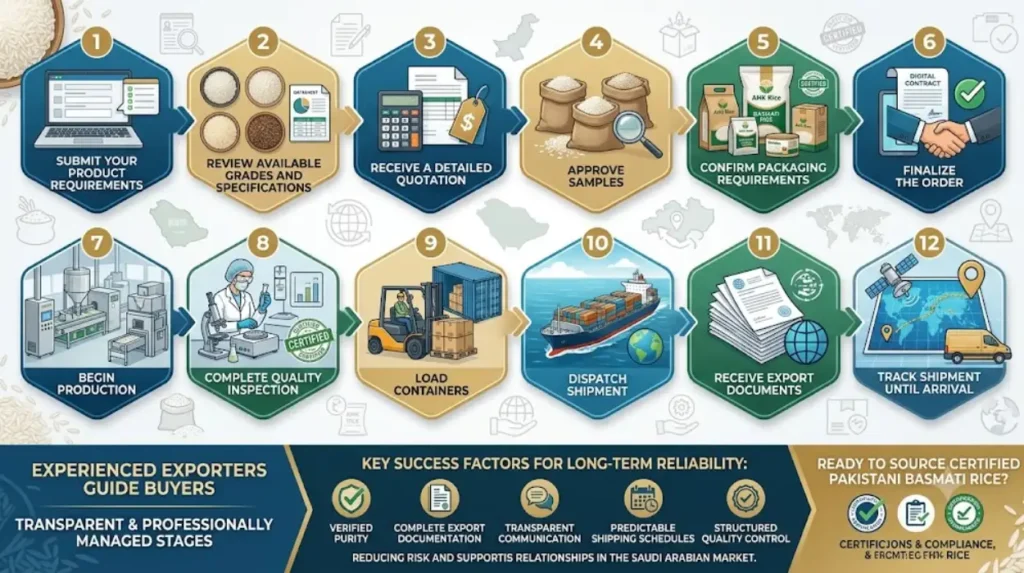
Beginning the purchasing process is straightforward because experienced exporters guide buyers from product selection through sampling, quotation, production planning, inspection, documentation, shipment scheduling, and after-sales communication to ensure every stage remains transparent and professionally managed.
The purchasing process typically follows these steps:
- Submit your product requirements.
- Review available grades and specifications.
- Receive a detailed quotation.
- Approve samples.
- Confirm packaging requirements.
- Finalize the order.
- Begin production.
- Complete quality inspection.
- Load containers.
- Dispatch shipment.
- Receive export documents.
- Track shipment until arrival.
Throughout the process, AHK Rice maintains communication so buyers understand production progress, inspection status, shipping schedules, and documentation timelines.
Selecting a supplier is ultimately a decision about long-term reliability rather than a single shipment. Verified purity, complete export documentation, transparent communication, predictable shipping schedules, and structured quality control reduce operational risk and support stronger commercial relationships in the Saudi Arabian market. If you are ready to source certified Pakistani Basmati rice with documented purity compliance, request a detailed quotation through request-a-quote from AHK Rice today.
Frequently Asked Questions
How does export-compliant purity certification benefit Saudi Arabian rice importers?
Export-compliant purity certification confirms that Pakistan Basmati rice meets the required quality standards before shipment. It helps Saudi importers reduce customs delays, verify product authenticity, and maintain consistent quality for retail and food service customers.
Which purity documents are included with AHK Rice export shipments?
AHK Rice can provide the required export documentation, including Certificate of Origin, Phytosanitary Certificate, Fumigation Certificate (when required), packing list, commercial invoice, and laboratory reports verifying purity according to buyer specifications and Saudi import requirements.
What purity level is commonly requested by Saudi Arabian buyers?
Most Saudi Arabian importers prefer high-purity Basmati rice with minimal admixture, low foreign matter, and consistent grain characteristics. Exact specifications vary depending on the importer, distribution channel, and contract requirements.
Can I request rice samples before placing a bulk order?
Yes. AHK Rice offers sample shipments so buyers can evaluate grain purity, cooking performance, aroma, grain length, and overall quality before confirming a commercial order. Sample costs and courier charges depend on the destination and sample quantity.
How long does it take to ship Pakistan Basmati rice to Saudi Arabia?
Production, inspection, and container preparation generally take around 7–10 working days after order confirmation. Sea freight to major Saudi Arabian ports usually takes approximately 15–25 days, depending on the destination port, shipping line, and vessel schedule.
Does AHK Rice support private label packaging for Saudi distributors?
Yes. AHK Rice provides customized private label packaging, multilingual printing, retail and wholesale bag sizes, and branding solutions designed to meet Saudi Arabian market requirements and importer specifications.
What factors affect the final export price of Pakistan Basmati rice?
Pricing depends on the rice variety, purity specification, processing type (White, Steam, or Sella), order volume, packaging requirements, inspection standards, freight rates, and seasonal market conditions.